
Buyers Now Ask AI Who to Shortlist. Is Your Company in the Answer?
B2B buyers increasingly ask AI assistants who to shortlist. What the surveys show, how the assistants choose, and six changes a supplier can make this quarter.
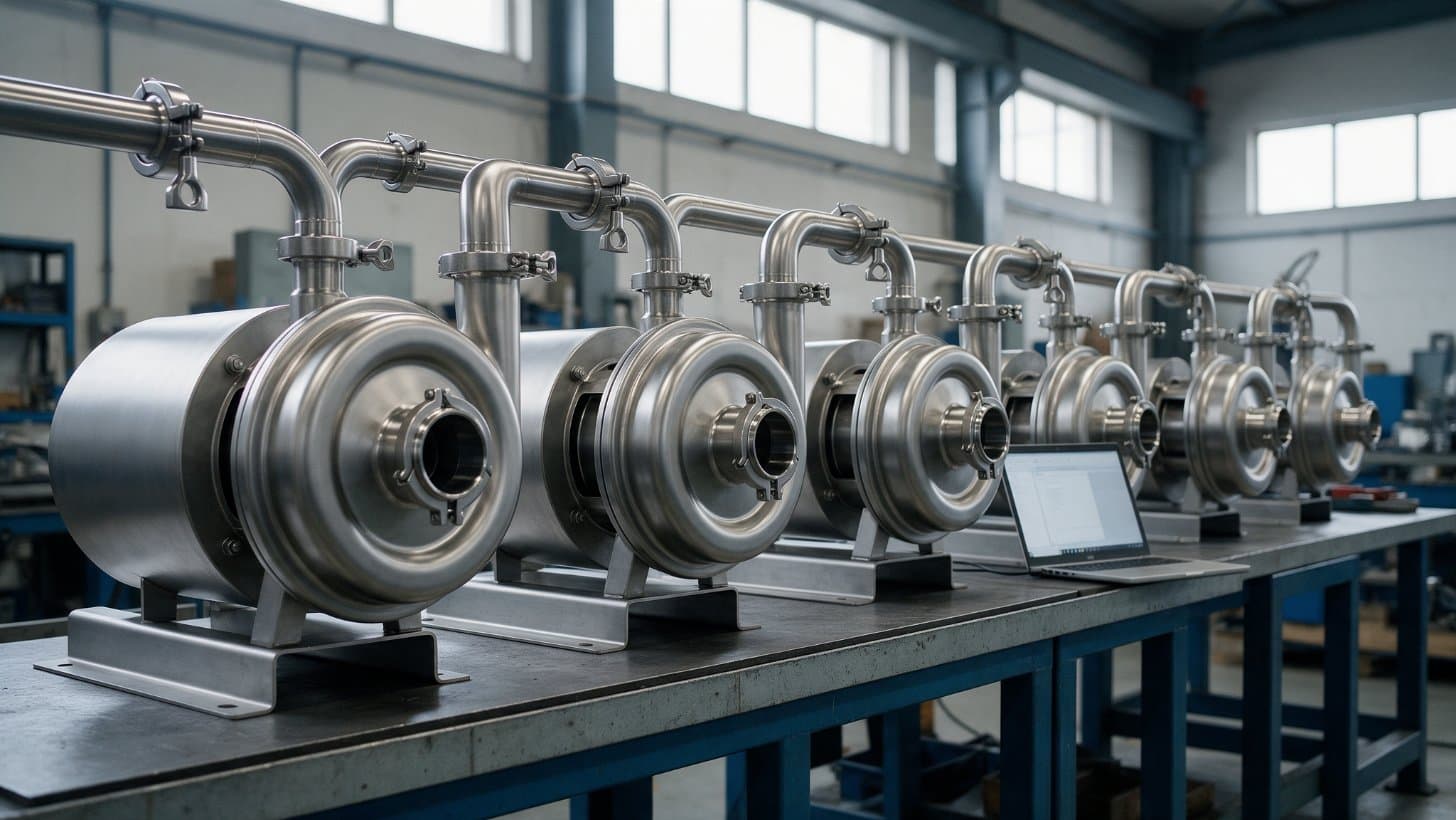
If your company does not appear when a buyer asks ChatGPT, Copilot, Perplexity, Gemini or Claude who makes a given piece of equipment, you are now missing a growing share of first contacts. The surveys disagree on how many buyers do this, from under half to over 90 percent depending on who was asked and what they were asked, but every one of them shows the share rising. The fix is less about marketing and more about publishing plain, specific, checkable facts where an AI assistant can read them.
Why this matters now
The evidence comes from several surveys, with different samples, and the figures should be read with that in mind.
Semrush surveyed 622 US B2B professionals in March and April 2026. Among the 519 who use AI at work, 92 percent said AI had shaped their vendor shortlist, and 41 percent said they now start research in an AI tool and check it afterwards with a search engine [1]. The same survey found that only 7 percent noticed a vendor in an AI answer because they recognised the name; fit to the use case mattered far more [1].
A UK survey of 300 senior decision makers with purchasing responsibility, run by the agency Magenta Associates and reported by Supply Chain Digital in November 2025, found 66 percent use AI tools to find and assess suppliers, 90 percent of those users trust the recommendations, and 83 percent still visit the websites the AI cites [2].
6sense's 2025 Buyer Experience Report, based on more than 4,000 buyers across North America, EMEA (Europe, the Middle East and Africa) and Asia Pacific, reported that 94 percent used large language models (LLMs, the technology behind these assistants) to summarise reviews or analyse data, and that 94 percent of buying groups had ranked their preferred vendors before first contact with any seller [3]. G2's 2025 survey of 1,169 software buyers found 29 percent begin research in tools like ChatGPT more often than in Google [4]. Forrester's 2025 Buyers' Journey Survey put AI use somewhere in the buying process at 94 percent, up from 89 percent a year earlier, with 61 percent using a private AI tool provided by their employer [5].
Gartner's figures are lower and more cautious: in a survey of 645 B2B buyers fielded in August and September 2025, 45 percent said they used generative AI, mainly to gather information on vendors and products, and 69 percent prefer to validate what the AI tells them with a sales representative [6]. Gartner has also reported for some years that buyers spend only about 17 percent of their buying time meeting potential suppliers at all [7].
Two things are consistent across all of this. First, the shortlist is increasingly formed before anyone emails you. Second, most buyers check the AI answer by visiting your website, so the answer and the website need to agree.
Access real procurement opportunities from global buyers
Join ChemCapital to get discovered by verified procurement teams across pharmaceutical, chemical, and industrial manufacturing.
How an AI assistant decides who to name
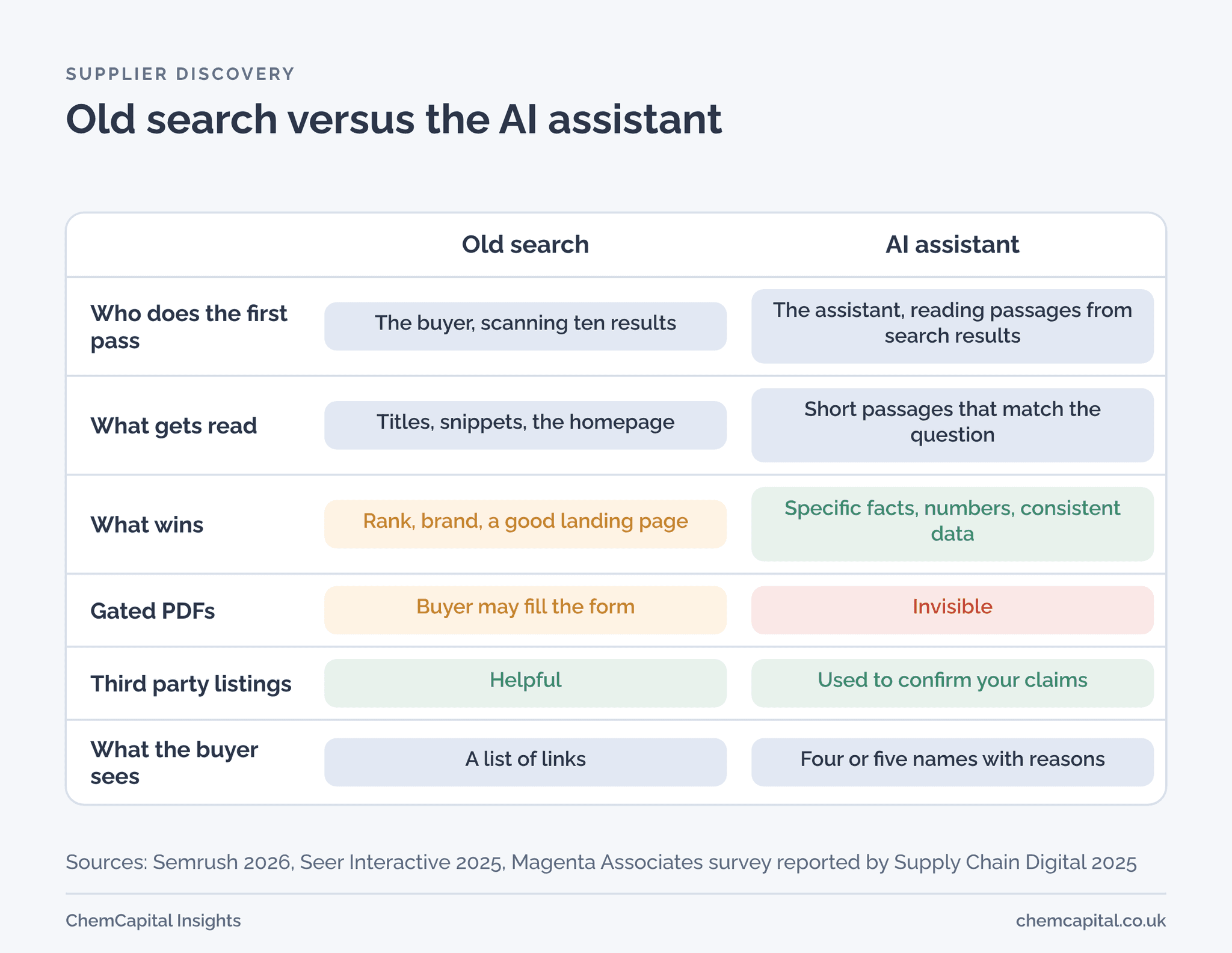
An assistant answering "who makes X" does not browse your site the way a person does. In most cases it runs a web search, pulls short passages from the pages that come back, and writes an answer from the passages that match the question most closely. In a small 2025 study, Seer Interactive compared more than 500 ChatGPT citations across about 100 queries and found that more than 87 percent matched a page in Bing's top 20 organic results for the same question. The authors call the finding directional because of the sample size, and note the questions were skewed towards "best" and "top" style queries, so treat the figure as a pointer rather than a rule. The direction is consistent with how these tools work: if a search engine cannot find a page, the assistant usually cannot either [8].
Within those pages, the assistant favours sentences it can lift and reuse: a certification with a number, a flow range in cubic metres per hour, a material grade, a named industry, a town. It also cross checks. A claim that appears on your website, in a certification body's public register and in a directory listing is far more likely to be repeated than one that appears only in your brochure. This is why the EHEDG public database of certified equipment matters: every EHEDG certificate is published there with a certificate number, equipment type and company name, and an assistant can read it [9].
The table below sets out what the assistant is looking for against what most process equipment websites currently do.
| What the AI assistant looks for | What most supplier websites do | What to change |
|---|---|---|
| Pages a search engine can index and read as plain text | Specifications locked in PDFs, often behind a form | Put the key specification table on the page itself; keep PDFs as a download, not a gate |
| Specific, factual statements it can quote | "Market leading hygienic solutions" | "Hygienic centrifugal pumps, 1 to 150 m3/h, 316L, EHEDG Type EL Class I, certificate number shown" |
| Certifications with numbers and issuing bodies | "Fully certified" | List each certificate, number, scope, issuer and expiry on one page |
| The same company description everywhere | Different wording on the site, on LinkedIn and in two directories | One approved 40 word description used in every listing |
| Third party corroboration | Nothing outside your own domain | Entries in the certification body register, one or two sector directories, a trade press mention |
| Evidence of real deliveries | "Trusted by leading brands" | Case data: sector, duty, scale, year, outcome in numbers |
None of this is new. It is what a careful procurement engineer has always wanted to see on a supplier's website. The difference is that the assistant now does that engineer's first pass, and it cannot phone you to ask.
What to do this quarter
Six actions cover most of the gap, and a small supplier can do them in a few weeks with the people it already has.
- Publish a supplier qualification page. One page, written for a procurement reader: what you make, capacities and sizes, materials, standards you design to, certifications with numbers, industries served, sites and the countries you ship to. Write it in plain sentences, not slogans.
- Give every product family a real specification table. Ranges, materials, connections, surface finishes, pressure and temperature ratings, options. HTML tables on the page, with the datasheet PDF beside them rather than instead of them.
- Make your company data consistent. Use the same legal name, description, address and product categories on your website, LinkedIn, the certification body's register and the two or three directories buyers in your sector actually use.
- Publish case data, not testimonials. "Twelve hygienic pump installations at dairy sites since 2022, 2 to 60 m3/h, all on CIP duty" (CIP is clean in place, washing the equipment without dismantling it) tells an assistant more than any quote.
- Stop gating the facts. Keep contact forms for quotations and drawings. Do not put the basic specification behind a form; the assistant cannot fill it in, and the buyers who visit your site afterwards will not either.
- Check the plumbing. Confirm your pages are indexed by Google and Bing, that specifications are in the page text and not drawn by scripts after the page loads, and that your robots file is not blocking AI crawlers you want to admit.
Then measure. Write down five questions a buyer would ask, in the buyer's words, and put them to three assistants once a month. Record whether you are named and which page is cited. Answers vary between runs, so look for the trend rather than any single result.
Practical example
Consider an illustrative UK manufacturer, Northfield Pumps, making hygienic centrifugal pumps for food and dairy duty. All figures below are illustrative.
The sales director asks three assistants the same question: "Who makes hygienic centrifugal pumps for a UK dairy with EHEDG certification?" Each assistant names four or five companies. Northfield appears in none of the answers, although it has held EHEDG certification on its main range for six years.
The reasons are familiar. The homepage says "hygienic pumping solutions for food and beverage". The product page has a photograph, three bullet points and a button to request the brochure. The brochure PDF holds the flow range, materials and the EHEDG certificate number, and sits behind a form. The EHEDG register lists the company under its legal name, Northfield Engineering Ltd, while the website and LinkedIn say Northfield Pumps. One directory lists the firm as an engineering services company. There is no case information anywhere.
Over three weeks, with one engineer and one marketing person, Northfield makes the following changes:
| Change | Effort | Why it matters to the assistant |
|---|---|---|
| Supplier qualification page: capabilities, EHEDG certificate numbers and types, materials, industries, Cheshire site, export countries | 2 days | Gives one indexable page that answers the buyer's question in full |
| Product page specification table: 1 to 150 m3/h, up to 90 m head, 316L wetted parts, surface finish Ra 0.8 micrometre, connections to DIN 11851 and tri clamp, rated for CIP and SIP (steam in place) | 2 days | Specific, quotable facts in plain text |
| Datasheets ungated; brochure left as a download | Half a day | Removes the barrier for the assistant and for buyers who follow its citation |
| Legal name and trading name aligned across the website, LinkedIn, EHEDG register and two directories | 1 day | Lets the assistant connect the certificate to the company |
| Case data page: 14 dairy installations since 2021, 2 to 60 m3/h, two creamery sites named with permission | 2 days | Third party evidence and sector words the buyer actually uses |
| Index check: pages submitted to Google and Bing; specification table confirmed in page source | Half a day | Confirms the pages can be found at all |
Before the work, the website offered an assistant perhaps four checkable facts about Northfield. Afterwards it offers around thirty, each of which matches a public register or a directory entry. In this example, the firm appears in two of the three assistants' answers by the second monthly check, with the qualification page as the cited source. Whether that happens in reality depends on the competitors and the question, which is why the monthly test matters more than any one result.
Roughly eight working days of effort, no agency and no new software. The Semrush survey suggests that most buyers who see you in an AI answer will visit your website next [1], so the same pages do double duty.
Being found by buyers who have never heard of you
The pattern above assumes the buyer phrases a question well and the assistant happens to search in the right places. Some buyers go a step further and use tools built for the job. ChemCapital's AI Supplier Discovery searches the web for suppliers from a buyer's description or RFQ (request for quotation) and extracts the published parameters it finds, with a link to the source for each one. The pages you publish for the assistants are the same pages it reads.
A verified company profile and detailed product listings on ChemCapital mean buyers using that search can find you and invite you to quote, even if they have never heard of your company. RFQs arrive structured, with specifications, quantities, delivery requirements and deadlines, and you can reply with a budgetary or firm quotation in one form. You also get an alert 30 days before any certification record lapses, which keeps the numbers on your profile current. See the supplier benefits page for the full list, and how suppliers win industrial contracts for what happens after the shortlist.
Ready to be found by the buyers already looking for what you make? List your company on ChemCapital. It is free to start.
Frequently asked questions
Do I need a specialist agency to get my company named by AI assistants?
Usually not. The factors that matter most are the ones a search engine already rewards: indexable pages, specific facts in plain text, consistent company data and third party corroboration. A manufacturer can cover these with its own engineers and whoever looks after the website.
Why do the surveys give such different percentages for AI use by buyers?
They ask different people different questions. Semrush surveyed US B2B professionals about any AI use at work, G2 asked software buyers, 6sense and Forrester asked B2B buyers in general, and Gartner asked specifically about generative AI. Treat the range as the honest answer and focus on the direction, which is the same in every study.
Will moving specifications out of gated PDFs cost me leads?
In practice buyers who want a quotation still contact you, and the Semrush and Magenta Associates surveys both found that most buyers visit the cited website after an AI answer. Keep the form for drawings, pricing and quotations, and put the basic specification table on the page so both the assistant and the buyer can read it.
Continue reading
Informational only, not procurement or legal advice. Cited names, frameworks, and statistics belong to their respective owners.
Access real procurement opportunities from global buyers
Join ChemCapital to get discovered by verified procurement teams across pharmaceutical, chemical, and industrial manufacturing.
List your companyRelated articles
Thomasnet, Europages, Kompass, GlobalSpec, Alibaba and ChemCapital: Where Should a Process Equipment Supplier List in 2027?
An honest comparison of eight supplier directories and marketplaces for process equipment makers: buyers, free listings, paid tiers, RFQs and how to decide where the budget goes.

Procurement Digitisation Trends Industrial Teams Should Watch
The procurement digitisation trends that matter most for industrial teams: connected workflows, supplier data, AI with oversight, and comparable quotations.
How Digital Procurement Reduces Cost Without Cutting Corners
Digital procurement reduces avoidable cost by improving competition, standardising specifications, and making lifecycle costs visible before award.