
CSV vs CSA: Computer Software Assurance for Equipment Buyers
FDA finalised its computer software assurance guidance in 2025 and updated it in 2026. Here is what changes from classic CSV, where it applies, and what to ask equipment suppliers.
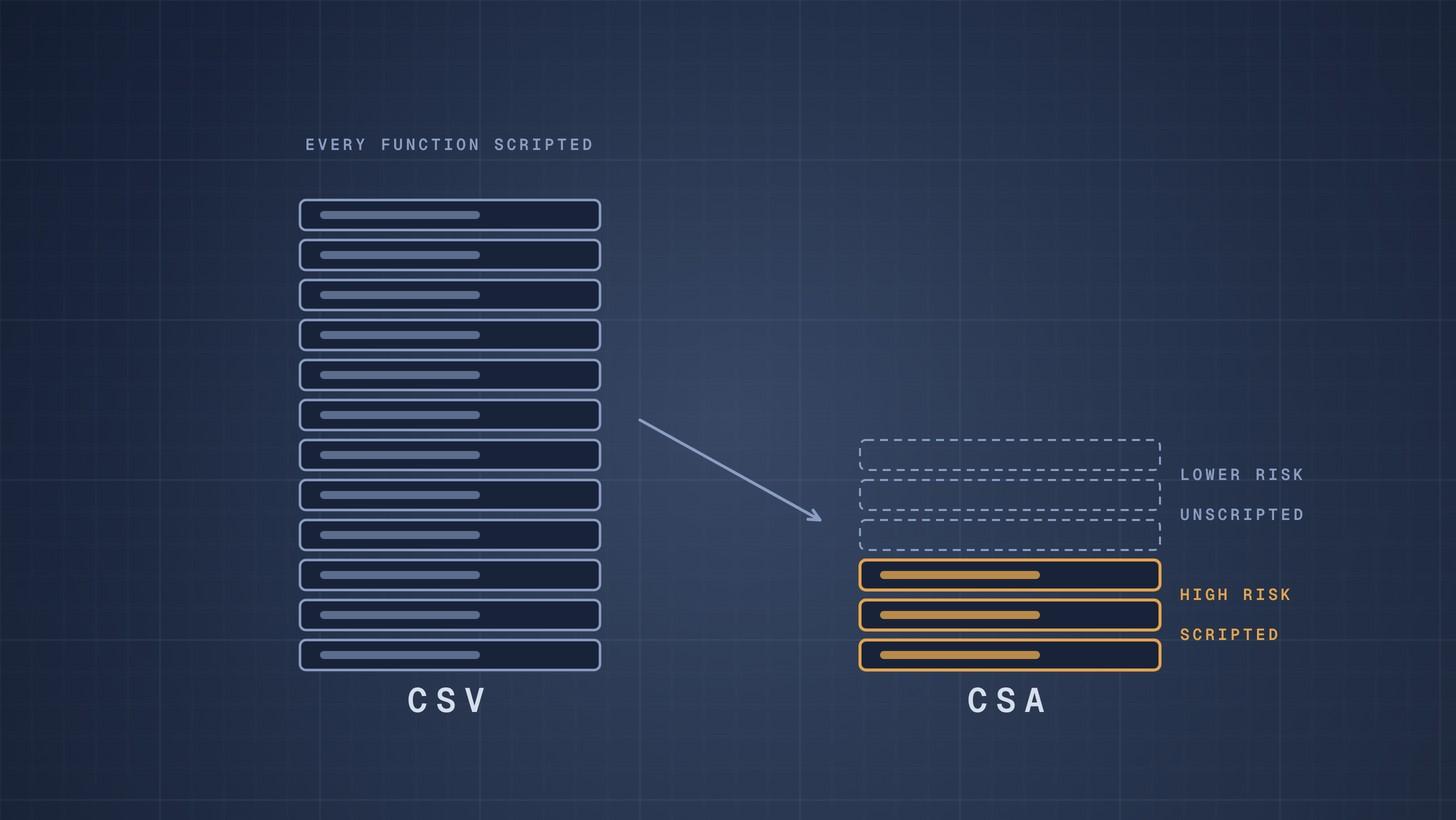
Computer software assurance (CSA) is FDA's risk based approach to confirming that software used in production and quality systems works as intended: you test hardest where a failure could harm patients or product, use lighter, unscripted testing elsewhere, and keep records proportionate to the risk. Classic computer system validation (CSV) often scripted and documented every function to the same depth. For equipment buyers, the practical change is that supplier testing and FAT evidence can count for more, and paperwork for its own sake counts for less.
This guide explains what FDA's guidance says, where it applies and where it does not, and what to ask suppliers of equipment with embedded software.
Why this matters now
FDA's device centre (CDRH) and biologics centre (CBER) issued the final guidance on 24 September 2025, after a 2022 draft. On 3 February 2026 FDA issued an updated version titled "Computer Software Assurance for Production and Quality Management System Software", in line with its new Quality Management System regulation [1]. The guidance supplements FDA's 2002 General Principles of Software Validation and supersedes only its Section 6 [2].
In Europe, the Commission consulted on a revised Annex 11 for computerised systems, alongside a revised Chapter 4 on documentation and a new Annex 22 on artificial intelligence, from 7 July to 7 October 2025 [3]. As of November 2026, check the current status before relying on either version. Buyers writing URS documents now are caught between old habits and new expectations.
Create and manage RFQs in minutes
ChemCapital handles the entire procurement cycle, from structured RFQs and supplier comparisons to formal purchase orders and delivery tracking.
What CSA actually asks for
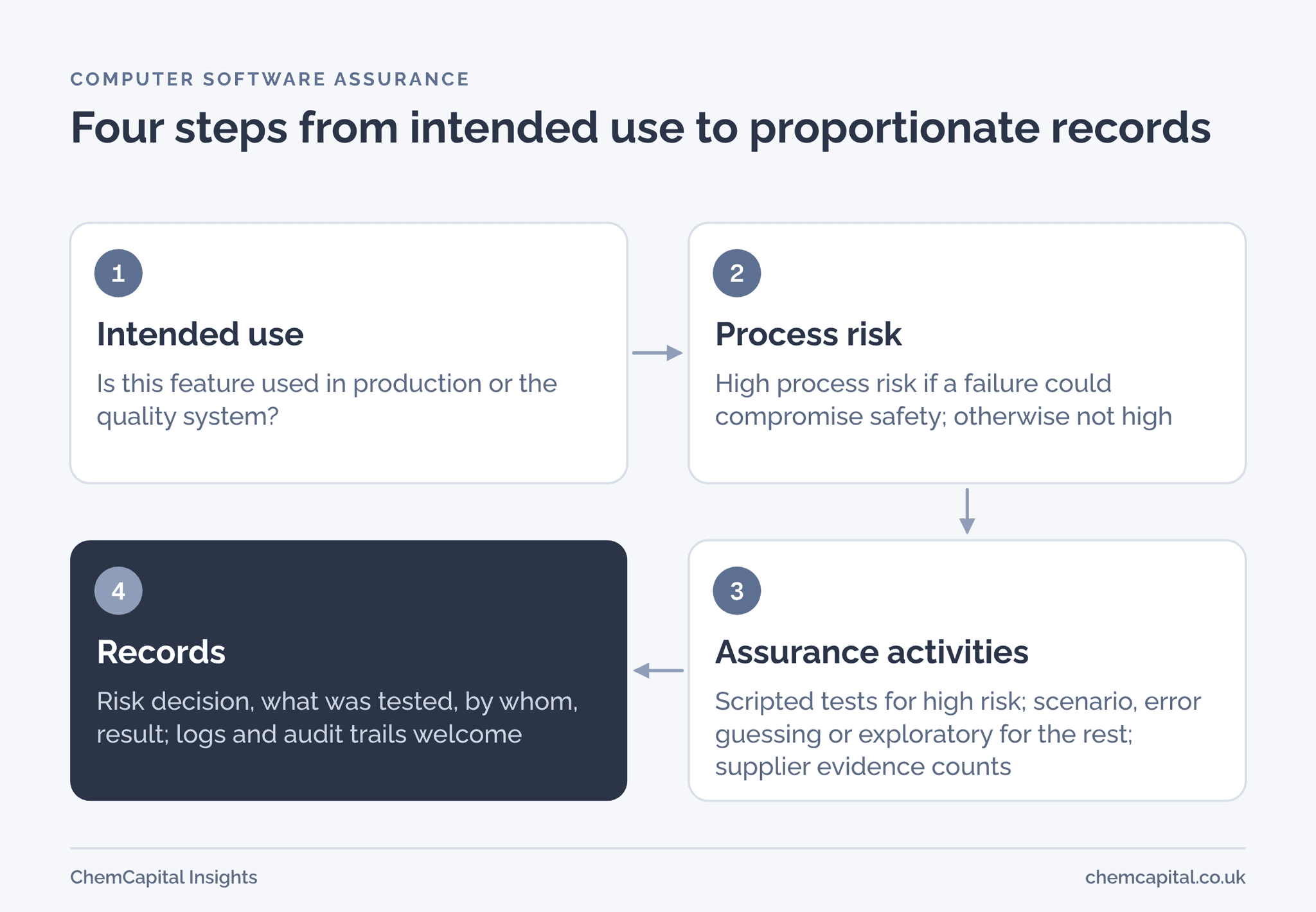
The guidance is about software used as part of production or the quality system, not software that is itself a medical device or part of one [2]. It works in four steps:
- Intended use. Decide whether the software, or a feature of it, is used in production or the quality system. That sets the scope [2].
- Risk. Classify each feature as high process risk, where a failure could foreseeably compromise safety, or not high process risk. Finer tiers are allowed [2].
- Assurance activities. For high risk features, rigorous scripted testing with traceability. For lower risk features, unscripted methods such as scenario testing, error guessing and exploratory testing. No single method is mandated [2].
- Records. Record the intended use, the risk decision, what was tested, by whom, and the result. Digital evidence such as system logs and audit trails is encouraged over screenshots and paper, at a level matching the risk [2].
The guidance also lets manufacturers rely on supplier evidence: certifications such as ISO and SOC reports, software bills of materials, threat modelling and data integrity controls, with on site audits optional [2].
CSV versus CSA side by side
| Classic CSV in practice | CSA | |
|---|---|---|
| Starting point | The document set the procedure requires | The intended use and the risk of each feature |
| Testing depth | Often the same scripted depth for every function | Scripted for high process risk; unscripted where risk is lower |
| Evidence | Signed test scripts, screenshots | Records proportionate to risk; system logs and audit trails welcome |
| Supplier work | Often repeated by the user | Relied on where the supplier's quality is assessed |
| Goal | A complete validation file | Confidence that the software is fit for its intended use |
None of this removes validation. CSA is a way of deciding how much of which activity gives real confidence. Note also that Part 11 still applies to electronic records kept under the device quality regulation, and FDA does not exercise enforcement discretion over validation of production or quality system software [2].
Does CSA apply to pharmaceutical equipment?
Strictly, no. The guidance is issued by FDA's device and biologics centres and covers device production and quality system software [1] [4]. Drug manufacturers are not bound by it.
In practice, the thinking has already reached pharma through GAMP. GAMP 5's second edition, published in July 2022, added an appendix on critical thinking that promotes proportionate validation, warns against over compliance and aligns with FDA's CSA approach. It also encourages using the supplier's validation package to avoid duplicated work, and favours testing over documentation for its own sake [5]. Our guide to GAMP 5 categories for equipment covers how software is classified.
For EU GMP, Annex 11 still applies. Its current version asks for risk based validation, a URS that describes required functions with traceability through the life cycle, assessment of suppliers, and a risk based audit trail of GMP relevant changes [6]. See our Annex 11 guide for equipment buyers. If you sell into the US, 21 CFR 11.10 still asks for validated systems, secure time stamped audit trails, operational sequence checks and authority checks [7]; our Part 11 article explains those controls.
What changes for equipment with embedded software
Most process equipment now carries software: a PLC on a skid, an HMI with recipes, a historian, a cycle record. For a buyer, CSA style thinking changes three things.
Risk assess features, not systems. A CIP skid's conductivity interlock and its cycle record are high risk; its screen colours and maintenance counters are not. Ask the supplier for a feature level risk assessment, or do it together at FDS stage.
Count the supplier's testing. If the supplier's quality system and test records are sound, FAT evidence can stand as part of your assurance, rather than being repeated at site. That puts more weight on assessing the supplier before award and on witnessing FAT properly.
Ask for evidence that is already digital. Audit trails, alarm logs and cycle records captured during FAT are often stronger evidence than screenshots pasted into a script.
Plan for updates. Embedded software changes after delivery: bug fixes, security patches, new recipes. Agree in the contract how the supplier tells you about a change, what they test, and what evidence they send, so each update gets a proportionate assessment instead of either a full revalidation or none at all.
What to put in the RFQ and URS
- The intended use of each software function, and which are GMP relevant.
- A request for the supplier's software development and test process, and evidence of it, such as quality certifications and test records.
- A feature level risk assessment at FDS stage, agreed with you.
- Scripted FAT tests for high risk features, with traceability to the URS.
- Exploratory or scenario testing for the rest, with a short record of what was tried and what was found.
- Audit trail, user roles, electronic records and signature functions stated explicitly.
- Delivery of digital records from FAT, not only signed paper.
A feature level risk assessment for a skid
Illustrative example for a CIP skid supplying a GMP process. The point is the method, not the specific ratings, which belong to your own quality risk management.
| Feature | Could a failure compromise product or patient safety? | Process risk | Assurance activity |
|---|---|---|---|
| Final rinse conductivity check before release to production | Yes, residue could reach product | High | Scripted test at FAT, traced to URS, repeated at site |
| Cycle record and audit trail | Yes, release relies on it | High | Scripted test of each recorded event and of record integrity |
| Recipe parameter limits and user roles | Yes, wrong parameters could pass unnoticed | High | Scripted tests of limits and permissions |
| Alarm display and acknowledgement | Indirectly | Not high | Scenario testing during FAT, recorded |
| Tank level trending screen | No | Not high | Exploratory check, short record |
| Maintenance hour counters | No | Not high | Rely on supplier testing |
Three of six features carry most of the effort. That is what proportionate looks like.
Assess the supplier before you rely on its testing
Relying on supplier evidence only works if you have reason to trust it. Before award, or at the latest before FAT, check:
- Quality system. A certified quality management system covering software, and how software changes are controlled.
- Development process. How requirements become code, who reviews it, and how versions are tracked.
- Test records. A sample of real test records from a previous project, not a blank template.
- Change after FAT. How a code change made after FAT is controlled, retested and reported to you.
- Data integrity controls. Audit trail, time synchronisation, user management and backup, shown working.
Record what you checked and what you concluded. That record is part of your own assurance file, and it is the first thing an auditor will ask for when you say you relied on supplier testing.
Common misreadings of CSA
- "CSA means less validation." It means validation aimed where it matters. High risk features may get more attention than before.
- "Unscripted means undocumented." Unscripted tests still need a record of what was tested, by whom, and what was found.
- "It only matters for US device makers." Formally, yes. In practice, GAMP 5 second edition has carried the same thinking into pharma, and many inspectors now expect proportionate, risk based validation.
- "Supplier evidence replaces our own work." It replaces duplicated work, after you have assessed the supplier. The decisions on intended use and risk remain yours.
Before you change your approach
A buyer cannot adopt CSA alone. The validation approach lives in your quality system, so agree these points with quality assurance before the RFQ goes out:
- Does our computerised system validation procedure allow risk tiers and unscripted testing? If not, update the procedure first. An RFQ that asks suppliers for something your own procedure forbids creates conflict at FAT.
- Who decides process risk? Usually a small team: process owner, quality and engineering, with the supplier contributing. Write down who signs.
- What evidence will we accept from suppliers? Set the bar once, for example certified quality system plus sample test records plus a witnessed FAT, rather than arguing it on every project.
- Which markets apply? A plant supplying the US, the EU and the UK will face different inspectors. Design the approach to satisfy the strictest relevant expectation for each high risk feature.
- What happens when the EU Annex 11 revision is finalised? Plan a review of the procedure when the final text appears, rather than rewriting it on the draft.
Getting these answers first turns the RFQ wording into something suppliers can price, and keeps the validation file consistent across projects.
Practical example
Illustrative figures. A skid's control system has 60 functions to verify. The site estimates 3 hours to write, run and review each scripted test, and 45 minutes for a recorded exploratory session on a low risk function.
| Approach | Scripted | Unscripted | Effort |
|---|---|---|---|
| Classic CSV, everything scripted | 60 × 3 h | none | 180 h |
| CSA style, 12 high process risk functions scripted | 12 × 3 h = 36 h | 48 × 0.75 h = 36 h | 72 h |
| Saving | 108 h, 60% |
The saving is not the point on its own. The point is that the 36 scripted hours now go where a failure would matter, rather than being spread evenly over functions that cannot harm product. A CSA approach still needs the risk assessment written down, and an inspector will read it.
If you are the supplier
Buyers will increasingly ask for a feature level risk assessment, evidence of your own development and testing, and digital FAT records. Have them ready. A supplier whose test evidence can be relied on saves the buyer weeks of site testing, and that is a real reason to choose them.
Where ChemCapital fits
ChemCapital's own records follow the same thinking: an audit trail built on ALCOA+ principles and GAMP 5, so procurement records for regulated equipment hold up to review. Our trust page explains how records are kept.
Ready to buy regulated equipment with the paperwork that matters and less of what does not? Start a free 14 day ChemCapital trial, with no credit card needed.
This is general information, not legal or regulatory advice; check the current text before you rely on it.
Frequently asked questions
What is the difference between CSV and CSA?
CSV is the traditional approach to validating computerised systems, often scripted and documented to the same depth for every function. CSA is FDA's risk based approach: scripted testing for high process risk features, lighter unscripted testing elsewhere, and records proportionate to risk.
When did FDA finalise the CSA guidance?
FDA issued the final guidance on 24 September 2025 and an updated version on 3 February 2026, retitled Computer Software Assurance for Production and Quality Management System Software.
Does FDA's CSA guidance apply to pharmaceutical manufacturers?
It is issued for medical device production and quality system software, so drug manufacturers are not bound by it. GAMP 5's second edition promotes the same critical thinking for pharma, and EU Annex 11 still applies in Europe.
What is unscripted testing in CSA?
Testing without a pre written step by step script, such as scenario testing, error guessing and exploratory testing, recorded briefly with what was tested and found. It suits features that are not high process risk.
Can we rely on the equipment supplier's testing?
Yes, where you have assessed the supplier's quality system and the evidence is sound. Both the CSA guidance and GAMP 5 second edition encourage using supplier activities rather than repeating them.
Continue reading
Informational only, not procurement or legal advice. Cited names, frameworks, and statistics belong to their respective owners.
Create and manage RFQs in minutes
ChemCapital handles the entire procurement cycle, from structured RFQs and supplier comparisons to formal purchase orders and delivery tracking.
Start for freeRelated articles
Spend Analysis for Engineered Equipment (Free Template)
How to run a spend analysis for pumps, valves, instruments and packages: data sources, cleaning, supplier grouping, classification, what to look for, and a column template you can copy.
Coupa or SAP Ariba Supplier Discovery vs a Specialist Tool: When to Use Each
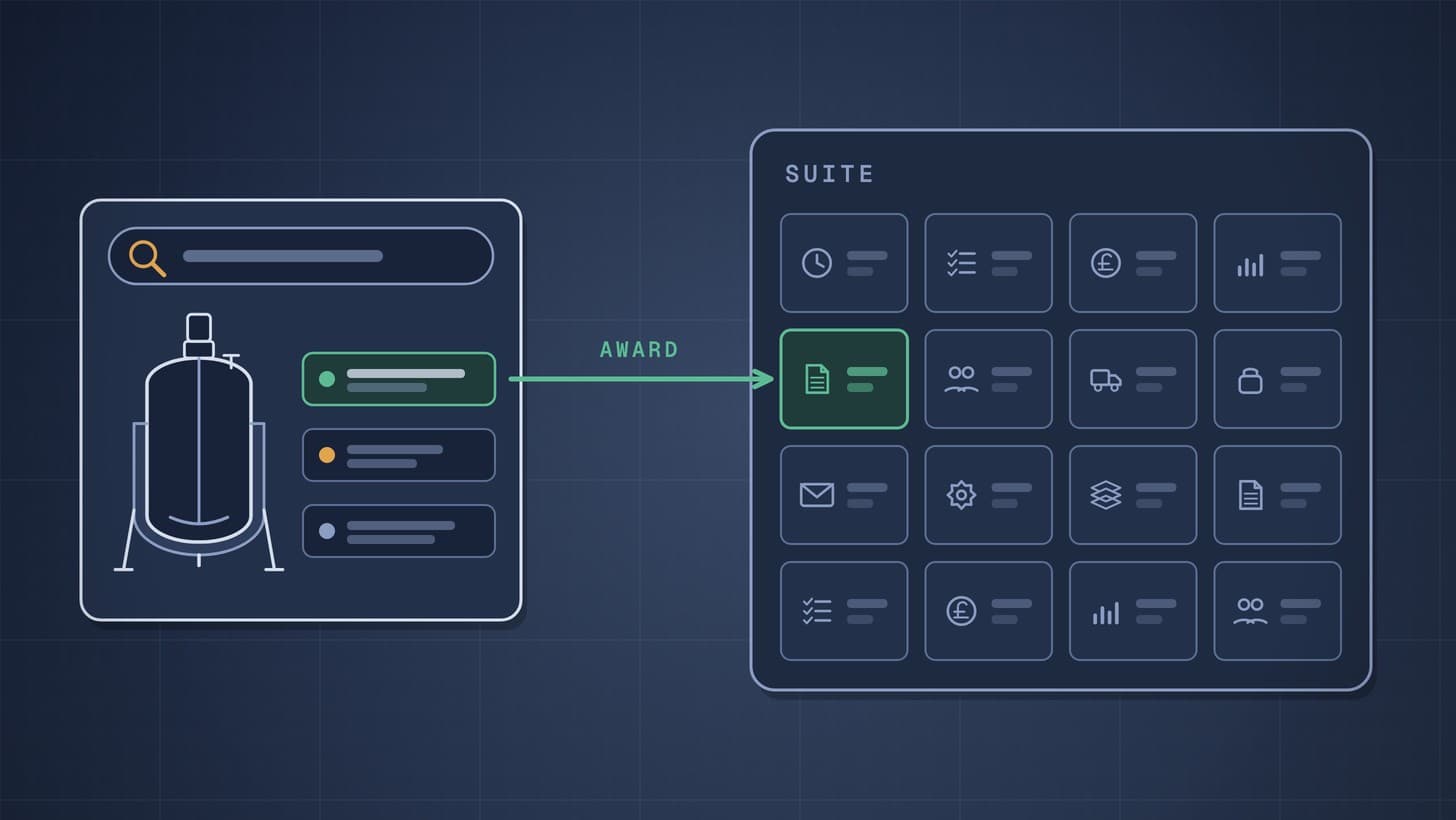
Coupa and SAP Ariba run sourcing well. For engineered equipment, here is where a specialist supplier search tool helps, how it works alongside the suite, and a decision table.
EU GMP Annex 11 and Its Revision: What Equipment Buyers Should Ask For
What Annex 11 already requires when you buy equipment with software, what the 2025 draft revision adds on suppliers, access, audit trails and security, and the questions to put in every RFQ.