
How to Find Distributors and Agents for Process Equipment in New Markets
Agent or distributor, where to find candidates, how to vet them, what the agreement must cover and how to make the partnership deliver.
The fastest route into a new market for a process equipment maker is usually a partner who already sells to your target plants: an agent who works for commission, or a distributor who buys your equipment and resells it. The two are legally very different, and the choice changes who owns the customer, who holds stock and what it costs you to end the relationship. Find candidates through government export services, trade associations, trade shows and your competitors' own distributor pages; vet them on technical staff, service capability, stock, finances and compliance; then put the territory, targets, pricing, spares, warranty and termination terms in writing before the first order ships.
This is general information, not legal advice. Take advice in both your own country and the target market before you sign.
Why this matters now
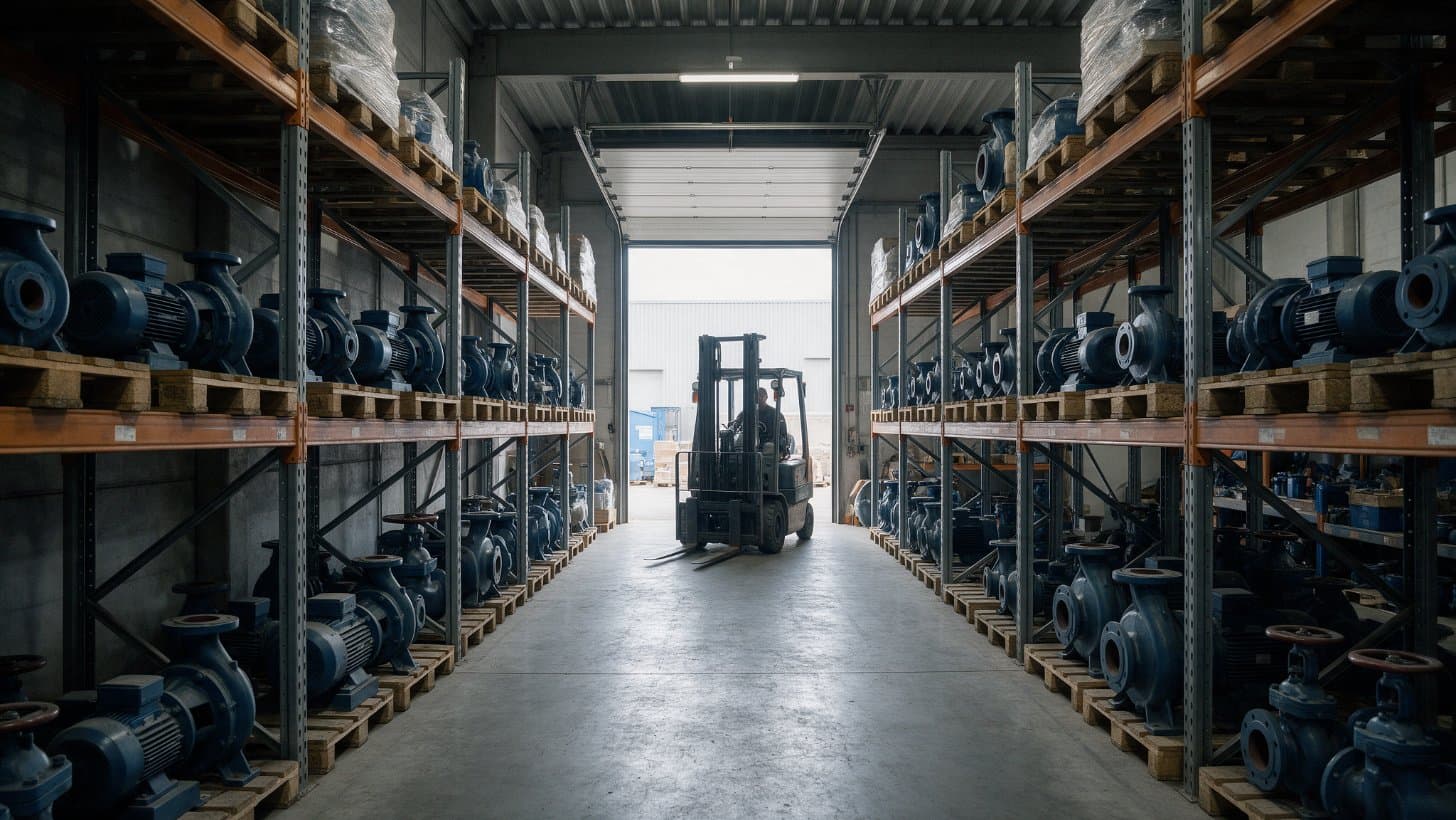
Pumps, valves, heat exchangers, mixers, filters and skids rarely sell themselves abroad. A plant engineer in Jubail, Pune or Houston wants someone local who can quote in days, hold spares, send a technician and speak the language of the site. A good partner gives you that presence without a subsidiary. A bad one locks up your territory for years while selling a competitor's line, and ending the relationship can cost you a statutory payment on top of the notice period.
The legal framework has also settled since 2022. The UK's block exemption for vertical agreements, which covers distribution agreements, came into force that year and sets out exactly which contract terms are off limits [3]. The UK rules that protect commercial agents on termination date from 1993 and still apply [2]. Getting the structure right at the start is cheaper than untangling it later.
Access real procurement opportunities from global buyers
Join ChemCapital to get discovered by verified procurement teams across pharmaceutical, chemical, and industrial manufacturing.
Agent or distributor: the legal line
An agent sells on your behalf. In the EU definition, a commercial agent is a self employed intermediary with continuing authority to negotiate the sale of goods for a principal, and sometimes to conclude those sales in the principal's name [1]. You contract with the end customer, you invoice them, you carry the credit risk, and the agent takes a commission.
A distributor buys from you and resells. The distributor contracts with the customer, sets its own resale price, carries stock and takes the credit and warranty risk on the first line. You see the distributor as your customer, not the plant.
The termination consequences are where the two routes diverge most. Under the Commercial Agents (Council Directive) Regulations 1993, which apply in Great Britain, a commercial agent is entitled to compensation or an indemnity when the agency ends. Compensation is the default unless the contract chooses indemnity, and the indemnity is capped at one year's remuneration averaged over the previous five years. The agent must notify you within one year of termination that they intend to claim [2]. The EU directive the UK regulations implement sets the same structure across EU member states, and removes the entitlement where you terminated for the agent's own default or the agent ended the contract without justification [1]. These rules apply to commercial agents and generally not to distributors, who have no equivalent statutory right in the UK, which is one reason manufacturers often prefer the distributor model for a long term presence. Some countries do give distributors protection on termination, so check local law in the target market.
Competition law constrains the distributor route. In the UK, a distribution agreement loses the protection of the Vertical Agreements Block Exemption Order 2022 if it contains a "hardcore restriction". Fixing or setting a minimum resale price is hardcore, although you may recommend a price or set a maximum. You may appoint an exclusive distributor and stop them actively selling into a territory you have reserved for yourself or allocated to another distributor, but you cannot stop passive sales, meaning sales that respond to an unsolicited customer request from outside their area [3]. The EU block exemption, Regulation 2022/720, works on the same principles: resale price maintenance is hardcore, and active sales restrictions are permitted for territories reserved to the supplier or allocated to other exclusive distributors [10]. An agent is treated differently because you carry the commercial risk, so you can usually restrict an agent's territory and customers more freely.
| Question | Agent | Distributor |
|---|---|---|
| Who contracts with the customer | You, the manufacturer | The distributor |
| Who sets the selling price | You | The distributor, within competition law limits |
| Who holds stock and spares | Usually you | The distributor |
| Who carries customer credit risk | You | The distributor |
| How the partner earns | Commission on your sales | Margin between buy and resale price |
| Statutory payment on termination (UK and EU) | Yes, compensation or indemnity [2] | Generally no statutory right in the UK, contract terms apply |
| Control of marketing and pricing | High | Lower |
| Typical fit | High value engineered equipment, few orders a year | Standard products, spares, fast turnaround |
Bribery law applies to both. Under the UK Bribery Act 2010, a company can be prosecuted for failing to prevent bribery by a person associated with it, and the only defence is to show it had adequate procedures in place. The Ministry of Justice guidance sets out six principles for those procedures, including risk assessment and due diligence [4]. The US Foreign Corrupt Practices Act prohibits payments to foreign officials made directly or indirectly to obtain or retain business, and applies to US persons, certain foreign issuers and anyone who causes a corrupt act within US territory [5]. An agent who "knows the right people" in a ministry is a liability, not an asset.
Where to find candidates
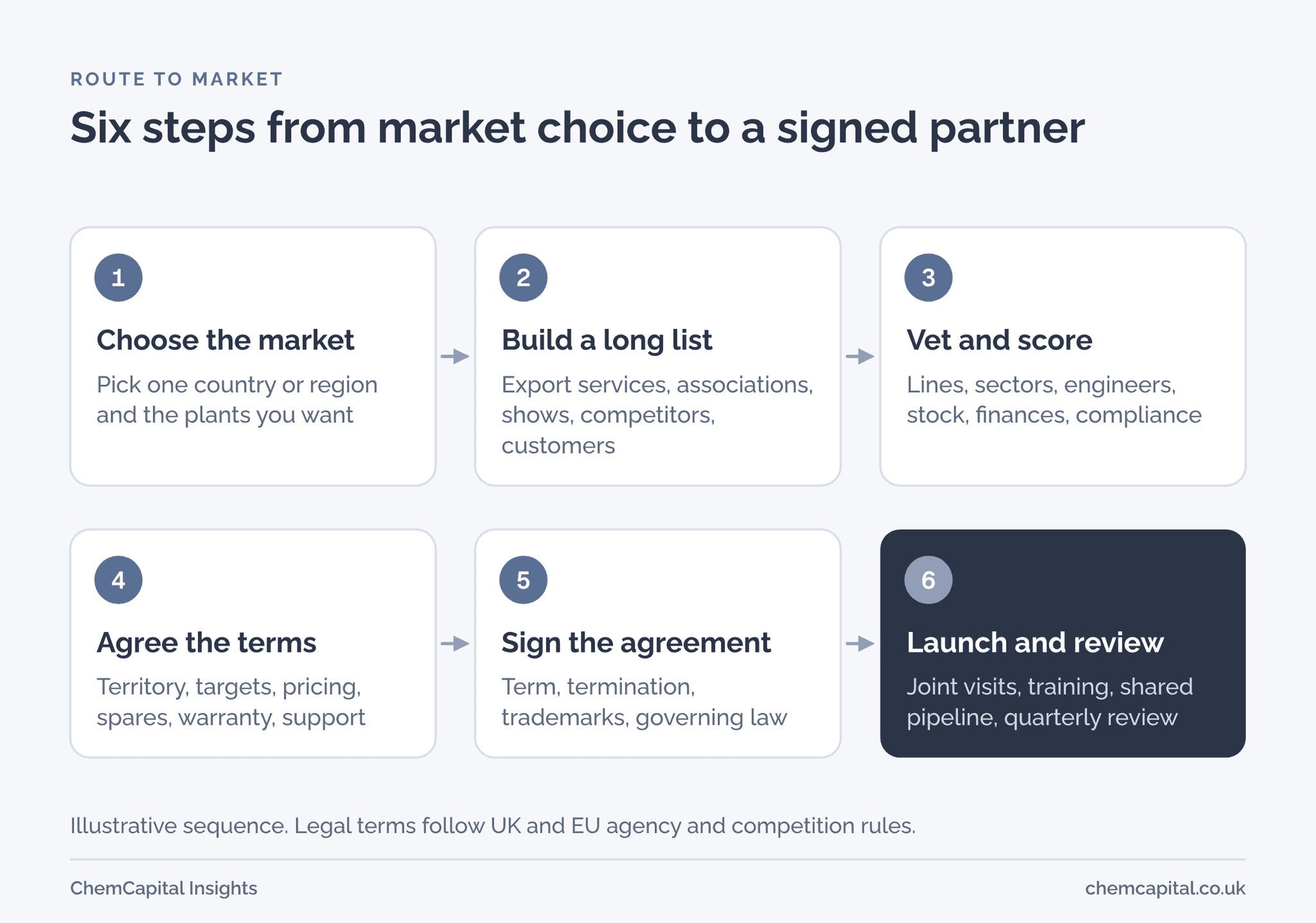
Start with government export services, because they are cheap and their staff already know who sells what in the market.
- UK government export support. The business.gov.uk export support service offers guidance on topics including market selection and routes to market, a Business Academy with free live events, a market comparison tool and an enquiry route that aims to respond within three working days [7].
- US Commercial Service Gold Key Service. For export ready US companies, the International Trade Administration identifies, vets and arranges meetings with up to five interested partners in the target market. The standard package, in which its staff identify the contacts, arrange the meetings and attend them with you, costs USD 3,250 for all US companies; your own travel, translation and other direct costs are extra [6].
- Enterprise Europe Network. Launched by the European Commission and funded through the EU Single Market Programme, the network runs a large online database of business opportunities where companies can search for partners to distribute their products, with contact points across the EU and more than 30 non EU countries [8].
Then work the industry itself.
- Trade associations. The British Valve and Actuator Association publishes a full members list that covers the wider supply chain, including distributors and stockists as well as manufacturers [9]. Pump, mixer and hygienic equipment associations publish similar lists. A distributor who already belongs to the association in your sector has shown commitment.
- Competitors' websites. Most equipment makers publish a "find a distributor" page by country. A distributor carrying a competitor is not usually available, but their neighbours in that list often are, and the page tells you who the serious players are.
- Trade shows. ACHEMA, ADIPEC, Chemspec, Interphex and the regional water and oil and gas shows put distributors and manufacturers in one hall. Walk the stands of complementary product lines, not competing ones.
- Your own customers. Ask the engineering contractor or end user who already buys from you who they trust locally for pumps, valves or instrumentation. A referral from a customer is the strongest lead you will get.
Aim for a long list of eight to twelve names per market, then shortlist three.
How to vet them
A distributor is going to carry your name on their van. Check them the way a buyer would check you.
| Check | What you are looking for | How to check |
|---|---|---|
| Product lines carried | Complementary lines, no direct competitor, not too many principals to focus | Their website, catalogue and a direct question |
| Sectors served | Match to your target plants: chemical, pharma, water, food | Customer list, case studies, reference calls |
| Technical staff | Engineers who can size, select and specify, not just sell | CVs, a technical conversation, a site visit |
| Service capability | Workshop, field technicians, commissioning, calibration | Visit the workshop, ask for service records |
| Stock and spares | Willingness and space to hold agreed stock | Warehouse visit, stock policy |
| References from principals | Other manufacturers they represent will tell you how they perform | Call two principals, ask about reporting and payment |
| Financial standing | Accounts, credit rating, payment history | Credit report, filed accounts, trade references |
| Sanctions and export control | No listed owners or customers, awareness of export licences | Screen the company and its owners, check end use procedures |
| Anti bribery | Adequate procedures, no government ownership conflicts | Questionnaire, declaration, ownership disclosure [4] |
| Commitment | Responsiveness, willingness to visit you and invest | Speed of replies, a draft business plan from them |
Due diligence on ownership matters in the Gulf and in parts of Asia, where a distributor may be part owned by someone connected to a state customer. That is not disqualifying, but it must be known, documented and managed under your anti bribery procedures [4].
What the agreement must cover
A good distributor agreement runs to a few pages of substance. The headings below are the ones that cause disputes when they are missing.
- Territory and exclusivity. Define the territory by country or region, say whether it is exclusive, and set out which customers or sectors you reserve. Remember the limits on active and passive sales restrictions [3].
- Targets and review. Annual order targets, quarterly reviews, and what happens if targets are missed: a conversion to non exclusive status is a common and proportionate step.
- Pricing and margin. Your transfer price list, discount structure and currency. Recommend resale prices if you wish, but do not fix them [3].
- Stock and spares. The minimum stock the distributor holds, who funds it, and buy back terms on termination.
- Technical support and training. Who trains whom, how often, and who pays for travel.
- Warranty handling. Who does first line diagnosis, who pays for site visits, and how claims flow back to you.
- Trademarks and marketing. A licence to use your name in the territory, approval of local materials, and an obligation to stop using them when the agreement ends.
- Term and termination. An initial term of two to three years with notice periods, termination for breach, and for an agent the compensation or indemnity choice under the 1993 regulations [2].
- Governing law and disputes. Your home law and an arbitration seat, bearing in mind local law may still apply to some protective provisions.
Making the partnership work
Signing is the start, not the end. The distributors who deliver are the ones who are treated like a sales team rather than a customer.
- Make joint visits to the top ten target plants in the first six months.
- Train their engineers on sizing and selection at your factory, then again on site.
- Share leads both ways: enquiries you receive from the territory go to them, and their pipeline is visible to you in a shared tracker.
- Give them marketing material in the local language with local approvals and case studies.
- Hold a quarterly review that looks at quotations issued and won, not just orders.
Practical example
An illustrative UK centrifugal pump maker with £6 million turnover wants to enter the Gulf, targeting chemical and desalination plants. It builds a long list of ten names from the BVAA style association lists, two competitors' distributor pages, a trade show in Abu Dhabi and a referral from an engineering contractor customer. It shortlists three and scores them on a weighted matrix. All figures are illustrative.
| Criterion | Weight | Distributor A (Dubai, large, multi brand) | Distributor B (Dammam, mid size, two complementary lines) | Distributor C (Muscat, small, no stock) |
|---|---|---|---|---|
| Sector fit | 25% | 4 | 5 | 3 |
| Technical and service capability | 25% | 5 | 5 | 2 |
| Stock and spares | 15% | 5 | 3 | 1 |
| Financial standing | 15% | 5 | 4 | 3 |
| Compliance and due diligence | 10% | 4 | 5 | 4 |
| Commitment and responsiveness | 10% | 2 | 5 | 5 |
| Weighted score (out of 5) | 4.35 | 4.55 | 2.75 |
Scores are 1 to 5. Distributor A is the biggest and best resourced, but it already carries a competing pump line and took three weeks to reply to a technical question, so its commitment score drags it down. Distributor B scores highest: it serves the right plants, has engineers who can size a pump, passed the ownership and sanctions checks cleanly, and sent a draft business plan unprompted. Distributor C would suit an agency model in Oman later, but not an exclusive distributorship now.
The pump maker appoints Distributor B as exclusive distributor for Saudi Arabia, Bahrain and Kuwait on a three year initial term with year one targets of £300,000 in orders, 40 quotations issued, £25,000 of spares held in stock, two joint customer visits per quarter and a factory training week in month one. Exclusivity continues into year two only if at least 70% of the order target is met. The agreement recommends resale prices but does not fix them, and restricts active sales into the UAE, which is kept for a later appointment, while leaving passive sales open [3].
Be found by the distributors and buyers already looking
A distributor needs manufacturers to carry, and a manufacturer needs buyers to find its new partner. On ChemCapital, a manufacturer can create a free supplier profile, verified by a human, with detailed product listings, and a distributor creates a supplier profile and lists the products it supplies, the same as a manufacturer, so both can be found when a buyer runs an AI supplier search and invites companies to quote. Structured RFQs arrive with specifications, quantities, delivery requirements and deadlines, and quotations are submitted with line items, assumptions and attachments in one form. Growth plan subscribers can also see which buyers view their profile and where they are shortlisted, which is useful evidence in a quarterly distributor review. See how suppliers win industrial contracts and AI supplier discovery for how buyers search.
Ready to be found by the buyers already looking for what you make? List your company on ChemCapital. It is free to start.
Frequently asked questions
What is the difference between an agent and a distributor for process equipment?
An agent negotiates sales on your behalf for a commission, and you contract with and invoice the end customer. A distributor buys the equipment from you, holds stock and resells it under its own contract with the customer, keeping the margin.
Do I have to pay an agent when I terminate the agreement?
In the UK and EU, a commercial agent is usually entitled to compensation or an indemnity on termination, with the indemnity capped at one year's average remuneration. In Great Britain compensation is the default unless the contract chooses indemnity. These rights apply to commercial agents and generally not to distributors, so for a distributor the contract governs. Take legal advice before terminating either.
Can I give a distributor an exclusive territory and fix their resale prices?
You can appoint an exclusive distributor and restrict their active sales into territories reserved for you or other distributors, but you cannot block passive sales to customers who approach them. Fixing or setting a minimum resale price is a hardcore restriction under UK and EU competition rules, although you may recommend or cap prices.
Informational only, not procurement or legal advice. Cited names, frameworks, and statistics belong to their respective owners.
Access real procurement opportunities from global buyers
Join ChemCapital to get discovered by verified procurement teams across pharmaceutical, chemical, and industrial manufacturing.
List your companyRelated articles
Pharma and Process Industry Trade Shows 2027: Which Stands Are Worth the Money, and What to Do Afterwards
Verified 2027 dates for ACHEMA, INTERPHEX, CPHI and the other pharma and process shows, what a stand really costs, and a six step plan for the leads.

UK and Ireland Process Plant Projects to Watch in 2026
Eleven UK and Irish process plant projects in pharma, food and drink, carbon capture, hydrogen and lithium, with values, timing and named contractors.
Buyers Now Ask AI Who to Shortlist. Is Your Company in the Answer?
B2B buyers increasingly ask AI assistants who to shortlist. What the surveys show, how the assistants choose, and six changes a supplier can make this quarter.