
Audit Trail Requirements in GMP: What a Compliant Record Must Capture
What EU Annex 11, 21 CFR Part 11 and MHRA guidance require of an audit trail, what audit trail review means in practice, and worked entries for a procurement record.
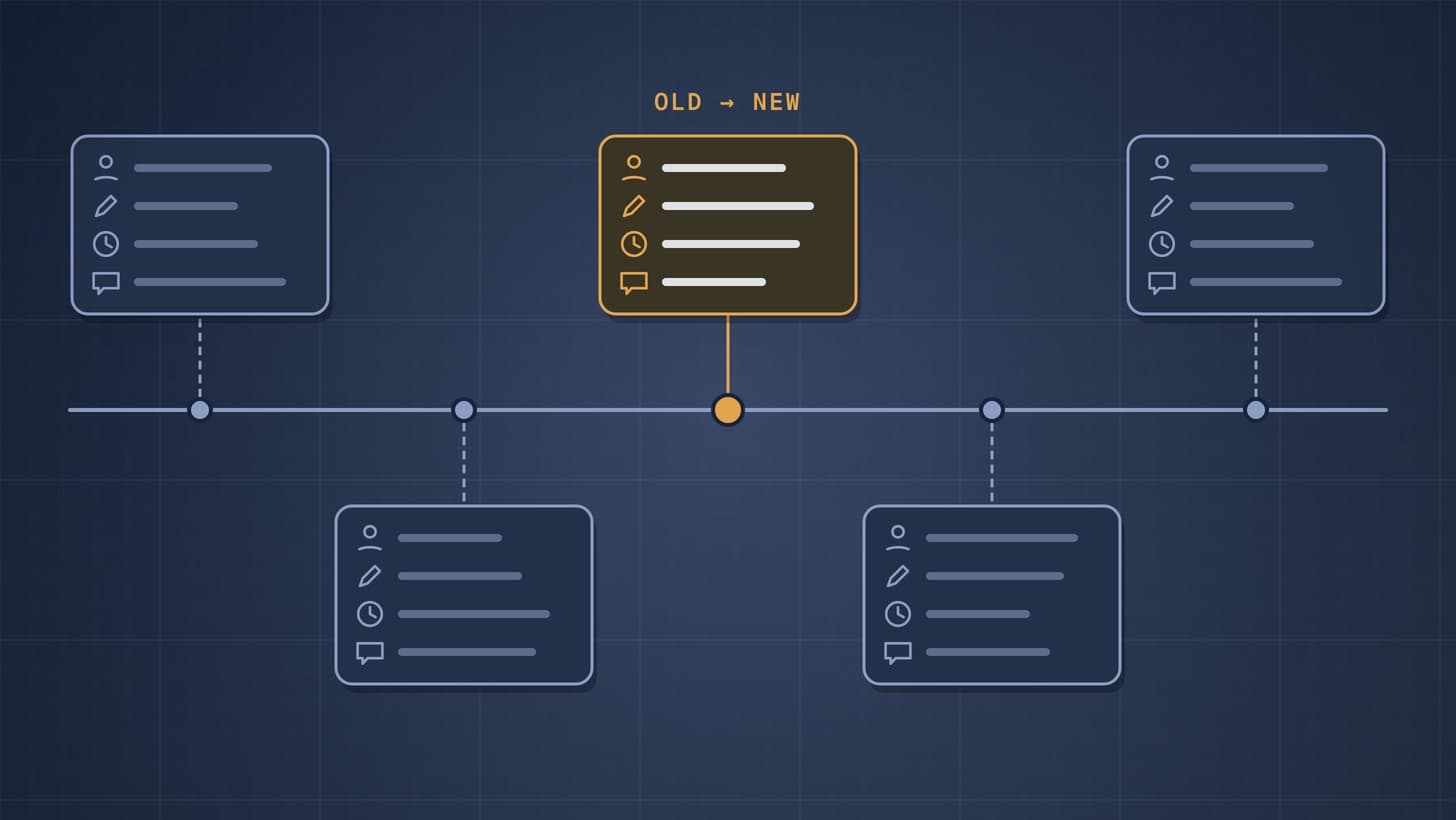
A GMP audit trail is a secure, system generated, time stamped record of every action that creates, changes or deletes a GMP record. Each entry should show who acted, what changed, including the old and new value, when, and why for changes to GMP relevant data, without obscuring the original entry. It must be kept as long as the record itself, be readable on demand, and be reviewed.
That definition comes from three main sources: EU GMP Annex 11, the US rule 21 CFR 11.10(e), and the UK MHRA's data integrity guidance. Purchasing systems that hold GMP records, such as specifications, supplier assessments, bid evaluations and vendor documents, are in scope where those records support quality decisions.
Why this matters now
The EU rules are being tightened. Draft revisions of Annex 11 and Chapter 4, published for consultation in July 2025 with comments closing on 7 October 2025, strengthen controls on data integrity and audit trails [1]. The draft Annex 11 grows from 5 to 19 pages and gives audit trails their own section [2]. The current 2011 text remains the reference until a final version is adopted, but the direction is clear.
Join ChemCapital to streamline sourcing and connect with verified partners
Whether you're buying or supplying, ChemCapital gives you the tools to manage the complete procurement cycle in one platform.
What regulators require
| Requirement | What the rules say | In plain words |
|---|---|---|
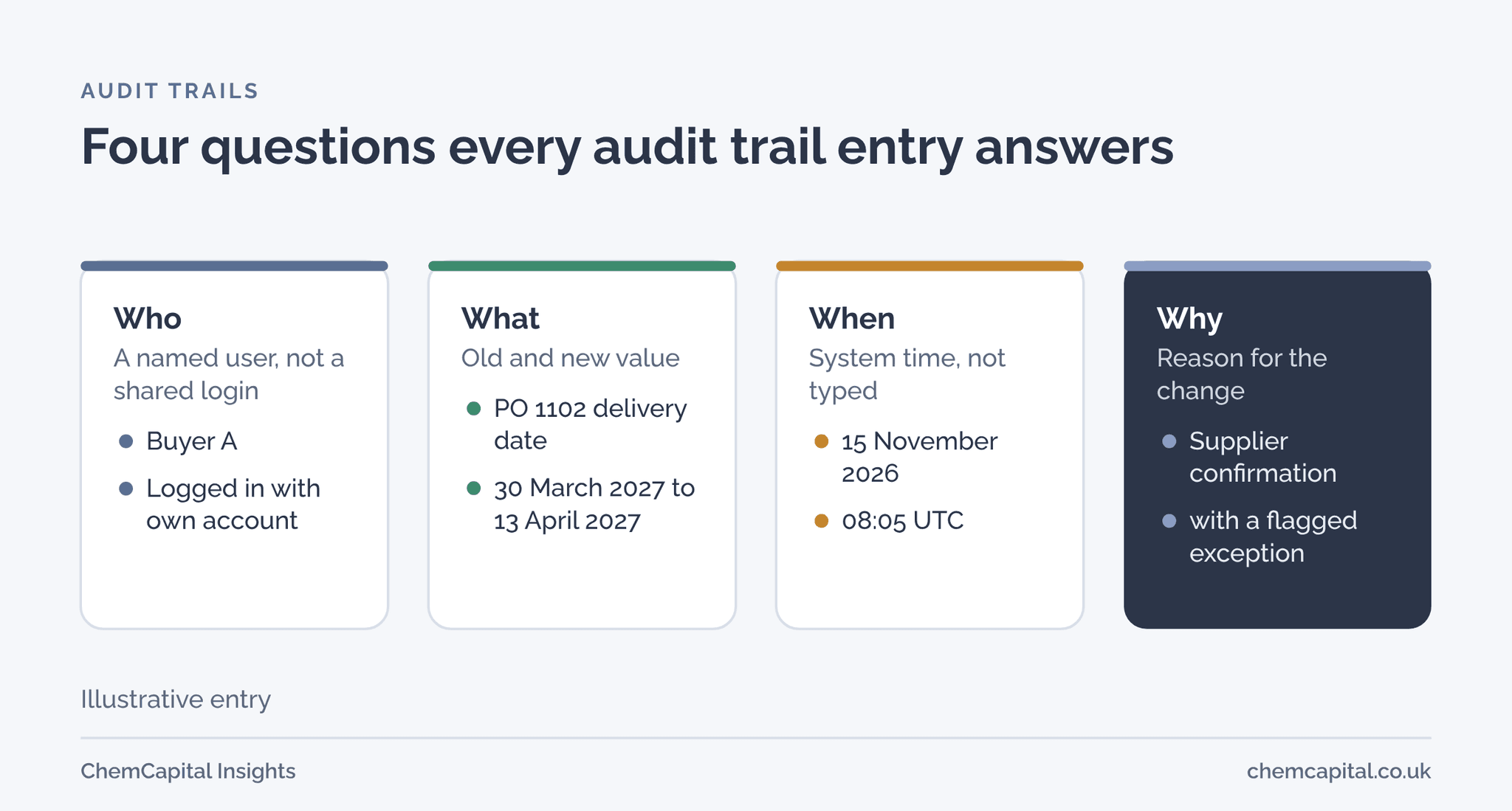
| Who | Annex 11 asks systems to record the identity of operators entering, changing, confirming or deleting data [3] | A named person, never a shared login |
| What | Part 11 says record changes must not obscure previously recorded information [4] | Keep the old value and the new one |
| When | Both rules require the date and time of each action [3, 4] | System time, not typed by the user |
| Why | Annex 11 asks for the reason to be documented for changes or deletions of GMP relevant data [3] | A reason field that cannot be left blank |
| Secure and automatic | Part 11 requires secure, computer generated, time stamped audit trails [4]; MHRA says users should not be able to amend or switch them off [5] | Users cannot edit or disable it |
| Kept and available | Part 11 requires retention at least as long as the record, available for review and copying [4]; Annex 11 says audit trails must be convertible to a generally intelligible form [3] | Exportable and readable for an inspector |
| Reviewed | Annex 11 says audit trails should be regularly reviewed [3] | Someone actually looks at it |
Annex 11 also asks for a risk assessment to decide where an audit trail is built in [3], so not every field in every system needs one. A supplier's price on a GMP critical vessel probably does; the colour of a bid folder does not.
What audit trail review means in practice
FDA expects the people who review GMP records to review the related audit trails as well, and says that where the rules set no frequency, the frequency should be set from process knowledge and risk [6]. FDA compares audit trail review to checking the crossings out on a paper record [6].
A practical review for a procurement record looks for:
- changes made after the record was approved or signed;
- deletions, and who made them;
- changes to technical scores after commercial bids were opened;
- entries out of time sequence, or made at unusual times;
- actions by administrators, which MHRA says must themselves be recorded [5].
Record that the review happened, who did it and what was found, in the same way as any other GMP review. Our article on ALCOA+ data integrity covers the wider principles behind it.
Practical example: audit trail entries for a purchase
In this illustrative example, a buyer receives a quote for a GMP vessel, the quote is revised, the evaluation is updated, and the purchase order is approved and then amended. A compliant audit trail would show entries like these.
| Time (UTC) | User | Action | Record and field | Old value | New value | Reason |
|---|---|---|---|---|---|---|
| 3 Nov 2026 09:14 | Buyer A | Created | Quote 0457, price | (none) | £84,200 | Quote received from Vendor B |
| 10 Nov 2026 14:02 | Vendor B user | Revised | Quote 0457 rev 1, price | £84,200 | £81,900 | Revised after technical query 7 |
| 12 Nov 2026 10:30 | Engineer B | Edited | Evaluation, technical score | 3 | 4 | Seal plan confirmed in technical query 7 |
| 14 Nov 2026 16:45 | Approver C | Approved | PO 1102, status | Draft | Approved | Within delegated authority |
| 15 Nov 2026 08:05 | Buyer A | Edited | PO 1102, delivery date | 30 Mar 2027 | 13 Apr 2027 | Supplier confirmation with exception |
A reviewer would ask two questions here. Was the technical score change on 12 November made before or after commercial bids were opened, and is the technical query that justifies it on file? And was the delivery date change after approval covered by the supplier's confirmation? If both answers are yes, the trail tells a clean story. If the reason fields had been blank, it would not.
For equipment that goes on to qualification, the same discipline continues into vendor documents and test records; see IQ, OQ and PQ explained.
Where ChemCapital fits
ChemCapital logs interactions, revisions and decisions with timestamps and links every action to the person who took it. Its Trust Centre describes the audit log as tamper evident, using a SHA 256 hash chain on data changes, with timestamps in UTC that cannot be backdated and mandatory reason for change fields; the log can be exported as CSV, with tamper evident export on Enterprise. These are ChemCapital's own descriptions, to be assessed by your quality team like any supplier's; for US electronic records rules, see our guide to 21 CFR Part 11 for procurement records.
Ready to keep a full record of every quote, score and order change? Start free with ChemCapital.
Frequently asked questions
What must a GMP audit trail record?
Who made the change, what was changed including the old and new values, when it happened, and why for changes to GMP relevant data. It must be secure, generated by the system rather than typed by users, and must not hide the original entry.
How often should audit trails be reviewed?
EU Annex 11 says audit trails should be reviewed regularly, and FDA expects the people who review GMP records to review the related audit trails too, at a frequency set by risk where the rules give none. In practice that usually means reviewing them with the record before it is approved.
Can users switch off an audit trail?
No. MHRA guidance says users should not be able to amend or switch off audit trails, and that any action by administrators on them should itself be recorded.
Continue reading
Informational only, not procurement or legal advice. Cited names, frameworks, and statistics belong to their respective owners.
Join ChemCapital to streamline sourcing and connect with verified partners
Whether you're buying or supplying, ChemCapital gives you the tools to manage the complete procurement cycle in one platform.
Get started freeRelated articles

Commissioning and Qualification: ASTM E2500 vs Traditional IQ OQ PQ
How the science and risk based ASTM E2500 approach differs from traditional IQ, OQ and PQ, who does what, how vendor tests can be reused, and what to put in the RFQ.

GAMP 5 Software Categories for Bought In Skids and Control Systems
GAMP 5 software categories 1, 3, 4 and 5 in plain words, mapped to the skids, instruments and control systems a buyer actually orders, with what to ask suppliers for.

21 CFR Part 11 and Electronic Signatures on Procurement Records
A plain guide to 21 CFR Part 11 for buyers at GMP sites: which purchasing and vendor records fall in scope, what electronic signatures must show, and what to check in a tool.