
Commissioning and Qualification: ASTM E2500 vs Traditional IQ OQ PQ
How the science and risk based ASTM E2500 approach differs from traditional IQ, OQ and PQ, who does what, how vendor tests can be reused, and what to put in the RFQ.

Commissioning and qualification (C&Q) is how a regulated manufacturer shows that new equipment is installed correctly, works as intended and is fit for its use. The traditional approach adds formal qualification stages after commissioning: installation qualification (IQ), operational qualification (OQ) and performance qualification (PQ), each run against protocols approved by quality, and often repeating tests already done by the supplier. The ASTM E2500 approach is science and risk based: it focuses verification on the aspects critical to product quality and patient safety, uses good engineering practice, and lets properly documented supplier and commissioning tests count.
For a buyer, the difference is decided early. The tests you can rely on later are the ones you specified, and paid for, in the RFQ.
Why this matters now
The main reference points, a standard and two regulators, are all moving towards risk based verification. ASTM's guide for the specification, design and verification of pharmaceutical manufacturing systems is now in its 2025 version, E2500 25, and states that it applies to process equipment, utilities, control and automation systems across their lifecycle, consistent with ICH Q8 to Q11 [1]. In Europe, a revision of GMP Annex 15 on qualification and validation is under way: the concept paper, agreed with PIC/S in January 2026, plans to align it with the revised ICH Q9 on quality risk management, with a draft guideline planned for consultation in December 2026 and publication in 2028 [2]. And in the US, FDA's final guidance on computer software assurance, issued in September 2025, encourages effort matched to risk and the use of vendor assessments and system records [3].
Join ChemCapital to streamline sourcing and connect with verified partners
Whether you're buying or supplying, ChemCapital gives you the tools to manage the complete procurement cycle in one platform.
Traditional and E2500 compared
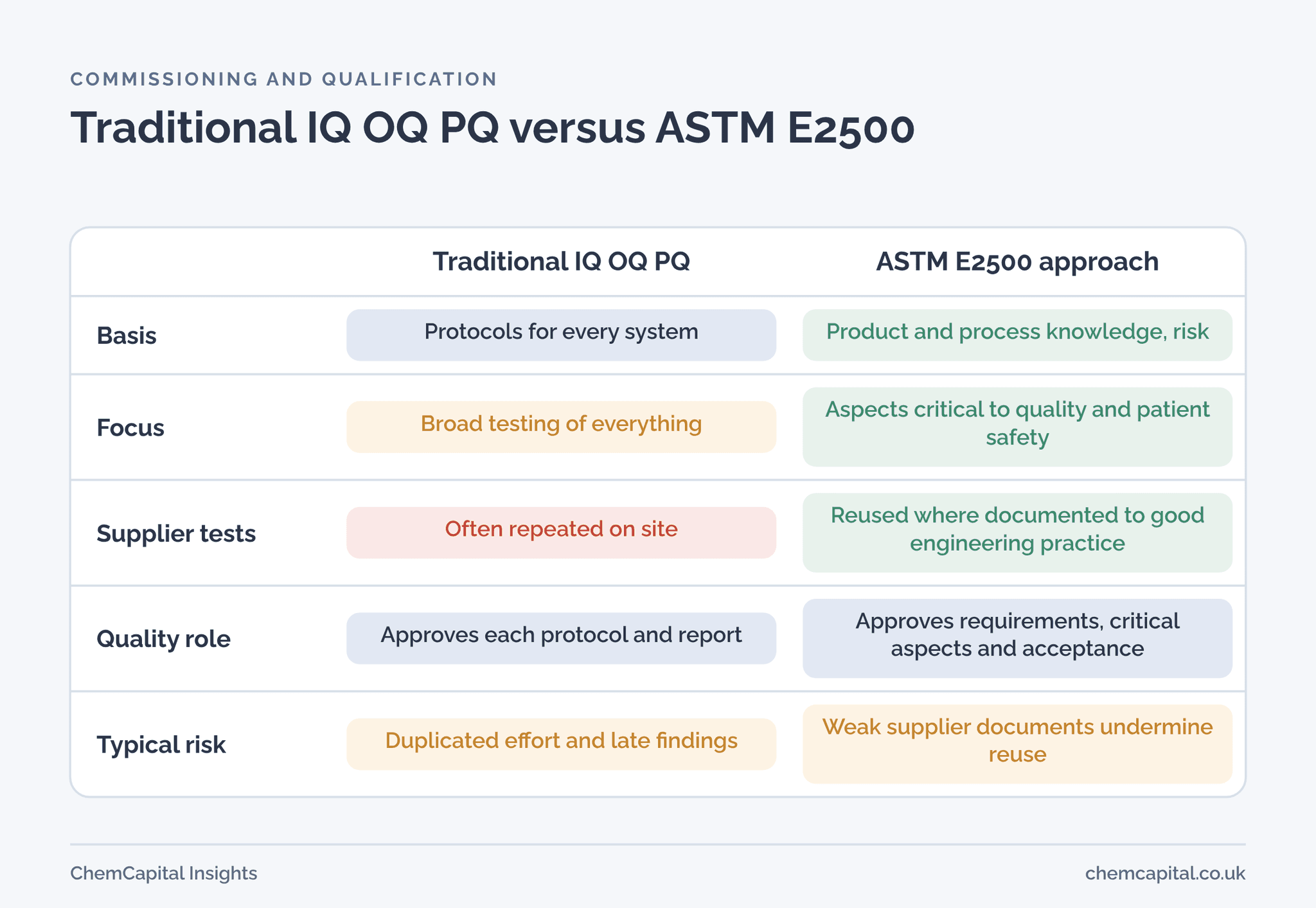
Under the traditional model, every system goes through IQ, OQ and PQ protocols; see our guide to IQ, OQ and PQ. Under E2500, the team starts from product and process knowledge, identifies which aspects of the system are critical, and verifies those rigorously, while the rest is covered by good engineering practice and commissioning. ISPE's Baseline Guide on commissioning and qualification, second edition 2019, follows the same direction, covering how to apply quality risk management to C&Q, URS, design review and design qualification, and good engineering practice documentation standards [4].
Neither approach is a licence to do less where it matters. The aim is to put effort where risk is, and to stop repeating tests that add nothing.
Who does what
| Party | Traditional model | E2500 model |
|---|---|---|
| Owner's quality unit | Approves every protocol and report | Approves requirements, critical aspects, acceptance criteria and the final verification report |
| Owner's engineering team | Supports quality's protocols | Leads verification as subject matter experts |
| Supplier | Builds and tests to its own standard | Tests to agreed good engineering practice, so results can be reused |
| Buyer | Places the order | Writes the testing and document expectations into the RFQ and order |
Supplier involvement is the hinge. ISPE's GAMP 5 second edition makes the same point for computerised systems, putting more weight on suppliers and service providers and on critical thinking by subject matter experts [5].
Reusing supplier tests: FAT and SAT
EU GMP Annex 15, revised in 2015, starts qualification from user requirements, adds design qualification and factory and site acceptance tests, and allows tests and documentation reviews from the factory acceptance test to be used in later qualification instead of being repeated, where appropriate and assessed; qualification documents can also be combined, for example IQ and OQ [6].
For a supplier test to be reusable, it usually needs:
- a test procedure agreed before the test, with acceptance criteria;
- calibrated test instruments, with certificates;
- results recorded at the time, signed and dated;
- deviations recorded and resolved;
- witness or review by the owner's engineering or quality team where the aspect is critical;
- change control after the test, so nothing changes before the equipment leaves the factory without being assessed.
Our checklists for the factory acceptance test and the site acceptance test cover the practical steps.
What to put in the RFQ
| Requirement | Why |
|---|---|
| Reference to your user requirement specification | Every test traces back to a requirement |
| List of critical aspects, or a commitment to agree them | Focuses testing where it matters |
| Test procedures to good engineering practice, agreed before testing | Makes results reusable |
| Calibration certificates for test instruments | Evidence the results are valid |
| Owner witness points at FAT for critical aspects | Quality and engineering see the critical tests |
| Deviation and change control rules after FAT | Keeps the tested state intact |
| Document formats and timing | Fits your quality system and qualification plan |
Ask bidders to price these items. Testing to a documented standard costs the supplier time, and an unpriced requirement tends to disappear.
Common pitfalls
- Calling it E2500 but running it the old way. If quality still rewrites every supplier test as a new protocol, nothing is saved.
- Leaving critical aspects undefined until site. The supplier cannot test to a list that does not exist when it quotes.
- Accepting supplier tests without seeing the raw records. A summary certificate is not enough evidence for a critical aspect.
- Changing the skid after FAT without telling anyone. A modification after the test can void its reuse; the order should require notification of any change.
- Treating the approach as a quality matter only. Engineering, procurement and the supplier all have to plan for it, and the plan starts with the RFQ.
Practical example
In this illustrative example, a cleaning in place skid has 120 test items in the supplier's factory acceptance test.
Under a traditional approach, the owner repeats 80 of them on site as IQ and OQ, for 200 test executions in total. Under an E2500 approach, the risk assessment identifies 25 critical aspects. The supplier runs all 120 tests to an agreed procedure, with the owner witnessing the 25 critical ones; on site, 15 tests affected by transport and installation are repeated during the site acceptance test, and the verification report references the rest. That is 135 executions, 65 fewer, about a third less test effort, with more attention on the tests that matter.
The saving only happens because the RFQ required test procedures, calibrated instruments and witness points from the start.
Where ChemCapital fits
ChemCapital sends one structured RFQ with line items and attachments, such as your URS, test expectations and document list, to several suppliers, so testing and documentation are priced in every bid. Quotes come back in a consistent format and are checked for missing fields and compliance gaps, and after award each order carries its own message thread and milestone updates, which keeps FAT dates and witness arrangements with the order they belong to.
Ready to put qualification expectations into every equipment RFQ? Start free with ChemCapital.
Frequently asked questions
What is ASTM E2500?
ASTM E2500 is a standard guide for the specification, design and verification of pharmaceutical and biopharmaceutical manufacturing systems and equipment. It applies a science and risk based approach, consistent with ICH Q8 to Q11, so that systems are shown to be fit for their intended use.
What is the difference between ASTM E2500 and IQ OQ PQ?
Traditional IQ, OQ and PQ run quality approved protocols for installation, operation and performance, often repeating tests already done by the supplier. E2500 focuses verification on the aspects critical to product quality and patient safety, uses good engineering practice, and allows supplier and commissioning tests to count where they are properly documented.
Can factory acceptance tests be used for qualification?
Yes, under EU GMP Annex 15, if it is appropriate and the tests have been assessed, results from factory acceptance testing can be used in later qualification instead of repeating them. Plan this in the RFQ so the supplier's tests are documented to the standard your quality team needs.
Continue reading
Informational only, not procurement or legal advice. Cited names, frameworks, and statistics belong to their respective owners.
Join ChemCapital to streamline sourcing and connect with verified partners
Whether you're buying or supplying, ChemCapital gives you the tools to manage the complete procurement cycle in one platform.
Get started freeRelated articles

GAMP 5 Software Categories for Bought In Skids and Control Systems
GAMP 5 software categories 1, 3, 4 and 5 in plain words, mapped to the skids, instruments and control systems a buyer actually orders, with what to ask suppliers for.
Audit Trail Requirements in GMP: What a Compliant Record Must Capture
What EU Annex 11, 21 CFR Part 11 and MHRA guidance require of an audit trail, what audit trail review means in practice, and worked entries for a procurement record.

21 CFR Part 11 and Electronic Signatures on Procurement Records
A plain guide to 21 CFR Part 11 for buyers at GMP sites: which purchasing and vendor records fall in scope, what electronic signatures must show, and what to check in a tool.