
PED Categories: How to Classify Pressure Equipment Under PER 2016
PED and PER 2016 categories run from sound engineering practice to category IV. How fluid group, state, PS and volume set the category, the module and the marking.
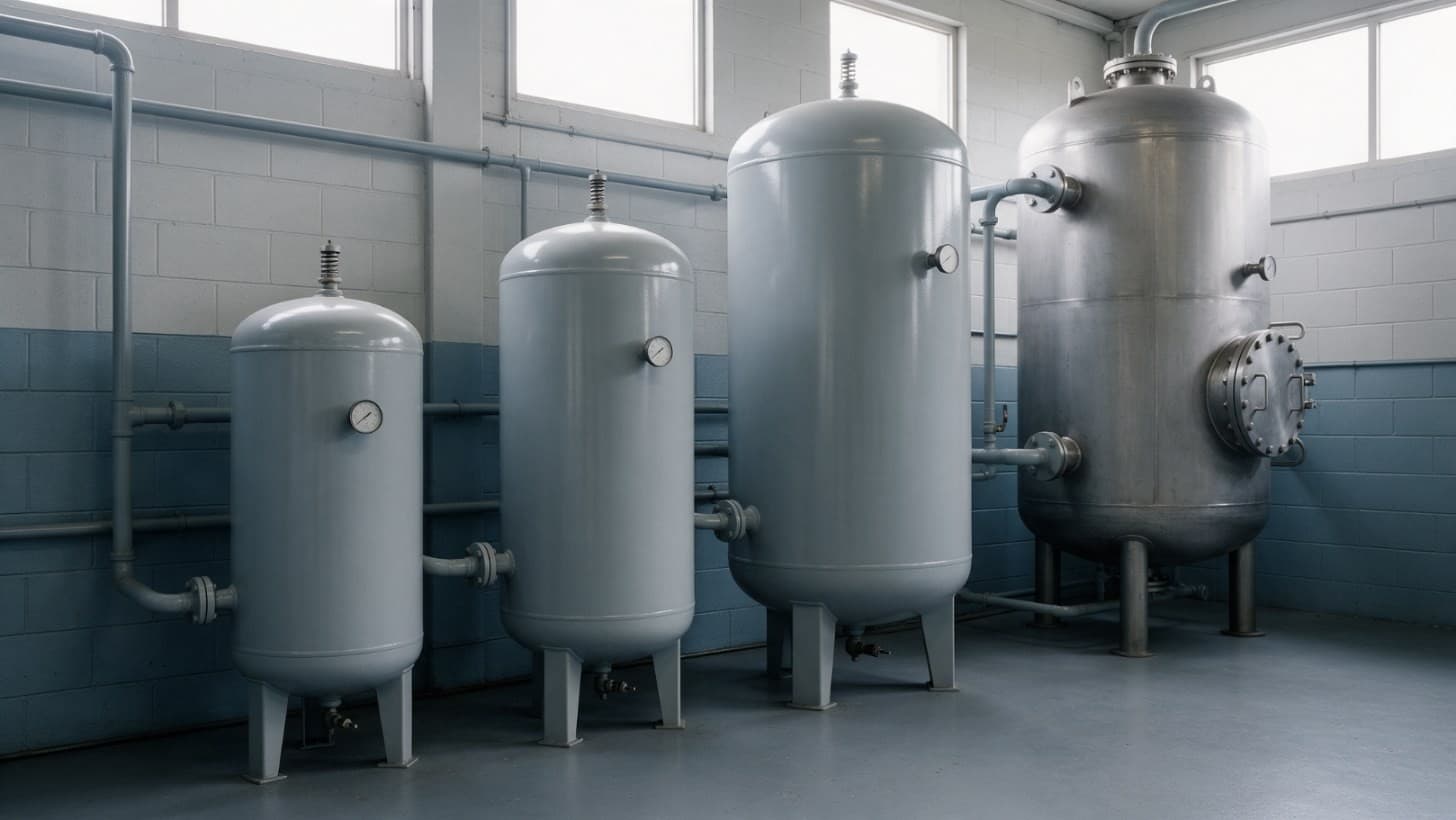
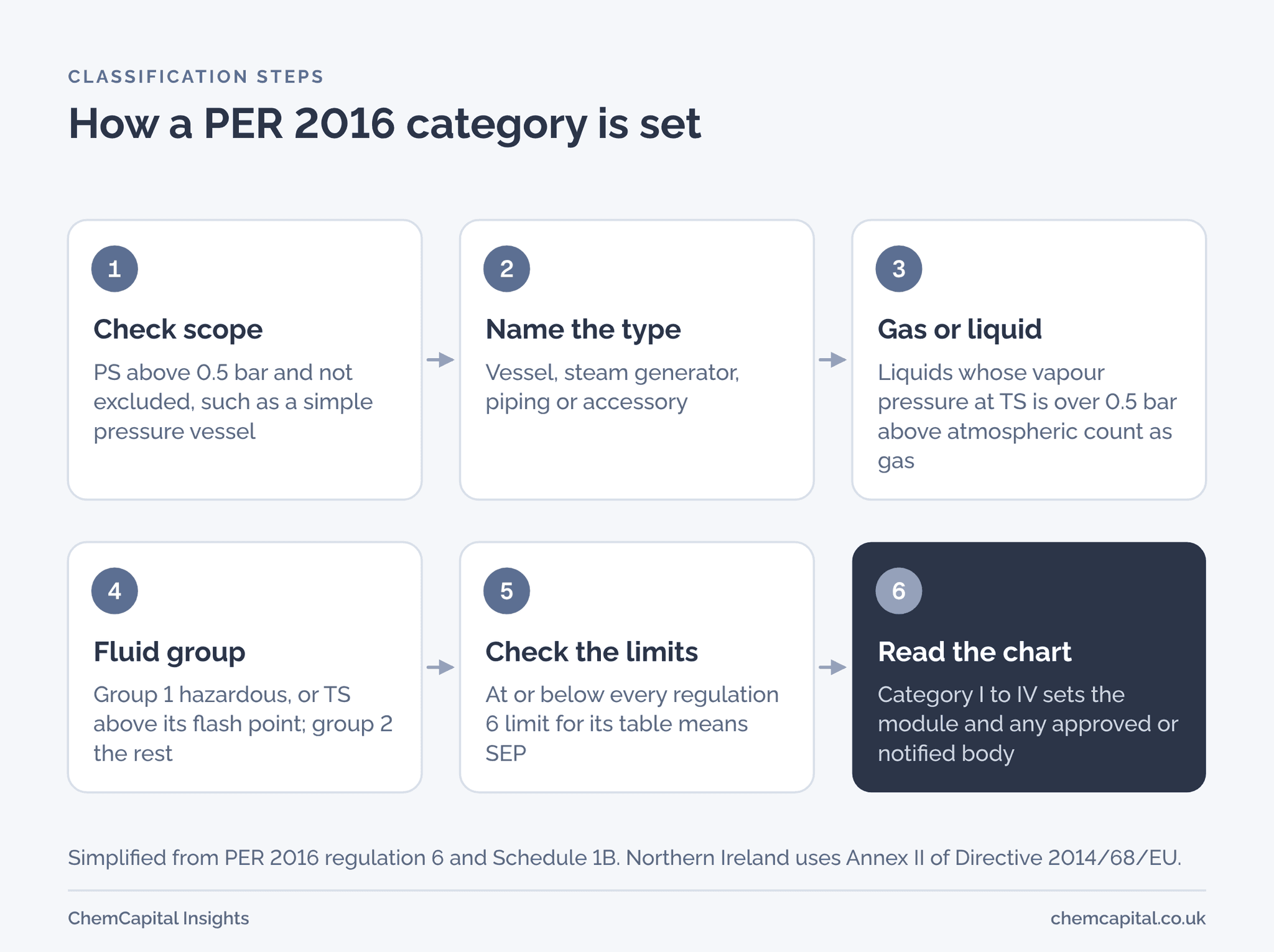
Under the EU Pressure Equipment Directive 2014/68/EU (PED) and its Great Britain counterpart, the Pressure Equipment (Safety) Regulations 2016 (PER), equipment with a maximum allowable pressure (PS) above 0.5 bar goes into category I, II, III or IV, in ascending level of hazard, or sits below category I under sound engineering practice (SEP) [1, 3, 9]. The manufacturer sets the category from four facts: the type of equipment, whether the fluid counts as a gas or a liquid, its fluid group, and its PS with its volume V (or nominal size DN for piping) [3].
Category I is self declared; categories II to IV need an approved body for UKCA marking or a notified body for CE marking [2, 3, 9].
Why this matters now
The category sets how much third party work, and so cost and lead time, goes into a vessel. From category II, procedures and personnel for permanent joints such as welds must be approved, and the main pressure parts need a certificate of specific product control. From category III, NDT (non destructive testing) staff must be approved by a recognised third party organisation [1].
Regulations in force from 1 October 2024 extended recognition of CE marking in Great Britain indefinitely, so equipment can carry UKCA or CE [3]; the guidance was unchanged on 25 October 2026.
Create and manage RFQs in minutes
ChemCapital handles the entire procurement cycle, from structured RFQs and supplier comparisons to formal purchase orders and delivery tracking.
The four inputs that set the category
Equipment type. Vessels, fired or heated equipment making steam or water above 110 °C, and piping each have their own tables. Pressure accessories, operational devices with a pressure bearing housing, use the vessel or piping table, taking the higher result where both V and DN apply [1, 2].
Fluid state. "Gas" includes vapours and any liquid whose vapour pressure at the maximum allowable temperature (TS) is more than 0.5 bar above normal atmospheric pressure (1013 mbar) [1].
Fluid group. Group 1 covers listed hazard classes of the CLP Regulation, such as explosives, flammable gases, flammable liquids in categories 1 and 2, and some oxidising and acute toxicity categories. It also includes any fluid where the maximum allowable temperature TS exceeds its flash point, whatever temperature the fluid normally runs at. Group 2 is everything else, steam included [1, 3].
PS and V, or PS and DN. PS is the maximum pressure, in bar gauge, that the manufacturer specifies for the design. V is the internal volume of a chamber, including nozzles to the first connection or weld [1].
A vessel takes the highest category of its chambers, and a chamber holding several fluids is classified on the fluid needing the highest category [1]. The Commission's PED guidelines count the shell and tube sides of an exchanger as two chambers of one vessel, so a spare bundle cannot be CE marked alone [7]. Safety accessories, such as safety valves and bursting discs, are category IV unless made for specific equipment, when they may take its category [1, 2].
At or below these regulation 6 limits, equipment is SEP [1, 2]:
| Equipment and fluid | Schedule 1B table | Inside the categories when |
|---|---|---|
| Vessel, gas, group 1 | Table 1 | V > 1 L and PS × V > 25 bar·L, or PS > 200 bar |
| Vessel, gas, group 2 | Table 2 | V > 1 L and PS × V > 50 bar·L, or PS > 1,000 bar; also all portable extinguishers and breathing apparatus bottles |
| Vessel, liquid, group 1 | Table 3 | V > 1 L and PS × V > 200 bar·L, or PS > 500 bar |
| Vessel, liquid, group 2 | Table 4 | PS > 10 bar and PS × V > 10,000 bar·L, or PS > 1,000 bar |
| Steam or water above 110 °C, fired or heated | Table 5 | V > 2 L; also all pressure cookers |
| Piping, gas | Tables 6 and 7 | Group 1: DN > 25. Group 2: DN > 32 and PS × DN > 1,000 bar |
| Piping, liquid | Tables 8 and 9 | Group 1: DN > 25 and PS × DN > 2,000 bar. Group 2: PS > 10 bar, DN > 200 and PS × DN > 5,000 bar |
Above them, the category is read off the Schedule 1B chart of PS against V or DN [2, 3]. Some text rules override it: vessels and piping for unstable gases in category I or II move to III, and group 2 gas piping in category II carrying fluids above 350 °C moves to III [2].
| Category | Conformity assessment modules (the manufacturer picks one route) |
|---|---|
| SEP | None: sound engineering practice, instructions, no UKCA or CE marking |
| I | A, self declared |
| II | A2, D1 or E1 |
| III | B (design type) + D, B (design type) + F, B (production type) + E, B (production type) + C2, or H |
| IV | B (production type) + D, B (production type) + F, G, or H1 |
Sound engineering practice and simple pressure vessels
SEP equipment must be designed and made to sound engineering practice with adequate instructions, and must not carry the UK marking unless other legislation requires it [1, 3]. Size matters: Emerson classes a gas regulator series from SEP at DN 25 to category II at DN 100, and category IV with a slam shut device [8].
Many air receivers sit outside the PER. The Simple Pressure Vessels (Safety) Regulations 2016 cover welded, unfired vessels made in series for air or nitrogen, in non alloy quality steel, non alloy aluminium or non age hardening aluminium alloy, with a maximum working pressure up to 30 bar and PS × V up to 10,000 bar·L [6], and the PER exclude them [1]. A stainless steel receiver, or a one off, falls back under the PER.
UKCA, CE and Northern Ireland
In Great Britain, a UK approved body's work leads only to UKCA marking. An EU notified body's work leads to CE marking and can also support UKCA [3]. HSE says new equipment on the GB market must be UKCA or CE marked with instructions in English [5]; SEP items carry no marking [1].
Northern Ireland still applies the Directive under the Windsor Framework. UKCA is not accepted there, so equipment needs CE; where a UK notified body did the assessment, CE must be joined by UKNI, and the equipment cannot then be placed on the EEA market [4].
This is general information, not legal advice. The PER cover placing equipment on the market, not a user assembling equipment on its own site, where the Pressure Systems Safety Regulations 2000 apply instead [5]. For in service duties, see our PSSR written scheme of examination guide.
What to ask the vendor to state
The nameplate need not show the category, since Schedule 2's marking list omits it [1]. Ask each bidder to state in writing:
- PS, TS and V for each chamber, or DN for piping
- the fluid group, Schedule 1B table and category for each chamber
- the module, and the name and number of the approved or notified body [1, 2]
- the marking: UKCA, CE, CE with UKNI, or none for SEP
- for a skid or other assembly, the category of each item and of the integration, set by the highest category other than safety accessories [1]
The declaration of conformity should name the procedure followed and any body, with its number and certificate reference [1]. For the design code, see our comparison of ASME VIII, PD 5500 and EN 13445.
Practical example
Five illustrative items for a pharma utility package. Air is group 2 here, as the Commission's guidelines read a compressed air tank's category from Table 2 [7].
| Item (illustrative) | Fluid, table | PS | V | PS × V | Result |
|---|---|---|---|---|---|
| A. Stainless receiver, one off | Air, Table 2 | 11 bar | 500 L | 5,500 bar·L | Above 50 bar·L: read category from Table 2 |
| B. Non alloy steel receiver, made in series | Air | 11 bar | 270 L | 2,970 bar·L | Inside simple pressure vessel limits: those rules apply if it fits the definition |
| C. Stainless buffer bottle | Air, Table 2 | 10 bar | 4 L | 40 bar·L | Not above 50 bar·L: SEP |
| D. Chilled water buffer | Water, Table 4 | 10 bar | 2,000 L | 20,000 bar·L | PS not above 10 bar: SEP |
| E. Same shell, low volatility group 1 solvent | Liquid, Table 3 | 10 bar | 2,000 L | 20,000 bar·L | Above 200 bar·L: read category from Table 3 |
Receiver A is 110 times the 50 bar·L limit, so it needs a category. Schedule 1B prints the boundaries only as charts, so we quote no band: plot 11 bar against 500 L on Table 2, where each line marks a category's upper limit, and have the manufacturer confirm category and module in writing [2].
D and E share one shell. Water at 10 bar escapes Table 4 because PS must also exceed 10 bar. Switch to E's solvent, or raise D to 16 bar (32,000 bar·L), and it moves into a category.
Find vendors who can build to your category
For a category III or IV vessel, the manufacturer needs an approved or notified body behind one of the permitted modules: an approved quality system (D, E, H or H1), or the body examining and testing the equipment itself (F, or G for unit verification) [1]. Supplier Discovery searches the web for suppliers from a plain text description, pasted RFQ or uploaded spec, and gives each a fit verdict with source links. Certifications are shown as claimed, not verified, so before award check the quality system certificate, or agree which body will verify the vessel.
Ready to find vendors who can build to your category? Start a free 14 day ChemCapital trial, with no credit card needed.
Frequently asked questions
What are the PED categories?
Pressure equipment with a maximum allowable pressure (PS) above 0.5 bar is classified in category I, II, III or IV in ascending level of hazard, or as sound engineering practice below category I. The category comes from the equipment type, whether the fluid is a gas or a liquid, the fluid group and PS times V or DN, and it fixes the conformity assessment modules.
Which PED categories need a notified body?
Categories II, III and IV. Category I uses Module A, the manufacturer's own internal production control; in Great Britain a UK approved body assesses for UKCA marking and an EU notified body for CE marking.
Is an air receiver covered by the Pressure Equipment Regulations?
A welded receiver for air or nitrogen made in series from non alloy quality steel, non alloy aluminium or non age hardening aluminium alloy, with a working pressure up to 30 bar and PS times V up to 10,000 bar·L, and meeting the rest of the definition, falls under the Simple Pressure Vessels (Safety) Regulations 2016 instead. A stainless or one off receiver falls under the Pressure Equipment (Safety) Regulations 2016: in a category if V is over 1 L and PS times V is over 50 bar·L, otherwise at sound engineering practice.
Does pressure equipment need UKCA or CE marking in Great Britain?
Either is accepted, because recognition of CE marking in Great Britain was extended indefinitely from 1 October 2024; work by a UK approved body leads to UKCA. Northern Ireland requires CE, with UKNI added where a UK notified body did the assessment, and equipment at sound engineering practice carries no marking.
Continue reading
Informational only, not procurement or legal advice. Cited names, frameworks, and statistics belong to their respective owners.
Create and manage RFQs in minutes
ChemCapital handles the entire procurement cycle, from structured RFQs and supplier comparisons to formal purchase orders and delivery tracking.
Start for freeRelated articles
BIOSECURE Act: What It Means for Equipment Suppliers to Biopharma (and Who Wins)
What Section 851 prohibits, who gets listed and when, and how equipment and consumables suppliers should prepare for customer BIOSECURE diligence.
PSSR Written Scheme of Examination: What to Get from Your Vendor
Under PSSR, most pressure systems cannot run until they have safe operating limits and a written scheme of examination. What the law asks, and what to get from the vendor.
Long Lead Items: Identify, Prioritise and Order Them Early
Long lead items decide when a process plant can start. What makes an item long lead, how to find and rank them early, ways to order ahead and the risks.