
ASME VIII vs PD 5500 vs EN 13445: Choosing a Pressure Vessel Code
How the three main pressure vessel codes differ for a project in Great Britain: legal status under PESR, extra work for ASME vessels, vendor pool and a worked bid comparison.
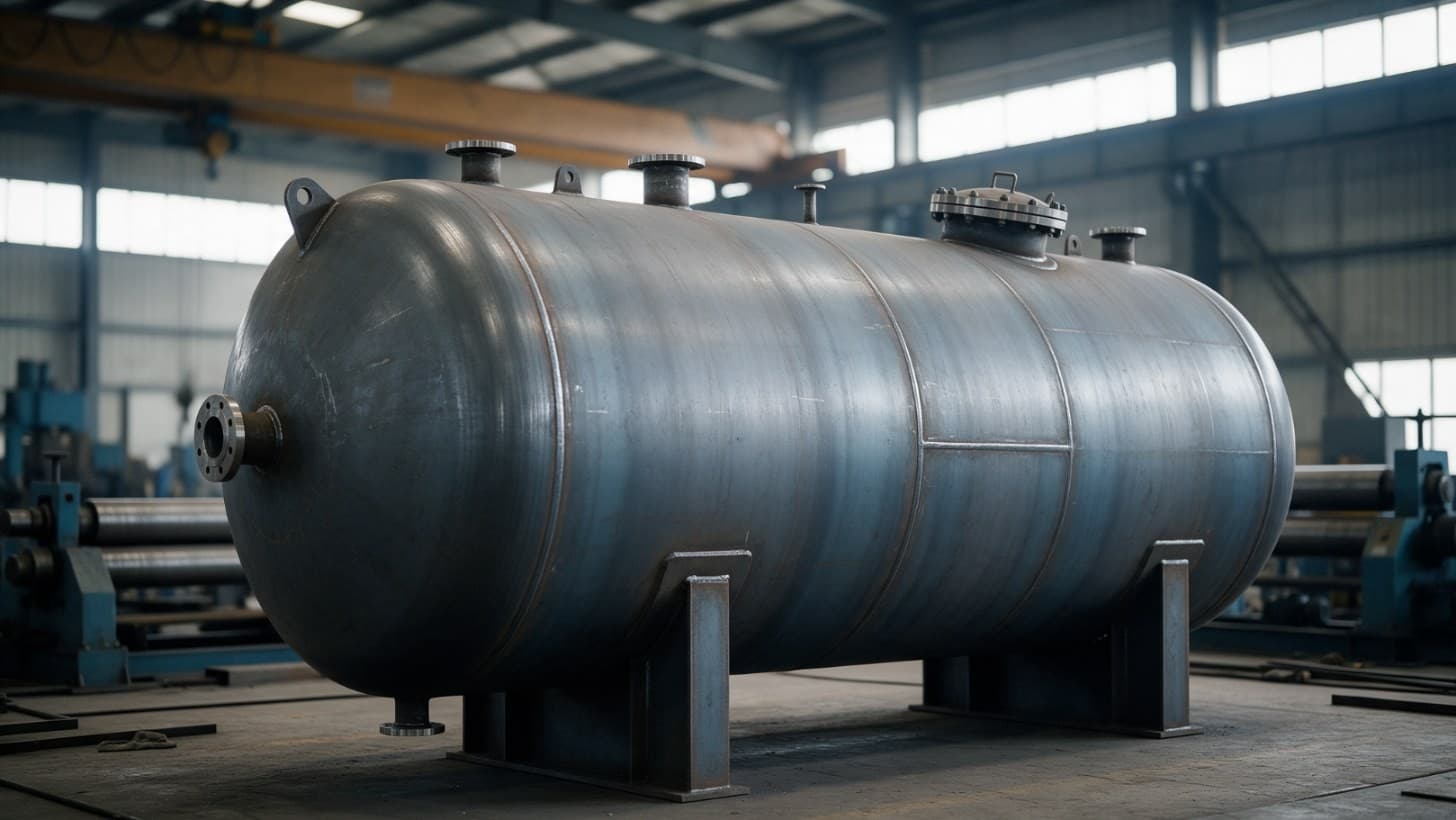
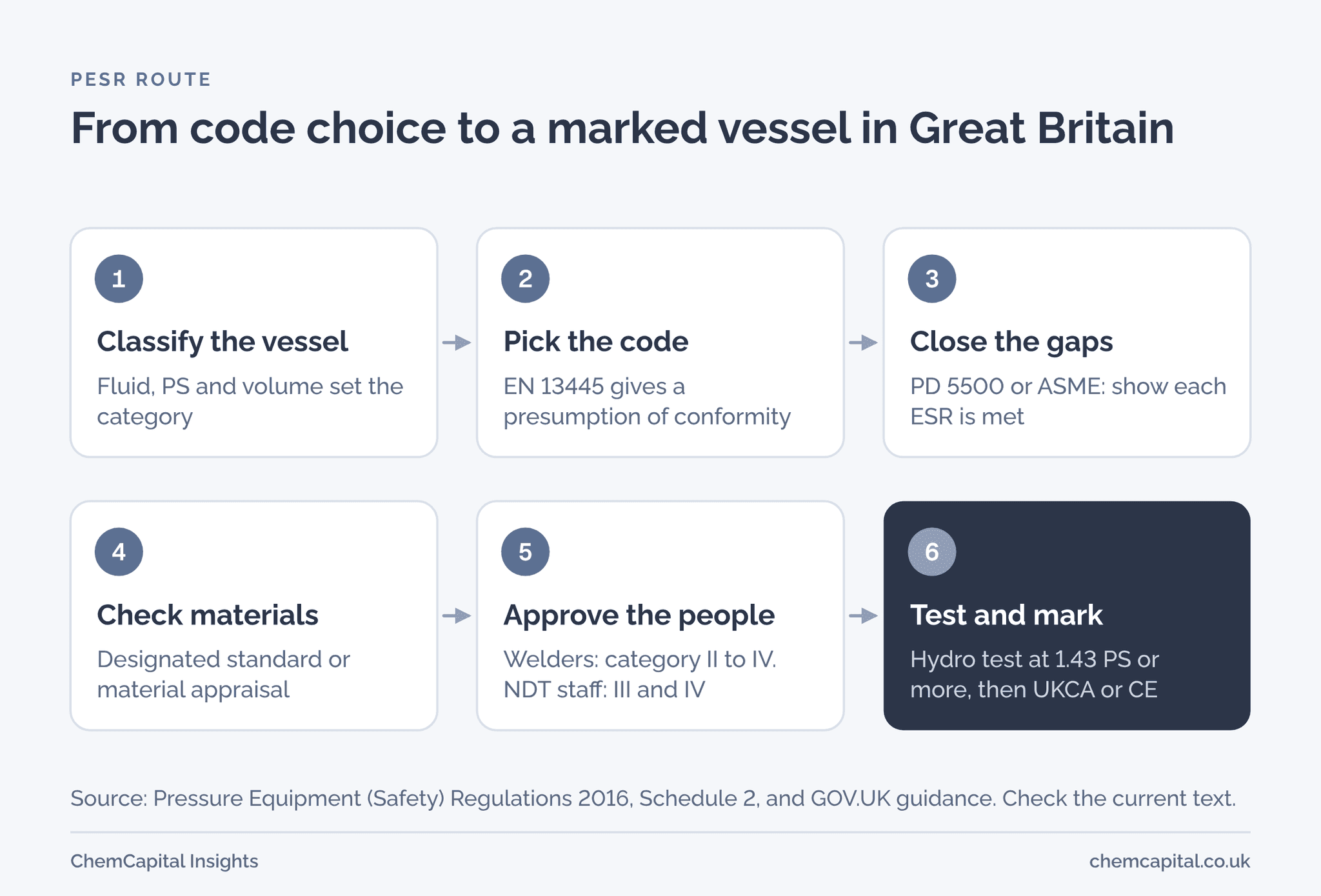
For a vessel going into service in Great Britain, all three codes can produce a lawful vessel, but they reach the law by different routes. EN 13445 is a designated standard under the Pressure Equipment (Safety) Regulations 2016, so a vessel built to it is presumed to meet the essential safety requirements the standard covers [1]. PD 5500 and ASME Section VIII are not on the designated list, so the manufacturer must show how the design meets each requirement, and an ASME vessel usually needs the most extra work.
The right choice depends on where the vessel will be installed, your client's specification and which fabricators you want bidding. Whichever you pick, make every bid price the work needed to reach a UKCA or CE marking, not just the code stamp.
Why this matters now
Regulations in force from 1 October 2024 extended recognition of CE marking in Great Britain indefinitely, so a vessel can carry either UKCA or CE marking [2]. That keeps European fabricators building to EN 13445 in your bidding pool.
The designated list keeps moving. The Department for Business and Trade notice of 18 March 2026 lists Parts 1 to 6, 8, 10 and 11 of EN 13445, including a new Part 11 for titanium. Its list of withdrawals shows the plain 2021 editions of Part 2 (materials) and Part 4 (fabrication) stopped being designated on 31 July 2026; the designated versions carry 2023 amendments [1]. A bid quoting "EN 13445:2021" with no amendment deserves a question.
PD 5500 moves too: BSI says the 2024 edition began a three year cycle, with amendments each September from 2024 to 2026 [4]. Ask which amendment the design uses.
Join ChemCapital to streamline sourcing and connect with verified partners
Whether you're buying or supplying, ChemCapital gives you the tools to manage the complete procurement cycle in one platform.
Who publishes each code and how UK law treats it
The Pressure Equipment (Safety) Regulations 2016 (PESR) apply to equipment with a maximum allowable pressure, PS, greater than 0.5 bar [2]. The manufacturer places the vessel in a category based on the fluid, PS and volume, then follows the matching conformity assessment route. Vessels at or below the regulation 8 limits (set by fluid, PS and volume) are built to sound engineering practice and carry no conformity marking [2]. Schedule 2 sets out the essential safety requirements (ESRs), the legal targets every vessel above those limits must meet, whatever code is used [3].
This is general information, not legal advice. It covers Great Britain; Northern Ireland follows different rules, so check the Northern Ireland guidance [2].
EN 13445
EN 13445 is the European standard for unfired pressure vessels. BSI publishes it in the UK as BS EN 13445 and notes the series is more widely used in Europe [5]. Because its parts are designated in Great Britain, conforming to them gives a presumption of conformity with the corresponding ESRs [1]. The approved body (the independent organisation that assesses conformity; for CE marking, an EU notified body) still does its work for the vessel's category.
PD 5500
PD 5500 first appeared as BS 5500 in 1976 and was later renamed [4]. BSI calls it the UK's national pressure vessel code [5], and it is also used in Commonwealth countries, the Middle East and parts of Asia [4]. It is not a designated standard [1], so it gives no presumption of conformity: the manufacturer must show, and for higher categories the approved body must check, how the design meets each ESR.
ASME Section VIII
In ASME's Boiler and Pressure Vessel Code, Section VIII Division 1 covers vessels above 15 psig and contains the rules for the U certification mark [6]. Division 2 leans more heavily on stress analysis, and the user must supply a design specification for every Division 2 vessel [7]. Division 3 covers pressures above 10,000 psi [5].
The U stamp shows the vessel meets the ASME code. It is not a UKCA or CE marking. Asked whether a U stamped vessel automatically qualifies for CE marking, one US fabricator answers "At present, no" [8]. An ASME vessel can still carry a UKCA or CE marking, but only after PESR conformity assessment against the ESRs.
The three codes side by side
| ASME VIII | PD 5500 | EN 13445 | |
|---|---|---|---|
| Publisher | ASME (US) | BSI (UK) | European standard, published in the UK by BSI |
| Designated under PESR | No | No | Yes, Parts 1 to 6, 8, 10 and 11 |
| Presumption of conformity | No | No | Yes, for the ESRs it covers |
| Own mark | U mark (Division 1) | None | None |
| Mainly used in | US; in use in about 100 countries | UK, Commonwealth, Middle East, parts of Asia | Europe |
| Extra work for UKCA or CE | Most: materials, toughness, test pressure, staff approvals | Show how each ESR is met | Least, within the standard's scope |
Where an ASME vessel needs extra work
Design stress is rarely the problem. For ferritic steel (other than fine grained and specially heat treated steels), the PESR general rule limits general membrane stress to the smaller of two thirds of yield strength at calculation temperature and five twelfths of minimum tensile strength at 20 °C [3]. Five twelfths is the same as dividing by 2.4. ASME Division 1 divides tensile strength by 3.5 and yield by 1.5 [7], so a Division 1 design in ferritic steel usually sits inside the PESR limit. The gaps are elsewhere.
Materials. ASME plate such as SA 516 Grade 70 [7] is not made to a designated standard, so unless it is also certified to a designated material standard such as EN 10028 Part 2 [1], it normally needs a particular material appraisal. For categories III and IV, an approved body or notified body must carry out that assessment [3], and GOV.UK confirms either can do so for UKCA [2].
Toughness. As a general rule, the PESR treats steel as ductile enough when elongation after rupture is at least 14% and Charpy V impact energy is at least 27 J, with the impact test done at no more than 20 °C and no higher than the lowest scheduled operating temperature [3]. Expect each ASME material to be checked against these figures.
Test pressure. The hydrostatic test must be at least the greater of 1.25 times the maximum service loading and 1.43 times PS [3]. Check the test pressure in an ASME bid against this floor; our guide to hydrostatic test pressure compares the rules.
People. For categories II to IV, welding procedures and welders need approval by a competent third party; for categories III and IV, NDT (non destructive testing) staff need approval by a recognised third party organisation [3]. Meyer Tool says European and ASME welding and NDT requirements are close, yet an approval under one system does not replace the other [8].
Paperwork. The manufacturer keeps the declaration of conformity and technical documentation for 10 years [2]. Main pressure parts in categories II to IV need a material certificate of specific product control [3]; see our guide to EN 10204 3.1 and 3.2 certificates.
What the choice means for vendors, price and lead time
The code in your RFQ decides who can bid. ASME opens the widest international pool, EN 13445 suits European fabricators and PD 5500 suits UK fabricators and markets that use it [4, 5]. Where you can, accept more than one code and put PESR conformity and the marking in the scope.
Headline prices are not comparable until every bid carries the same compliance work. Ask bidders to price conformity assessment, material appraisal and third party approvals as separate lines, with approval time inside the lead time. BSI names material restrictions, allowable stresses and joint efficiencies as the main differences between the codes [5], so wall thickness, weight and price can differ for the same duty.
Practical example
A chemicals site in England needs a carbon steel buffer vessel of about 10 m³ for a gas in the lower hazard fluid group (group 2), with PS of 10 bar at ambient temperature. The manufacturer classifies it as category IV. All figures below are illustrative.
First, the stress check. Take a plate with a minimum tensile strength of 485 MPa and yield of 260 MPa. The PESR general limit is the smaller of 173.3 MPa (two thirds of 260) and 202.1 MPa (five twelfths of 485), so 173.3 MPa. ASME Division 1 gives the smaller of 138.6 MPa (485 divided by 3.5) and 173.3 MPa (260 divided by 1.5), so 138.6 MPa, about 20% below the PESR limit.
Second, the test pressure floor: the greater of 12.5 bar (1.25 times 10) and 14.3 bar (1.43 times 10), so 14.3 bar.
Third, the bids, normalised to the same scope:
| Item | Bid A: EN 13445 | Bid B: PD 5500 | Bid C: ASME VIII Division 1 |
|---|---|---|---|
| Vessel, as quoted | £92,000 | £96,000 | £78,000 |
| PESR conformity assessment | Included | Included | £6,500 |
| Particular material appraisal | Not needed | Not needed | £2,000 |
| Approval of welding and NDT staff | Included | Included | £3,000 |
| Delivery to site | £4,500 | £1,500 | £7,500 |
| Comparable total | £96,500 | £97,500 | £97,000 |
The ASME bid looked £14,000 (15%) cheaper than Bid A. With the same compliance scope it is £500 dearer, and its lead time must now include the approvals. The code changed the ranking, not the steel.
Writing the code into your RFQ
State the code, edition and amendment (and the division for ASME); the PESR category, or ask the supplier to confirm it; UKCA or CE marking; who appoints the approved body (UKCA) or notified body (CE); the material certificate type; and the documents due at delivery.
To find fabricators, describe the vessel in Supplier Discovery, for example "carbon steel vessel to EN 13445 or PD 5500, UKCA or CE marked". It shows certifications as suppliers claim them, not as verified, so confirm any ASME authorisation or approved body arrangement before award.
Ready to find fabricators who build to the right code? Start free with ChemCapital.
Frequently asked questions
Can an ASME stamped pressure vessel be used in Great Britain?
Yes, but the U stamp alone does not satisfy the Pressure Equipment (Safety) Regulations 2016. A vessel with PS above 0.5 bar that is above the regulation 8 limits still needs conformity assessment against the essential safety requirements and a UKCA or CE marking, which usually means extra work on materials, toughness, test pressure and third party approval of welding and NDT staff. Once installed, the user must also meet the Pressure Systems Safety Regulations 2000, including a written scheme of examination.
Is PD 5500 a harmonised or designated standard?
No. PD 5500 is published by BSI but does not appear on the GOV.UK list of designated standards for pressure equipment, so it gives no presumption of conformity. The manufacturer must show, and for higher categories the approved body must check, how the design meets each essential safety requirement.
Which pressure vessel code is best for a UK project?
In Great Britain, EN 13445 gives the shortest legal route because its parts are designated there. PD 5500 is the UK's national code, while ASME VIII opens the widest international vendor pool; compare bids only after each one includes the same compliance scope.
Continue reading
Informational only, not procurement or legal advice. Cited names, frameworks, and statistics belong to their respective owners.
Join ChemCapital to streamline sourcing and connect with verified partners
Whether you're buying or supplying, ChemCapital gives you the tools to manage the complete procurement cycle in one platform.
Get started freeRelated articles
Where to Find Pharma and Chemical Plant Projects Before They Go to Tender: the 2027 Pipeline
Twenty pharma and chemical plant projects checked against owner or government announcements, the buying timeline on each, and where to watch for the next ones for free.
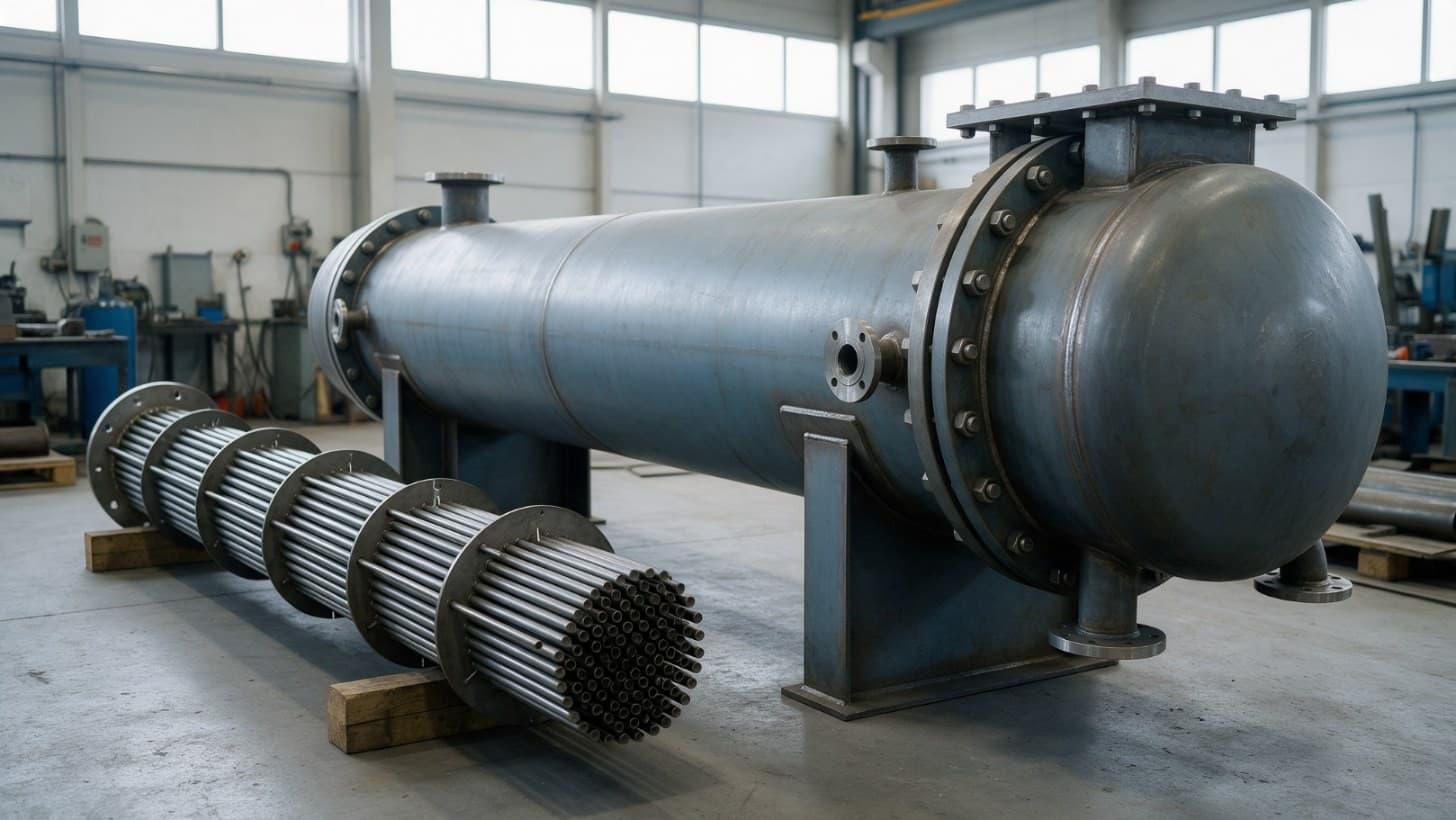
TEMA Heat Exchanger Types: How to Read AES, BEM and AEU
How to decode the three letter TEMA type, what AES, BEM, AEU and other common types mean for cleaning, expansion, leaks and cost, and how to compare bids that differ.
Safety Valve vs Relief Valve vs Bursting Disc: How to Choose
How safety valves, relief valves and bursting discs differ, when to fit a disc under a valve, the pressure terms that matter, GB duties and what to put in the RFQ.