
PSSR Written Scheme of Examination: What to Get from Your Vendor
Under PSSR, most pressure systems cannot run until they have safe operating limits and a written scheme of examination. What the law asks, and what to get from the vendor.
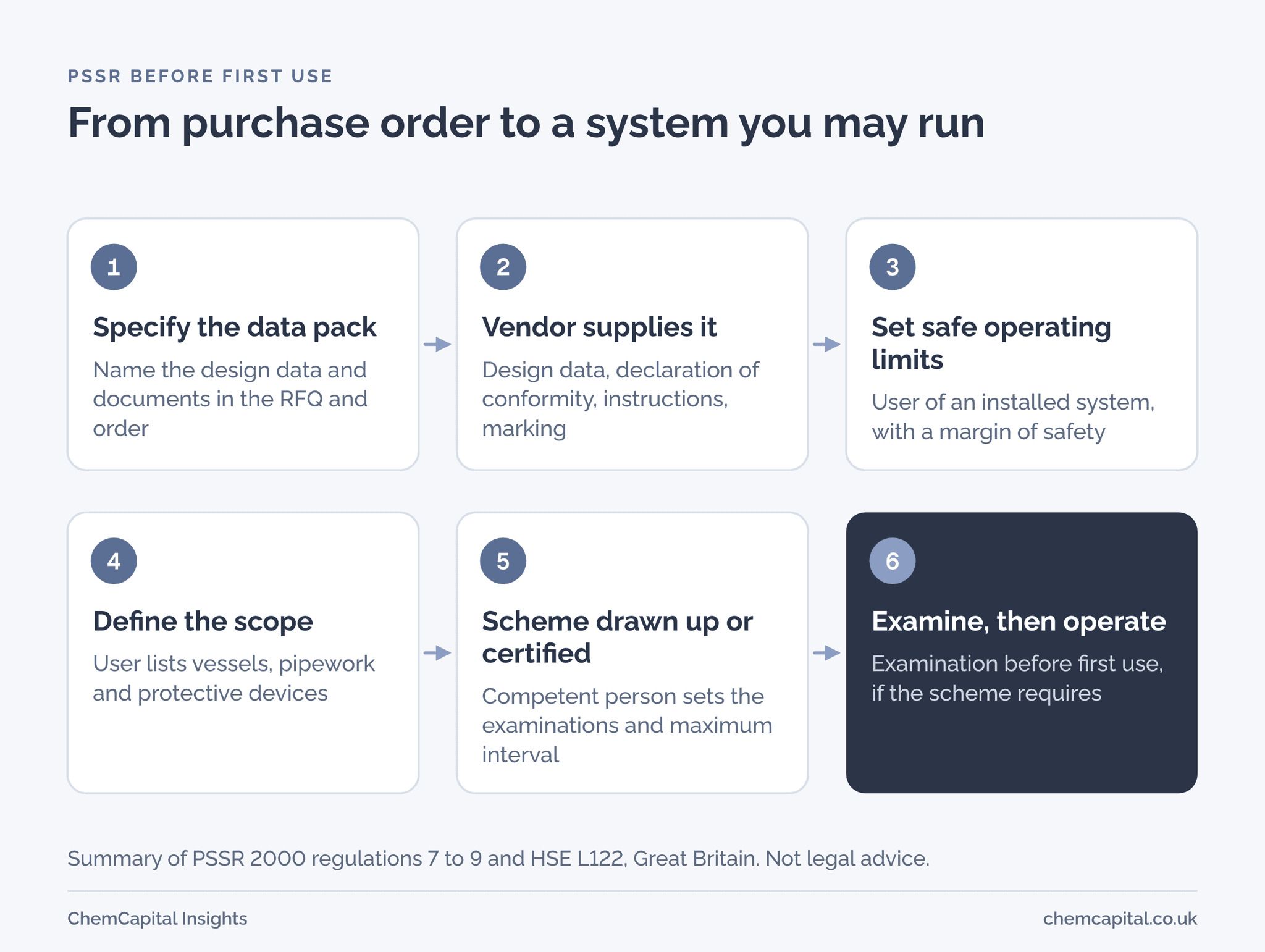
Under the Pressure Systems Safety Regulations 2000 (PSSR), the user of an installed pressure system must not run it until it has safe operating limits and, for most systems, a written scheme of examination that a competent person has drawn up or certified as suitable [1]. The scheme names the vessels, pipework and protective devices to be examined, says how and how often, and, where appropriate, calls for an examination before first use [1, 3]. The competent person sets the intervals; the law does not fix them [2, 3].
A competent person cannot write a good scheme without the vendor's design data, so require it in the RFQ and purchase order, and have it before the equipment arrives.
Why this matters now
HSE says qualifying equipment, new or otherwise, needs a scheme in place before use, and the regulations require an examination before first use wherever the scheme provides for one [1, 4].
In 2024 EEMUA, SAFed (the Safety Assessment Federation) and the Pressure Equipment Consultation Forum, with technical advice from HSE, published EEMUA 248, a free guide to the information a competent person needs to draw up a scheme [7].
Join ChemCapital to streamline sourcing and connect with verified partners
Whether you're buying or supplying, ChemCapital gives you the tools to manage the complete procurement cycle in one platform.
What PSSR covers and who holds the duties
PSSR applies in Great Britain to pressure systems used at work [1]. A pressure system is one or more rigid pressure vessels with their pipework and protective devices, or a pipeline, containing or liable to contain a relevant fluid. That means steam at any pressure, or a gas above 0.5 bar above atmospheric pressure. A liquid held above 0.5 bar counts if its vapour pressure would exceed 0.5 bar above atmospheric at its actual temperature or 17.5 °C [1]. HSE gives pressurised hot water above 110 °C as an example and excludes hydraulic oils [4, 8], though L122, HSE's Approved Code of Practice, lists a gas loaded hydraulic accumulator among items likely to need a scheme [2].
In a system without steam where every vessel's pressure times volume is below 250 bar litres, the regulations on the scheme, examinations and records do not apply; steam systems get no such exception. Safe operating limits, operating instructions and maintenance duties still apply to those small systems [1]. And for equipment placed on the market under the Pressure Equipment (Safety) Regulations 2016 (PE(S)R), the PSSR design and supplier information duties give way to PE(S)R's own [1].
| Role | Who it is | Main duties |
|---|---|---|
| User | Employer or self employed person controlling an installed system | Safe operating limits, a scheme kept under review, examinations, operator instructions, maintenance, records [1] |
| Owner | Employer or self employed person who owns the system | The same duties for a mobile system, such as a compressor moved between sites [1, 4] |
| Competent person | A competent individual (not an employee) or organisation, which can be the user company itself | Draw up or certify the scheme, examine, report within 28 days; report imminent danger to the user at once and to the enforcing authority within 14 days [1, 2] |
| Vendor | Designer, manufacturer, importer or supplier | PE(S)R conformity, marking and instructions; otherwise the PSSR design and information duties [1, 5, 6] |
| Installer's employer | The firm fitting the system | Installation causes no danger and does not impair protective devices or inspection facilities [1] |
An in house competent person should be independent of operations, with authority to stop the equipment [4]. UKAS accreditation to ISO/IEC 17020 is voluntary, but L122 recommends it for bodies working on major systems [2]. If you lease or hire an installed system, the supplier can accept the scheme duties in writing [4].
Northern Ireland has its own Pressure Systems Safety Regulations (Northern Ireland) 2004, with the same structure, including a regulation on the written scheme [9]. This is general information, not legal advice.
What the scheme contains, and who sets the intervals
The user decides which parts of the system the scheme covers. The competent person specifies the nature and frequency of examination and any special preparation [2]. HSE's leaflet sums up the scope rule as "one system, one scheme" [3].
A scheme normally sets out [2, 3]:
- the plant, and the parts to be examined
- the nature of each examination, including testing of protective devices
- preparatory work for safe examination
- any examination before first use
- the maximum interval between examinations
- critical parts to examine after repair or modification
- the certifying competent person's name and the date
Protective devices should be examined at least as often as the plant they protect [2].
L122 asks the competent person to use judgement and experience, weighing history, condition, operating conditions, fluid quality, maintenance and any on stream monitoring [2]. Earlier legislation, it notes, used fixed maxima: usually 14 months for steam plant, 26 to 38 months for steam receivers linked to it, and 24 to 48 months for air receivers, or 72 months where corrosion was minimal and standards high. A competent person may use these as a guide, not as legal limits [2].
After each examination the competent person sends a signed, dated report within 28 days (sooner if it sets an earlier repair deadline), with the date after which the system may not run without another examination [1]. If that causes no danger, the date can be postponed once, by written agreement with the competent person and prior written notice to the enforcing authority [1].
What to require from the vendor at purchase
PE(S)R requires instructions covering mounting, putting into service, use and maintenance, including checks by the user, with technical documents, drawings and diagrams where appropriate [5]. It also requires marking that includes the allowable limits and, where relevant, the volume, test pressure and date, and safety device set pressure [5]. PSSR then makes the user keep those instructions alongside the examination reports [1]. These rules apply to equipment in the PE(S)R hazard categories; items made to sound engineering practice carry no UKCA or CE mark and need only adequate instructions [6]. PE(S)R also lets the manufacturer keep the technical file, including calculations, rather than hand it over [6], so name the design data you need in the order.
L122 says the manufacturer of a standard production item should assess its safe operating limits and pass them on; for a user specified design, that falls to the user. The table follows L122's design information list [2].
| Ask the vendor for | Why the scheme needs it |
|---|---|
| Design code and edition, calculations and evidence of compliance | The rules the equipment was designed to [2] |
| Maximum and minimum design pressures and temperatures, and intended contents | The starting point for safe operating limits [1, 2] |
| Corrosion allowance, wall thickness, fatigue life and creep life | A baseline for thickness checks and for setting intervals [2] |
| Materials of construction, with material certificates | How the metal may degrade, and how it can be repaired [2] |
| Protective device type, set pressure, flow rates and discharge capacities | What the scheme tests, and proof the device suits the duty [2, 5] |
| Volume of each vessel | Pressure times volume, for scope and the 250 bar litres test [1, 2] |
| UK or EU declaration of conformity, with UKCA or CE marking, for equipment in a PE(S)R category | Conformity evidence, which L122 tells users to check [2, 6] |
| Instructions, drawings and a means to inspect the inside | Preparation for, and access to, examination [5] |
Ask too for the pressure test certificate and its basis (see hydrostatic test pressure), and for a vessel built to ASME VIII, how PE(S)R conformity was shown (see ASME VIII vs PD 5500 vs EN 13445).
Practical example
Take an illustrative reactor skid for a site in England, using the maximum allowable pressure in bar gauge (an assumption; confirm the basis with your competent person).
| Vessel | Fluid | Volume (litres) | Maximum allowable pressure (bar) | Pressure × volume (bar litres) | In the scheme? |
|---|---|---|---|---|---|
| Reactor | Solvent under nitrogen | 2,000 | 4 | 8,000 | Yes |
| Jacket | Steam | 300 | 3 | 900 | Yes |
| Condensate pot | Steam and condensate | 25 | 3 | 75 | Yes, steam has no 250 bar litres exception [1] |
| Instrument air receiver | Compressed air | 150 | 10 | 1,500 | Yes |
A 20 litre air receiver would be 200 bar litres; as the only vessel on its own air system, it would need no scheme, though safe operating limits and maintenance would still apply [1]. The reactor's 8,000 bar litres is far below the 100,000 bar litres L122 uses as one marker of a major chemical reaction system [2].
Illustrative timing: data pack due at week 12, delivery at week 16, first use at week 20, and an assumed 4 weeks for the competent person to certify the scheme from a complete pack. A pack at week 12 gives a scheme at week 16, leaving 4 weeks for installation and the examination before first use. A pack that arrives with the skid gives a scheme at week 20, with no time for that examination.
Make the data pack part of the order
Scheme data is cheap to request and slow to chase. ChemCapital sends one structured RFQ to all your suppliers at once, so every bidder sees the same data pack requirement and you compare their replies side by side. After award, suppliers post milestone updates against the order, and a timestamped audit trail records every interaction, revision and decision.
Ready to get the scheme data with the equipment, not after it? Start free with ChemCapital.
Frequently asked questions
What is a written scheme of examination under PSSR?
It is a document, drawn up or certified as suitable by a competent person, that identifies the pressure vessels, pipework and protective devices to be examined and sets the nature and maximum interval of each examination, plus any examination before first use. The user of an installed system, or the owner of a mobile one, must have it before the system is operated, unless the small system exception in Schedule 1 applies.
Who can draw up a written scheme of examination?
Anyone can prepare a draft, but a competent person must draw it up or certify it as suitable. That can be the user company itself if it has the expertise and independence, or a third party; UKAS accreditation to ISO/IEC 17020 is voluntary but recommended in L122 for major systems.
How often does a pressure system need to be examined?
PSSR sets no fixed interval; the competent person sets the maximum interval in the scheme. L122 records that earlier legislation usually used 14 months for steam plant and 24 to 48 months for air receivers, which a competent person may use as a guide.
Does PSSR apply in Northern Ireland?
The Pressure Systems Safety Regulations 2000 apply in Great Britain. Northern Ireland has its own Pressure Systems Safety Regulations (Northern Ireland) 2004, with the same structure, including a regulation on the written scheme of examination.
Continue reading
Informational only, not procurement or legal advice. Cited names, frameworks, and statistics belong to their respective owners.
Join ChemCapital to streamline sourcing and connect with verified partners
Whether you're buying or supplying, ChemCapital gives you the tools to manage the complete procurement cycle in one platform.
Get started freeRelated articles
BIOSECURE Act: What It Means for Equipment Suppliers to Biopharma (and Who Wins)
What Section 851 prohibits, who gets listed and when, and how equipment and consumables suppliers should prepare for customer BIOSECURE diligence.
PED Categories: How to Classify Pressure Equipment Under PER 2016
PED and PER 2016 categories run from sound engineering practice to category IV. How fluid group, state, PS and volume set the category, the module and the marking.
Long Lead Items: Identify, Prioritise and Order Them Early
Long lead items decide when a process plant can start. What makes an item long lead, how to find and rank them early, ways to order ahead and the risks.