
Preferred Supplier List vs Approved Vendor List: A Buyer's Template
The difference between an approved vendor list and a preferred supplier list, how the two should work together, how to maintain them, and a template with columns.
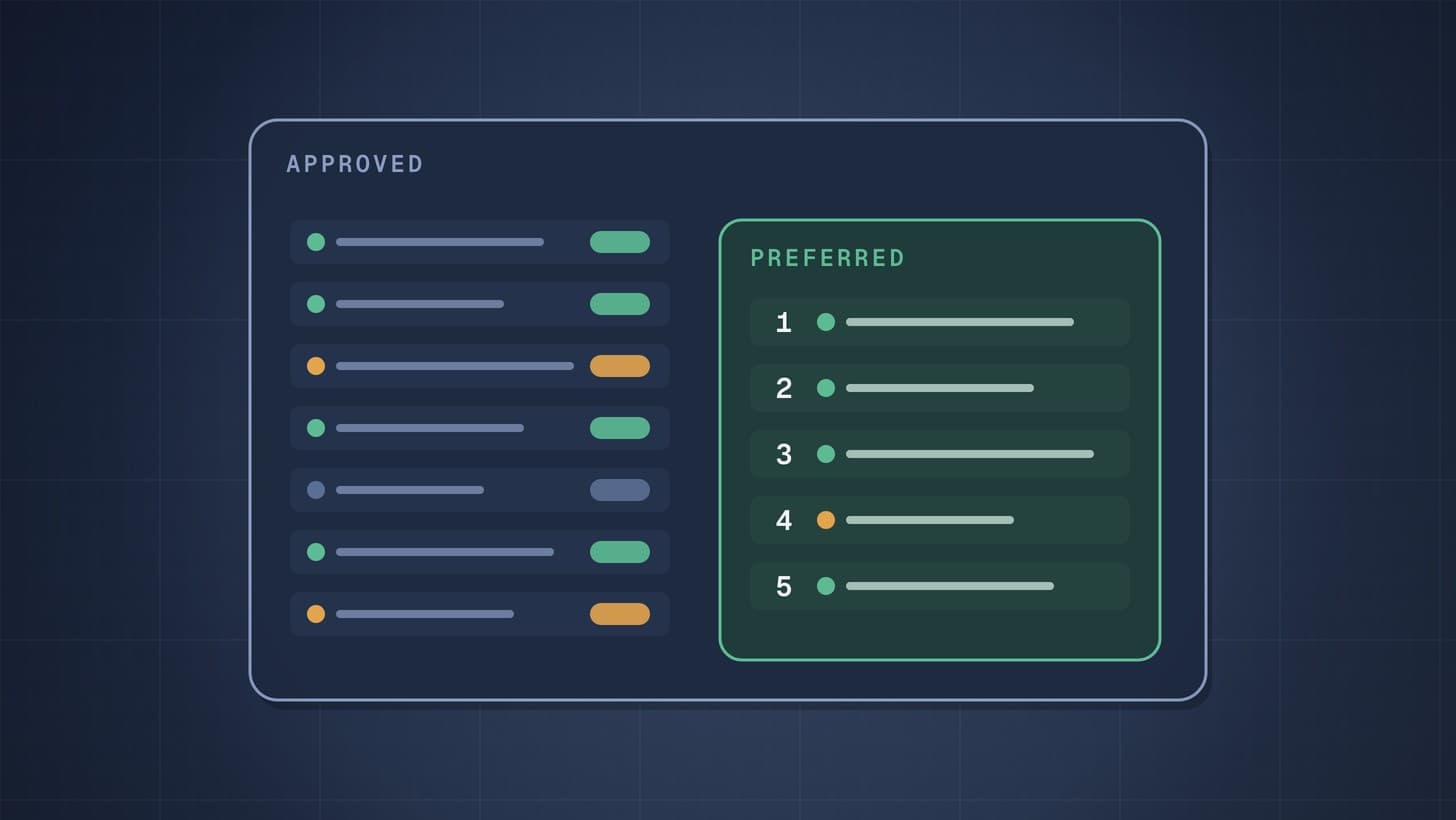
An approved vendor list (AVL) records the suppliers that your quality function has approved to supply a given item or material for regulated use. A preferred supplier list (PSL) records the suppliers procurement favours for commercial reasons, such as a price agreement, good service or a strategic relationship. The two answer different questions: the AVL says who may supply, the PSL says who we would rather buy from. For regulated items, the rule is simple: a preferred supplier must also be an approved one.
Supplier teams see the same lists from the other side; our article on getting on an approved vendor list in pharma covers what suppliers need to do.
Why this matters now
Most buyers are adding suppliers, not removing them. In Deloitte's 2025 survey of chief procurement officers, 74% named finding alternative supply sources as the most effective way to reduce supply risk [1]. Every new source must be approved before it can be preferred, and every approval needs maintaining. Lists that mix the two decisions, or that nobody reviews, are where regulated sites get caught out.
Create and manage RFQs in minutes
ChemCapital handles the entire procurement cycle, from structured RFQs and supplier comparisons to formal purchase orders and delivery tracking.
AVL and PSL compared
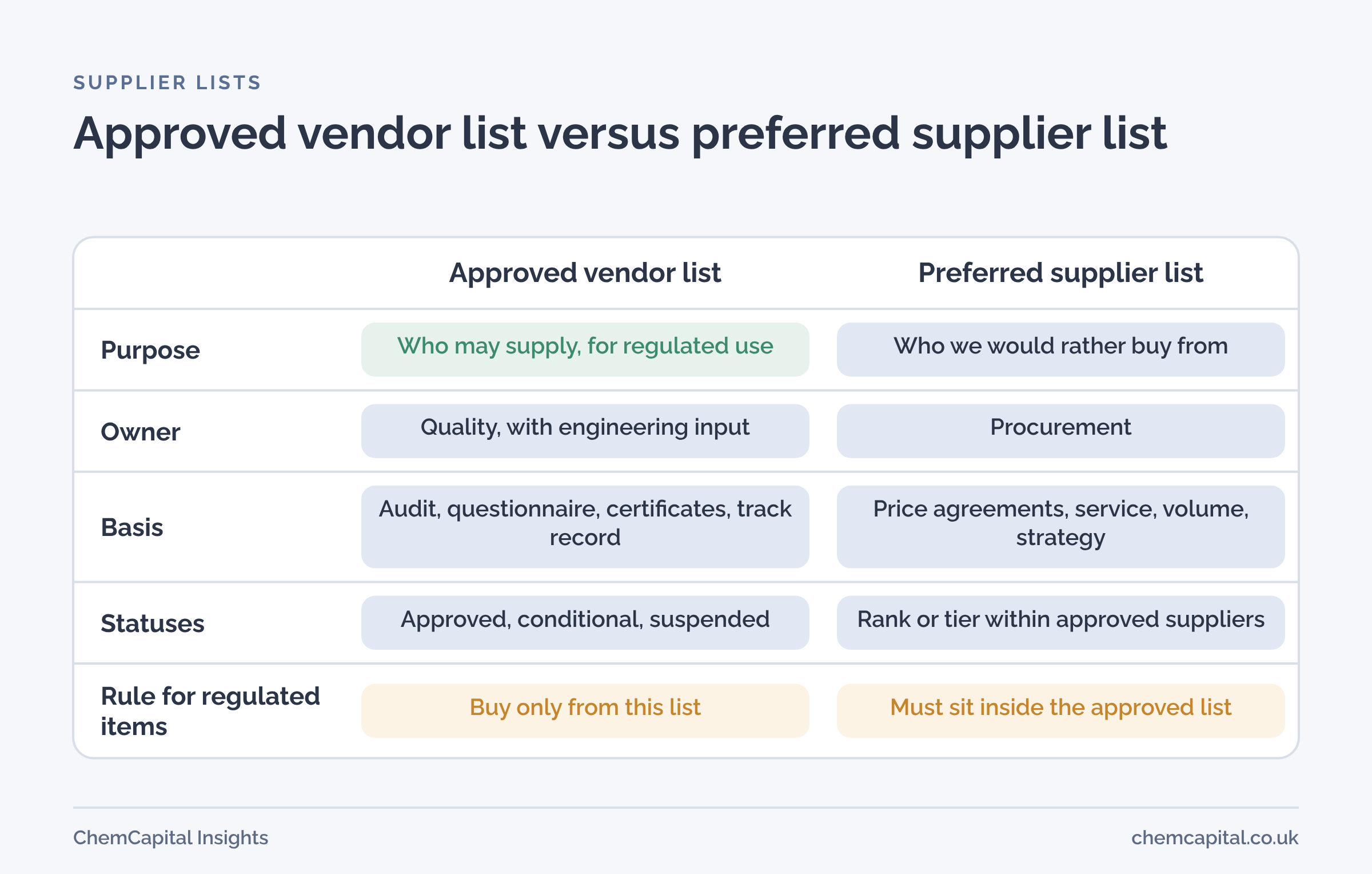
The AVL is a quality record. EU GMP expects the selection, qualification, approval and maintenance of suppliers of starting materials to be documented as part of the quality system, and gives the heads of production, quality control and quality assurance shared responsibility for approving and monitoring suppliers of materials [2]. For active substances, EU GMP also says materials should be bought against an agreed specification from suppliers approved by the quality unit [3].
The PSL is a commercial tool. It steers spend towards suppliers with framework agreements, good delivery and fair prices, and it changes as markets and contracts change.
How the two lists should work together
- Approval first. For regulated items, buy only from approved suppliers, and rank preferences only among them.
- Scope matters. Approve a supplier for specific item categories, not for everything it sells. A gasket maker approved for PTFE gaskets is not thereby approved for elastomer seals.
- Keep alternates. Where an item is critical, aim for at least two approved sources, even if only one is preferred.
- Record every change. A status change, with its reason and evidence, is part of the quality record. ICH Q10 expects companies to monitor and review supplier performance and act on what they find [4].
Maintaining the lists
- Requalify by risk. EU GMP expects further audits of active substance suppliers at intervals set by quality risk management [2]; the same principle works for equipment and component suppliers.
- Watch certificates. Track expiry dates for quality and pressure equipment certificates, and check them at source, for example on IAF CertSearch, because ISO itself certifies nobody [5].
- Use performance data. Late deliveries, rejected items and slow corrective actions should move a supplier's status, not just its preference rank.
- Know what you rely on. In US drug manufacturing, relying on a supplier's certificate of analysis instead of full testing requires establishing the reliability of the supplier's results through validation at appropriate intervals [6], which is exactly the evidence an AVL should point to.
Template
| Column | What it holds | Illustrative entry |
|---|---|---|
| Supplier | Legal name and site | Supplier A, Manchester works |
| Scope of approval | Item categories approved | PTFE envelope gaskets, DN 15 to DN 300 |
| AVL status | Approved, conditional, suspended, disqualified | Approved |
| Basis of approval | Audit, questionnaire, certificates, history | Audit 2025, questionnaire, ISO 9001 |
| Approved since and next review | Dates | March 2025; review March 2027 |
| Certificates and expiry | Number, body, expiry | ISO 9001, expires June 2027 |
| PSL rank | Preference within approved suppliers | 1 |
| Commercial agreement | Framework or price agreement | Framework to December 2027 |
| Performance | On time delivery, rejections | 96% on time, no rejections |
| Status history | Changes with reasons | None |
Practical example
In this illustrative example, a site has three approved suppliers for PTFE gaskets, ranked 1 to 3 on its PSL. The rank 1 supplier's ISO 9001 certificate lapses during a change of certification body.
Quality moves the supplier from approved to conditional, with the reason and a date for review. Procurement keeps the supplier on the PSL but routes new orders to the rank 2 supplier until the new certificate is confirmed on IAF CertSearch. Six weeks later the certificate is issued, quality restores the approved status, and the PSL rank returns to 1. Both lists show what happened and why, and no unapproved gasket reached the plant.
Where ChemCapital fits
ChemCapital lets buyers manage an approved vendor list with the statuses preferred, approved, conditional and suspended, recording reasons and evidence for each change, and sends alerts 30 days before a supplier's certification record expires. When you need alternatives, Supplier Discovery can weight searches towards your own vendor list or search the open web for new candidates, which then go through your normal prequalification before approval.
Ready to keep supplier approvals and preferences in one place? Start a free 14 day ChemCapital trial, with no credit card needed.
Frequently asked questions
What is the difference between an approved vendor list and a preferred supplier list?
An approved vendor list records suppliers your quality function has approved to supply a given item for regulated use. A preferred supplier list records the suppliers procurement favours for commercial reasons such as price agreements or service. For regulated items, a preferred supplier must also be approved.
Who owns the approved vendor list?
Quality owns approval decisions, usually with engineering or production input, while procurement keeps the list current and uses it. EU GMP gives the heads of production, quality control and quality assurance shared responsibility for approving and monitoring suppliers of materials.
How often should approved suppliers be requalified?
At intervals set by risk. EU GMP expects further audits of active substance suppliers at intervals defined by quality risk management, and the same principle works for equipment and component suppliers: shorter intervals for critical items or weaker performance.
Continue reading
Informational only, not procurement or legal advice. Cited names, frameworks, and statistics belong to their respective owners.
Create and manage RFQs in minutes
ChemCapital handles the entire procurement cycle, from structured RFQs and supplier comparisons to formal purchase orders and delivery tracking.
Start for freeRelated articles

How to Get on a Pharmaceutical Company's Approved Vendor List (and Stay On It)
What an approved vendor list is, how pharma buyers qualify equipment suppliers, what to have ready, why vendors stall, and how to get invited in the first place.

Commissioning and Qualification: ASTM E2500 vs Traditional IQ OQ PQ
How the science and risk based ASTM E2500 approach differs from traditional IQ, OQ and PQ, who does what, how vendor tests can be reused, and what to put in the RFQ.

GAMP 5 Software Categories for Bought In Skids and Control Systems
GAMP 5 software categories 1, 3, 4 and 5 in plain words, mapped to the skids, instruments and control systems a buyer actually orders, with what to ask suppliers for.