
Single Source and Sole Source Justification for Equipment (Template)
The difference between sole source and single source, valid reasons in equipment buying, the evidence to attach, the risk of not testing the market, and a template.
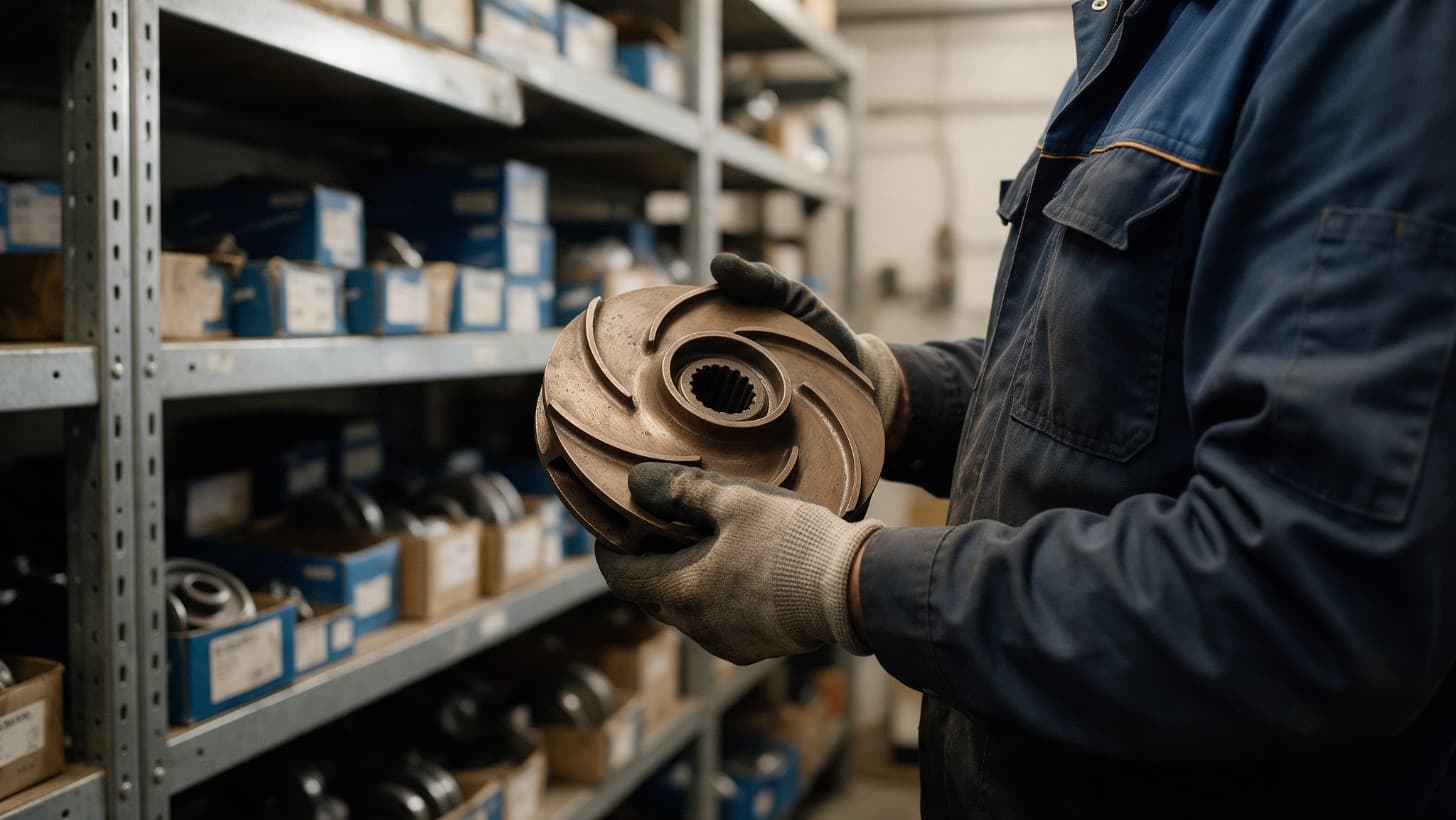
A sole source purchase is one where only one supplier can provide the item at all. A single source purchase is one where alternatives exist, but one supplier is chosen for a documented reason, such as compatibility with installed equipment [1]. Both skip open competition, so both need a written justification that shows the alternatives were considered, why they were rejected, and that the price is fair.
Most published templates are US public sector forms. Industrial buyers need the same discipline for different reasons: auditors, finance teams and, at regulated sites, quality teams will ask why a purchase went to one supplier without competition.
Why this matters now
Two pressures pull in opposite directions. Supply risk pushes buyers towards more suppliers: in Deloitte's 2025 survey of chief procurement officers, 74% named finding alternative supply sources as the most effective way to reduce risk [2]. Meanwhile, the installed base, validated processes and OEM spares keep pushing purchases back to one supplier. The justification is where you show you weighed both.
The cost of weak justifications is well documented. The National Audit Office found that of £17.3 billion of new COVID related contracts, £10.5 billion was awarded directly without competition, and it found inadequate documentation in a number of cases [3].
Create and manage RFQs in minutes
ChemCapital handles the entire procurement cycle, from structured RFQs and supplier comparisons to formal purchase orders and delivery tracking.
Valid reasons in equipment buying
The UK's Procurement Act 2023 gives public buyers a useful checklist. Its direct award justifications include goods that only one supplier can provide because of intellectual property or other exclusive rights, or for technical reasons with no reasonable alternative; additional goods from the existing supplier where a change would cause incompatibility or disproportionate technical difficulties in operation or maintenance; and extreme and unavoidable urgency that the buyer did not cause and could not foresee [4]. Private buyers are not bound by the Act, but the same reasons hold up well:
| Reason | Equipment example | Evidence to attach |
|---|---|---|
| Exclusive rights | OEM spare parts for a patented pump design | OEM statement, drawings ownership, failed search for licensed alternatives |
| Compatibility with the installed base | Extra modules for an existing control system | Engineering note on interfaces and the cost of mixing systems |
| Validated or qualified state | Replacement part for a qualified GMP skid | Quality assessment of change; a different part would need requalification |
| Genuine urgency | Breakdown on a critical line, with no stock | Incident record; why it could not have been foreseen |
| Agreed standardisation | Site standard for instruments | Standardisation decision and its review date |
On validated equipment, ICH Q10 expects changes to be assessed with quality risk management so there are no unintended consequences [5]. Staying with the original supplier can be the right answer, but write down why switching would cost more than the competition would save.
Weak reasons include "we always use them", "they are cheapest" without a price check, and urgency caused by late planning. One university procurement guide makes the same points: an existing relationship or incumbency cannot on its own justify a non competitive award, and urgency is measured from when the need arose [6].
Template
| Field | What to write |
|---|---|
| Item and quantity | Description, tag or part number, quantity, estimated value |
| Type | Sole source or single source |
| Need | Function and performance required, not a brand name |
| Alternatives considered | Who was searched for, how, and what was found |
| Reason for single or sole source | Exclusive rights, compatibility, validated state, urgency or standardisation |
| Technical and quality support | Engineering and quality statements, if relevant |
| Price reasonableness | Comparison with past orders, list prices or benchmarks; negotiation result |
| Risks and mitigation | Dependency on one supplier; spares stock, second source plan |
| Duration | One purchase, or a period with a review date |
| Requested by and approved by | Names, roles and dates; approver independent of the requester |
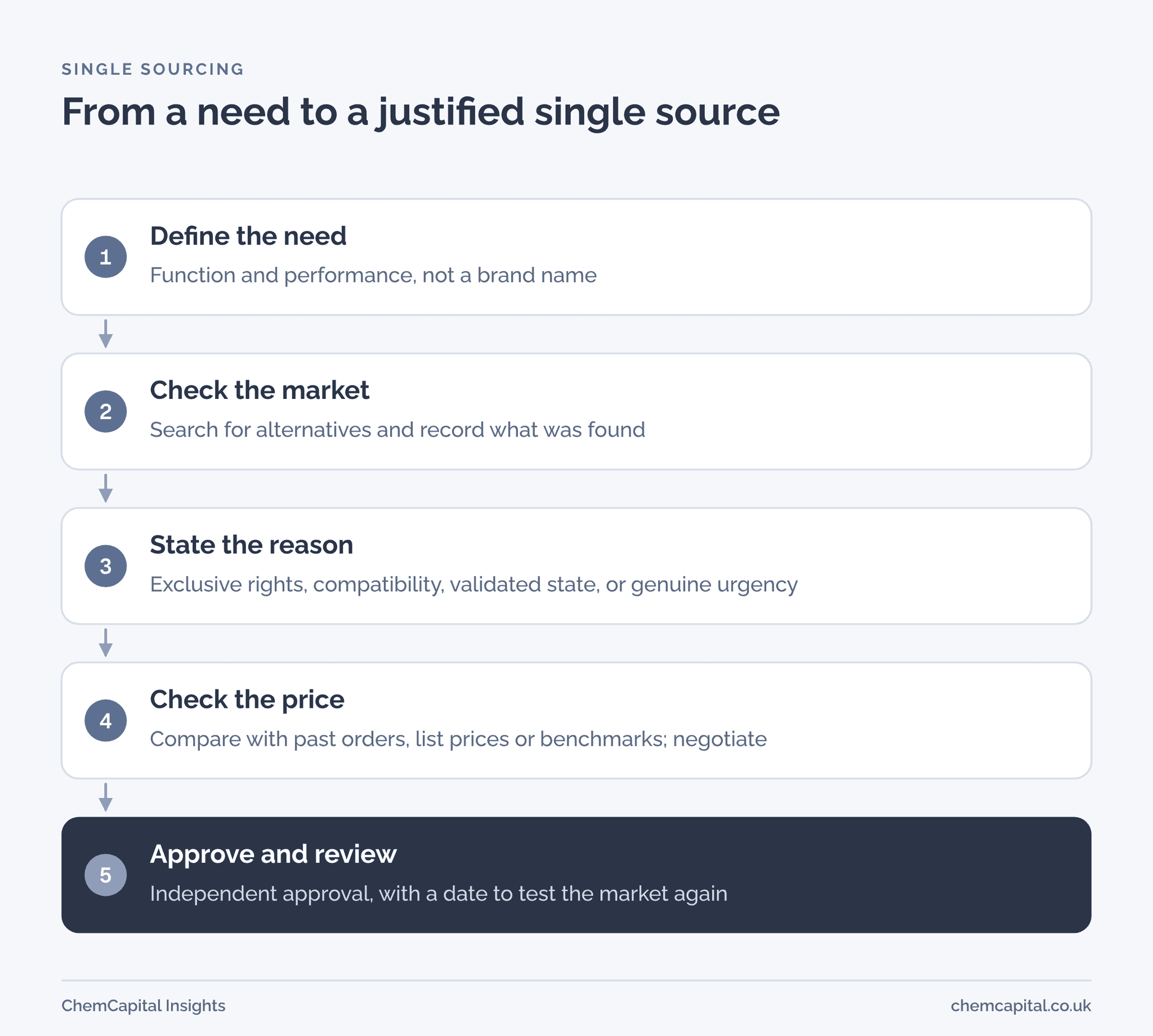
Keep the market check honest. A short search for alternatives, recorded with dates and results, is the part auditors look for first. Our guide on how to find and vet suppliers covers the search itself.
The risk of not testing the market
Every single source decision creates a dependency. Prices drift up when a supplier knows it will not be tested, lead times stretch, and if the supplier fails, there is no qualified alternative. Set a review date on each justification, and use it to test the market again. Our article on vendor risk management covers how to track that dependency across a supplier base.
Practical example
In this illustrative example, a site needs two replacement mechanical seals for a qualified pump on a GMP line. Engineering confirms the seals are OEM designs, and quality notes that a different seal would need a change assessment and requalification of the pump. The buyer searches for licensed alternatives and finds one distributor of the same OEM seal, at a price 4% higher with a longer lead time.
The justification records single source to the OEM, attaches the engineering and quality notes and the search result, compares the price with the last two orders, and is approved by the procurement manager with a review date in 12 months. At the review, the buyer asks the OEM for a framework price and checks whether a qualified second source has emerged.
Where ChemCapital fits
Supplier Discovery makes the market check quick and recorded. You describe the need in plain text or upload a spec, and it searches the open web for suppliers, returning each with the web address where it was found, its published parameters and a fit verdict. Each search, brief and verdict is recorded with its source, which gives a single source justification the evidence that alternatives were looked for. You can try three searches free, with no sign up.
Ready to document your market checks properly? Start a free 14 day ChemCapital trial, with no credit card needed.
Frequently asked questions
What is the difference between sole source and single source?
Sole source means only one supplier can provide the item at all. Single source means other suppliers exist, but one is chosen for a documented reason, such as compatibility with installed equipment or a validated process.
What are valid reasons for single sourcing equipment?
Common valid reasons are OEM spares protected by intellectual property, compatibility with an installed base, a change that would disturb a validated process, a genuine emergency not caused by the buyer, and standardisation agreed in advance. Lower price alone, or a preferred relationship, is not a justification.
What evidence should support a single source justification?
Evidence that alternatives were considered and why they fail: a market check or supplier search, technical reasons from engineering or quality, a price check against previous orders or benchmarks, and approval by someone independent of the requester.
Continue reading
Informational only, not procurement or legal advice. Cited names, frameworks, and statistics belong to their respective owners.
Create and manage RFQs in minutes
ChemCapital handles the entire procurement cycle, from structured RFQs and supplier comparisons to formal purchase orders and delivery tracking.
Start for freeRelated articles
PED Sound Engineering Practice: What Applies Below Category I
What sound engineering practice means under the Pressure Equipment Directive and the UK regulations, what SEP equipment must and must not carry, and what buyers should still ask for.

BIOSECURE Act: What It Means for Equipment Suppliers to Biopharma (and Who Wins)
What Section 851 prohibits, who gets listed and when, and how equipment and consumables suppliers should prepare for customer BIOSECURE diligence.
PSSR Written Scheme of Examination: What to Get from Your Vendor
Under PSSR, most pressure systems cannot run until they have safe operating limits and a written scheme of examination. What the law asks, and what to get from the vendor.