
How to Find and Vet Suppliers for Process Equipment
Where to find makers of engineered process equipment, and the quick checks that turn a long list into a shortlist worth sending an RFQ to.
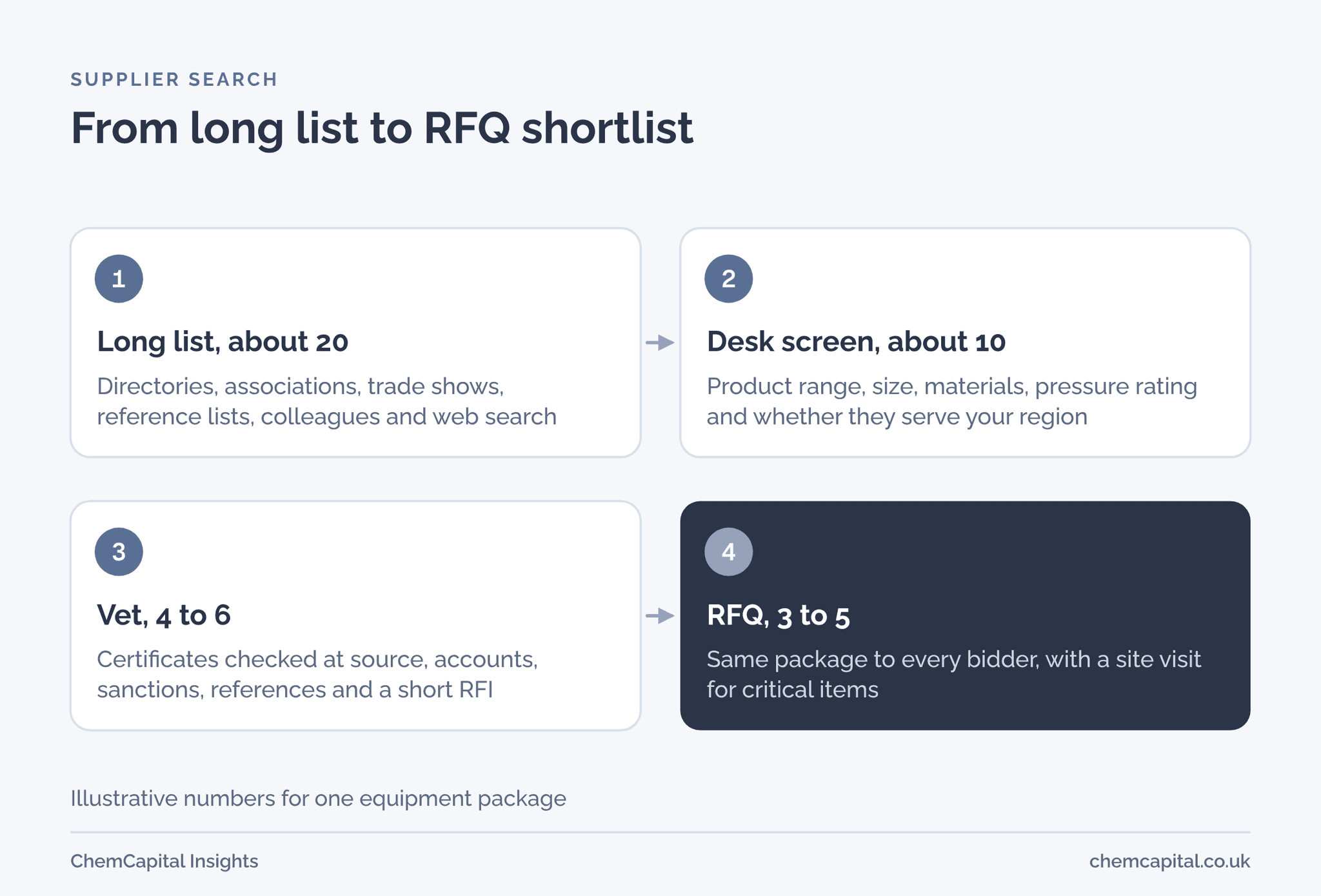
To find suppliers for engineered process equipment, build a long list from several channels at once: supplier directories, trade associations, trade shows, reference lists from equipment makers and EPC (engineering, procurement and construction) contractors, colleagues, and web or AI search. Then vet each candidate quickly before the RFQ (request for quotation): does it make what you need, are its certificates real, is it financially sound, is it clear of sanctions, and can it show references for similar duty?
The aim is three to five credible bidders per package. Fewer gives you no competition; more gives your engineers more bids to evaluate without a better price.
Why this matters now
Two things have changed the job. First, many buyers now start with an AI assistant, which produces a confident shortlist in seconds. It is a useful starting point, but the names it gives still need every check below.
Second, the rules for screening moved this year. Since 28 January 2026, the UK Sanctions List published by the Foreign, Commonwealth and Development Office is the only source for UK sanctions designations; the old Treasury consolidated list closed on that date and stays online for reference only [1]. If your vetting checklist still points to the old list, update it.
Create and manage RFQs in minutes
ChemCapital handles the entire procurement cycle, from structured RFQs and supplier comparisons to formal purchase orders and delivery tracking.
Where to look
Each channel finds suppliers the others miss. Use at least three.
| Channel | Strengths | Limits |
|---|---|---|
| Supplier directories | Broad coverage, filters by product and region, quick to search | Listings are written by the suppliers, and paid placement can set the order |
| Trade associations | Established members; the British Pump Manufacturers Association, for example, has over 100 UK and Irish members [2] | Usually national, and membership says nothing about fit for your duty |
| Trade shows | Engineers on the stand, equipment you can see; ACHEMA runs in Frankfurt from 14 to 18 June 2027 [3] | Costly in time, and only every two or three years for the big ones |
| Reference lists from equipment makers and licensors | Suppliers already used on similar duty | Can be dated, and tend to favour the incumbent |
| EPC contractor vendor lists | Pre qualified by a team with similar projects | Not always shared, and qualified for someone else's standards |
| Colleagues and user groups | Honest views on service after delivery | Small sample, and biased by one good or bad job |
| Web and AI search | Finds niche makers that are not in directories | Everything must be checked at source |
ACHEMA's last edition, in 2024, drew 106,001 participants, and its pumps, valves and materials halls alone justify a day for anyone buying fluid handling equipment [3]. Our list of pharma and process industry trade shows for 2027 covers the rest of the calendar.
Search by duty, not by company type
Whichever channel you use, search for the duty rather than a category. "Jacketed reactor, 5 m³, 316L, full vacuum to 6 bar" finds better candidates than "reactor manufacturers". Read the maker's own datasheets for the limits that matter to you, such as pressure, temperature, size and materials.
Decide early whether you want manufacturers, distributors or both. A manufacturer controls design and lead time. A local distributor or agent may give faster service, spares from stock and a contract under your own law, which can matter more after start up than the price difference at award.
A fast vetting checklist
Vetting before the RFQ is lighter than full prequalification. It answers one question: is this supplier worth the effort of a bid? Run it as a desk exercise plus a short request for information (RFI).
| Check | How to do it | Warning signs |
|---|---|---|
| Product fit | Compare the published range (size, pressure, temperature, materials) with your duty | Range stops short of your duty; only resells others' products |
| References | Ask for two or three users with similar duty in recent years, and call one | No similar duty, or references that cannot be contacted |
| Quality certificate | Check the ISO 9001 certificate on IAF CertSearch or with the certification body named on it [4] | Not found, expired, or "issued by ISO", which never certifies anyone [4] |
| Pressure equipment | For equipment under the Pressure Equipment Directive, check the named notified body in the EU's NANDO database [5] | Notified body not listed for that directive |
| Financial health | For UK companies, read the Companies House filing history, officers and insolvency records, all free [6] | Accounts overdue, frequent director changes, insolvency notices |
| Sanctions | Screen the company and its owners against the UK Sanctions List [1], plus EU or US lists if they apply to you | Any match, or an owner who will not be named |
| Export and shipping | Ask where the equipment is made and how it reaches your site | Unclear country of manufacture, or no export experience |
| Site visit | For critical or GMP equipment, see the workshop, welding and quality records | Visits refused, or a showroom with no workshop |
The Companies House "Follow" service sends a free email alert whenever a company you follow files something, so you can keep watching a supplier after award [6]. In Great Britain, pressure equipment falls under the Pressure Equipment (Safety) Regulations 2016, so check UK approved bodies too.
For regulated pharmaceutical work, this light check is the first step, not the last; supplier prequalification and ongoing vendor risk management follow.
Practical example
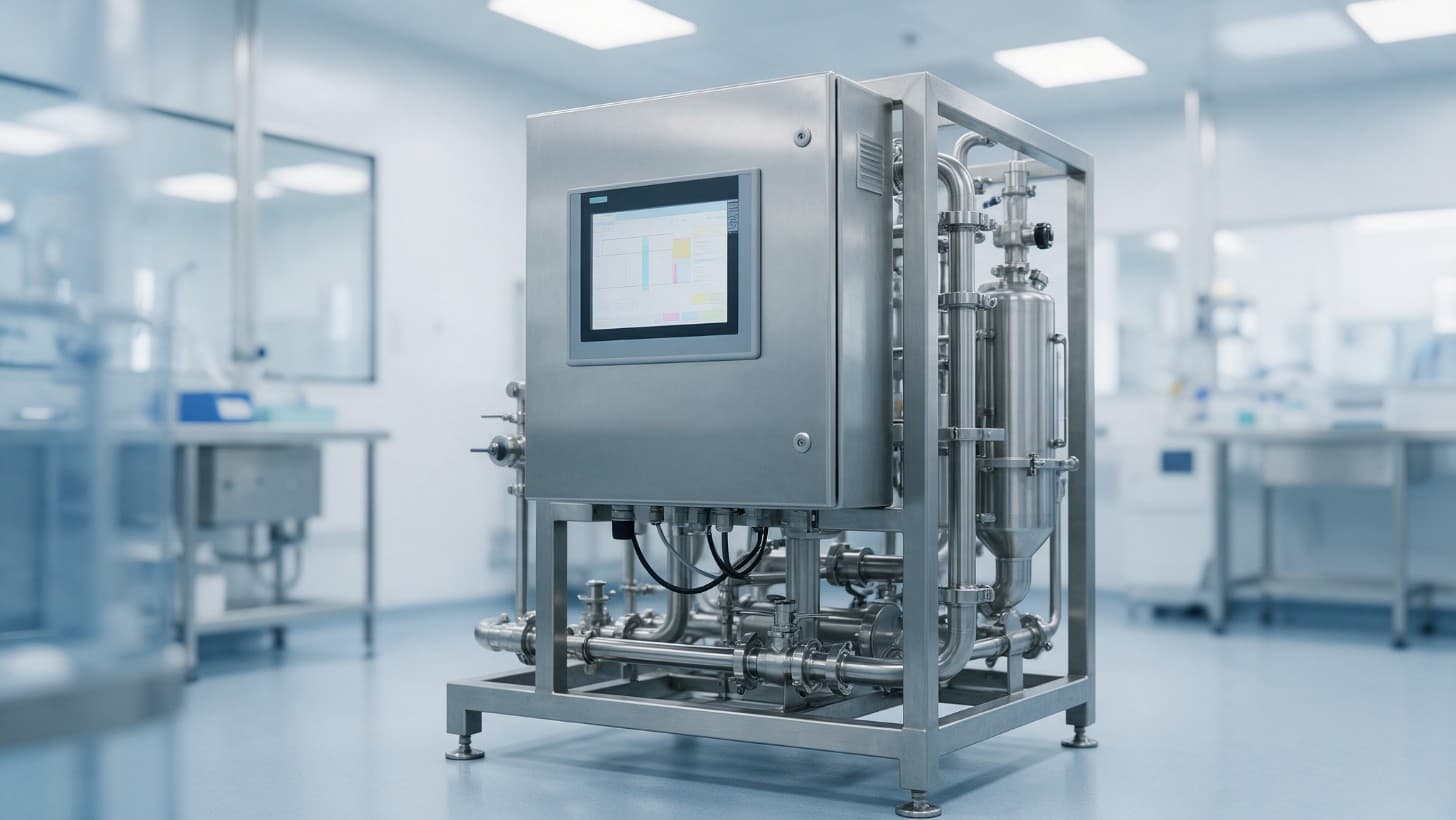
In this illustrative example, a buyer needs a 5 m³ jacketed stainless steel reactor for a UK pharmaceutical site.
The long list has 22 names: 9 from directories, 4 from trade association member lists, 3 contacts from a trade show, 2 from an EPC contractor's vendor list and 4 from web and AI search.
A desk screen removes 12: six do not build vessels this size, three make only standard tanks, two do not ship to the UK and one only resells. That leaves 10.
The vetting checks remove five more. One has accounts overdue at Companies House. One quotes an ISO 9001 certificate that is not on IAF CertSearch, and the certification body confirms it has lapsed. Two cannot give a reference for a jacketed reactor in pharmaceutical service. One declines to bid.
Five suppliers receive the RFQ. The vetting took about two days of desk work and saved five bid evaluations that would each have taken longer.
Where ChemCapital fits
Supplier Discovery speeds up the long list. You describe what you need in plain text, paste an RFQ or upload a spec, and it turns that into a structured brief you check before it searches the open web. Each supplier comes with the web address where it was found, the product parameters it publishes with the source wording, and a fit verdict of Strong, Partial, Information Missing or Rejected. Certifications are shown as the supplier claims them, with a source link; ChemCapital does not verify them, so the certificate, finance and sanctions checks above still apply. You can try three searches free, with no sign up.
Ready to build a supplier long list in minutes, then vet it properly? Start a free 14 day ChemCapital trial, with no credit card needed.
Frequently asked questions
How do I find manufacturers of process equipment?
Use several channels at once: supplier directories, trade associations, trade shows, reference lists from equipment makers and EPC contractors, colleagues, and web or AI search. Each channel finds suppliers the others miss, so a long list built from three or more is far more complete.
How do I check that a supplier's ISO 9001 certificate is real?
Search the certificate on IAF CertSearch, the International Accreditation Forum's database of accredited certificates, or ask the certification body named on it. ISO itself does not issue certificates, so a certificate that says it was issued by ISO is a warning sign.
How many suppliers should get an RFQ?
For most engineered equipment, three to five vetted bidders is enough for real competition without overloading your engineers with evaluation. Sending to more suppliers rarely improves price and raises the effort on both sides.
Continue reading
Informational only, not procurement or legal advice. Cited names, frameworks, and statistics belong to their respective owners.
Create and manage RFQs in minutes
ChemCapital handles the entire procurement cycle, from structured RFQs and supplier comparisons to formal purchase orders and delivery tracking.
Start for freeRelated articles

Commissioning and Qualification: ASTM E2500 vs Traditional IQ OQ PQ
How the science and risk based ASTM E2500 approach differs from traditional IQ, OQ and PQ, who does what, how vendor tests can be reused, and what to put in the RFQ.
GAMP 5 Software Categories for Bought In Skids and Control Systems
GAMP 5 software categories 1, 3, 4 and 5 in plain words, mapped to the skids, instruments and control systems a buyer actually orders, with what to ask suppliers for.
Audit Trail Requirements in GMP: What a Compliant Record Must Capture
What EU Annex 11, 21 CFR Part 11 and MHRA guidance require of an audit trail, what audit trail review means in practice, and worked entries for a procurement record.