
PED Sound Engineering Practice: What Applies Below Category I
What sound engineering practice means under the Pressure Equipment Directive and the UK regulations, what SEP equipment must and must not carry, and what buyers should still ask for.
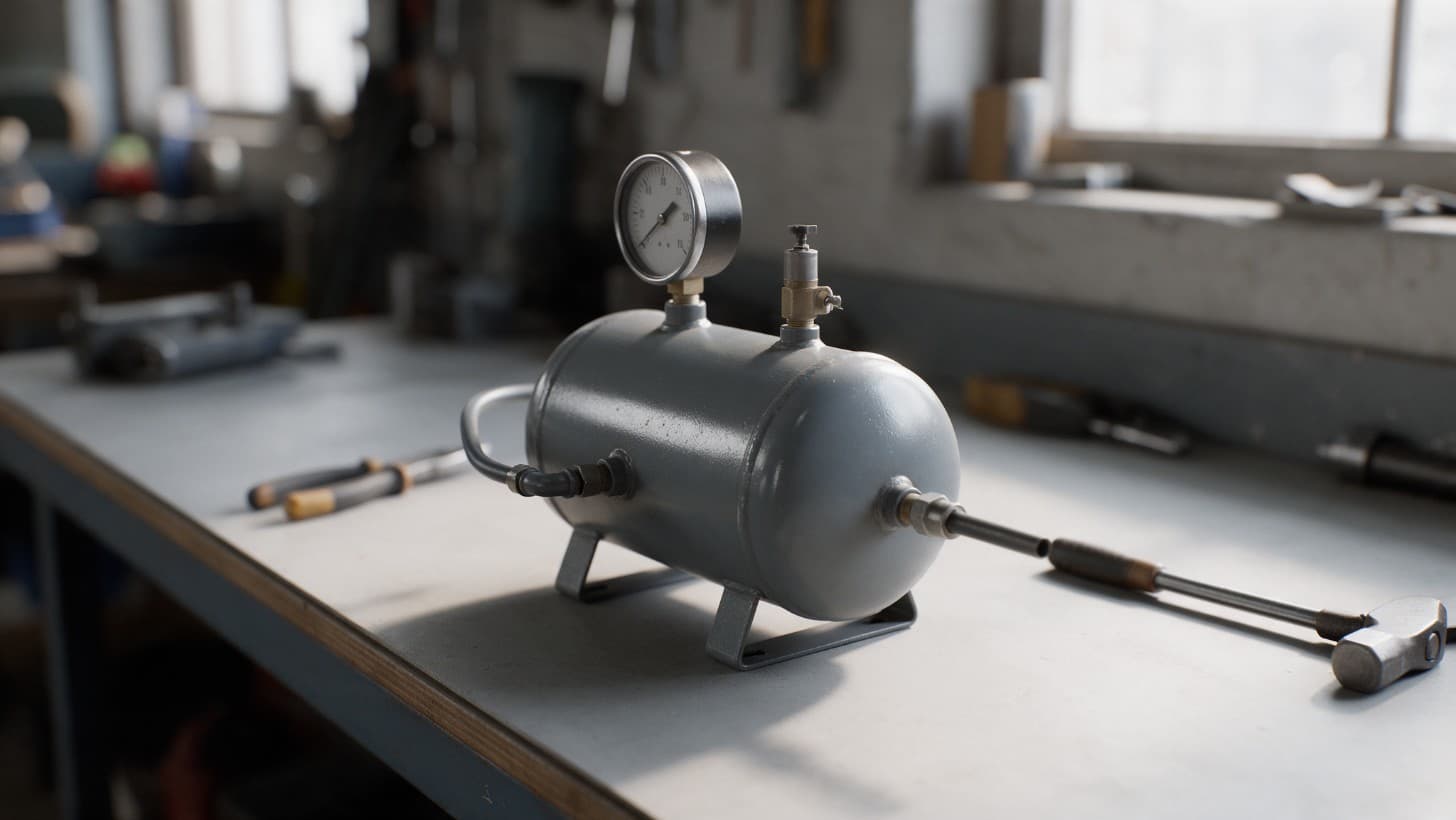
Sound engineering practice (SEP) is the category for pressure equipment that falls below the thresholds for Category I. In the EU it comes from Article 4(3) of the Pressure Equipment Directive; in Great Britain, from regulation 8 of the Pressure Equipment (Safety) Regulations 2016, which covers equipment "generally for lower temperatures or pressures" [1]. SEP equipment must be designed and manufactured in accordance with sound engineering practice and come with adequate instructions, but it goes through no conformity assessment by a notified or approved body and must not carry a CE or UKCA marking under the pressure equipment rules [2].
This is general information, not legal advice. For your own equipment, check the classification against the regulations and take advice where needed.
Why this matters now
GB guidance on the 2016 regulations was updated in March 2025, after 2024 amendments extended recognition of CE marking indefinitely in Great Britain [2]. With both marks now in circulation, buyers increasingly see small items offered with a CE or UKCA mark for pressure equipment that, on the category tables, is SEP. EU guidance is direct on this: Article 4(3) explicitly prohibits CE marking of SEP equipment, and a manufacturer cannot choose a higher assessment module to apply one [3]. A mark on SEP equipment is a reason to ask questions, not a sign of extra quality.
Create and manage RFQs in minutes
ChemCapital handles the entire procurement cycle, from structured RFQs and supplier comparisons to formal purchase orders and delivery tracking.
Which equipment falls under SEP
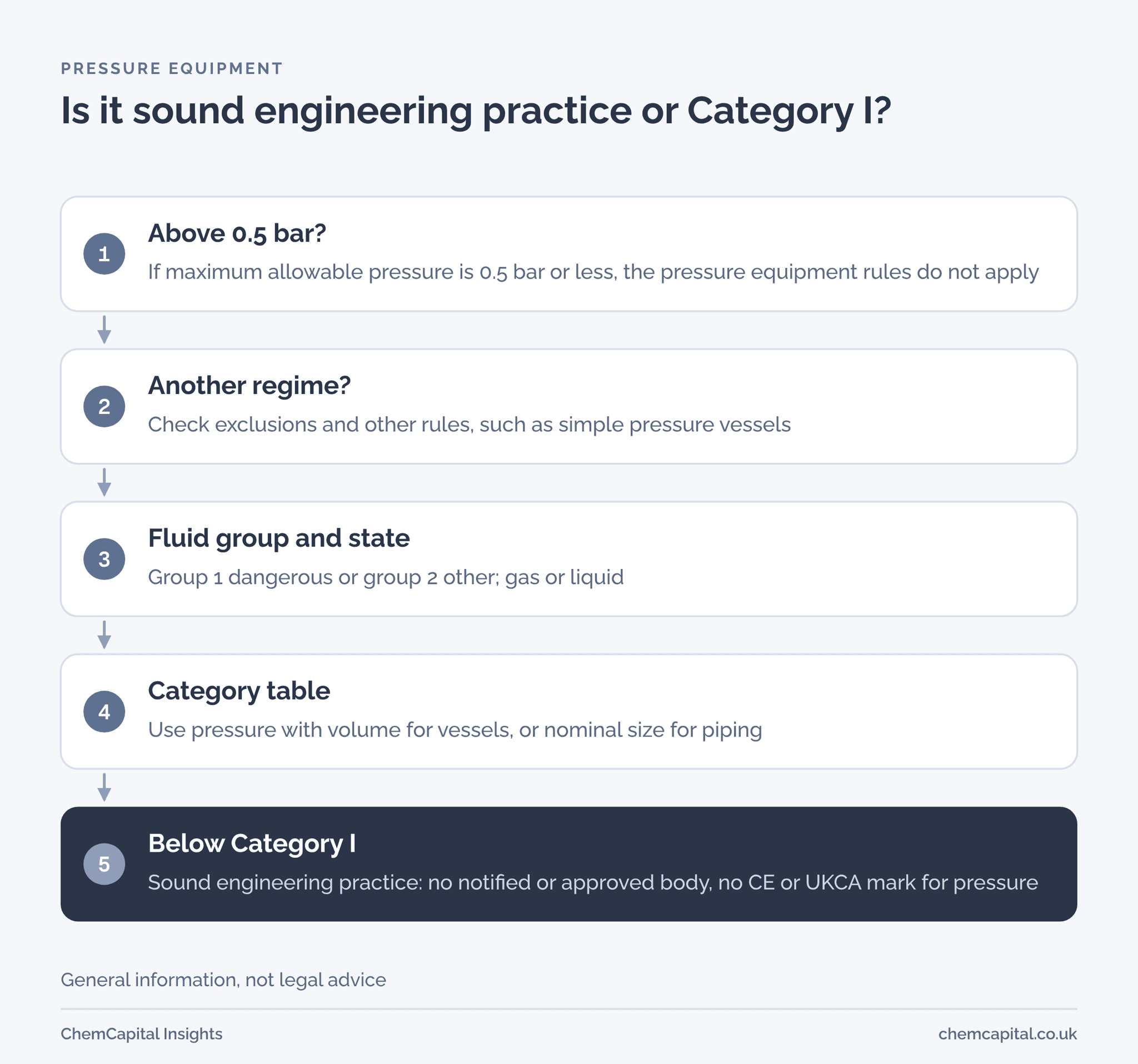
The pressure equipment rules apply where the maximum allowable pressure is above 0.5 bar [2]. The manufacturer then classifies the equipment from its type, the state of the fluid (gas or liquid), the fluid group, and the maximum allowable pressure combined with volume for vessels or nominal size for piping [2]. Group 1 covers dangerous fluids, such as flammable, toxic or oxidising ones; group 2 covers the rest, including steam [2].
Equipment that falls below Category I in the tables is SEP. In practice that often means small vessels and small bore piping, especially for group 2 fluids. Our guide to PED and PER 2016 categories explains how to read the tables.
Check first whether another regime applies. Some items are excluded from the pressure equipment rules, and some small air and nitrogen receivers are covered by separate simple pressure vessel rules instead.
What SEP equipment must and must not carry
| SEP equipment | Category I to IV equipment | |
|---|---|---|
| Design and manufacture | To sound engineering practice | To the essential safety requirements |
| Conformity assessment | None by a notified or approved body | By the module for its category |
| CE or UKCA marking for pressure | Must not carry one [2, 3] | Required |
| Instructions | Adequate instructions required | Instructions and safety information required |
| Declaration of conformity | Not under the pressure rules | Required |
The European Commission's page on the directive confirms its scope covers the design, manufacture and conformity assessment of stationary pressure equipment, with notified bodies listed in the NANDO database [4]; none of that machinery applies to SEP items. The UK regulations came into force on 8 December 2016, replacing the 1999 regulations [5].
What a buyer should still ask for
"Sound engineering practice" is not "no standard". Because the rules leave the details to the manufacturer, the purchase order has to fill the gap.
- Design basis. Name a recognised design code, often the same one you use for categorised equipment, so wall thicknesses and welds are designed, not guessed. See our guide to pressure vessel datasheets.
- Materials. Ask for material certificates for pressure parts.
- Pressure test. State the test and ask for the certificate.
- Marking and nameplate. Ask for the manufacturer's name, serial number, year, design pressure and temperature, and test pressure, so the item can be identified and examined later.
- Instructions. Ask for installation, operation and maintenance instructions in English.
- No misleading marks. Ask the supplier to confirm the category, and question any pressure related CE or UKCA mark on an SEP item.
SEP equipment in use
Classification under the product rules does not end the story. Once the equipment is installed at work in a system containing a relevant fluid, such as steam or a gas above 0.5 bar, the Pressure Systems Safety Regulations 2000 apply to its use: the user must not operate the system without a written scheme of examination where the regulations require one, and parts in the scheme must be examined by a competent person [6]. The same regulations require designers and suppliers to provide adequate written information about design, construction, examination, operation and maintenance [6]. Our article on the PSSR written scheme of examination covers the user's side.
Practical example
In this illustrative example, a buyer's RFQ for a small utilities package covers 12 pressure items. The supplier's classification puts 9 of them below Category I, as SEP, and 3 in Category I or II.
For the 3 categorised items, the RFQ asks for conformity assessment, UKCA or CE marking as the project requires, and declarations of conformity. For the 9 SEP items, it asks for the design code, material certificates, pressure test certificates, nameplate details and instructions, and states that no pressure equipment marking should be applied. When one bid arrives with all 12 items described as CE marked, the buyer raises a technical query asking for the classification of each item, which reveals that the supplier had marked SEP items in error.
Where ChemCapital fits
ChemCapital sends one structured RFQ with line items and attachments to several suppliers, so the classification and document requirements for each pressure item are clear to every bidder. Incoming quotes are checked for missing fields, compliance gaps and scope differences. When you search for new suppliers, Supplier Discovery shows certifications such as PED as the supplier claims them, with a source link; ChemCapital does not verify them, so classification and certificates still need checking.
Ready to send pressure equipment RFQs with the right regulatory basis? Start a free 14 day ChemCapital trial, with no credit card needed.
Frequently asked questions
What is sound engineering practice under the PED?
It is the category for pressure equipment that falls below the thresholds for Category I, under Article 4(3) of the Pressure Equipment Directive and regulation 8 of the UK Pressure Equipment (Safety) Regulations 2016. Such equipment must be designed and made to sound engineering practice and come with adequate instructions, but no conformity assessment body is involved. This is general information, not legal advice.
Can sound engineering practice equipment carry a CE or UKCA mark?
Not under the pressure equipment rules. EU guidance says Article 4(3) explicitly prohibits CE marking of SEP equipment, and the UK guidance says it must not bear a conformity marking unless other legislation requires one, for example machinery rules.
Does the PSSR apply to sound engineering practice equipment?
Yes, if it forms part of a pressure system containing a relevant fluid at work. The Pressure Systems Safety Regulations 2000 govern use, so the user still needs safe operating limits, maintenance and, where required, a written scheme of examination.
Continue reading
Informational only, not procurement or legal advice. Cited names, frameworks, and statistics belong to their respective owners.
Create and manage RFQs in minutes
ChemCapital handles the entire procurement cycle, from structured RFQs and supplier comparisons to formal purchase orders and delivery tracking.
Start for freeRelated articles
Single Source and Sole Source Justification for Equipment (Template)
The difference between sole source and single source, valid reasons in equipment buying, the evidence to attach, the risk of not testing the market, and a template.

BIOSECURE Act: What It Means for Equipment Suppliers to Biopharma (and Who Wins)
What Section 851 prohibits, who gets listed and when, and how equipment and consumables suppliers should prepare for customer BIOSECURE diligence.
PSSR Written Scheme of Examination: What to Get from Your Vendor
Under PSSR, most pressure systems cannot run until they have safe operating limits and a written scheme of examination. What the law asks, and what to get from the vendor.