
ADNOC Supplier Registration and ICV for Overseas Equipment Makers
How an equipment maker outside the UAE registers and prequalifies on the ADNOC Supplier Hub, why its ICV counts as zero without a UAE certificate, and what the October 2026 changes and Local+ mean.
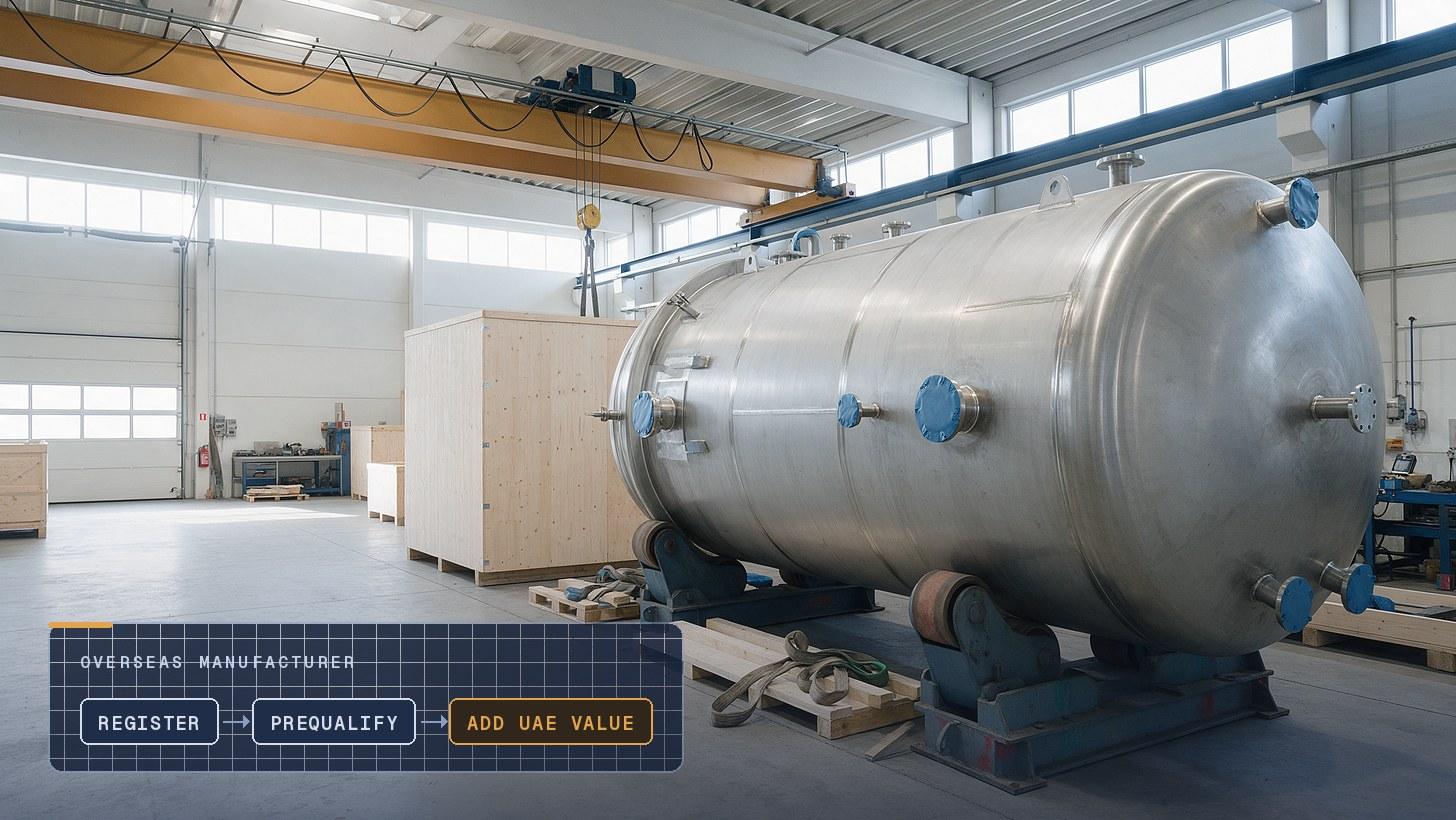
Every ADNOC supplier registers once, centrally for the whole ADNOC Group, through the ADNOC Supplier Hub, which runs on SAP Ariba, and must then prequalify for at least one product or service group before tender invitations arrive [1] [2]. For an equipment maker outside the UAE the harder question is In Country Value (ICV): under the national rules a foreign vendor's ICV counts as zero unless it holds a valid UAE ICV certificate [3], and on 25 October 2026 ADNOC announced that commercial and ICV offers will be judged together in one evaluation [4].
ChemCapital is not affiliated with ADNOC. Registration happens only through ADNOC's own Supplier Hub, described below, and the hub states that ADNOC charges no fees for registration or prequalification. Checked on 24 November 2026.
Registration gives you access; prequalification gets you invited
The Supplier Hub is ADNOC's single gateway for suppliers. Its registration page says that whether you are a UAE or an overseas supplier, the first step to any business is to register and prequalify for at least one product or service group, and that registration is centralised for the entire group [1]. The same page gives an estimated timeline of 14 days for registration [1].
ADNOC's guided tour of the hub sets out the sequence [2]:
- Select "Get Started" and complete the SAP Ariba registration. Suppliers already on SAP Ariba can sign in with their existing account.
- Once the request is approved, you get full access to the hub.
- Submit a prequalification request for your product or service groups and track it in the hub.
- When prequalification is approved, you receive tender invitations based on ADNOC's requirements.
Step 3 is where suppliers stall. Registration alone puts you in the system; it is the approved product or service group that makes you visible to the buyer who needs you [2]. Choose the groups that match what you actually make, and no more, because each one you claim has to be supported in prequalification.
After that, the hub is where you live as a supplier: tender invitations, the status of invoices and payments, and requests for ICV related payments on eligible contracts all sit there [2].
If you have no UAE company, read the hub's FAQ answer on how overseas manufacturers register before you start, and confirm with ADNOC whether your product group needs a UAE based agent. Do this before you sign any agency agreement.
Arranging ICV and a UAE partner takes time. List your products free on ChemCapital so buyers can find you and invite you to quote while you do.
ADNOC announced a faster registration model on 25 October 2026
At its second Make it with ADNOC Forum, ADNOC announced a redesign of supplier registration and prequalification [4]:
- a target of up to 80% less time to register and become ready to compete
- half the number of required documents
- prequalification removed for 60% of service categories
- one window for registration, qualification and compliance, with requirements scaled to the nature and risk of the work
- AI used to verify documents and reuse data you have already submitted
The announcement does not say when each change takes effect, and most of it speaks to service categories. Treat it as a direction of travel and check what the hub asks of your product group on the day you apply.
A foreign vendor's ICV counts as zero without a UAE certificate
ICV is the UAE's measure of how much of a supplier's spending and activity stays in the country. Certification is governed by the Ministry of Industry and Advanced Technology (MoIAT) and is the same for every participating buyer; each buyer then decides how to use the certificate in its own tenders [5]. ADNOC has implemented ICV across the group since 2018 [5].
MoIAT's October 2023 guidelines set the rules that matter to an overseas maker [3]:
| Rule | What the guidelines say |
|---|---|
| Who is certified | Each legal entity (each licence) separately; branches in the same emirate with the same activities and owners share one certificate |
| Goods manufacturer | A supplier holding a UAE industrial licence; everyone else is treated as a service provider |
| Foreign vendors | Count as spend outside the UAE; a foreign vendor's ICV is zero unless it holds a valid ICV certificate |
| Accounts | Figures must come from IFRS financial statements audited by a UAE licensed auditor, no more than two years older than the certification year |
| Validity | 14 months from the issue date of the audited statements |
| Who issues it | Professional services firms empanelled by MoIAT, through the ICV platform |
ADNOC's own FAQ confirms the practical points: you approach an empanelled certifying body with the certification submission template once your audited IFRS accounts are issued, one certificate per trade licence serves every participating entity, and questions go to MoIAT or to ADNOC's ICV team [6].
For a manufacturer exporting from Europe or Asia, the consequence is plain. Value added in your factory outside the UAE does not count as ICV, so your offer carries a low or zero ICV score unless you hold a valid certificate or a UAE partner with its own certificate is part of the supply. That might be a UAE distributor, a service partner, or your own assembly site.
The guidelines also show what lifts a score: manufacturing or third party spend in the UAE, investment in UAE assets, pay to Emirati staff, the expatriate workforce, and smaller bonuses for export revenue, asset growth, advanced technology and environmental certifications such as ISO 14001 [3]. Our capability statement guide is a good place to record which of these your UAE partner can show.
ICV is now weighed alongside price, not after it
The 25 October announcement changes how ICV counts in ADNOC tenders [4]:
- commercial and ICV offers are combined into a single evaluation model
- the previous bid matching approach is retired, so suppliers are expected to submit their most competitive offer at the outset
- ICV requirements are proportionate to the size and scope of the contract
- retention payments tied to ICV are calculated and released automatically through the Supplier Hub
The release is explicit that suppliers should put their most competitive offer in from the outset. For an overseas maker that means one shot: the price and the ICV position go in together. Decide your local partner before the tender, not during it.
Local+ sends EPC contractors to approved UAE manufacturers
The same announcement expanded ADNOC's Local+ programme to more than 100 UAE manufacturers, up from 70 at its launch in May 2026. EPC contractors bidding on new ADNOC tenders must source the relevant products from manufacturers on that approved list [4].
ADNOC also named more than 200 products and a range of critical spare parts it wants made locally, worth more than AED 60 billion through 2030, across rotating equipment and power; electrical, control and automation systems; drilling and completion equipment; chemicals and catalysts; piping, fabrication and heavy equipment; and spare parts [4].
If your product falls in those categories, the long term route to ADNOC projects may run through UAE manufacture or a licensing partner on the Local+ list, not through export. For products outside them, the EPC contractor's vendor list still decides most orders; our guide to EPC contractor vendor registration explains how those lists work.
Practical example
The scenario is illustrative. A UK maker of control valves wants to supply ADNOC projects.
| Route | ICV position | What it takes | Fits when |
|---|---|---|---|
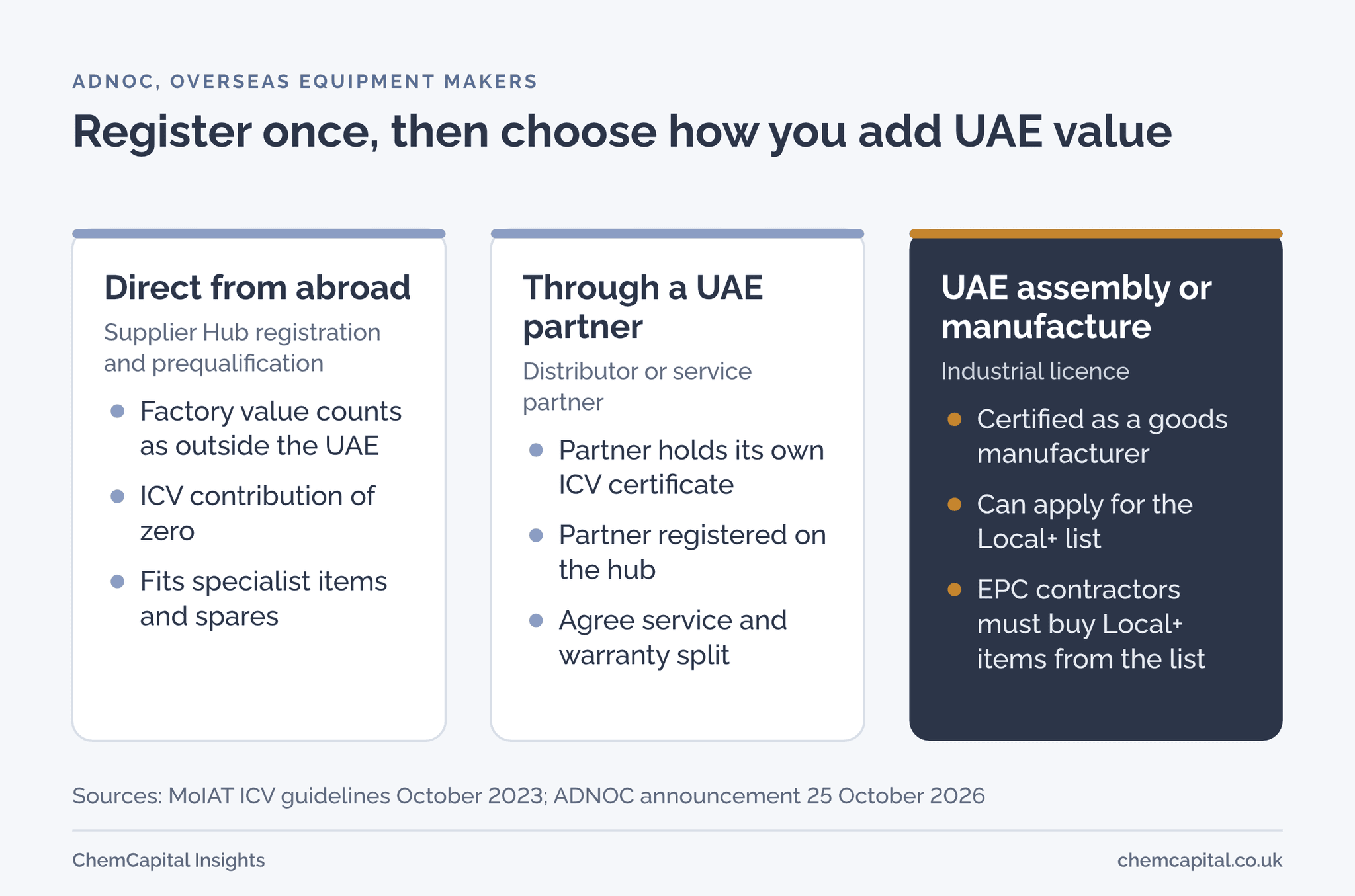
| Sell direct from the UK | The UK factory's value counts as outside the UAE, so the ICV contribution is zero | Supplier Hub registration and prequalification for the valve product group | A specialist item with few competitors, or spares for valves already installed |
| Through a UAE distributor with its own ICV certificate | The distributor's certificate covers its own UAE activity | Distributor registered and prequalified on the hub; clear split of warranty and service | Regular orders where local stock and service matter |
| UAE assembly or manufacture | The UAE entity can be certified as a goods manufacturer with an industrial licence and apply for Local+ | Licence, premises, audited IFRS accounts for the entity, then certification | Control valves fall within ADNOC's named categories and volume justifies a plant |
The maker registers and prequalifies its UK company first, because the hub charges no fee, publishes an estimate of 14 days for registration, and keeps direct sales open. In parallel it asks two UAE distributors for their current ICV certificates and how they would split service work. It leaves the assembly decision until it has seen a year of enquiries.
Where ChemCapital fits
Arranging ICV and a local partner takes time, and ADNOC is one buyer. ChemCapital lets you list your products and say what you can certify, so buyers searching by duty, size, material and certification can find you and invite you to quote, including buyers whose approved vendor list you are not on yet.
Ready to be found by more buyers while your ADNOC plans take shape? List your company on ChemCapital. It is free to start.
Frequently asked questions
How do I register as a supplier with ADNOC?
Register through the ADNOC Supplier Hub, which uses SAP Ariba, then prequalify for at least one product or service group. Registration is centralised for the whole ADNOC Group, and tender invitations follow approved prequalification.
Is ADNOC supplier registration free?
Yes. The Supplier Hub states that ADNOC does not charge fees for registration or prequalification. ICV certification is separate: it is issued by certifying bodies empanelled by the UAE Ministry of Industry and Advanced Technology.
Do I need an ICV certificate to bid for ADNOC work?
ADNOC weighs ICV in its tenders, and from its October 2026 announcement commercial and ICV offers are evaluated together. Under the national rules a foreign vendor's ICV counts as zero unless it holds a valid certificate, and certification needs IFRS accounts audited by a UAE licensed auditor.
What is ADNOC's Local+ programme?
Local+ is ADNOC's list of approved UAE manufacturers, more than 100 as of October 2026. EPC contractors bidding on new ADNOC tenders must source the relevant products from manufacturers on that list.
Continue reading
Informational only, not procurement or legal advice. Cited names, frameworks, and statistics belong to their respective owners.
Be found by buyers who search by specification
Create your profile and list your products so buyers can find you and invite you to quote. It is free to start: list up to five products and quote on your first three RFQs at no cost.
List your products freeRelated articles
Achilles UVDB for Equipment Suppliers: What It Is, the Verify Audit and Whether You Need It
What Achilles UVDB is under the Procurement Act 2023, what the subscription and Verify audit cost in 2026, which Verify category fits a manufacturer, and what UVDB does not do.

Becoming an Anglian Water Supplier: Alliances, Frameworks and Scanmarket
Who delivers Anglian Water's £11bn AMP8 programme, how it buys directly on Scanmarket, the prequalification it accepts for goods, the Water Innovation Network for new products, and its payment terms.
Severn Trent Supplier Registration: Registered, Then Qualified
How Severn Trent registers suppliers on SAP Ariba, why qualified supplier status is what puts you in its teams' searches, how its tenders run, what is coming after AMP8, and its payment terms.