
Capability Statement for an Engineering Supplier (Template)
The one page a buyer forwards to engineering when adding you to a long list. Here is what it should say for an engineering supplier, and a template you can copy.
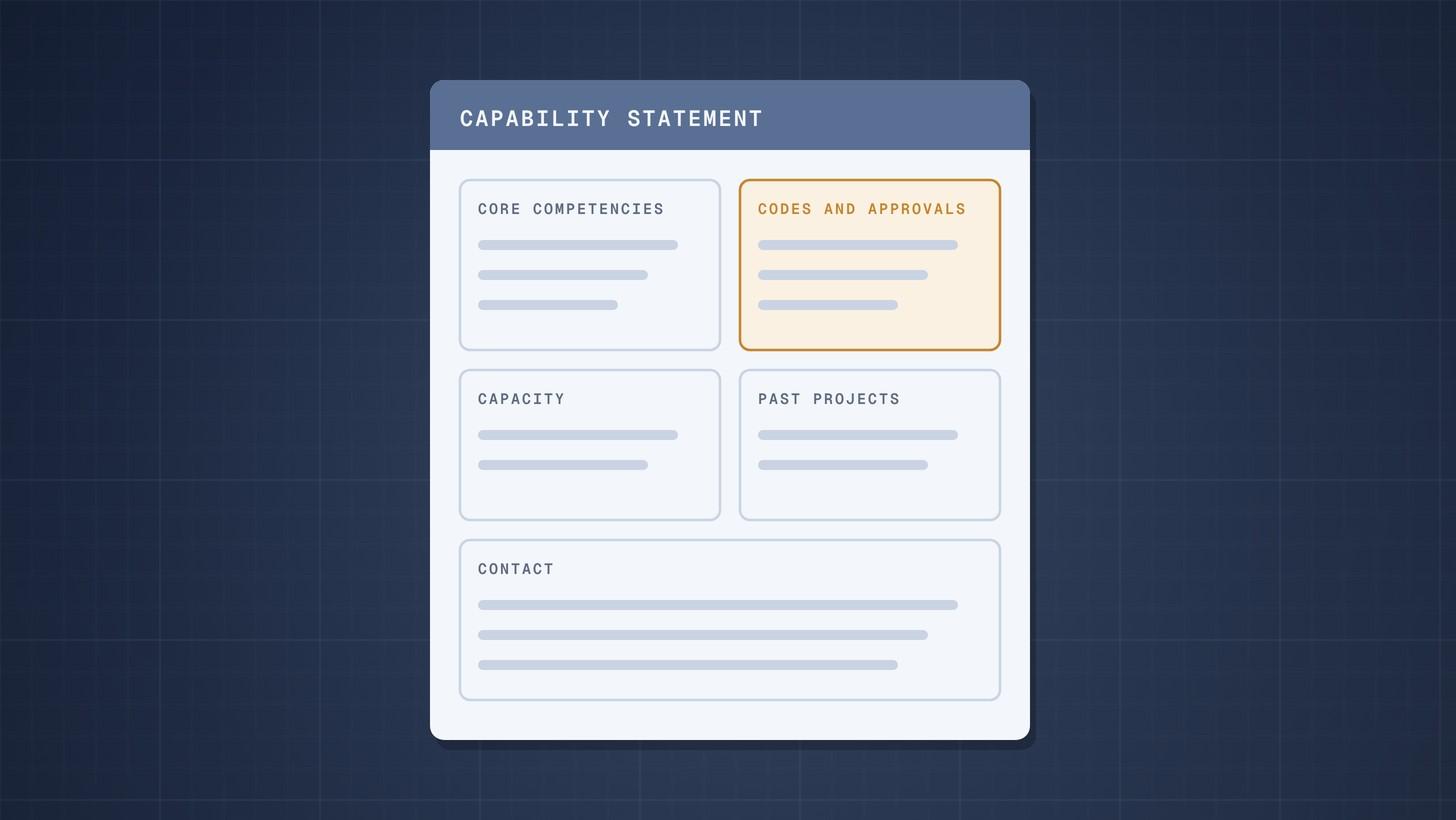
A capability statement is a one page summary of what your company does, what it has done, what sets it apart and how to contact you, written so a buyer can forward it internally and an engineer can decide in a minute whether you belong on the long list. For an engineering or fabrication supplier, that means core competencies in plain technical terms, codes and approvals, workshop capacity, a few relevant past projects, and a named contact.
Why this matters now
Buyers build long lists quickly, from searches, exhibitions and colleagues' suggestions. Public sector advisers describe how officials receive many statements, file some, and copy others to colleagues such as buyers, with no guarantee it gets forwarded [1]. In engineering, the colleague is usually a project or discipline engineer. If your one page does not answer their first questions, you never reach the RFQ.
The format comes from public procurement, where small businesses have used capability statements for years. The advice transfers well to private engineering buyers, with a few changes covered below.
Access real procurement opportunities from global buyers
Join ChemCapital to get discovered by verified procurement teams across pharmaceutical, chemical, and industrial manufacturing.
What goes in it
Public sector guides agree on the core: core competencies, past performance, differentiators, and company data with contact details and identifiers [2] [3]. One page is preferred, a second page is acceptable only if the first stands alone, and a searchable PDF is the normal format [1] [3].
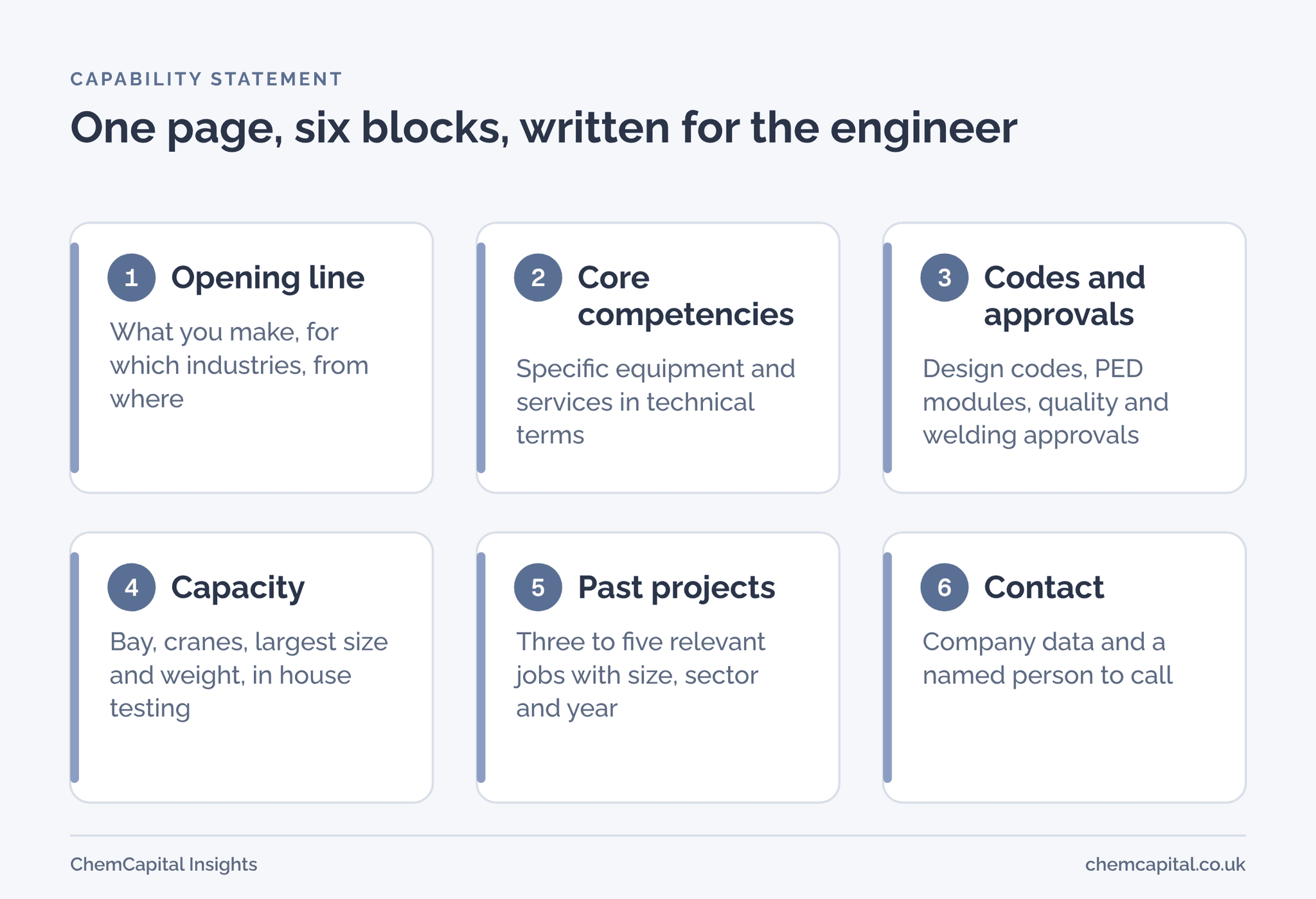
For an engineering supplier, translate each section into what an engineer checks:
| Section | For an engineering supplier |
|---|---|
| Opening line | One or two sentences: what you make, for which industries, from where |
| Core competencies | Specific equipment and services, in technical terms: for example ASME VIII vessels to 3 m diameter, 316L hygienic skids, shop testing |
| Codes and approvals | Design codes, PED modules and notified body, quality certification, welding approvals, hazardous area capability |
| Capacity | Bay length, crane capacity, largest diameter and weight, in house NDT, pressure testing, clean assembly area |
| Past projects | Three to five relevant jobs: type, size, sector, year; client names only with permission |
| Differentiators | Real, checkable ones: lead time on a standard design, in house design, documentation quality |
| Company data and contact | Legal name, registration and VAT numbers, address, a named sales or engineering contact |
The Missouri APEX Accelerator suggests opening with a specific one or two sentence pitch, using statistics and metrics, keeping certifications in the company data rather than the differentiators, and avoiding vague claims such as best in class [4]. New Hampshire's guidance also says certifications are not differentiators, and that differentiators should be things like special equipment, capacity, experience or specialised services [1]. For a fabricator, that is good news: crane capacity and in house testing are exactly that.
Evidence, not adjectives
The UK government's guide for small businesses bidding for public contracts lists the kinds of evidence that persuade evaluators: statistics such as performance against target, testimonials, case studies, lists of similar contracts, and CVs, each with strengths and weaknesses [5]. On one page, statistics and short lists work best. A line such as "delivered 42 pressure vessels to PED Category III and IV in 2025", if true, says more than "extensive experience". Use your own figures only, and keep them current.
Tailor it. Guides recommend researching what each buyer cares about and, over time, keeping versions for different customers [1] [4]. A pharma buyer wants hygienic design, surface finish and documentation; a petrochemical buyer wants API standards, materials and NDT. The same workshop, two different first paragraphs.
Practical example: a filled template
Illustrative only, for a fictional company.
| Block | Content |
|---|---|
| Opening line | Example Fabrication Ltd designs and builds pressure vessels and process skids for chemical and pharmaceutical plants, from a 4,000 m² workshop in the North West of England. |
| Core competencies | Pressure vessels to ASME VIII Div 1 and EN 13445; 316L hygienic skids with orbital welding; heat exchangers to TEMA; shop hydrostatic testing; data books and FAT |
| Codes and approvals | PED modules H and G with notified body 0000; ISO 9001; welding procedures to ISO 15614 |
| Capacity | 60 m bay, two 20 tonne cranes, vessels to 3.5 m diameter and 40 tonnes, in house radiography and dye penetrant testing |
| Past projects | 2025: six jacketed reactors, 6 m³, pharma API site. 2024: CIP skid, 4 circuits, dairy. 2024: knock out drum, 2.4 m diameter, refinery |
| Differentiators | In house design team; standard skid frames on an 8 week build; data book delivered with the equipment |
| Company data and contact | Company number, VAT number, address, named contact, phone and email |
Every figure on your own statement must be true and checkable. Buyers will ask for evidence at qualification, and the statement should survive it; see our supplier qualification questionnaire guide.
Common mistakes
- Trying to do everything. A narrow, specific list of competencies beats a long one [3].
- A history lesson. Founding date and family story belong on your website, not here [4].
- Unprovable claims. Phrases like innovative solutions are filtered out by every engineer who reads them.
- Out of date approvals. An expired certificate on your statement is worse than none.
- No named contact. "Info at" addresses slow the buyer down.
Once a buyer is interested, the next document is usually their vendor registration form. Keep the two consistent.
Where ChemCapital fits
Buyers increasingly search before they ask. A ChemCapital supplier profile carries the same information as a good capability statement, with your products and approvals, so buyers searching for your kind of equipment can find you and send an enquiry.
Ready to put your capability in front of buyers who are searching now? List your company on ChemCapital. It is free to start.
Frequently asked questions
What is a capability statement?
A one page summary of a company's core competencies, past performance, differentiators and company data, used by buyers to decide whether to add a supplier to a long list.
What should an engineering company include in a capability statement?
What you make and for which industries, technical core competencies, codes and approvals, workshop capacity in figures, three to five relevant past projects, real differentiators, and a named contact.
How long should a capability statement be?
One page is preferred. A second page is acceptable if the first stands alone. Save it as a searchable PDF.
Are certifications differentiators?
Not on their own. Guidance recommends listing certifications with company data, and using the differentiators section for things like special equipment, capacity, experience or services competitors lack.
Continue reading
Informational only, not procurement or legal advice. Cited names, frameworks, and statistics belong to their respective owners.
Access real procurement opportunities from global buyers
Join ChemCapital to get discovered by verified procurement teams across pharmaceutical, chemical, and industrial manufacturing.
List your companyRelated articles
AMP8 for Equipment Suppliers: How Water Companies Buy, 2025 to 2030
AMP8 is the 2025 to 2030 investment period for water companies in England and Wales, with £104bn approved. Here is how the money is spent, how water companies buy through frameworks and delivery partners, and how equipment suppliers get in.
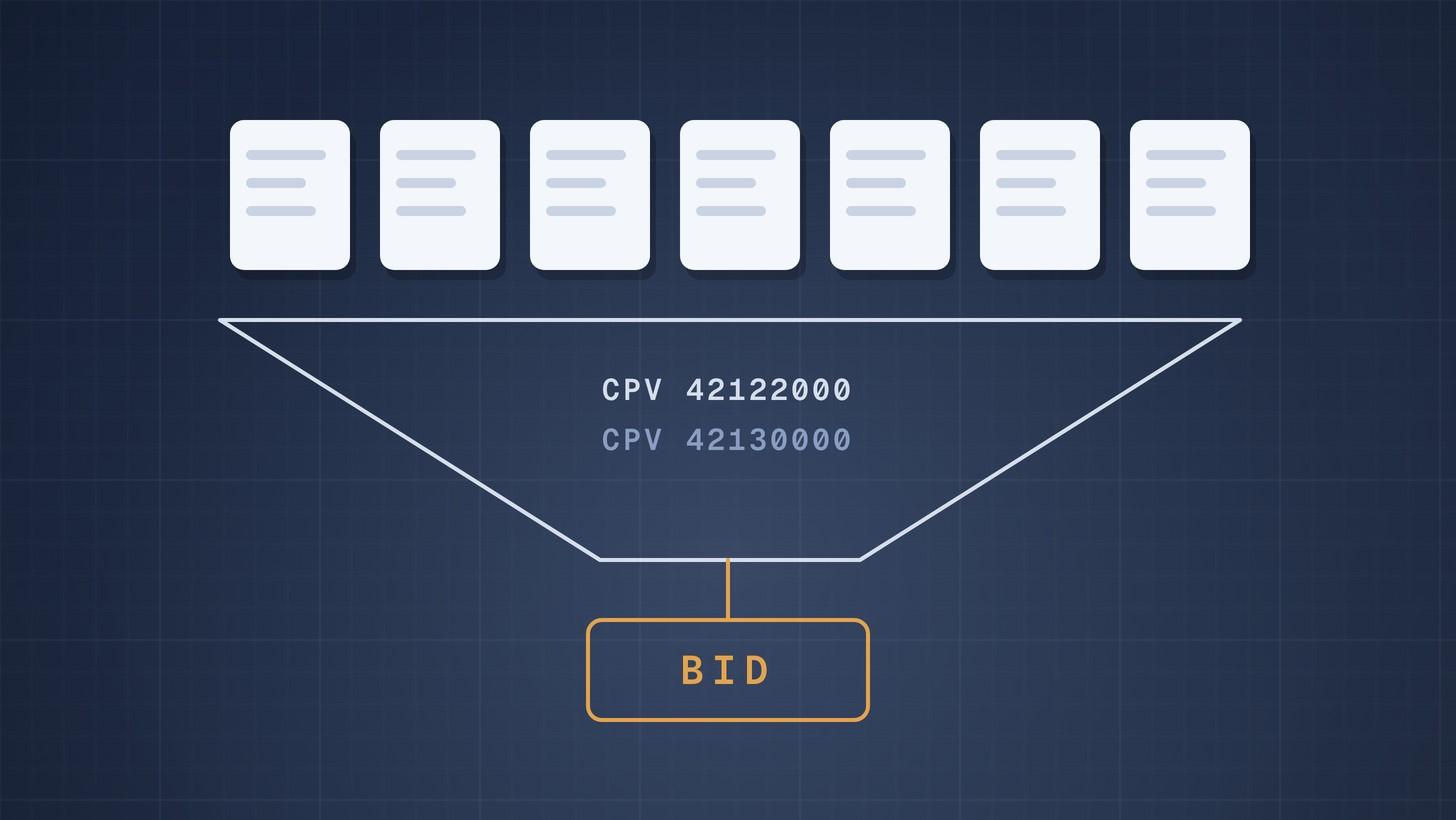
How to Find Tenders for Pumps, Valves and Process Equipment
Public tenders for process equipment are published free on Find a Tender in the UK, TED in the EU and SAM.gov in the US. Here is how to set alerts with the right CPV codes and where utility frameworks fit.

Framework Agreements for Pumps, Valves and Instruments: When They Beat Project Buying
A frame agreement for pumps, valves or instruments pays off when you buy the same types repeatedly. Here is when it beats project by project buying, what to put in it, and a worked example.