
CEPCI: How to Escalate an Old Equipment Quote to Today's Prices
How to bring an old equipment quote up to date with the CEPCI: the index ratio, the six tenths rule, currency for UK buyers and the pitfalls to check first.

To escalate an old equipment quote with the CEPCI, multiply the quoted price by the latest final index value and divide by the index value for the month the price was set. A vessel quoted at $100,000 when the index stood at 100, with the latest final value at 115, comes out at $115,000 (illustrative values). The CEPCI, or Chemical Engineering Plant Cost Index, is built from US price data, so a UK buyer should escalate in the quote's own currency, convert to sterling at today's exchange rate, and treat the answer as a budget figure, not a price.
Keep the method to about five years, the rule of thumb in both Chemical Engineering's 2002 article on the index and the US Environmental Protection Agency's cost manual. Beyond that, get a fresh quote [1, 4].
Why this matters now
Most project teams hold quotes from earlier projects, and early budgets often start from them. AACE International, a professional body for cost engineers, sees escalation as money set aside for uncertain cost changes over time, whether technical, economic or market driven, with inflation only one part of it [6]. Its recommended practice on escalation warns that when prices swing hard, escalation can become the biggest single line in an estimate. An AACE article repeated that warning in December 2021, amid supply chain disruption and rising inflation, when many quotes still on file were issued [6].
The index is also a paid product: Chemical Engineering magazine sells its full database of annual values from 1947 and monthly values from 1970 through a paid membership [2]. We do not reproduce recent values, and every index figure in our example is illustrative.
Join ChemCapital to streamline sourcing and connect with verified partners
Whether you're buying or supplying, ChemCapital gives you the tools to manage the complete procurement cycle in one platform.
What the CEPCI is and what sits inside it
Chemical Engineering has published the index every month since 1963, on a base of 100 for 1957 to 1959 [3, 1]. It is a composite of four sub indices. As described for its 2002 revision, those draw on 41 producer price indices and 12 labour cost indices compiled by the US Bureau of Labor Statistics [1], with labour costs adjusted for an assumed 2.2% a year growth in productivity [1, 3].
| Sub index | Weight in the composite | What sits inside it |
|---|---|---|
| Equipment | 50.7% | Heat exchangers and tanks 33.8%, pipe, valves and fittings 19.0%, process machinery 12.8%, process instruments 10.5%, structural supports and miscellaneous 10.5%, electrical equipment 7.0%, pumps and compressors 6.4% (shares of the equipment sub index) |
| Construction labour | 29.0% | Site labour costs, adjusted for productivity |
| Engineering and supervision | 15.8% | Engineering and supervision costs |
| Buildings | 4.6% | Building costs |
The four main weights are from the 2002 revision, repeated in a 2014 University of Edinburgh paper [1, 3]; the equipment shares are from the 2002 article only [1]. Check the current methodology with the publisher.
A purchased equipment quote carries no site labour or buildings, so if you hold the sub indices, the equipment index is a closer match than the composite. The composite suits an installed plant cost, such as the result of a Lang factor estimate.
How to escalate a quote with the index
The ratio method is one line:
Cost today = cost then × (latest final index ÷ index then)
Three choices matter:
- The base date. Use the month the price was set, which is usually the quote date, not the date the quote was filed or the project approved.
- Final or preliminary. The newest monthly value is published as preliminary and finalised later. On 28 May 2025, for example, the latest figure was a preliminary value for March, published alongside the final value for February [2]. Use final values where you can and record the month used.
- The span. The 2002 article sets a rule of thumb limit of five years and shows why: escalating a $10 million plant from 1970 gives roughly $31 million in 2000, a figure it says is not likely to be accurate [1]. The EPA manual also advises getting new quotes beyond five years [4].
Combining escalation with the six tenths rule
The six tenths rule scales cost with capacity:
Cost of new size = cost of old size × (new capacity ÷ old capacity) raised to the power n
The exponent n is often about 0.6, but it varies between 0.30 and 0.84 with the type of equipment [5]. At 0.6, doubling capacity raises the purchased cost by about 52%, not 100% [5]. Compare like with like, in type, material and pressure rating, and use the size parameter that drives cost: heat transfer area for an exchanger, volume for a tank, power for a compressor. Both corrections are multipliers, so their order makes no difference, but large extrapolation does: stay close to the size you started from [5].
Currency and location for a UK buyer
The CEPCI rests mainly on US data: its producer price inputs follow what US producers are paid for their output, and its labour inputs are US labour costs [1, 3]. That gives a simple rule: escalate in the currency and country where the item is made, using an index for that place, then convert to sterling at today's rate. The Bank of England publishes daily spot rates against sterling, with the caveat that they are not official rates [9]. Record the rate and the date you used.
To move a whole estimate from one country to another, the index is often paired with a location factor [3]: the ratio of what the same scope costs in one place to what it costs in another. For an item made in the UK and quoted in sterling, a US index is only a proxy. The Office for National Statistics publishes monthly producer price indices tracking what UK manufacturers pay for materials and charge for their products, including lower level product groups, under the Open Government Licence. The latest two months are provisional and the last 12 months can be revised [7]. The Ministry of Defence, among others, uses them as a neutral price measure in contracts [7].
Pitfalls to check before you trust the number
| Pitfall | Why it matters | What to do |
|---|---|---|
| US basis | The index is built from US price data [1, 3] | Escalate in the source currency; consider ONS indices for items made in the UK [7] |
| Publication lag | The newest month is preliminary [2] | Use final values and note the month |
| Composite index | Almost half of it is labour, engineering and buildings [1] | Use the equipment sub index for a purchased item |
| Alloy surcharges | At Outokumpu a stainless price has three parts: a negotiated base price, extras and an alloy surcharge, usually reset each month from recent alloy costs [8] | Ask whether the old quote's surcharge was fixed or floating, and get the base price and surcharge shown separately |
| Volatile or tight markets | Indices have lagged behind sharp price swings, and none can capture a market where few firms bid and demand is surging [3] | Treat the result as a budget figure and test it with a fresh quote |
| Exchange rates | Lecture notes on estimating flag foreign currency as a trap [5] | Convert after escalating, at a dated rate [9] |
Practical example
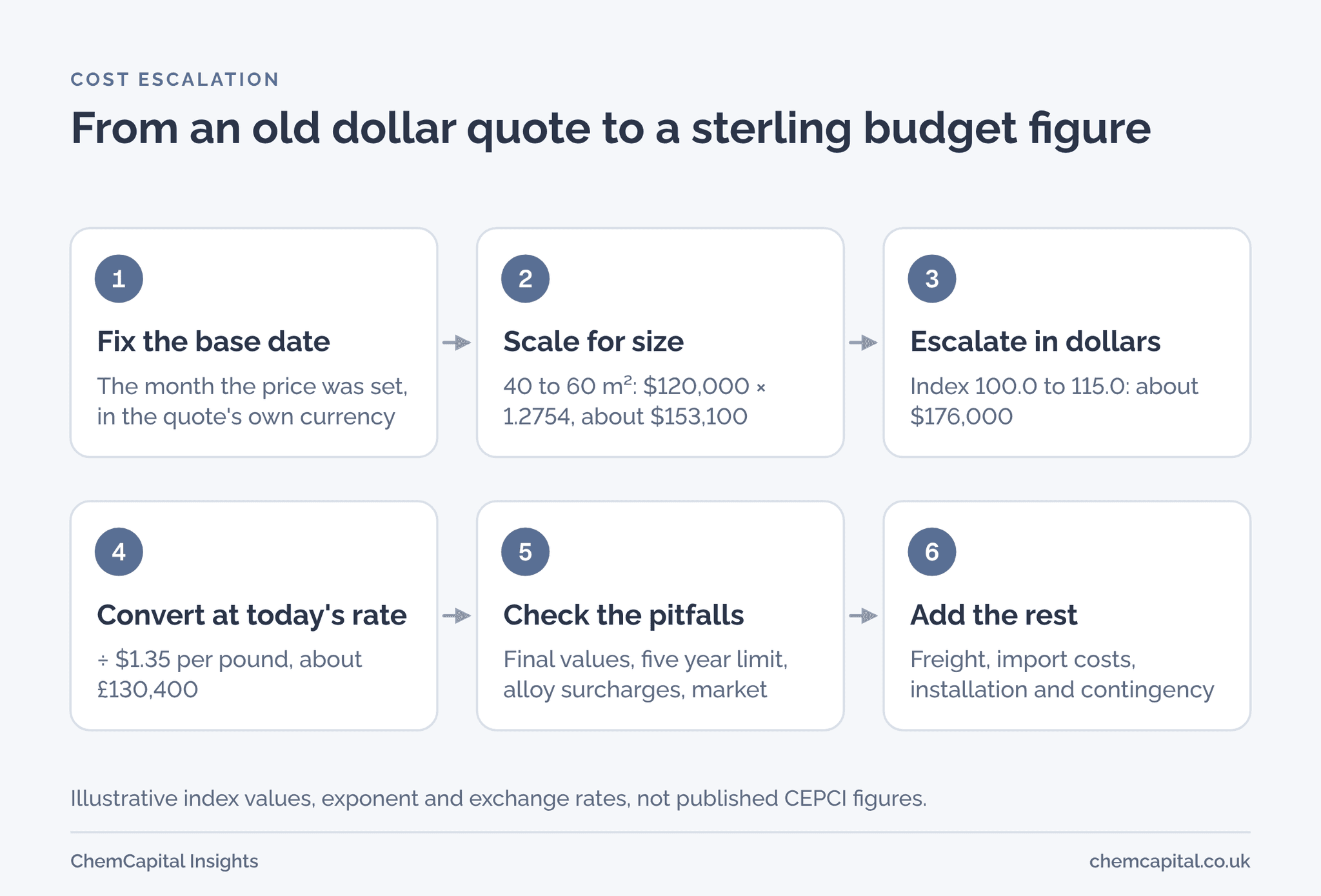
A UK project team needs a budget for a stainless steel shell and tube heat exchanger with 60 m² of heat transfer area. The nearest record is a quote from a US fabricator, dated three years ago: $120,000 ex works for a similar 40 m² unit. All inputs are illustrative: index values rebased to 100.0 at the quote date (not published CEPCI figures), an exponent of 0.6 standing in for a published value for this equipment type, and exchange rates of $1.25 per pound then and $1.35 now.
| Step | Calculation | Result |
|---|---|---|
| 1. Scale for size | $120,000 × (60 ÷ 40) raised to the power 0.6, a factor of 1.2754 | about $153,100 |
| 2. Escalate in dollars | $153,051 × (115.0 ÷ 100.0) | about $176,000 |
| 3. Convert at today's rate | $176,009 ÷ 1.35 | about £130,400 |
| Shortcut: convert at the old rate, then escalate | $153,051 ÷ 1.25 × 1.15 | about £140,800 |
The shortcut overstates the budget by about £10,400, or 8%. That is exactly the move in the exchange rate, since 1.35 ÷ 1.25 is 1.08. Converting at the old rate ignores that each pound now buys more dollars. Had the pound fallen instead, the shortcut would have understated the budget. Indices can fall as well as rise, so an old quote is not always too low.
The £130,400 is an ex works equipment figure. Freight, import costs, installation and contingency still sit on top, and the 2002 article notes that budget estimates are usually good only to within plus or minus 20% to 30% [1]. Our guide to contingency in capital cost estimates covers how much to add at each stage, and our article on AACE estimate classes explains how wide the range should be.
Keep the working with the number
An escalated figure is only as useful as the record behind it: the original quote, its base date, the index months, the exponent and the exchange rates.
ChemCapital's Project Costing keeps a library of historical quotations and reprices stored quotes for currency, age, geography, Incoterms, quantity and scope, using CEPCI and Nelson Farrar indices, with every adjustment shown. Contingency ranges narrow as the project matures, and line items can become RFQs when you need a firm price.
Ready to see what your old quotes are worth today? Start free with ChemCapital.
Frequently asked questions
What is the CEPCI index?
The Chemical Engineering Plant Cost Index is a cost index published every month by Chemical Engineering magazine since 1963, on a base of 100 for 1957 to 1959. It combines four sub indices, for equipment, construction labour, buildings, and engineering and supervision, built from US price and labour data.
How do you calculate cost escalation with CEPCI?
Multiply the old cost by the latest final index value divided by the index value for the month the price was set. Keep the span to about five years, record the months you used, and escalate in the quote's own currency before converting to sterling.
Where can I find CEPCI 2026 values?
Chemical Engineering publishes the index in each issue and in a database that needs a paid membership, with the newest month first issued as a preliminary value. We do not reproduce recent values, so take them from the publisher and record the month you used.
What is the six tenths rule in cost estimating?
It scales equipment cost with capacity using an exponent, often about 0.6, so doubling capacity raises cost by about 52% rather than 100%. The exponent varies between about 0.30 and 0.84 with the type of equipment, so use a published value where you can.
Continue reading
Informational only, not procurement or legal advice. Cited names, frameworks, and statistics belong to their respective owners.
Join ChemCapital to streamline sourcing and connect with verified partners
Whether you're buying or supplying, ChemCapital gives you the tools to manage the complete procurement cycle in one platform.
Get started freeRelated articles
Rapid Plant Cost Estimates for Sales Engineers: Days, Not Weeks
How a sales engineer prices an integrated process package in days from historical quotes: escalation, scaling, material and currency adjustments, and a defendable Class 4 budget.
Contingency in Cost Estimates: How Much at Each AACE Class
AACE sets no contingency percentage per estimate class. What contingency covers, why it shrinks, how to set it at P50 or P80, and a worked Class 3 example.
Lang Factor Method Explained: From Equipment Cost to Plant Cost
The Lang factor turns a list of equipment prices into a first estimate of plant cost. Here are the factors, the formula, the accuracy and where it goes wrong.