
Contingency in Cost Estimates: How Much at Each AACE Class
AACE sets no contingency percentage per estimate class. What contingency covers, why it shrinks, how to set it at P50 or P80, and a worked Class 3 example.
Contingency is money added to a base estimate for costs that experience says will turn up within the agreed scope but cannot yet be pinned to a line [1]. AACE International sets no contingency percentage for any estimate class: it expects the amount to come from your own project's risks [2]. What holds at every class is the direction: as definition matures from Class 5 to Class 1, the risks shrink, and contingency should shrink with them.
Why this matters now
Contingency decides whether a project comes back for more money. Too little, and the overrun is built in on the day of approval. Too much, and capital sits idle and the business case looks worse than it is.
It also decides whether the estimate's range means anything. AACE's typical Class 3 range, roughly 10% to 20% below and 10% to 30% above, assumes contingency has been added for about an even chance of overrun; if it is set properly, about 80% of projects should land inside AACE's ranges [2]. Leave contingency out, or pick it by habit, and the range stops describing your project.
UK government guidance asks for a P50 cost that includes risk [3], and suppliers pricing lump sum work face the same question from the other side.
Join ChemCapital to streamline sourcing and connect with verified partners
Whether you're buying or supplying, ChemCapital gives you the tools to manage the complete procurement cycle in one platform.
What contingency covers, and what it does not
Start with the base estimate: the cost of the defined scope at today's prices. AACE defines contingency as an allowance for uncertain items, conditions and events that, taken together, experience shows will add cost, such as estimating errors and omissions, minor price movements other than general escalation, and design development within scope. It is expected to be spent [1].
AACE also lists what contingency usually excludes [1]:
| Excluded from contingency | Where it belongs |
|---|---|
| General escalation and currency | Separate escalation and currency lines |
| Major scope change, such as capacity | Change control |
| Major strikes, natural disasters | Outside the estimate |
| Management reserve | Its own reserve and rules |
Terms vary. The US Government Accountability Office uses contingency for government funds held for unknown unknowns outside the contractor's control, and management reserve for the contractor's budget for known unknowns in the contract, and notes that others use the terms differently [4]. Write your definitions into the basis of estimate, which records how it was built.
Why contingency shrinks from Class 5 to Class 1
An estimate's AACE class is set by the maturity of project definition, not the width of its range [2]. Early on, the biggest risks are often not events at all. AACE calls them systemic risks: facts about the project system, such as the level of scope definition, process complexity and technology, and notes that poor scope definition was often the greatest driver of cost and schedule risk [5]. Project specific risks are discrete events, such as poor ground or an extra shutdown, each priced on its own [6].
As definition matures, much of the systemic risk is engineered out: the piping and instrumentation diagrams are frozen, the hazard and operability study (Hazop) is done, and the main equipment moves from budgetary to firm quotes. What remains is smaller and easier to price. UK guidance agrees that uncertainty falls as a project matures and that contingency must be resized with it [3].
So the honest answer to "how much at each class" is whatever your risk analysis says, and less at each step. If contingency is the same percentage at Class 2 as at Class 4, ask what the extra engineering bought.
Four ways to set contingency
- Percentage by judgement. Quick, and fine for screening a Lang factor estimate if you check it against your own history. But it ignores this project's risks, which UK guidance expects contingency to reflect by impact and probability [3].
- Expected value. Multiply each risk's probability by its cost if it happens, and add them up. AACE recommends this for project specific risks, ideally five, ten or more. No single risk is funded: some will happen, and nobody knows which [6].
- Range estimating with Monte Carlo. Put ranges on uncertain prices and risks, simulate thousands of outcomes and plot an S curve of the chance of staying under each cost. Contingency is the gap from the base to your chosen confidence level [1]: P50 is the cost with an even chance of overrun, P80 the cost you stay under four times in five. UK guidance calls this the most common method late in a project, but warns of false certainty very early on novel or complex projects [3].
- Parametric. A statistical model fitted to completed projects links cost growth to systemic drivers, such as scope definition measured by AACE class. AACE rates it best for systemic risks, not critical project specific ones [5].
AACE also describes a hybrid of methods 2 and 4, and calls for a Monte Carlo distribution, not a single average [6]. For a Class 3 process plant estimate, start there.
How to present and spend it
Show contingency as one line, never spread into item prices, with its method, confidence level and exclusions. Hidden contingency inflates the base, spoils comparison with supplier quotes and cannot be tracked.
Agree who holds what. UK guidance puts the P50 value of risk into the project's anticipated final cost, while unallocated contingency can sit higher up, with sponsors or HM Treasury, across portfolios [3]. A private owner can mirror that: the project manager holds P50, the sponsor the step to P80.
Spend it only on what it was for. The same guidance says projects should not repurpose contingency, even within the same cost envelope [3]; scope changes need their own money. Do not cut contingency as each risk closes either: it was sized for the whole register, and AACE calls drawing it down risk by risk illogical [6]. Rerun the analysis at each stage gate.
Practical example
A chemicals site is approving a skid mounted effluent neutralisation plant on a Class 3 estimate. All figures are illustrative.
The £4.00m base estimate, at today's prices, includes two process skids on firm quotes, skid C on a £500,000 budgetary quote, installation on a contractor's budget price, electrical and instrumentation from history adjusted for date, and indicative civils. The team lists five project specific risks:
| Risk | Chance | Cost if it happens | Expected value |
|---|---|---|---|
| Skid C firm price is higher | 50% | £120,000 | £60,000 |
| Hazop adds instruments | 40% | £100,000 | £40,000 |
| Extra shutdown for live connections | 30% | £150,000 | £45,000 |
| Plinth needs piling | 20% | £200,000 | £40,000 |
| Commissioning runs two weeks over | 30% | £80,000 | £24,000 |
| Total | £209,000 |
That £209,000 is an average, not the contingency. The team runs the register through a Monte Carlo model, with ranges on the softer prices and a systemic allowance from its own Class 3 history.
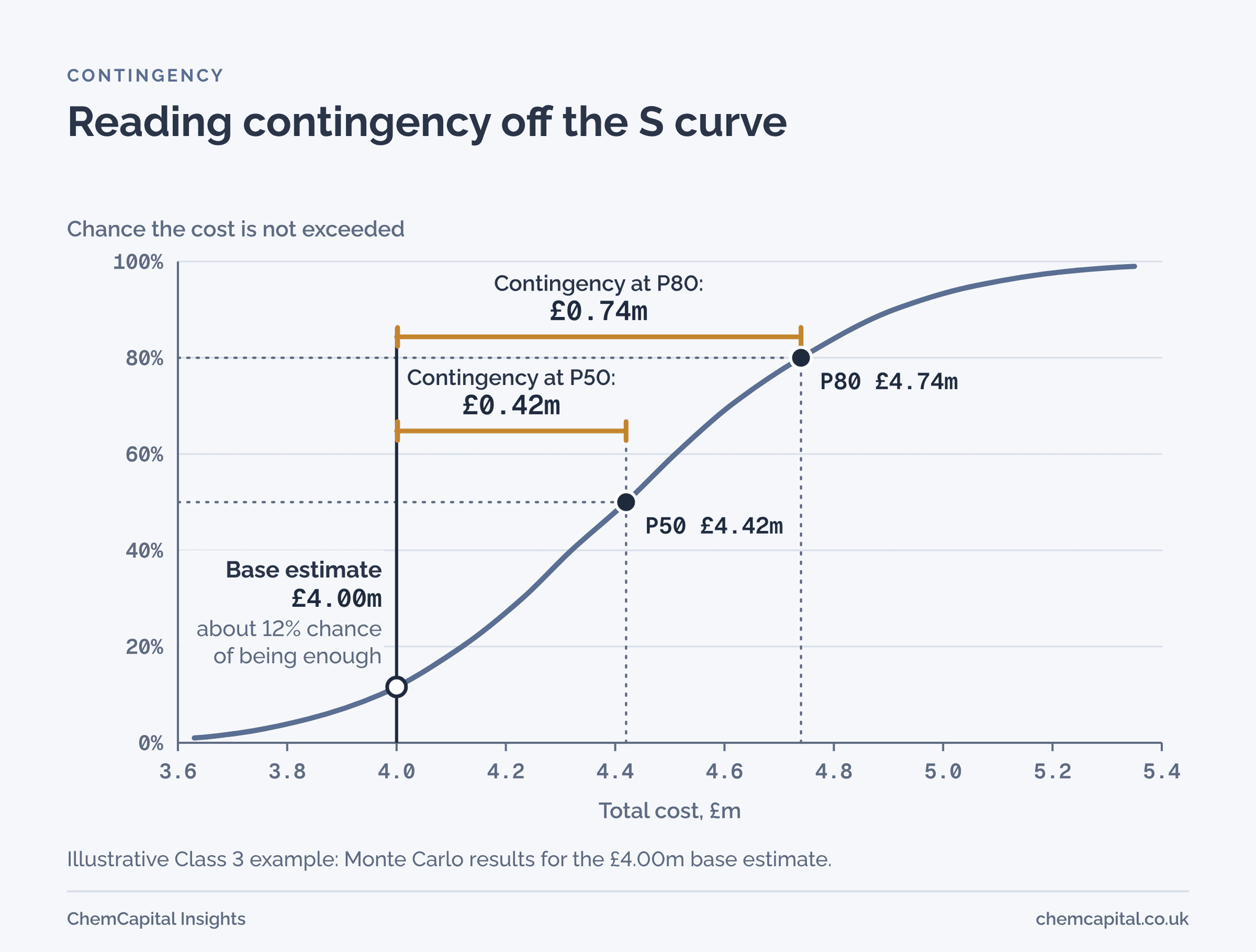
The base estimate alone has about one chance in eight of being enough. Contingency is £0.42m at P50 (£4.42m), about 10% of the base, and £0.74m at P80 (£4.74m), about 18%. Nobody picked a percentage; the analysis did. The funding request keeps every layer separate:
| Line | Amount | Held by |
|---|---|---|
| Base estimate | £4.00m | Project |
| Contingency to P50 | £0.42m | Project manager |
| Extra to P80 | £0.32m | Sponsor |
| Escalation | £0.18m | Project |
| Management reserve for scope change | £0.30m | Business |
| Total | £5.22m |
When skid C's firm quote arrives, that risk closes, but contingency is not cut by £60,000; it is reassessed at the next stage gate.
Contingency starts with the base estimate
Contingency is only as good as the base estimate under it: if you cannot see which prices are firm and which are three years old, you cannot see the risk.
ChemCapital's Project Costing shows what each total rests on: firm quotes, budgetary quotes, repriced history, indicative values and unquoted items. Each estimate is tied to its project stage, and the platform applies typical industry contingency ranges that narrow as the evidence improves. Treat those as a first check: for funding, the risk analysis and confidence level remain your call, and the platform makes the base beneath them visible. More in our guide to AACE estimate classes.
Want contingency that rests on evidence, not habit? Start free with ChemCapital, with no credit card needed.
Frequently asked questions
How much contingency should a Class 3 estimate have?
AACE sets no percentage for any class: contingency should come from an analysis of the project's own risks, and AACE's Class 3 accuracy range assumes it has been set for about an even chance of overrun. In our illustrative skid plant example it came to about 10% of the base at P50 and 18% at P80, but your figure depends on your risks.
Is escalation or management reserve part of contingency?
No. AACE's definition says contingency usually excludes escalation and currency effects, major scope changes, extraordinary events such as major strikes, and management reserves, so keep each out of the contingency line. Organisations define management reserve differently, so write your definitions into the basis of estimate.
What is the difference between P50 and P80 contingency?
P50 contingency takes the estimate to the cost with an even chance of overrun; P80 takes it to the cost with an 80% chance of not being exceeded. UK government guidance puts the P50 value of risk into a project's anticipated final cost, with sponsors able to hold further contingency above the project.
Continue reading
Informational only, not procurement or legal advice. Cited names, frameworks, and statistics belong to their respective owners.
Join ChemCapital to streamline sourcing and connect with verified partners
Whether you're buying or supplying, ChemCapital gives you the tools to manage the complete procurement cycle in one platform.
Get started freeRelated articles
Lang Factor Method Explained: From Equipment Cost to Plant Cost
The Lang factor turns a list of equipment prices into a first estimate of plant cost. Here are the factors, the formula, the accuracy and where it goes wrong.
Rapid Plant Cost Estimates for Sales Engineers: Days, Not Weeks
How a sales engineer prices an integrated process package in days from historical quotes: escalation, scaling, material and currency adjustments, and a defendable Class 4 budget.

CEPCI: How to Escalate an Old Equipment Quote to Today's Prices
How to bring an old equipment quote up to date with the CEPCI: the index ratio, the six tenths rule, currency for UK buyers and the pitfalls to check first.