
Lang Factor Method Explained: From Equipment Cost to Plant Cost
The Lang factor turns a list of equipment prices into a first estimate of plant cost. Here are the factors, the formula, the accuracy and where it goes wrong.
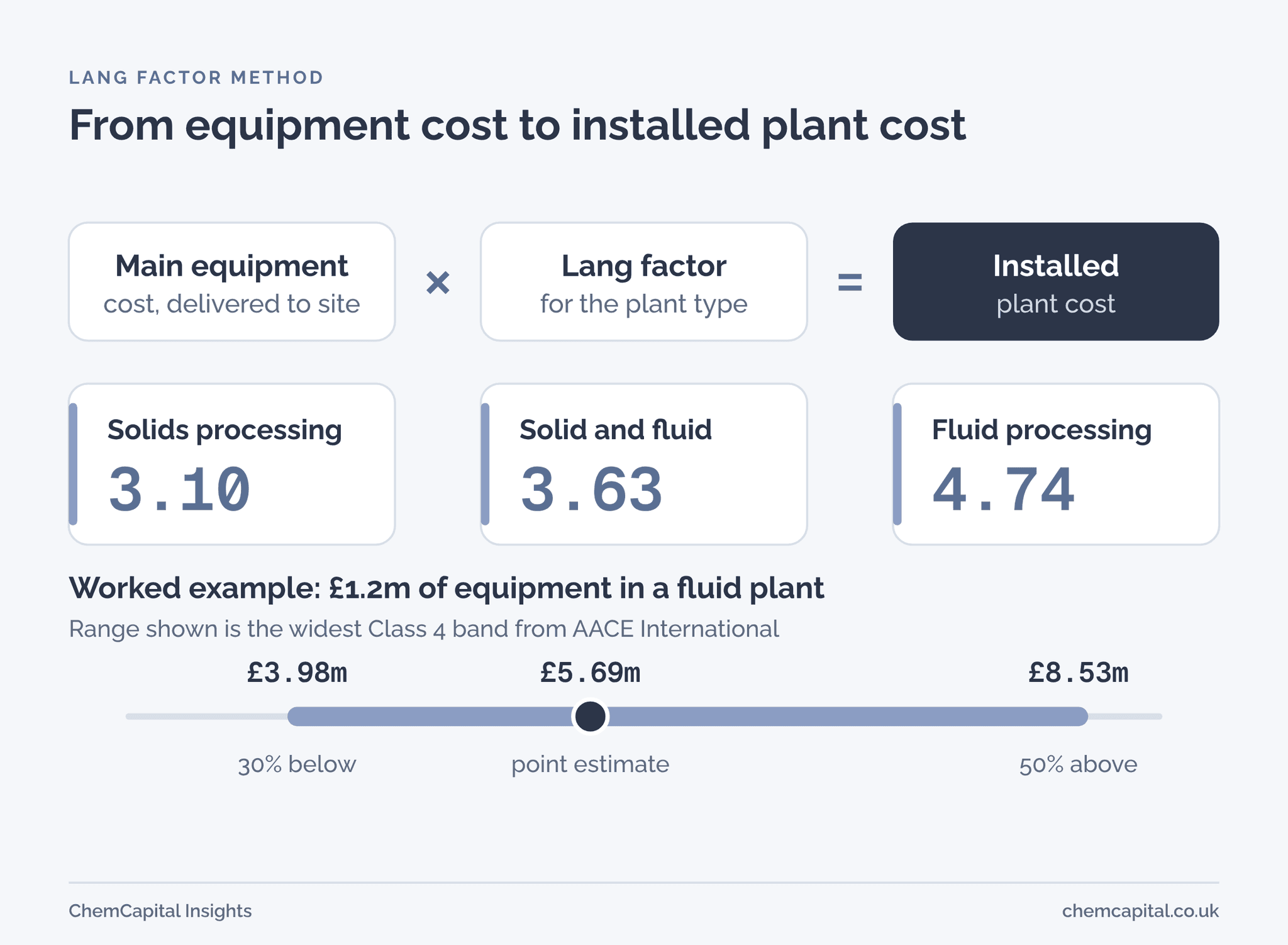
A Lang factor turns a list of equipment prices into a first estimate of what the whole plant will cost to build. You add up the cost of the main equipment, normally taken as delivered to site, and multiply it by 3.10 for a solids plant, 3.63 for a solid and fluid plant or 4.74 for a fluid plant [2]. It is quick, it is rough, and used properly it is still one of the most useful numbers in early project work.
Why this matters now
Most capital projects start with a question nobody can answer precisely yet: roughly what will this cost? Procurement gets pulled in early to sound out suppliers, engineering has a process flow diagram and a draft equipment list, and finance wants a number for the business case.
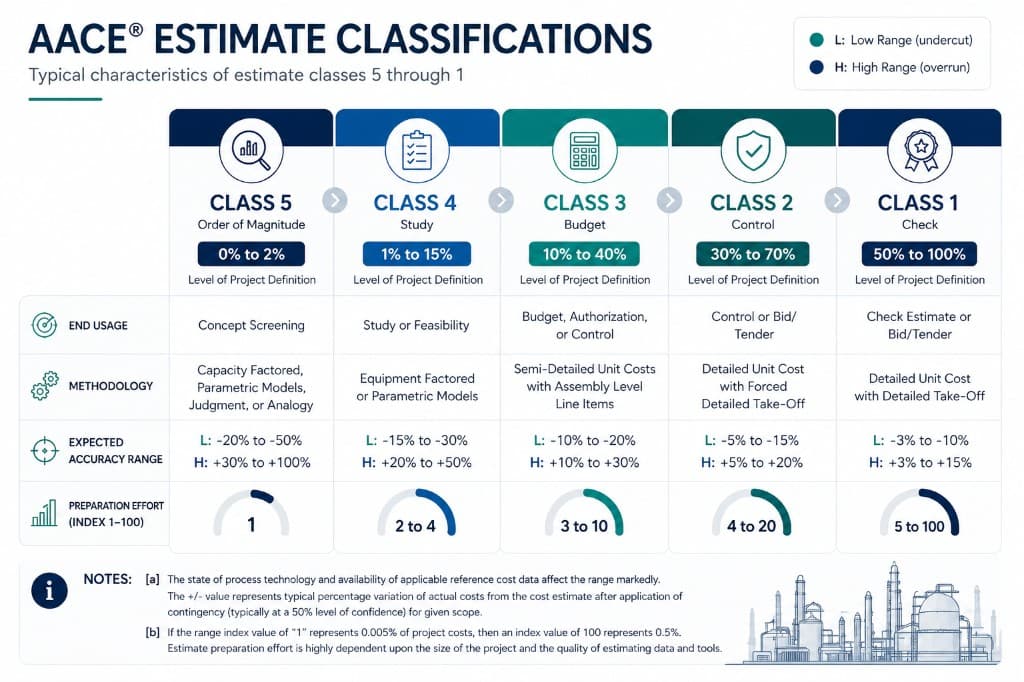
That is exactly the stage the Lang method was built for. AACE International lists equipment factoring as a typical method for a Class 4 estimate, used at the study or feasibility stage. At Class 4 the actual cost may land anywhere from 15% to 30% below the estimate to 20% to 50% above it [1, 2]. With only a thin equipment list it behaves more like Class 5, where the range widens to as much as 50% below and 100% above.
So the point is not precision. The point is a defensible first number, built from real equipment prices, that tells you whether the project is worth the next round of engineering.
Join ChemCapital to streamline sourcing and connect with verified partners
Whether you're buying or supplying, ChemCapital gives you the tools to manage the complete procurement cycle in one platform.
Where the method comes from
Hans J. Lang, an engineer writing in Chemical Engineering magazine in 1947 and 1948, noticed that the total cost of a plant tracked its equipment cost in a fairly steady ratio [2]. Everything else on site scales with the equipment: foundations, structural steel, piping, electrical, instruments, insulation, buildings, engineering, construction overheads and contractor fees.
He grouped plants into three types and published one multiplier for each. Plants that mostly move solids need less piping and fewer instruments, so their factor is lowest. Plants that mostly handle liquids and gases need far more pipework, valves and instrumentation, so their factor is highest.
The formula and the factors
The method is one line:
Installed plant cost = Lang factor × total delivered cost of the main equipment
| Plant type | Typical examples | Lang factor |
|---|---|---|
| Solids processing | Briquetting, crushing, solids handling | 3.10 |
| Solid and fluid processing | Extraction with solids preparation, crystallisation | 3.63 |
| Fluid processing | Distillation, solvent recovery, liquid reactions | 4.74 |
Two details matter more than people expect.
First, use the equipment cost as delivered to site, so include freight. A supplier quote on an ex works basis needs freight added before you apply the factor, and whichever basis you choose, use it for every item.
Second, the answer is the installed cost of the plant. Dysert describes the classic factors as covering the total installed cost, inside and outside battery limits [2]. Land, working capital and the owner's other costs are usually estimated separately, but sources differ on exactly what the factors cover, so state your basis in the estimate rather than leaving it implied.
Where Lang factors go wrong
The factors date from the late 1940s, and much of the published factor data is old [2]. They still work as a sense check, but they mislead in predictable ways.
- Alloy equipment. Installation factors are usually based on carbon steel equipment [3], and the right factor falls when equipment is made from expensive alloys [2]. Applying the full factor to a 316L price overstates the foundations, structural steel and civil works, which cost the same whatever the vessel is made of.
- Equipment size. Larger equipment needs proportionally less bulk material around it, so the factor falls as equipment gets bigger [2]. Very large plants therefore need lower factors and small plants higher ones.
- Pharma and biotech. Cleanrooms, HVAC, validation and utilities change the picture completely. Published bioprocess guidance puts fixed capital at roughly 3 to 10 times equipment cost, with biopharmaceutical facilities at the top of that range [4].
- Revamps. Placing large equipment in an existing facility needs special consideration [2]. Working in a live, congested plant usually costs more than a greenfield site, and no single factor captures that.
- Old prices. A quote from five years ago needs escalating with a published plant cost index, such as the United States index from Chemical Engineering magazine, before it goes anywhere near a factor [3]. Allow for exchange rates too when the estimate is in pounds.
Later refinements, such as Hand's factors for each type of equipment, give more detail [2]. If you have a detailed equipment list, they are worth the extra effort.
Practical example
A team is sizing a new solvent recovery unit, a fluid processing plant. The main equipment list, with delivered prices from recent supplier quotes, looks like this:
| Item | Description | Delivered cost |
|---|---|---|
| C101 | Distillation column with internals | £420,000 |
| E101, E102 | Reboiler and condenser | £260,000 |
| P101A/B, P102A/B | Feed and reflux pumps | £140,000 |
| V101, T101, T102 | Reflux drum and storage tanks | £380,000 |
| Total delivered equipment | £1,200,000 |
Applying the fluid factor: £1,200,000 × 4.74 = £5,688,000 installed cost.
At the widest Class 4 range, that number spans roughly £3.98m (30% below) to £8.53m (50% above); at the narrowest, about £4.83m to £6.83m. That range is not a weakness to hide. It is the honest answer at this stage, and it tells the business how much the next stage of definition is worth.
Notice where the quality of the estimate really comes from: the equipment prices. Four solid quotes on the main items move the whole estimate further than any debate about whether the factor should be 4.74 or 5.0.
Build the equipment number from real quotes
A Lang estimate is only as good as the equipment list underneath it. If your prices come from old spreadsheets, half remembered numbers and one supplier's catalogue, the factor multiplies that weakness by nearly five.
ChemCapital's Project Costing builds the equipment basis from your quote library and marks every line as a firm quotation, a budgetary quote, a historical quote adjusted for date or an indicative figure, so you can see what the total rests on. Where a price is missing or too old, Supplier Discovery helps you find suppliers to quote it. For how factor estimates fit the wider estimate class system, read our guide to AACE estimate classes.
Want your next factored estimate to rest on real quotes? Start a free 14 day ChemCapital trial, with no credit card needed.
Frequently asked questions
What is a Lang factor?
A multiplier that turns the delivered cost of a plant's main equipment into an estimate of the installed plant cost. Hans Lang published the method in Chemical Engineering magazine in 1947 and 1948.
What are the Lang factors for solids, solid and fluid, and fluid plants?
3.10 for solids processing, 3.63 for solid and fluid processing and 4.74 for fluid processing.
How accurate is a Lang factor estimate?
AACE International lists equipment factoring as a typical method for Class 4 estimates, where the actual cost may land anywhere from 15% to 30% below to 20% to 50% above the estimate. With a thin equipment list it is closer to Class 5.
Does a Lang factor estimate include land and working capital?
Usually not. The classic factors cover the total installed cost of the plant. Land, working capital and the owner's other costs are normally estimated separately, so state your basis.
Continue reading
Informational only, not procurement or legal advice. Cited names, frameworks, and statistics belong to their respective owners.
Join ChemCapital to streamline sourcing and connect with verified partners
Whether you're buying or supplying, ChemCapital gives you the tools to manage the complete procurement cycle in one platform.
Get started freeRelated articles
Contingency in Cost Estimates: How Much at Each AACE Class
AACE sets no contingency percentage per estimate class. What contingency covers, why it shrinks, how to set it at P50 or P80, and a worked Class 3 example.
CAPEX Procurement Strategy for Manufacturing Projects
Build a CAPEX procurement strategy that matches package risk and timing to the right market action, supplier engagement model, and cost control discipline.
AACE Estimate Classes Explained for Procurement Teams
Learn how AACE estimate classes help procurement teams match supplier engagement to scope maturity, reduce rework, and run cleaner capital project sourcing.