
Rapid Plant Cost Estimates for Sales Engineers: Days, Not Weeks
How a sales engineer prices an integrated process package in days from historical quotes: escalation, scaling, material and currency adjustments, and a defendable Class 4 budget.
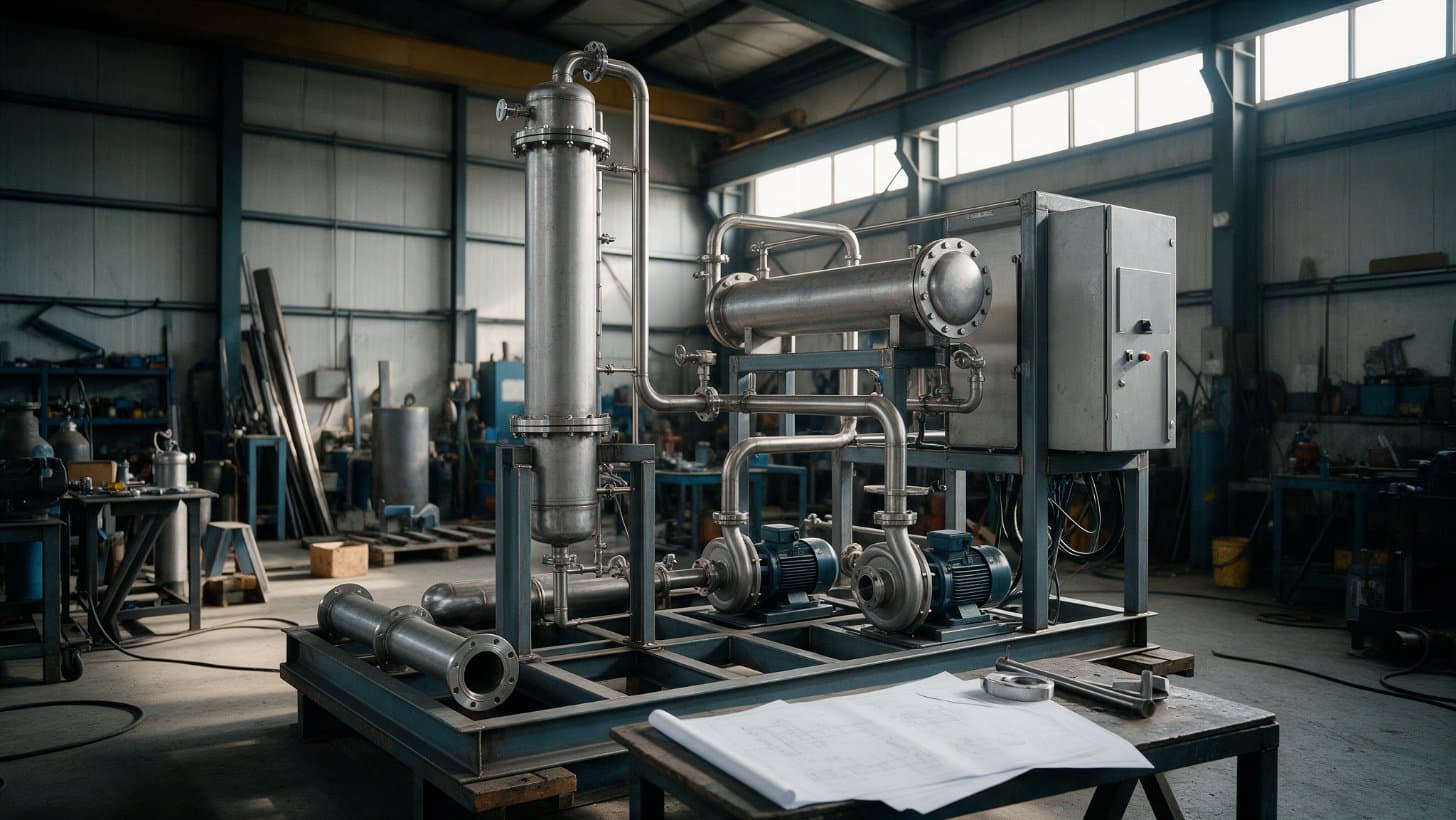
A sales engineer can put a defendable budgetary price on an integrated package in two or three days if three things are in place: a library of past quotations with dates and scope recorded, a short set of published adjustment factors for age, size, material and currency, and the habit of writing down the basis of every line. The result is a Class 4 estimate in AACE International terms, with an expected accuracy of roughly minus 15% to minus 30% on the low side and plus 20% to plus 50% on the high side [1]. That is good enough for a customer to decide whether to proceed, and honest enough that nobody is surprised when the firm price arrives.
The steps below apply to any package built from bought in equipment plus your own fabrication, engineering and margin: a CIP (clean in place) skid, a solvent recovery unit, a small API (active pharmaceutical ingredient) plant module.
Why this matters now
Customers expect a budgetary number within days, often before they have finished their own scope. The supplier who answers first with a credible range and a clear list of exclusions usually sets the frame for the enquiry. The supplier who answers in three weeks with a precise price often finds the budget already set by someone else.
At the same time, the inputs move faster than they used to. Stainless steel prices carry a monthly alloy surcharge on top of the base price, published month by month by mills such as Outokumpu [8]. The pound against the euro ranged between 1.1314 and 1.1934 over the twelve months to 22 October 2026 according to the Bank of England's daily spot series [7], a swing of about 5% on any euro priced line. A quote that was accurate eighteen months ago can be wrong on three counts at once.
Access real procurement opportunities from global buyers
Join ChemCapital to get discovered by verified procurement teams across pharmaceutical, chemical, and industrial manufacturing.
Estimate classes and what a sales engineer uses them for
AACE International Recommended Practice 18R 97 classifies estimates by how mature the project definition is, from Class 5 (0% to 2% defined) to Class 1 (65% to 100% defined). Each class has a typical method and an expected accuracy range at an 80% confidence interval [1]. The table restates the classes in the language of a package supplier.
| Estimate class | Expected accuracy range (AACE 18R 97) | Typical basis for a package | When a sales engineer uses it |
|---|---|---|---|
| Class 5 | minus 20% to minus 50%, plus 30% to plus 100% | Analogy to a similar package, capacity scaled | A phone enquiry: "roughly what does a 500 litre per hour solvent recovery skid cost?" |
| Class 4 | minus 15% to minus 30%, plus 20% to plus 50% | Equipment list priced from historical quotes, own scope factored | A written budgetary price for a customer feasibility study |
| Class 3 | minus 10% to minus 20%, plus 10% to plus 30% | Fresh budgetary quotes on major items, preliminary P&ID and layout | A budget the customer will take to their board for approval |
| Class 2 | minus 5% to minus 15%, plus 5% to plus 20% | Firm supplier quotes, detailed take off of piping, steel and labour hours | A firm proposal with commercial terms |
| Class 1 | minus 3% to minus 10%, plus 3% to plus 15% | Full detailed take off, all purchase orders priced | A check estimate before contract signature |
Source for the ranges: AACE International 18R 97, Table 1 [1]. The "typical basis" and "when used" columns are our interpretation for package suppliers.
The important point is the honest label. A Class 4 number presented as Class 2 damages trust when the firm price lands 25% higher. The same number presented as Class 4, with its range and exclusions, is useful to both sides. Our article on AACE estimate classes covers the classes from the buyer's side.
Building a package price from a historical quote library
Most skid builders already hold the raw material: hundreds of supplier quotations from past projects in email and shared drives. The work is turning a quotation for a different size, alloy, year and sometimes currency into a number you can use today. Six adjustments do most of it.
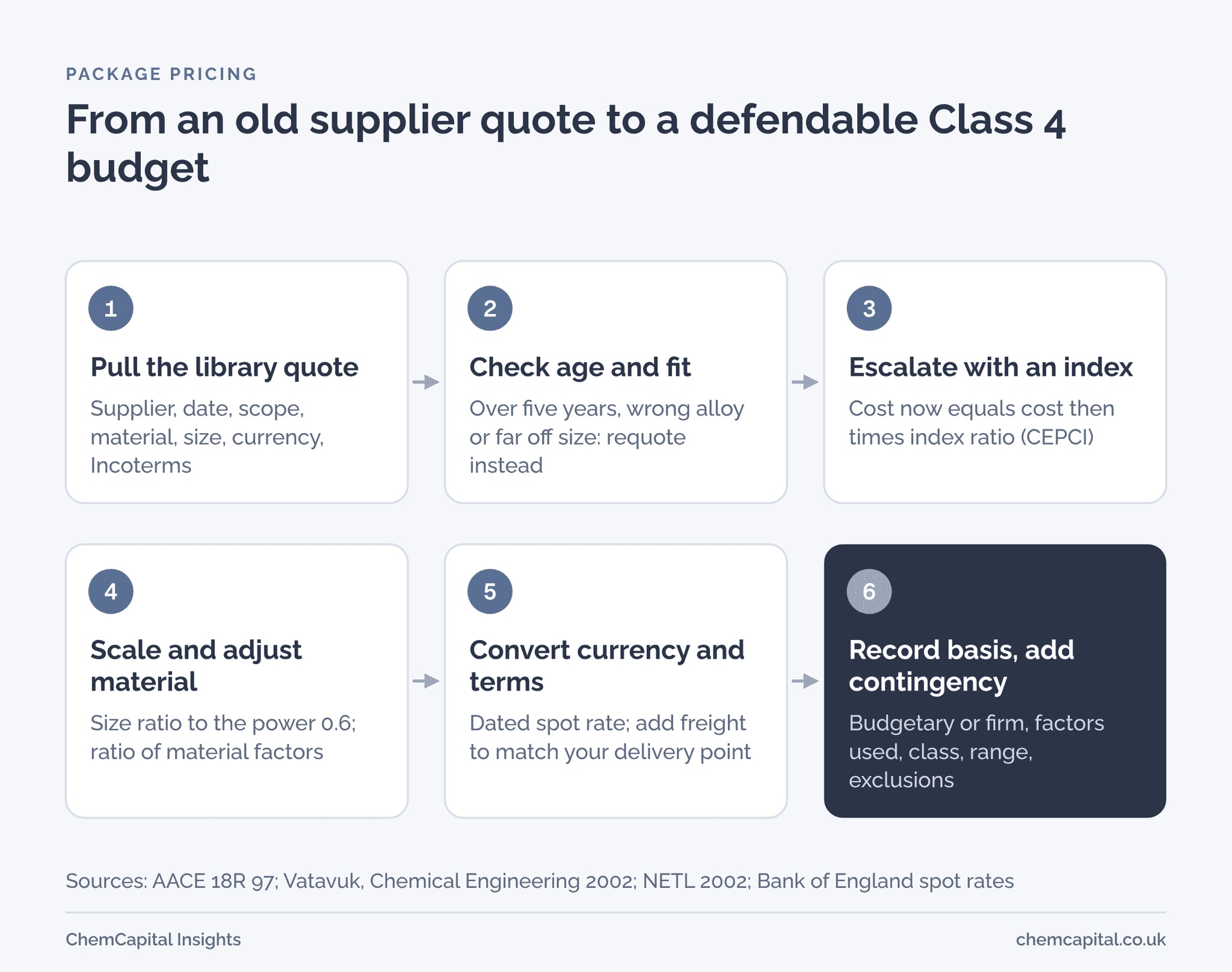
| Adjustment | Formula or rule | Source and notes |
|---|---|---|
| Age (escalation) | Cost now = Cost then × (Index now ÷ Index then) | Chemical Engineering Plant Cost Index (CEPCI), published monthly by Chemical Engineering magazine, composite of equipment, construction labour, buildings, and engineering and supervision sub indexes [3]. Rule of thumb: do not escalate over more than five years [2] |
| Size (capacity) | Cost B = Cost A × (Size B ÷ Size A)^n, with n about 0.6 | Exponent varies from about 0.3 to 0.84 by equipment type; 0.6 is the default when nothing better is known [5]. Doubling capacity at n = 0.6 raises cost by about 52% [5] |
| Material of construction | Cost in alloy = Cost in carbon steel × material factor | NETL (2002), Table 7: relative to carbon steel at 1.00, Type 304 stainless 2.80 and Type 316 stainless 2.90 in the "other equipment" column (vessels, columns and similar); 1.70 and 1.80 in the "pumps" column; shell and tube exchangers have their own factors [4]. Use the ratio of two factors to move between alloys |
| Alloy surcharge | Check the mill's monthly surcharge for the grade | Published month by month; the surcharge passes alloy cost changes down the chain [8] |
| Currency | Cost in GBP = Cost in EUR ÷ spot rate (EUR per GBP) | Bank of England daily spot rates against sterling, 27 currencies [7]. Record the date of the rate used |
| Incoterms and scope | Add or remove freight, packing, insurance, duties and site services to match your delivery term | Match every bought in line to the same delivery point before adding your own scope. See our guide to Incoterms for process equipment |
Three of these deserve a closer look.
Escalation and the five year rule. Vatavuk's 2002 article in Chemical Engineering, which set out the revised CEPCI, gives a rule of thumb limit for cost escalation of five years. Over shorter periods the gap between index predictions and actual prices stays small compared with the normal error of a budget estimate, which he puts at plus or minus 20% to 30%; over longer periods the deviations can become much larger [2]. A quote older than five years is a reference, not a basis. Requote it. Our CEPCI escalation guide walks through the arithmetic.
Scaling and its limits. The six tenths rule is a default, not a law. Seoul National University's design course notes give the exponent range as 0.30 to 0.84 with 0.6 as typical [5]. Dysert, writing for AACE, gives plant level exponents of about 0.5 to 0.85 and notes that the exponent rises towards 1.0 as capacity approaches the limit of existing technology [6]. In practice: scale a column or vessel by the rule with some confidence, scale a pump or control panel with caution, and do not scale across a factor of more than about three without a fresh quote.
Material factors are for small moves. Moving a 304 stainless quote to 316 stainless by the ratio of published factors (2.90 ÷ 2.80, a 3.6% uplift in the NETL table) is reasonable [4]. Moving a carbon steel quote to Hastelloy by a factor is not; the fabrication route, the welding procedure and the mill lead time all change, and even for stainless grades the surcharge changes month by month [8]. Requote.
Factored installed cost versus a skid only package
Textbook factored methods give installed plant cost from purchased equipment cost. Lang factors are 3.10 for solids processing, 3.63 for mixed solids and fluids and 4.74 for fluid processing [5]. Hand factors refine this by equipment type and typically run from 2.0 to 3.5 on direct field cost, or about 2.4 to 4.3 with instrumentation included [6]. Our Lang factor explainer covers the method.
A sales engineer pricing a skid should use these factors for one purpose only: a sanity check. A package supplier does not pour foundations, build the pipe rack, run site cabling or commission the plant. In the worked example below the budgetary price comes out at about 2.2 times the bought in subtotal (equipment plus instruments), well below the fluid processing Lang factor of 4.74, and that is as it should be. If your skid price lands near a full installed cost factor, something is wrong with the equipment list or the own scope allowance. If it lands near 1.3 times equipment, you have probably forgotten the instruments, the panel or the documentation.
What to record so the estimate can be defended
The price will be questioned by the customer, by your commercial manager, or by the project engineer who inherits it after award. Every line needs a basis another person can read without you in the room.
- Line basis. Budgetary or firm. Supplier name. Quote reference and date. Validity period. Whether the number is the original quote, an escalated quote, a scaled quote or a factored allowance.
- Factors applied. Index values and dates used for escalation, the size ratio and exponent, the material factor and its source, the exchange rate and its date.
- Delivery basis. The Incoterms rule on the supplier quote and the rule you are offering the customer, with the freight and packing allowance that bridges them. This is general information, not legal advice.
- Contingency. AACE 18R 97 sets no fixed contingency percentage per class; the amount should come from the project's own risks, and it should fall as the class improves. Our article on contingency at each AACE class explains how to set it.
- Exclusions. Civil works, utilities to battery limit, site installation, commissioning, spares, taxes and duties, anything not on the equipment list. An exclusion list is not defensive; it is the half of the scope the customer most needs to see.
Four pitfalls recur in package estimates and are worth a standing check:
- Alloy surcharges. A stainless or duplex quote from a quiet month in the nickel market will understate a quote placed in a busy one. Check the current month's surcharge for the grade before you commit; Outokumpu says that from January 2027 its European monthly surcharges will be published only to registered customers through its online portal [8].
- Instrumentation and controls. A manually operated skid and a fully automated package with sensors, control panel and plant control system integration are different products with different prices, and the difference is easy to underestimate when the customer's specification is thin [9].
- Documentation and FAT hours. Codes, CE marking, hazardous area rules and client specific requirements add engineering, compliance and testing work; witnessed tests and third party inspection add cost on top of standard hydrostatic and functional tests [9]. Price the hours, not a percentage.
- Freight and packing for export. Size, weight and destination drive logistics; oversized loads and remote sites add expense [9]. Price export packing, lashing and the lift separately from road freight, and check the width limit for the route before the frame is designed.
Practical example
A UK skid builder is asked for a budgetary price on a solvent recovery skid: packed column, overhead condenser, reflux and product pump, and reboiler, in 316 stainless, delivered to a UK site. The library holds four relevant records. All figures are illustrative. The index values are invented for the example and are not published CEPCI figures; use the real index for a customer.
Illustrative index values used throughout: 790 (2022), 800 (2023), 840 (2025), 850 (current).
| Line | Library record | Adjustments | Result (illustrative) | Basis recorded |
|---|---|---|---|---|
| Packed column | 2023 budgetary quote, £84,000, 304 stainless, 15 m³ packed volume | Escalate 850 ÷ 800 = 1.063 → £89,250. Scale to 22.5 m³: 1.5^0.6 = 1.275 → £113,800. Material 304 to 316: 2.90 ÷ 2.80 = 1.036 → £117,900 | £117,900 | Historical, escalated, scaled, material adjusted. Three years old. Validity expired |
| Condenser | 2022 budgetary quote, £22,000, 304 shell and tube, 40 m² | Escalate 850 ÷ 790 = 1.076 → £23,700. Scale to 64 m²: 1.6^0.6 = 1.326 → £31,400. Material unchanged (304 acceptable for condenser duty) | £31,400 | Historical, escalated, scaled. Four years old, inside the five year limit but flagged for requote before firm price |
| Pump, duplex | 2025 firm quote, €9,800 EXW Germany | Convert at 1.1934 EUR per GBP → £8,210. Escalate 850 ÷ 840 → £8,310. Add freight and packing EXW to UK site, allowance £400 → £8,710, rounded to £8,700 | £8,700 | Historical, currency converted, escalated, delivery term adjusted. Rate dated 22 October 2026 |
| Reboiler | Only record is 2018, carbon steel, 8 years old | Outside the five year rule and wrong material. RFQ issued to two suppliers; budgetary reply received in two days | £26,500 | Budgetary, current, valid 30 days |
Bought in equipment comes to £184,500. Instruments, valves and the control hardware are priced from a current distributor price list at £31,000, firm. Bought in subtotal: £215,500.
Own scope, from the builder's own hours and rates: skid frame and fabrication £38,000; process piping and insulation £42,000; electrical, panel and control system £26,000; engineering, drawings and documentation £22,000; FAT and testing £9,000; project management £11,000; export packing and delivery to site £6,500. Own scope subtotal: £154,500.
Base cost: £370,000. Contingency at 15%, a figure chosen for this example from the project's own risk list (the condenser and column are both historical, the reboiler is budgetary): £55,500. Cost with contingency: £425,500. Margin at 12%: £51,100. Budgetary price: £476,600, Class 4, stated as a range of about £380,000 to £620,000 (minus 20% to plus 30%, inside the AACE Class 4 band [1]), valid for 60 days, delivered to site, excluding civils, utilities, installation and commissioning.
Two checks before it goes out. The price is 2.2 times the bought in subtotal of £215,500, consistent with a supply only package and well below an installed cost Lang factor [5]. And the 316 column price assumes this month's alloy surcharge; if the customer takes six months to decide, that line is the first to requote.
Where ChemCapital fits
ChemCapital Project Costing does the work above from a library of your historical quotations. Upload past supplier quotes, and each becomes a reusable, traceable pricing basis. The platform reprices each line for currency, cost index, geography, Incoterms, quantity and material, with every adjustment shown. The cost dashboard separates firm quotes, repriced estimates, indicative values and unquoted items, so the basis of each line is never in doubt. Lines that are stale or missing, like the 2018 reboiler, can be turned straight into an RFQ to suppliers found through Supplier Discovery.
For the equipment suppliers on the other side of those RFQs: a verified company profile and detailed product listings mean buyers and skid builders using AI supplier discovery can find and invite you to quote even if they have never heard of you. Budgetary and firm quotations are submitted in one form with line items, assumptions and attachments, with a revision history, so the basis you give is the basis they record.
Ready to be found by the buyers already looking for what you make? List your company on ChemCapital. It is free to start.
Frequently asked questions
How old can a supplier quote be before I have to requote it?
A widely used rule of thumb, set out by Vatavuk in Chemical Engineering, is that cost index escalation is reliable for up to about five years. A quote older than that, or one in a different material or far outside the size range, is a reference only and should go out as a fresh RFQ.
Should I apply a Lang factor to price a skid?
No. Lang and Hand factors estimate fully installed plant cost including civils, site piping and commissioning, which a package supplier does not provide. Build the skid price from bought in equipment plus your own fabrication, engineering, testing and documentation hours, and use the installed cost factor only as a sanity check.
How much contingency belongs in a Class 4 budgetary price?
AACE sets no fixed percentage; contingency should come from the specific risks in your estimate, such as how many lines rest on old or scaled quotes. State the class and its expected accuracy range alongside the single figure so the customer understands what the number can and cannot bear.
Continue reading
Informational only, not procurement or legal advice. Cited names, frameworks, and statistics belong to their respective owners.
Access real procurement opportunities from global buyers
Join ChemCapital to get discovered by verified procurement teams across pharmaceutical, chemical, and industrial manufacturing.
List your companyRelated articles

CEPCI: How to Escalate an Old Equipment Quote to Today's Prices
How to bring an old equipment quote up to date with the CEPCI: the index ratio, the six tenths rule, currency for UK buyers and the pitfalls to check first.
Contingency in Cost Estimates: How Much at Each AACE Class
AACE sets no contingency percentage per estimate class. What contingency covers, why it shrinks, how to set it at P50 or P80, and a worked Class 3 example.
Lang Factor Method Explained: From Equipment Cost to Plant Cost
The Lang factor turns a list of equipment prices into a first estimate of plant cost. Here are the factors, the formula, the accuracy and where it goes wrong.