
Pressure Vessel and Process Datasheets for Quotations
The difference between a process and a mechanical datasheet for vessels, the fields a fabricator needs to quote, and the omissions that cause requotes.
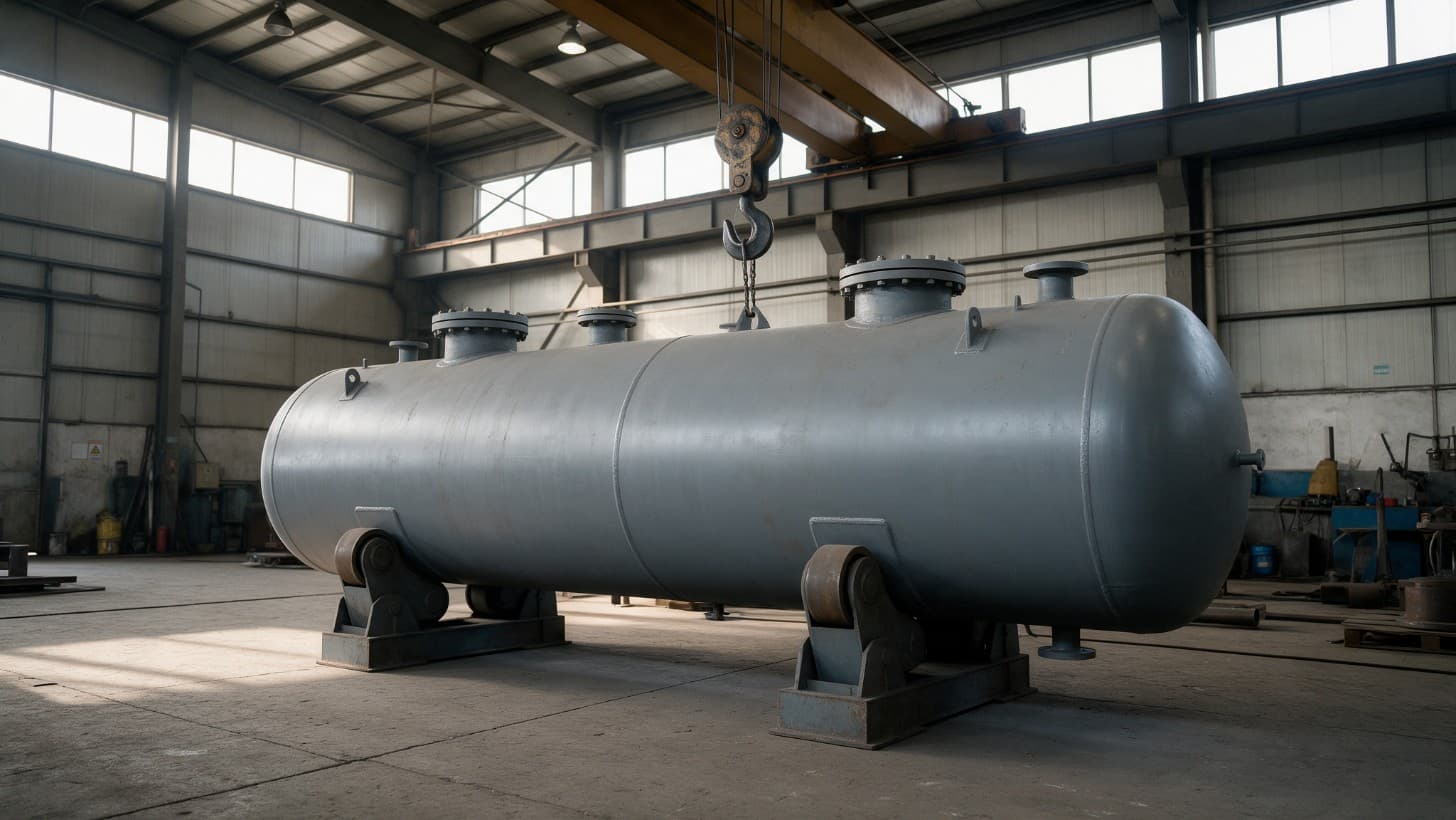
A pressure vessel normally has two datasheets. The process datasheet says what the vessel must do: its service, working volume, operating and upset conditions, the fluid, and the duty of each connection. The mechanical datasheet turns that into a design basis a fabricator can price: design code, design pressure and temperature, MDMT, corrosion allowance, materials, nozzle schedule, internals, supports, inspection and testing, conformity marking and documents. Fabricators quote from the mechanical datasheet, and each blank on it becomes an assumption in their price.
Get both right and three bidders quote the same vessel. Leave gaps and you get three different vessels and a round of requotes.
Why this matters now
The rules a fabricator works to keep moving. ASME's Section VIII Division 1 rules for pressure vessels are now in their 2025 edition [1], so your datasheet should name the edition as well as the code. In Great Britain, 2024 amendments to the Pressure Equipment (Safety) Regulations 2016 extended recognition of CE marking indefinitely, while UK approved bodies can only assess equipment for UKCA marking [2]. A datasheet that just says "PED" no longer tells a bidder which marking, and which assessment body, you expect.
Create and manage RFQs in minutes
ChemCapital handles the entire procurement cycle, from structured RFQs and supplier comparisons to formal purchase orders and delivery tracking.
Process datasheet versus mechanical datasheet
The Journal of Petroleum Technology describes the split well: the process engineer passes a process datasheet to the static equipment engineer, defining the design conditions and the basic material of construction, and the vessel is then specified and bought from there [3]. On larger projects the user's mechanical datasheet is a formal document; the Process Industry Practices form PIP VEDV1003, for example, is a user supplied vessel drawing and datasheet with instructions, used to support bids and purchasing of vessels built to ASME Section VIII [4].
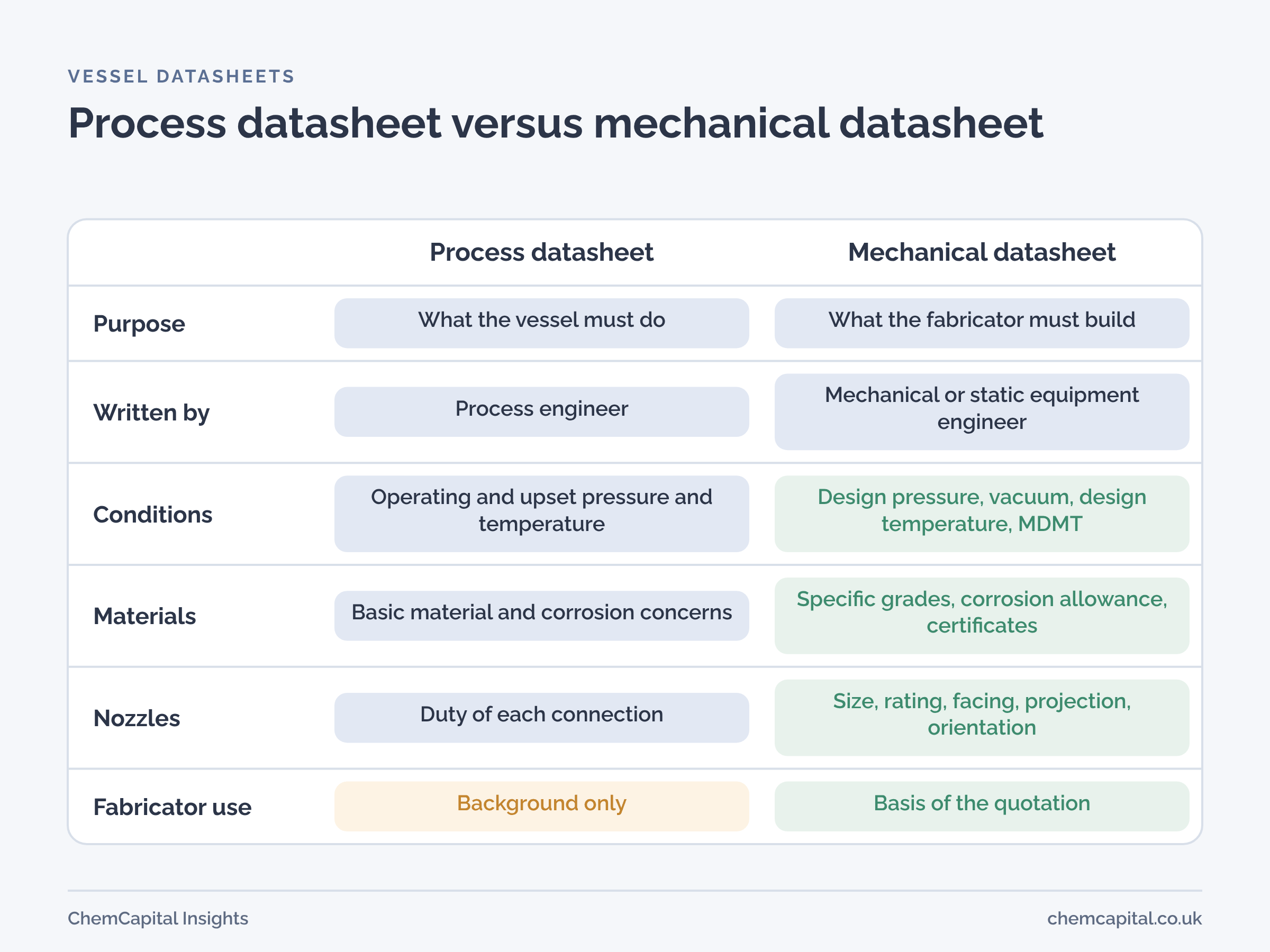
On small projects one combined sheet is fine, as long as every mechanical field is filled.
The fields a fabricator needs to quote
| Field | What to give | Common omission |
|---|---|---|
| Tag, service, quantity | As on the P&ID and equipment list | Tag differs from the P&ID |
| Design code and edition | For example ASME VIII Division 1, 2025; EN 13445; PD 5500 | Code given, edition missing |
| Design pressure | Internal, and external if vacuum is possible | Full vacuum not stated |
| Design temperature | Maximum, at the design pressure | Steam out or cleaning temperature forgotten |
| MDMT | Lowest metal temperature at full pressure | Left blank, so the fabricator picks one |
| Fluid and fluid group | Fluid, gas or liquid, and group 1 or 2 for PED or PER | Group not stated, so the category is guessed |
| Corrosion allowance | Shell, heads, nozzles and internals | One value only |
| Materials and certificates | Grades for shell, heads, nozzles, flanges, bolting, gaskets | Certificate type not stated |
| Dimensions and capacity | Inside diameter, length between tangent lines, head type, orientation | Working volume given, geometry not |
| Nozzle schedule | Mark, service, size, rating, facing, projection, orientation | Projections and orientations missing |
| Internals | Type and who supplies them | Supplier of internals not decided |
| Supports and attachments | Saddles, legs, skirt or lugs; clips for platforms and insulation | Clips left for later |
| Inspection and testing | Radiography extent, heat treatment, test pressure basis, hold points | Test basis not stated |
| Marking and assessment | UKCA, CE or both; ASME stamp if wanted | "PED" only |
| Documents | Vendor document list and final data book | List sent after award |
A few fields deserve more than a line.
MDMT, the minimum design metal temperature, is the lowest metal temperature allowed at the vessel's maximum allowable working pressure [5]. It sets the material and whether impact testing is needed. Include cold weather, rapid depressurisation and any cold process stream.
Fluid group and category. Under the GB regulations, the manufacturer classifies equipment from the fluid's state and group and the maximum allowable pressure, with volume for vessels [2]; the EU directive works the same way and lists its notified bodies in the NANDO database [6]. You cannot expect a bidder to classify correctly if the datasheet hides the fluid. Our guide to PED and PER 2016 categories shows the tables.
Internals and clips. JPT recommends choosing internals early, preferably before the vessel itself is ordered, because their weights and loads feed the vessel design. It also suggests asking bidders for unit rates for clips and for nozzle changes, since both tend to change after order [3].
Test pressure. State the basis rather than a number where you can; our article on hydrostatic test pressure explains how each code sets it.
Omissions that cause requotes
- No external design pressure on a vessel that can be pumped empty or steamed out.
- No MDMT, so one bidder prices impact tested plate and another does not.
- No nozzle projections or orientations, so the fabricator reprices after the piping layout arrives.
- Code without edition, or a code that does not match the marking you need. See ASME VIII, PD 5500 and EN 13445 compared.
- Vendor document list sent after award, which adds cost the bid never included.
Practical example
This simplified, illustrative example shows why two datasheet fields move the price. A carbon steel vessel has an inside diameter of 1,500 mm and a cylindrical shell 3,000 mm long. Assume an allowable stress of 138 MPa, a weld joint efficiency of 0.85 for spot radiography, and a 3 mm corrosion allowance.
Using the Division 1 formula for a cylinder under internal pressure, thickness equals pressure times radius divided by (stress times joint efficiency minus 0.6 times pressure):
| Design pressure | Pressure thickness | Plus 3 mm allowance | Plate chosen | Shell weight |
|---|---|---|---|---|
| 6 bar g (0.6 MPa) | 3.9 mm | 6.9 mm | 8 mm | about 890 kg |
| 10 bar g (1.0 MPa) | 6.4 mm | 9.4 mm | 10 mm | about 1,110 kg |
Raising the design pressure from 6 to 10 bar g adds about 25% more steel to the shell, before heads, nozzles and flanges move up a rating. If one bidder quotes on 6 bar g because the process datasheet showed operating pressure only, and another quotes on 10 bar g from the mechanical datasheet, their prices are not comparable.
Where ChemCapital fits
ChemCapital sends one structured RFQ with line items and attachments, such as your mechanical datasheet, nozzle schedule and document list, to several fabricators at once, and quotes come back in a consistent format. Incoming quotes are checked for missing fields, unit mismatches and scope differences, so a bid priced on a different design pressure is easier to spot before you compare prices.
Ready to get vessel quotes that price the same vessel? Start a free 14 day ChemCapital trial, with no credit card needed.
Frequently asked questions
What is the difference between a process datasheet and a mechanical datasheet?
The process datasheet says what the vessel must do: service, volume, operating and upset conditions, fluid and nozzle duties. The mechanical datasheet turns that into a design basis a fabricator can price, with code, design conditions, MDMT, corrosion allowance, materials, nozzle schedule, supports, testing and documents.
What information does a fabricator need to quote a pressure vessel?
At minimum: design code and edition, design pressure and temperature including vacuum, MDMT, corrosion allowance, materials, dimensions, a nozzle schedule, internals, supports, inspection and testing requirements, the conformity marking needed and the document list. Each missing item becomes an assumption that can change the price later.
What is MDMT on a vessel datasheet?
MDMT is the minimum design metal temperature, the lowest metal temperature allowed at the vessel's maximum allowable working pressure. It drives material choice and impact testing, so it must cover cold weather, depressurisation and any cold process conditions.
Continue reading
Informational only, not procurement or legal advice. Cited names, frameworks, and statistics belong to their respective owners.
Create and manage RFQs in minutes
ChemCapital handles the entire procurement cycle, from structured RFQs and supplier comparisons to formal purchase orders and delivery tracking.
Start for freeRelated articles
Heat Exchanger Datasheet Explained Line by Line (TEMA)
What each line of the TEMA shell and tube specification sheet means, which lines the buyer must fill, and which the thermal designer returns with the quote.

How to Fill In a Centrifugal Pump Datasheet for an RFQ (API 610)
A field by field guide to the buyer's side of an API 610 pump datasheet: liquid, flows, pressures, NPSH, scope, and what to check when bids come back.
Commercial Bid Evaluation: Levelling Price, Terms and Exclusions
How to level technically accepted equipment bids onto one basis: exclusions, options, delivery, payment terms, currency, warranty and lifetime costs, with a worked table.