
RFI Template for Equipment Suppliers (Request for Information)
When to send a request for information before an RFQ for process equipment, what to ask, how to score the replies, and a template you can copy.
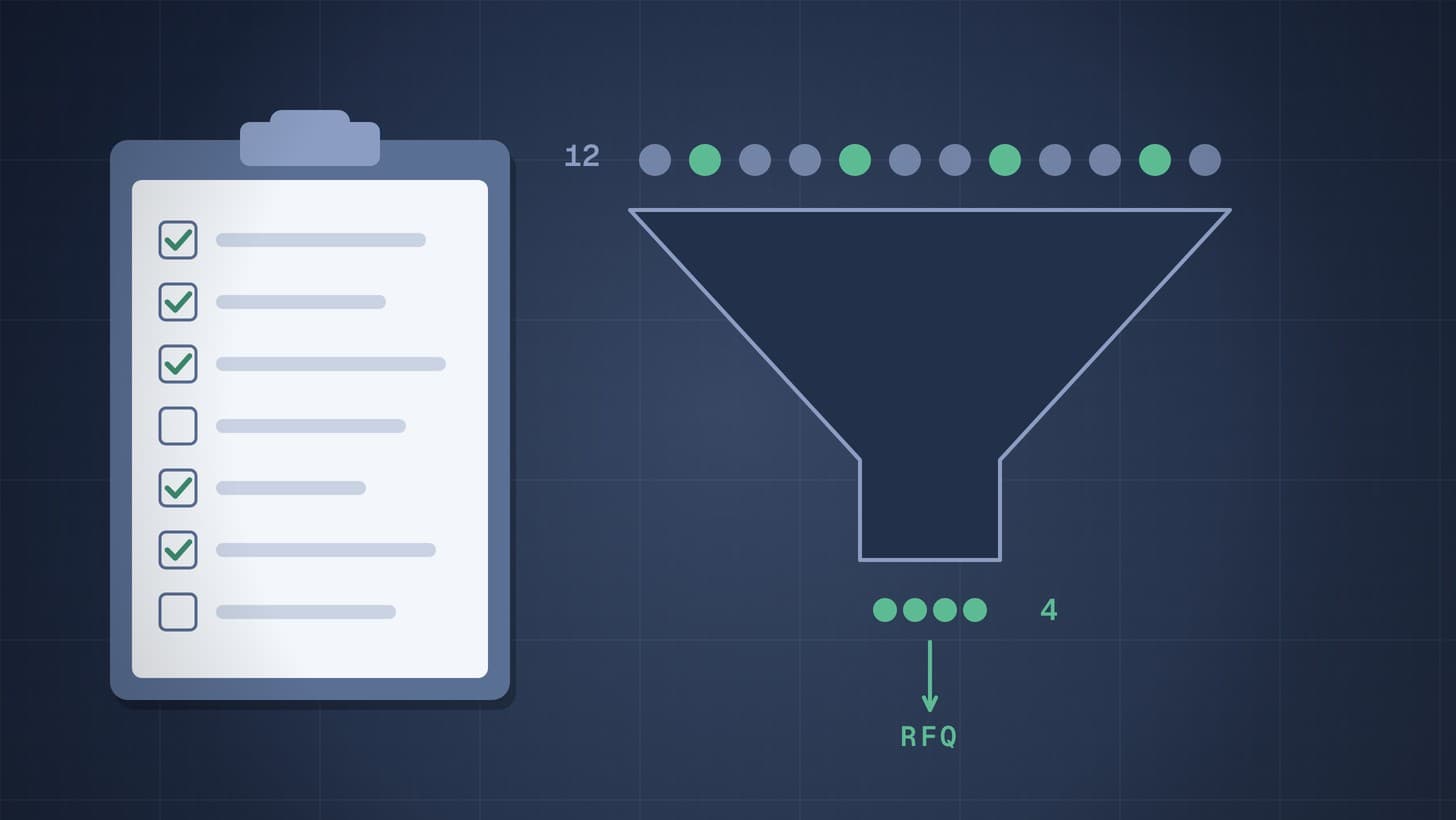
An RFI (request for information) in procurement is a short questionnaire sent to potential suppliers before an RFQ, to find out who can do the work: their capability, references, capacity, certifications, quality system, lead times, locations and aftermarket support. It is not a request for prices and not a commitment to buy. Its job is to turn a long list into a shortlist of three to five suppliers worth inviting to quote.
In construction, "RFI" also means a contractor's question to the designer about missing or unclear information [1]. This article uses the procurement sense.
Why this matters now
Buyers are widening their supplier base. In Deloitte's 2025 survey of chief procurement officers, 74% named finding alternative supply sources as the most effective way to reduce supply risk [2]. New suppliers need checking before they get an RFQ, and an RFI does that cheaply.
Public buyers have rules to follow. UK guidance on preliminary market engagement under the Procurement Act 2023, updated in July 2026, says engagement must not give any supplier an unfair advantage, that conflicts of interest must be identified and managed, and that the authority should keep a record of the information shared and received [3].
Create and manage RFQs in minutes
ChemCapital handles the entire procurement cycle, from structured RFQs and supplier comparisons to formal purchase orders and delivery tracking.
When to send an RFI
- The supplier market is new to you, or the equipment is unusual.
- The item is regulated or critical, so suppliers need assessing before they bid.
- The long list is too long for everyone to receive a full RFQ.
- You need to know realistic lead times or capacity before fixing the programme.
If you already have three to five qualified bidders, skip the RFI and go to the RFQ.
The RFI template
Keep it short: two or three pages and a reply in two weeks get better responses than a 40 question form.
| Section | What to ask | Evidence to request |
|---|---|---|
| Company | Legal name, registration number, ownership, manufacturing sites | Registration details |
| Capability | Products, size and pressure range, materials, design codes worked to | Datasheets or brochures |
| References | Two or three similar supplies in recent years, with a contact | Reference list |
| Capacity | Current workshop load, typical lead time for this type of item | Short statement |
| Quality | Certificate number and certification body for the quality system | Certificate copy |
| Pressure equipment | Notified or approved body used, if relevant | Body name and number |
| Compliance | Declaration on sanctions and export restrictions | Signed declaration |
| Financial | Latest filed accounts | Accounts or registry reference |
| Aftermarket | Spares stock, service engineers, response times in your region | Service locations |
| Commercial basics | Currencies and delivery terms usually offered, not prices | Short statement |
| Contact | Named sales and technical contacts | Names and emails |
Check what you receive rather than taking it on trust. Search quality certificates on IAF CertSearch or ask the certification body, because ISO itself certifies nobody [4]. For UK companies, read the filing history and insolvency records at Companies House, which are free [5]. Screen the company and its owners against the UK Sanctions List, now the single source for UK designations [6].
Scoring the replies
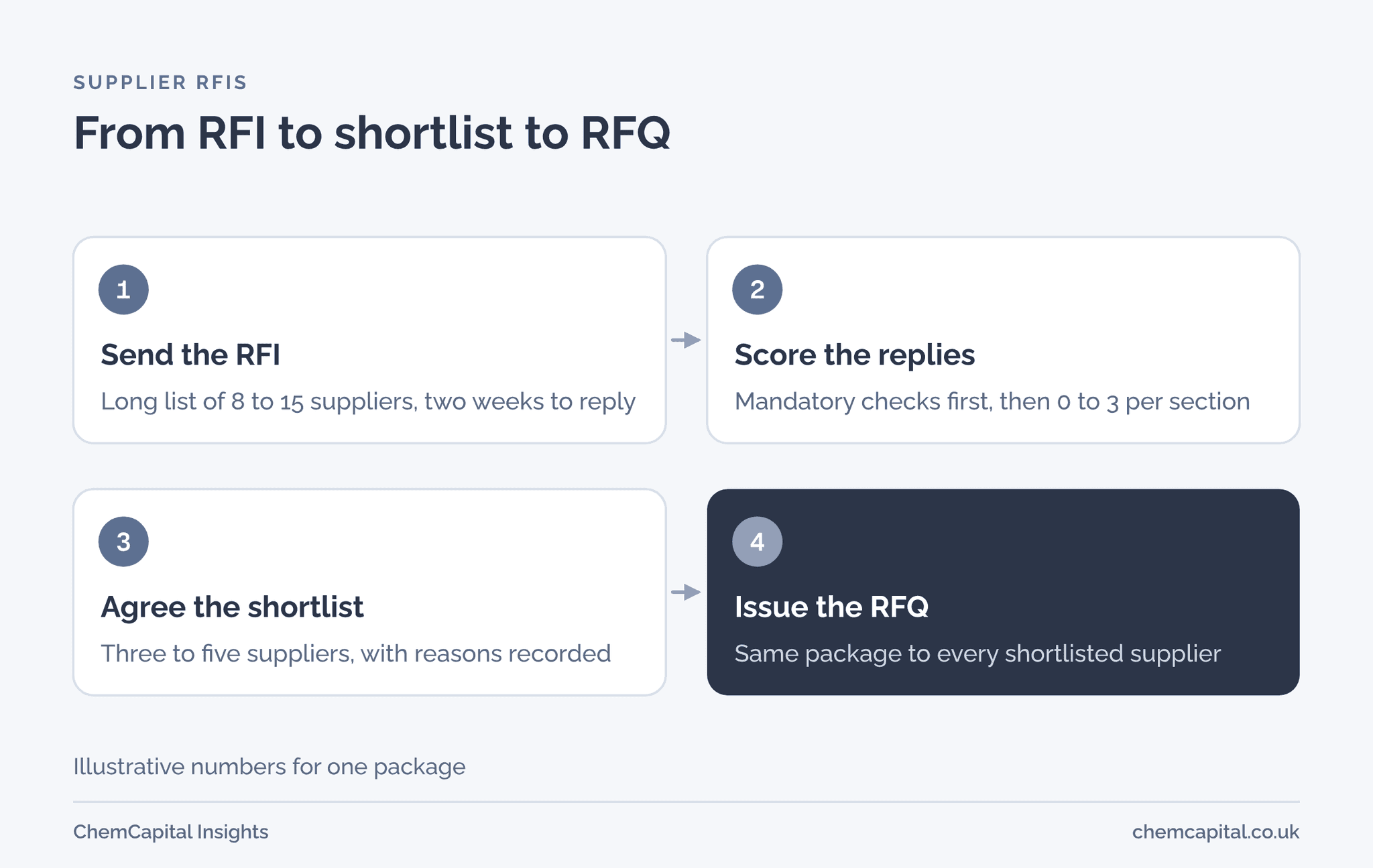
Mark a few items as mandatory, such as the right design code, a valid quality certificate and a clean sanctions check. Score the rest from 0 to 3 per section: 0 for no answer, 1 for weak, 2 for adequate and 3 for strong. Add the scores, rank the suppliers that passed the mandatory items, and record why each shortlisted supplier was chosen. Tell unsuccessful suppliers promptly; they may suit the next package.
Practical example
In this illustrative example, a buyer sends an RFI for a jacketed reactor to 12 suppliers. Nine reply within two weeks. Four fail a mandatory item: two have no experience of pressure equipment to the required code, one has no service presence in the UK, and one declines. That leaves five, scored between 14 and 26 out of 30. The top four receive the RFQ, and the fifth is kept on file. The whole exercise took about a week of desk time and avoided sending a full RFQ package to eight suppliers who would not have been chosen.
For building the long list in the first place, see how to find and vet process equipment suppliers.
Where ChemCapital fits
Supplier Discovery builds the long list from a plain text description, a pasted RFQ or an uploaded spec, searching the open web and returning each supplier with the address where it was found and its published product parameters. Certifications are shown as the supplier claims them, not verified, so the checks above still apply. Shortlisted suppliers can then receive a structured RFQ, including suppliers not yet on the platform.
Ready to build your next supplier shortlist faster? Start a free 14 day ChemCapital trial, with no credit card needed.
Frequently asked questions
What is the difference between an RFI and an RFQ?
An RFI asks suppliers for information about their capability, references, capacity and quality, so you can decide who to invite. An RFQ asks the chosen suppliers for a price against a defined specification.
When should I send an RFI for equipment?
When the supplier market is new to you, the equipment is novel or regulated, or your long list is too long to send an RFQ to everyone. If you already have three to five qualified bidders, go straight to the RFQ.
Should an RFI ask for prices?
Usually not. Asking for prices before the scope is defined produces numbers that cannot be compared and wastes suppliers' time. Ask for typical lead times and commercial basics instead, and save pricing for the RFQ.
Continue reading
Informational only, not procurement or legal advice. Cited names, frameworks, and statistics belong to their respective owners.
Create and manage RFQs in minutes
ChemCapital handles the entire procurement cycle, from structured RFQs and supplier comparisons to formal purchase orders and delivery tracking.
Start for freeRelated articles

Commissioning and Qualification: ASTM E2500 vs Traditional IQ OQ PQ
How the science and risk based ASTM E2500 approach differs from traditional IQ, OQ and PQ, who does what, how vendor tests can be reused, and what to put in the RFQ.

GAMP 5 Software Categories for Bought In Skids and Control Systems
GAMP 5 software categories 1, 3, 4 and 5 in plain words, mapped to the skids, instruments and control systems a buyer actually orders, with what to ask suppliers for.
Audit Trail Requirements in GMP: What a Compliant Record Must Capture
What EU Annex 11, 21 CFR Part 11 and MHRA guidance require of an audit trail, what audit trail review means in practice, and worked entries for a procurement record.