
RFQ and Sourcing Software for Engineered Equipment, Compared Honestly
What buyers of engineered equipment need from sourcing software, the four kinds of tool on offer with their real strengths and limits, and a checklist for choosing.

Buying engineered equipment is different from buying office supplies: each purchase is a package with datasheets, technical questions, a technical then commercial evaluation, vendor documents after award and, in regulated plants, an audit trail. Four kinds of tool compete for this work: sourcing modules inside large procurement suites, standalone sourcing tools, supplier directories and marketplaces, and spreadsheets with email. Each fits some teams well; the right choice depends on your volume, your ERP, whether you work under GMP, and how engineered your purchases are.
ChemCapital makes one of these tools, so treat this article as a well informed view, not a neutral one. We have tried to be fair, and the selection checklist works for any product.
Why this matters now
Supply risk has made sourcing tools a board topic. In Deloitte's 2025 global survey of chief procurement officers, 74% named finding alternative supply sources as the most effective way to mitigate risk, and the leaders in the survey met or beat their cost saving plans far more often than the rest, 96% against 80% [1]. For equipment buyers, alternative sources means new suppliers for engineered items, which is where many tools are weakest. For more on the wider shift, see what procurement 4.0 means.
Create and manage RFQs in minutes
ChemCapital handles the entire procurement cycle, from structured RFQs and supplier comparisons to formal purchase orders and delivery tracking.
What engineered equipment needs from a tool
| Need | Why it matters | What to ask a provider |
|---|---|---|
| Line items with datasheets and drawings | Bidders price the attachments, not the title | Can each line carry its own documents and revisions? |
| Technical questions log | Answers change scope and must reach every bidder | Where are questions logged, and who sees answers? |
| Technical then commercial evaluation | Mandatory failures must exclude a bid whatever its price | Can a bid fail a mandatory check and drop out of the ranking? |
| Finding new suppliers | Approved lists rarely cover every engineered item | Can it search beyond our vendor list, with sources? |
| Quote revisions kept | Negotiation history must be visible | Is every revision kept and comparable? |
| Orders, milestones and vendor documents | Most of the effort comes after award | Does the record continue after the purchase order? |
| Audit trail | Regulated buyers need who, what, when and why | Can the audit trail be exported and reviewed? |
Under GMP, the last row is not optional. MHRA expects audit trails to record who created, changed or deleted a record, when and why, and expects companies to review the data governance of the suppliers whose systems hold their records [2].
The four kinds of tool
Sourcing modules in procurement suites
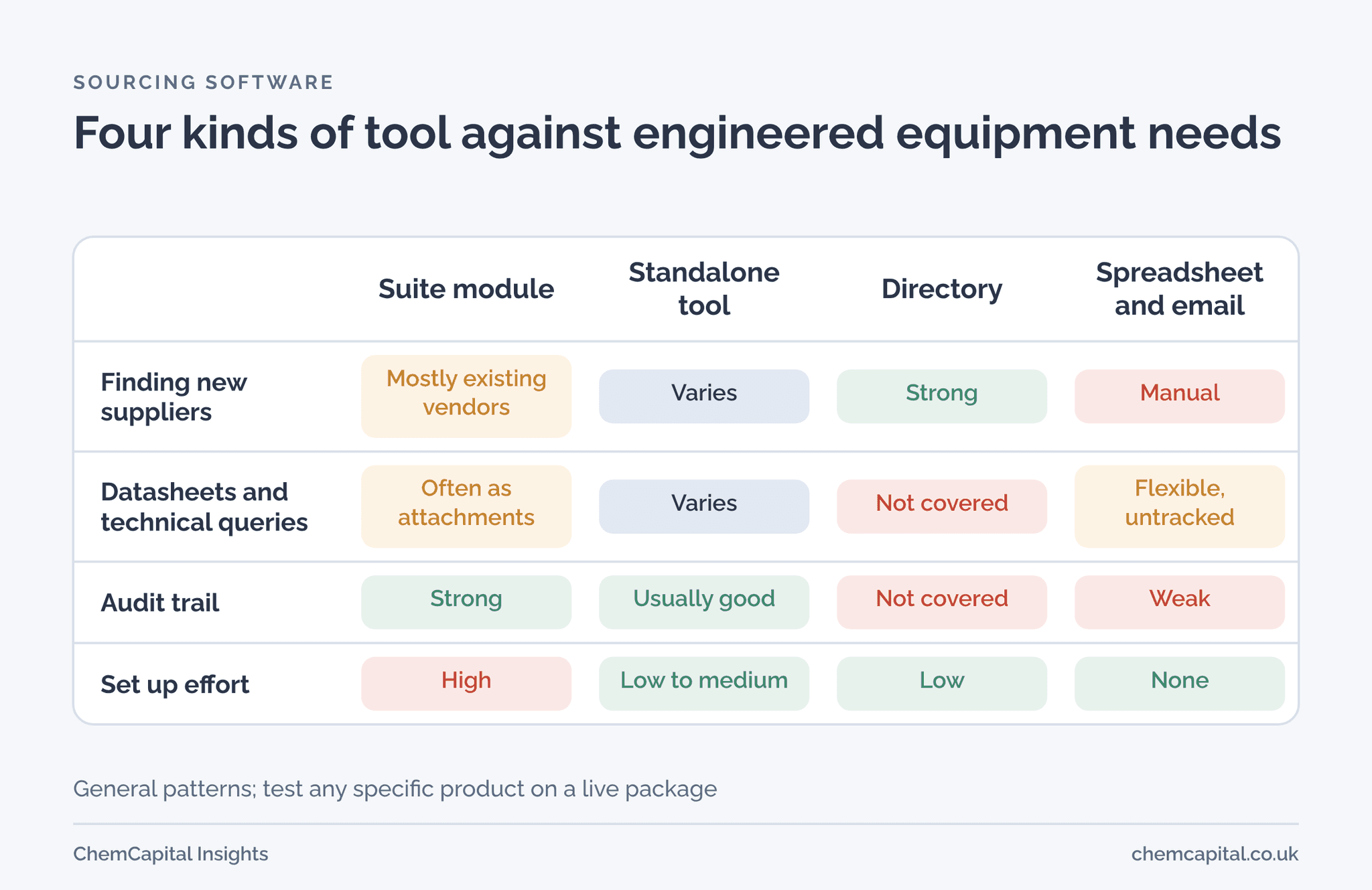
Large source to pay suites, such as SAP Ariba or Coupa, cover sourcing, contracts, catalogues, purchasing and spend analysis in one place, tied to the company's ERP. Their strengths are integration, control and a single company standard. Their limits for engineered equipment are usually practical rather than technical: they are configured for high volumes of standard purchases, engineering documents often travel as attachments, technical evaluation may happen offline, and changing the configuration needs IT time.
Standalone sourcing tools
Standalone e sourcing tools are quicker to start, with structured RFQs, bid collection and often reverse auctions. They suit teams without a suite or with needs the suite does not meet. Many are general purpose, so check how they handle technical schedules and evaluation; auctions rarely suit engineered equipment, where the cheapest bid may not meet the specification.
Supplier directories and marketplaces
Directories are good at discovery: broad listings, filters by product and region, and often free to search. Listings are written by suppliers, ranking can be influenced by paid placement, and there is no RFQ, evaluation or record keeping behind them. They feed a long list; they do not run a tender.
Spreadsheets and email
Spreadsheets are flexible, free and understood by everyone, and for a few packages a year they are often the sensible choice. The risks scale with volume. A review of spreadsheet research presented at EuSpRIG reports errors in 1% or more of formula cells and up to 90% of audited models with at least one material error [3]. Email adds a second problem: no reliable record of who changed a score, or which version of a quote was evaluated. Our supplier evaluation matrix helps if you stay with spreadsheets.
A selection checklist
- Pilot on a live package. Demos use tidy data. Run one real RFQ with real datasheets, questions and bids.
- Check security against a standard. The UK National Cyber Security Centre's 14 cloud security principles cover areas from data in transit and separation between customers to supply chain security and audit information for customers [4]. Ask which the provider meets and how.
- Check the data terms. Under UK GDPR, a processor contract must cover documented instructions, confidentiality, security, sub processors, deletion or return of data at the end, and audits [5]. Ask for the sub processor list and where data is hosted.
- Check the regulated features if you need them. Audit trail content, export, electronic signatures and supplier assessment support, judged against your own quality procedures. ISPE's GAMP 5 second edition gives more weight to IT service providers, including cloud providers, and adds guidance on assessing them [6].
- Check the exit. Can you export your RFQs, quotes and decisions in a usable format?
- Check total cost, including suppliers. Per user fees, transaction fees and any charges to suppliers all affect who will use it.
When to stay with what you have
A new tool is not always the answer. If your company already runs a suite and engineered packages are a small share of spend, configuring the sourcing module for datasheets and technical evaluation may be cheaper than adding another system. If you buy a few packages a year with a stable supplier base, a disciplined spreadsheet, a technical query log and a shared folder can be enough. The case for a specialist tool grows with the number of packages, the number of new suppliers you need, and the weight regulators or auditors put on your records.
Mistakes to avoid when choosing
- Buying for the demo. Tidy sample data hides how a tool copes with a 40 page datasheet pack and three rounds of questions.
- Ignoring suppliers. If bidders find the portal awkward, they reply by email and the record breaks.
- Forgetting after award. Most equipment effort comes after the order: documents, inspections, changes and delivery.
- Treating AI output as the decision. Extraction and summaries save time, but a person must check the extracted values and own the choice.
Practical example
In this illustrative example, an engineering team buys 40 engineered packages a year, with four bids each: 160 bids to receive, clarify and evaluate. It runs everything in spreadsheets and email today.
Rather than choose a tool from demos, it pilots two candidates on two live packages each and records the same measures for all four: days from RFQ issue to a signed evaluation, questions raised and answered, quote revisions caught, and any errors found in review. If a tool saved, say, two hours per bid, that would be 320 hours a year at this volume; replace the two hours with what the pilot actually shows. The point is to decide on measured results, not on screenshots.
Where ChemCapital fits, and where it does not
ChemCapital is built for this niche. Supplier Discovery searches the open web for suppliers from a plain text brief, with sources for every result. RFQs carry structured line items and attachments to several suppliers at once. AI quotation comparison extracts quote data with the source text kept beside it, checks mandatory requirements before ranking, and scores bids with adjustable weights, while people make the final call. Orders, milestones and an audit log described as tamper evident follow on, and data is hosted on AWS in London. See how it works.
The limits are real too. ChemCapital is a newer and smaller company than the suite providers. It is not ISO 27001 certified, which it lists as a roadmap item, and SOC 2 is also on its roadmap. It is built for engineered equipment and project buying, not catalogue purchasing, and it connects to suites such as SAP Ariba and Coupa on Enterprise plans on request rather than replacing them. Its sub processor list includes OpenAI in the US for document extraction and comparison. You can try the quote comparison and three supplier searches free, without signing up, before deciding anything.
Ready to pilot it on a live package? Start a free 14 day ChemCapital trial, with no credit card needed.
Frequently asked questions
What is the best RFQ software for engineered equipment?
There is no single best tool; it depends on your volume, your ERP, whether you work under GMP, and how engineered your purchases are. Test any tool on a real live package, checking how it handles datasheets, technical questions, technical and commercial evaluation, vendor documents and the audit trail.
Can I just use spreadsheets and email for RFQs?
For a handful of packages a year, yes, and many teams do. The risks grow with volume: research on spreadsheets finds errors in a large share of audited models, and email leaves no reliable record of who changed what and why.
What security questions should I ask a sourcing software provider?
Use the UK NCSC's 14 cloud security principles as a checklist, ask where data is hosted and which sub processors are used, and make sure the contract has the data processing terms that UK GDPR requires.
Informational only, not procurement or legal advice. Cited names, frameworks, and statistics belong to their respective owners.
Create and manage RFQs in minutes
ChemCapital handles the entire procurement cycle, from structured RFQs and supplier comparisons to formal purchase orders and delivery tracking.
Start for freeRelated articles
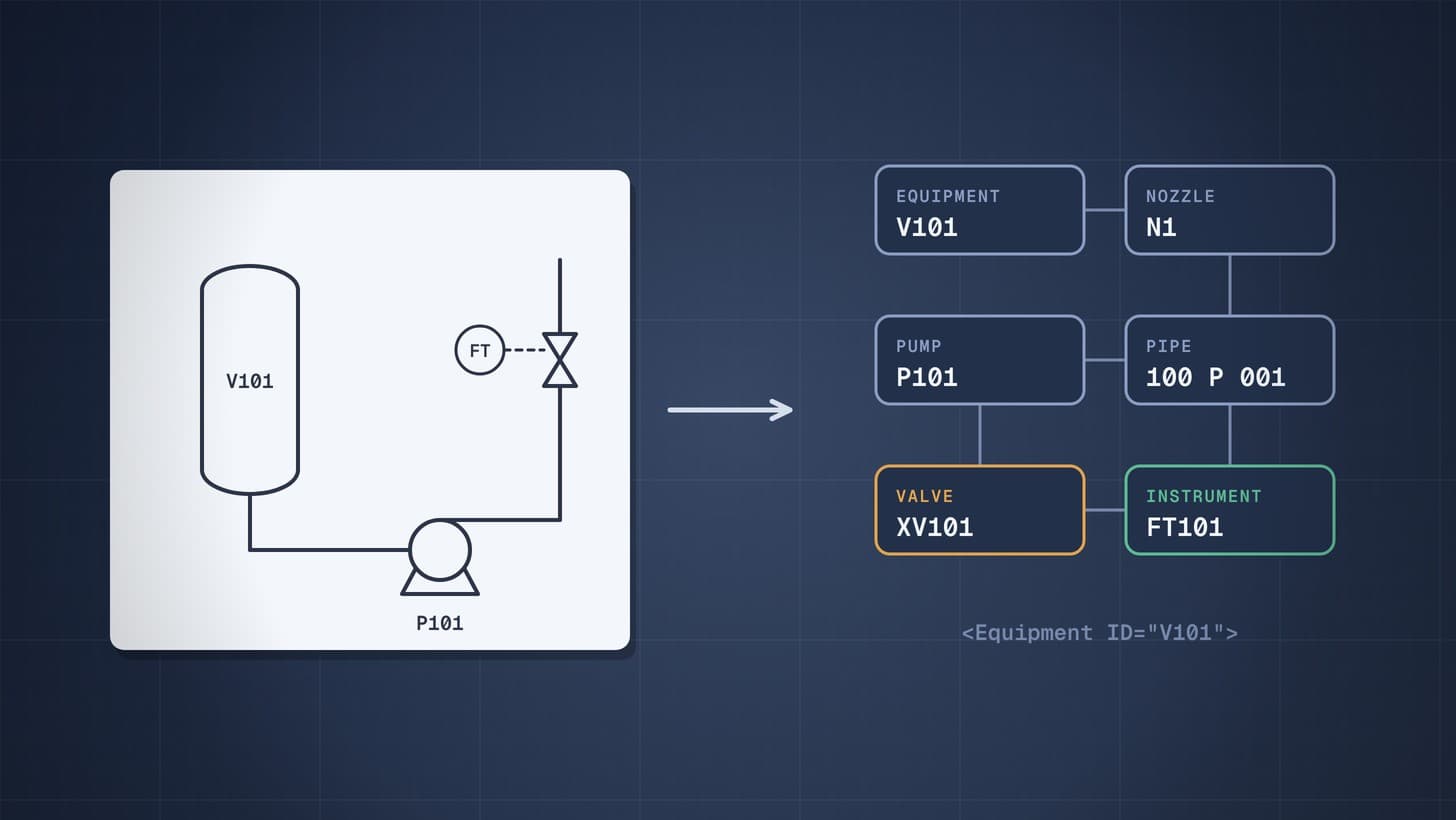
DEXPI Explained: Machine Readable P&IDs for Procurement
What DEXPI is, who is behind it, what a DEXPI file holds that a PDF does not, which tools export it, and what it changes for equipment lists and RFQs.
Buyers Now Ask AI Who to Shortlist. Is Your Company in the Answer?
B2B buyers increasingly ask AI assistants who to shortlist. What the surveys show, how the assistants choose, and six changes a supplier can make this quarter.
Thomasnet, Europages, Kompass, GlobalSpec, Alibaba and ChemCapital: Where Should a Process Equipment Supplier List in 2027?
An honest comparison of eight supplier directories and marketplaces for process equipment makers: buyers, free listings, paid tiers, RFQs and how to decide where the budget goes.