
Supplier Evaluation Matrix for Equipment Vendors (Template)
A weighted supplier evaluation matrix for engineered equipment: pass or fail checks, criteria and weights, a scoring scale with anchors, and a worked example.
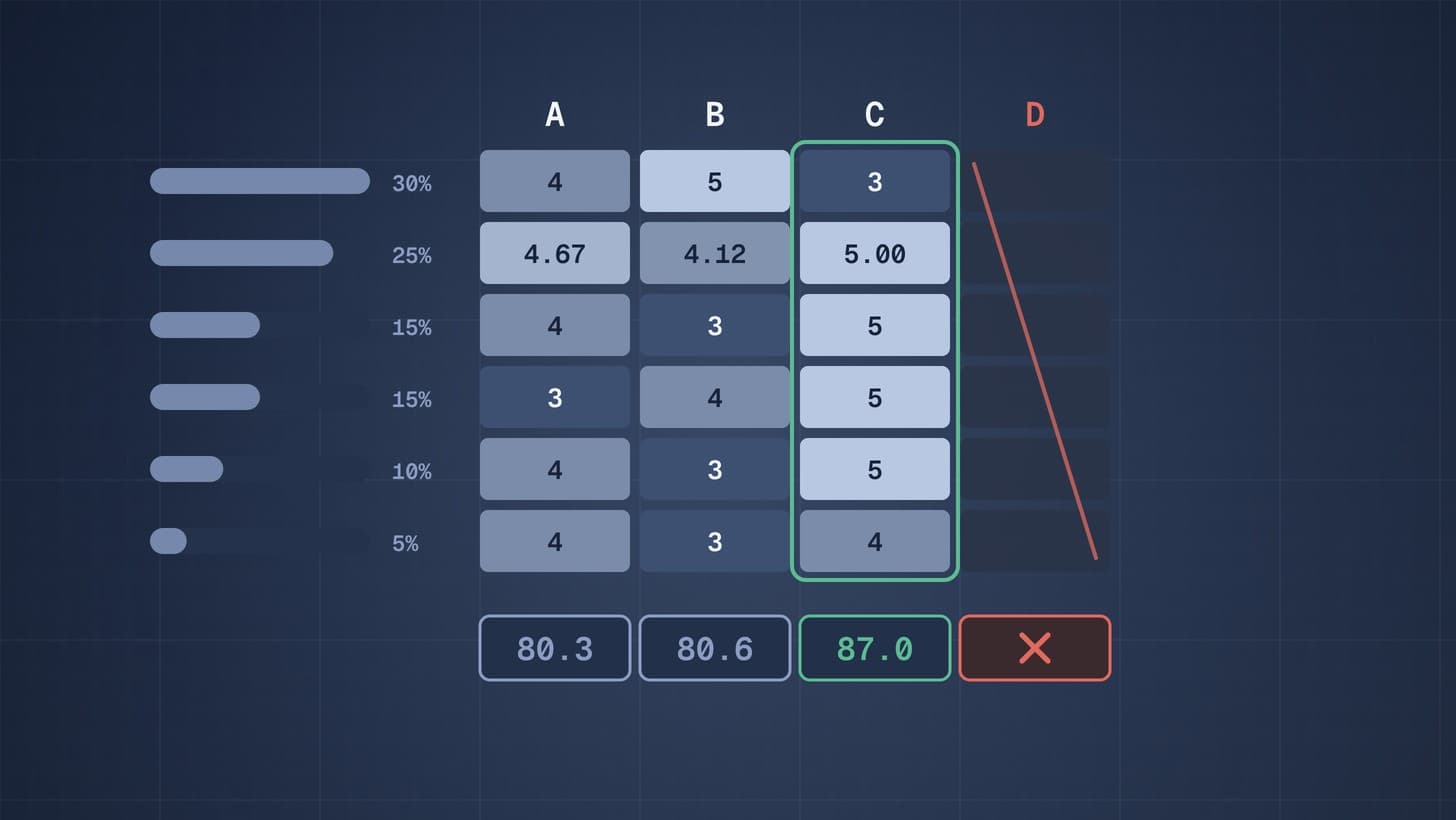
A supplier evaluation matrix scores each vendor against weighted criteria, so the choice can be explained and checked. For engineered equipment, the usual criteria are technical compliance, quality system and documentation, delivery and programme, aftermarket support and spares, commercial terms and price, and supplier risk. Mandatory requirements are checked first as pass or fail; vendors that pass are scored on a 0 to 5 scale with written anchors, and each score is multiplied by its weight to give a total out of 100.
The matrix does not replace judgement. It makes judgement visible, which is what auditors, finance teams and losing bidders ask to see.
Why this matters now
For public buyers in the UK, the Procurement Act 2023 makes this structure a duty: where there is more than one award criterion, the contracting authority must set out their relative importance, explain how tenders will be assessed, and say whether failing a criterion disqualifies a tender [1]. Welsh Government guidance on the Act adds that price does not have to take precedence over other factors and suggests testing different weightings, because the method chosen can directly affect value for money [2]. Private buyers are not bound by the Act, but the same discipline is what makes a selection defensible in a GMP audit or a board review.
Create and manage RFQs in minutes
ChemCapital handles the entire procurement cycle, from structured RFQs and supplier comparisons to formal purchase orders and delivery tracking.
Step 1: mandatory checks, pass or fail
Anything you cannot accept, whatever the price, belongs here rather than in the scores.
| Mandatory check | Evidence | Fail means |
|---|---|---|
| Design code and marking as specified | Compliance schedule, sample certificates | Excluded |
| Materials of construction as specified | Compliance schedule | Excluded, or accepted only as a formal deviation |
| Hazardous area certification, if required | Certificates for the offered equipment | Excluded |
| Valid quality certificate | Checked on IAF CertSearch or with the certification body [3] | Excluded |
| Financial standing | For UK companies, filing history and insolvency records at Companies House [4] | Excluded or reviewed with finance |
| Sanctions screening | Company and owners screened | Excluded |
Step 2: criteria and weights
Weights should reflect this package, not a company default. The figures below are an illustrative starting point for a critical item of process equipment.
| Criterion | Weight | What it covers | Evidence |
|---|---|---|---|
| Technical compliance | 30% | Meets the datasheets and specification; quality of the design offered | Compliance schedule, technical queries |
| Quality system and documents | 15% | Inspection and test plan, document list, track record | Quality manual extract, sample data book |
| Delivery and programme | 15% | Meets the required date, credible plan, shop load | Programme, references |
| Aftermarket support | 10% | Spares, service presence, response times | Spares list, service locations |
| Commercial | 25% | Evaluated price and acceptance of terms | Price schedule, deviations list |
| Supplier risk | 5% | Financial strength, dependency, location | Accounts, ownership, logistics |
| Total | 100% |
The UK government's manual on multi criteria analysis covers the theory behind weighted scoring in depth [5]. In practice, three rules matter most: fix the weights before you open any bid, avoid counting the same thing twice (for example lead time under both delivery and risk), and write down why each weight was chosen.
Step 3: a scoring scale with anchors
A score means little unless evaluators agree what it stands for. Many public tenders publish a five point scale running from unsatisfactory, through marginal, satisfactory and very good, to excellent, each with a short description of strengths and weaknesses [6]. Adding zero for no response or no evidence gives a 0 to 5 scale. Then write anchors specific to each criterion.
| Score | General meaning | Anchor for delivery and programme |
|---|---|---|
| 5 | Excellent: all elements, no significant weakness | Meets the date with float, detailed plan, shop capacity shown |
| 4 | Very good: most elements, few weaknesses | Meets the date, plan credible, little float |
| 3 | Satisfactory: adequate, strengths and weaknesses balance | Meets the date only if nothing slips |
| 2 | Marginal: few elements, many weaknesses | Misses the date by up to four weeks |
| 1 | Unsatisfactory: almost no element addressed | Misses the date by more than four weeks |
| 0 | No response or no evidence | No programme offered |
For price, a common formula gives the lowest compliant evaluated price 5 and scores others as 5 × lowest price ÷ bid price. Compare like for like after clarifications; our guide to technical bid evaluation covers how to level bids first.
Practical example
In this illustrative example, four vendors bid for a package. Vendor D offers equipment without the required hazardous area certification, so it fails a mandatory check and is not scored, however low its price.
| Criterion (weight) | Vendor A | Vendor B | Vendor C |
|---|---|---|---|
| Technical (30%) | 4 | 5 | 3 |
| Quality (15%) | 4 | 3 | 5 |
| Delivery (15%) | 3 | 4 | 5 |
| Support (10%) | 4 | 3 | 5 |
| Price | £300,000 | £340,000 | £280,000 |
| Commercial score (25%) | 4.67 | 4.12 | 5.00 |
| Risk (5%) | 4 | 3 | 4 |
| Weighted total | 80.3 | 80.6 | 87.0 |
Each total is the sum of weight × score ÷ 5. For Vendor C: 18.0 + 15.0 + 15.0 + 10.0 + 25.0 + 4.0 = 87.0.
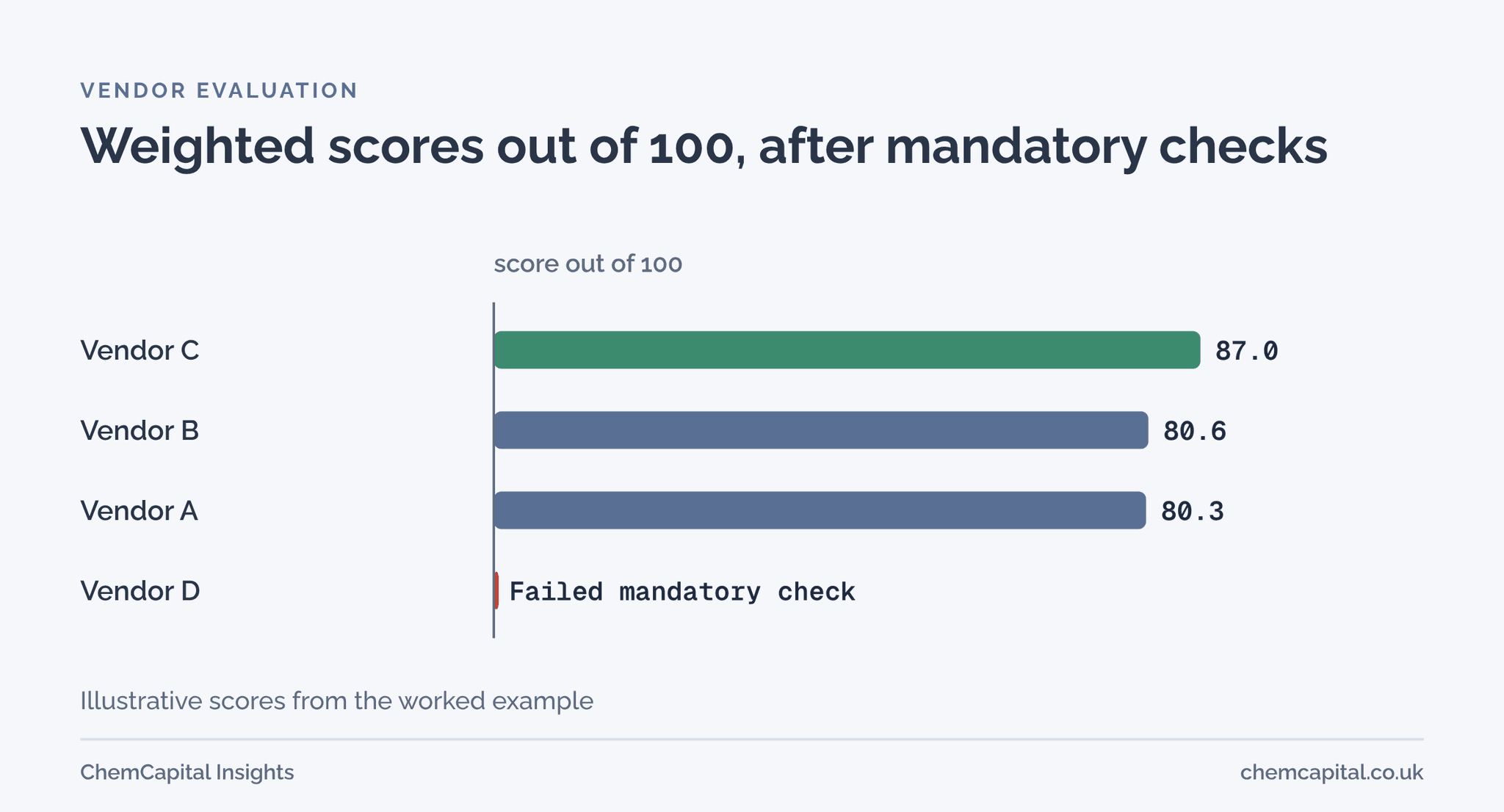
Now test the weights, as the Welsh guidance suggests. If technical compliance rises to 40% and commercial falls to 15%, the totals become 79.0 for A, 82.4 for B and 83.0 for C. Vendor C still leads, but only just, and its technical score of 3 is the weakest in the field. That is a prompt to check C's technical gaps through clarifications before award, not a reason to overturn the result.
Where ChemCapital fits
ChemCapital's AI quotation comparison applies the same structure to supplier quotes. AI pulls price, lead time, materials, certifications and scope from each quote, a rule based engine scores them with adjustable weights across commercial, technical, delivery, compliance and risk, and mandatory requirements are checked first: a quote that fails one is flagged and left out of the ranking whatever its price. The buyer and engineering team make the final call, and you can try the free version with up to three quotes and no account. For the checks that come before any bid, see supplier prequalification.
Ready to score supplier quotes the same way every time? Start a free 14 day ChemCapital trial, with no credit card needed.
Frequently asked questions
What criteria should a supplier evaluation matrix include for equipment vendors?
Typically technical compliance, quality system and documentation, delivery and programme, aftermarket support and spares, commercial terms and price, and supplier risk. Check mandatory requirements as pass or fail before any scoring.
How do you set weights in a supplier evaluation matrix?
Agree them before bids are opened, make them add up to 100%, and reflect what matters for this package, for example more weight on delivery for an item on the critical path. Then test whether a reasonable change in weights would change the winner.
How is price scored in a weighted evaluation?
A common method gives the lowest compliant price full marks and scores others in proportion, for example 5 times the lowest price divided by the bid price. Score price on a like for like basis after clarifications, not on headline totals.
Continue reading
Informational only, not procurement or legal advice. Cited names, frameworks, and statistics belong to their respective owners.
Create and manage RFQs in minutes
ChemCapital handles the entire procurement cycle, from structured RFQs and supplier comparisons to formal purchase orders and delivery tracking.
Start for freeRelated articles

Commissioning and Qualification: ASTM E2500 vs Traditional IQ OQ PQ
How the science and risk based ASTM E2500 approach differs from traditional IQ, OQ and PQ, who does what, how vendor tests can be reused, and what to put in the RFQ.

GAMP 5 Software Categories for Bought In Skids and Control Systems
GAMP 5 software categories 1, 3, 4 and 5 in plain words, mapped to the skids, instruments and control systems a buyer actually orders, with what to ask suppliers for.
Audit Trail Requirements in GMP: What a Compliant Record Must Capture
What EU Annex 11, 21 CFR Part 11 and MHRA guidance require of an audit trail, what audit trail review means in practice, and worked entries for a procurement record.