
DEXPI Explained: Machine Readable P&IDs for Procurement
What DEXPI is, who is behind it, what a DEXPI file holds that a PDF does not, which tools export it, and what it changes for equipment lists and RFQs.
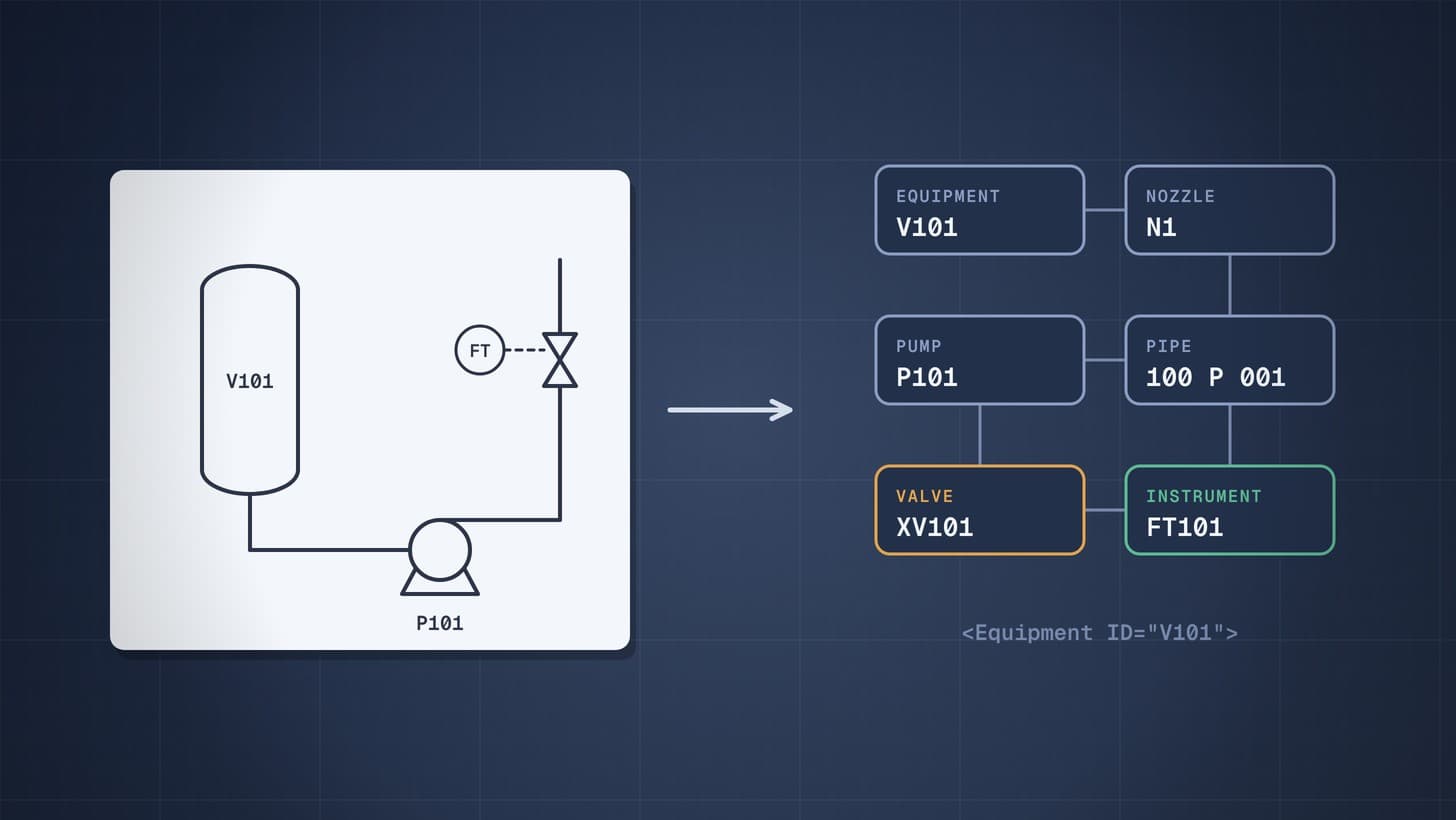
DEXPI, short for Data Exchange in the Process Industry, is an open standard for passing P&IDs (piping and instrumentation diagrams) between software as structured data rather than as pictures. A DEXPI file stores every equipment item, nozzle, pipe, valve and instrument as an object with its tag, its attributes and its connections, along with the graphics needed to draw it. For procurement, that means equipment lists, line lists and RFQ (request for quotation) packages can be built straight from the design instead of being retyped from a PDF.
A PDF P&ID is a drawing that a person reads. A DEXPI P&ID is a model that software reads. That difference is the whole point.
Why this matters now
The standard has just taken its biggest step. DEXPI 2.0 was released in late 2025 and brings block flow diagrams and process flow diagrams (PFDs) into the same model as the P&ID, with a single XML file format [1]. The DEXPI association held its 2.0 release event in November 2025 [2].
The backing is broad. ARC Advisory Group names software makers Autodesk, AVEVA, Bentley and Siemens and owner operators BASF, Bayer and Evonik among its supporters [1]. When owners and their design tools agree on one format, the files are more likely to arrive with engineering packages, and procurement teams that know what to do with them will save the most retyping.
Join ChemCapital to streamline sourcing and connect with verified partners
Whether you're buying or supplying, ChemCapital gives you the tools to manage the complete procurement cycle in one platform.
What DEXPI is, and who is behind it
DEXPI began as a working party of ProcessNet, the German process engineering platform, under the lead of DECHEMA. The idea was that owner operators would define a common data model and the makers of design software would implement it, so data could move between tools without being lost in conversion and could be stored in a form that does not depend on one vendor [3]. It is now run by the DEXPI association, DEXPI e.V. [4].
DEXPI does not invent everything itself. It builds on existing standards, including ISO 10628 for P&ID symbols, IEC 62424 for instrumentation and ISO 15926 for its reference data [4].
| Year | Milestone |
|---|---|
| 2016 | First release of the P&ID specification, DEXPI Plant 1.1 [4] |
| 2021 | DEXPI P&ID specification 1.3, the version behind most files exchanged today [5] |
| 2023 | DEXPI Process 1.0 for block flow diagrams and PFDs [4] |
| 2025 | DEXPI 2.0 joins process and plant in one model [1, 2] |
Two names cause confusion. DEXPI is the information model: which objects a P&ID contains and how they relate. Proteus XML, formerly called XMpLant, is the file schema that DEXPI 1.3 files are written in; DEXPI extended it to Proteus 4.0.1 [4]. DEXPI 2.0 moves to a new, simpler serialisation format designed to be extended [6]. In practice, when someone sends you "a DEXPI file" today, it is usually an XML file following the 1.3 specification.
What a DEXPI file holds that a PDF does not
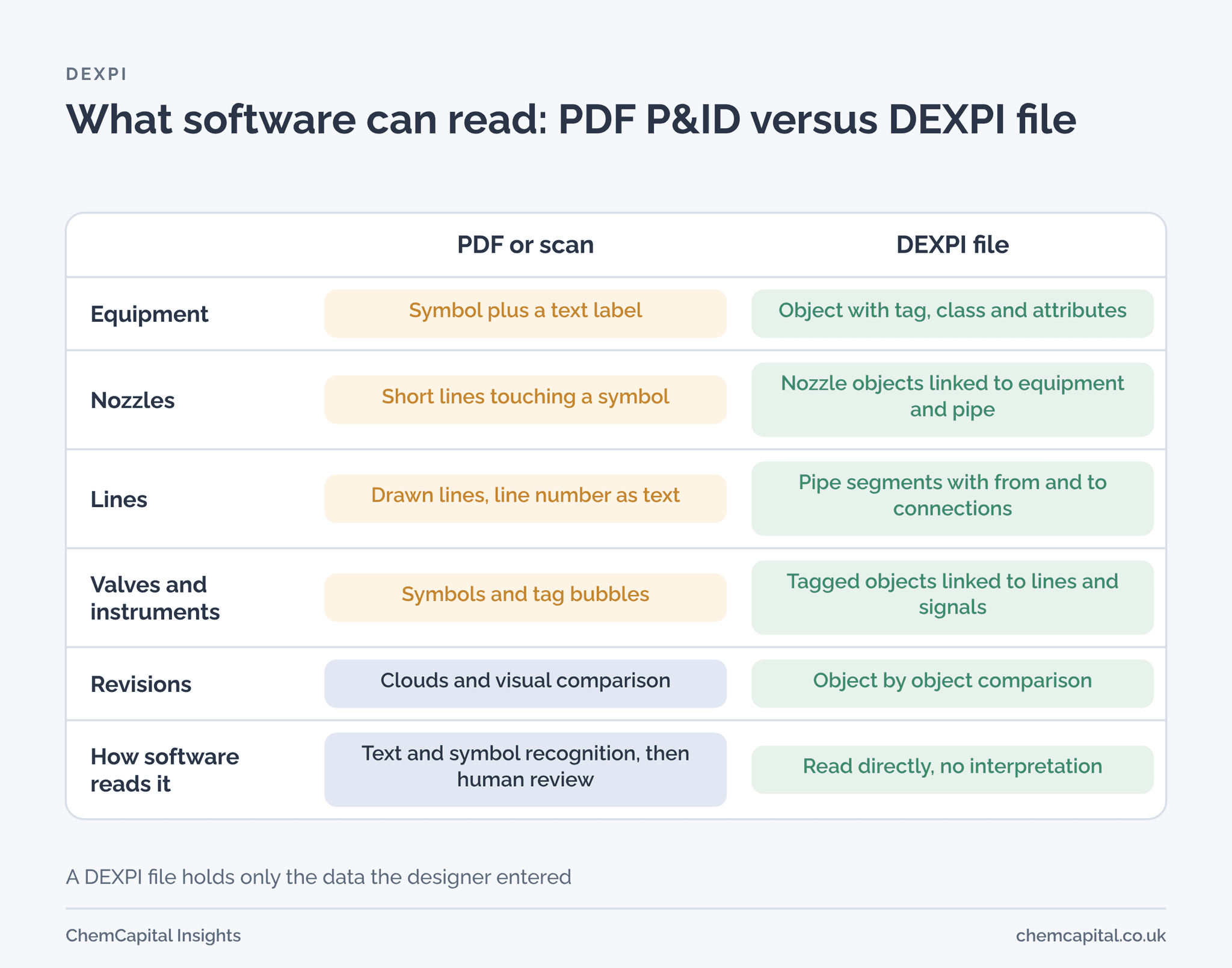
| Item | In a PDF P&ID | In a DEXPI file |
|---|---|---|
| Equipment | A symbol and a text label | An object with tag, class (for example a centrifugal pump) and any attributes the designer entered |
| Nozzles | Short lines where pipes meet a symbol | Nozzle objects belonging to the equipment and joined to pipes |
| Piping | Drawn lines with the line number as text | Pipe segments that know what they connect from and to |
| Valves | Symbols along a line | Tagged objects placed in a specific pipe segment |
| Instruments | Tag bubbles and dashed signal lines | Instrument objects with their signals and loops |
| Revisions | Clouds marked by hand | Objects that can be compared one by one |
Because the file carries connections, software can answer questions a picture cannot: which valves sit on line 100, which instruments belong to vessel V101, which nozzles a pump has. Our guide on how to read a P&ID covers what each symbol means; DEXPI is that meaning written down for a computer.
There is one firm limit. A DEXPI file only contains what the designer put into the design tool. If design pressure was never entered as an attribute, the file will not contain it. DEXPI moves data cleanly; it does not create data.
Which tools export DEXPI
A 2024 academic review describes DEXPI as a format that many of the main P&ID software vendors have adopted for import or export, while noting that implementation is still ongoing; the association lists supporting software on its website [5]. As one example, Autodesk Consulting publishes a DEXPI Data Bridge for AutoCAD Plant 3D, which exports P&ID data to DEXPI XML and imports it back, with mapping of classes and properties [7].
Support is not uniform. Some tools export the full model; others export a subset or need mapping set up first. Before you write DEXPI into a contract, ask your design contractor four questions:
- Which design tool and which DEXPI version will you export?
- Has the export been tested with the software we will use to receive it?
- Will you deliver DEXPI files alongside the PDFs at each P&ID revision?
- Which attributes will be populated, for example design pressure, temperature and material?
What it changes for procurement
Equipment lists. Tags, equipment classes and nozzles come straight from the design, so the equipment list starts complete and matches the drawings.
Line, valve and instrument data. Pipe segments, valves and instruments come out as lists too, which is the starting point for bulk valve and instrument purchases.
RFQ packages. Items can be grouped by type into packages, and every RFQ line still points back to a tag on a drawing.
Revisions. When a new revision arrives, software can compare objects and show exactly which tags were added, removed or changed, instead of an engineer hunting for clouds.
Handover. The same objects can travel on to the owner's maintenance and asset systems at the end of the project. DEXPI's own team reports work to align it with CFIHOS, the oil and gas industry's handover specification, and with other information models [4], so the tag you bought against can be the tag the plant maintains.
None of this needs procurement staff to understand XML. It needs one decision early in the project: ask for DEXPI files as a deliverable, at every P&ID revision, in the same contract that asks for the PDFs.
The honest limits
DEXPI is useful now, but it is not finished, and buyers should know where it falls short.
- Meaning is not always precise. The 2024 review found vague, missing and overlapping class definitions in the 1.3 specification, and 57 custom classes that are defined case by case. It warns that matching objects by name alone can produce false matches [5].
- Exports vary. Two tools can export the same drawing differently, especially for custom equipment.
- Versions matter. A 2.0 file uses a different format from a 1.3 file, so check that the receiving software reads the version you will get.
- Old plants have no DEXPI. Brownfield sites often hold P&IDs only as PDFs or scans, and those still need reading the old way.
Practical example
In this illustrative example, a contractor issues revision C of a 12 sheet P&ID set as both PDF and DEXPI. Revision B already fed the equipment list, and two RFQ packages, pumps and vessels, are out with bidders.
Comparing the two DEXPI files object by object shows three changes that matter to procurement: a new standby pump, P203B, has been added; vessel V101's design pressure attribute has risen from 6 bar g to 10 bar g; and exchanger E105's material attribute has changed from 316L to duplex stainless steel.
That gives three clear actions: an addendum to the pump RFQ for one more unit, an addendum to the vessel RFQ for the new design pressure, and a new long lead flag on E105 before its package goes out. With PDFs alone, the same check means comparing 12 sheets by eye, and a change that was not clouded can slip through.
Where ChemCapital fits
ChemCapital's P&ID to RFQ leads with DEXPI. It imports DEXPI XML version 1.3 through a rule based import that reads equipment, instruments, valves, nozzles, pipe segments and signals where the file follows supported DEXPI structures, and DEXPI files take seconds. You review the extracted tags, group accepted items into packages and turn a package into a live RFQ; when a revision arrives, a side by side comparison shows what changed. PDFs and scans can also be uploaded for extraction, with confidence scores and human review, and a sample DEXPI file is available for a guided first run.
Ready to see what your own DEXPI file can do? Start free with ChemCapital.
Frequently asked questions
What is DEXPI?
DEXPI stands for Data Exchange in the Process Industry. It is an open, vendor neutral standard for passing P&IDs and other process diagrams between software as structured data, with every equipment item, nozzle, line, valve and instrument stored as an object with its tag, attributes and connections.
What is the difference between DEXPI and Proteus XML?
DEXPI is the information model: it defines which objects a P&ID contains and how they relate. Proteus XML, formerly called XMpLant, is the file schema that DEXPI P&ID files have used up to version 1.3, extended by DEXPI to Proteus 4.0.1.
Which software exports DEXPI?
Many of the main P&ID design tools now offer DEXPI import or export, and the DEXPI association keeps a software list on its website. Support levels differ, so test an export from your own tool before you rely on it in a contract.
Is DEXPI only for oil and gas?
No. It began in the German process industry, and its backers include chemical companies such as BASF, Bayer and Evonik. It applies to any plant drawn with P&IDs.
Continue reading
Informational only, not procurement or legal advice. Cited names, frameworks, and statistics belong to their respective owners.
Join ChemCapital to streamline sourcing and connect with verified partners
Whether you're buying or supplying, ChemCapital gives you the tools to manage the complete procurement cycle in one platform.
Get started freeRelated articles

RFQ and Sourcing Software for Engineered Equipment, Compared Honestly
What buyers of engineered equipment need from sourcing software, the four kinds of tool on offer with their real strengths and limits, and a checklist for choosing.
Buyers Now Ask AI Who to Shortlist. Is Your Company in the Answer?
B2B buyers increasingly ask AI assistants who to shortlist. What the surveys show, how the assistants choose, and six changes a supplier can make this quarter.
Thomasnet, Europages, Kompass, GlobalSpec, Alibaba and ChemCapital: Where Should a Process Equipment Supplier List in 2027?
An honest comparison of eight supplier directories and marketplaces for process equipment makers: buyers, free listings, paid tiers, RFQs and how to decide where the budget goes.