
Supplier Change Notification: What Equipment Vendors Must Tell You
Which supplier changes a regulated buyer needs to hear about, how to write the clause into a quality agreement or order, sensible notice periods, and a template.

A supplier change notification is the supplier's formal advance notice of a change that could affect what it supplies: a new material, a different sub supplier, a move of manufacturing site, a design change, a new software version or a change to its quality system. It gives the buyer time to assess the change before it reaches the plant. For regulated buyers, the obligation belongs in the quality agreement or purchase order: which changes, how much notice, what evidence, and which changes need approval before they happen.
It helps suppliers too. A clear list of what must be notified is easier to follow than a vague promise to "inform the customer of significant changes".
Why this matters now
Supply chains keep shifting, and each shift creates changes at the supplier: a new foundry for castings, a new source of elastomers, a new controller after an obsolete one is withdrawn. Regulators expect those changes to be controlled through the buyer's quality system. The draft revision of EU GMP Annex 11 published in 2025, for example, includes a section on supplier and service management [1].
Join ChemCapital to streamline sourcing and connect with verified partners
Whether you're buying or supplying, ChemCapital gives you the tools to manage the complete procurement cycle in one platform.
Which changes you need to hear about
FDA's guidance on quality agreements lists the kinds of change the parties should agree how to report and approve, including components and their suppliers, establishment locations, manufacturing processes, major manufacturing equipment and testing procedures [2]. For equipment suppliers, that translates into this list.
| Change | Example in equipment | Why it matters |
|---|---|---|
| Product contact materials | New elastomer compound for valve diaphragms | Food and pharma compliance depends on the formulation; US rules for repeat use rubber articles set extraction limits [3] |
| Sub suppliers | New foundry for pump casings | Material quality and certificates change |
| Manufacturing site | Assembly moved to another factory | Workmanship, inspection and traceability change |
| Design | New impeller or seal type | Performance and spares change |
| Software and firmware | New controller version on a skid | Validated state and data integrity; Annex 11 expects formal agreements with system suppliers [4] |
| Quality system | Lapsed certificate, change of ownership | Basis of your supplier approval changes |
| Testing | New test method or test house | Comparability of test results |
Writing the clause
EU GMP Chapter 7 says a contract acceptor should not introduce unauthorised changes that could affect the quality of outsourced activities [5]. ICH Q10 asks companies to define quality responsibilities and communication in written agreements, to monitor suppliers' performance and to evaluate changes with quality risk management [6]. A workable clause has four parts:
- Classes of change. Class A needs your written approval before implementation; class B needs notice but no approval; class C is recorded at the supplier and visible at audit.
- Notice periods. For example, several months for class A changes such as materials or site moves, shorter for class B, and immediate notice for anything affecting safety.
- Evidence. What the supplier sends with the notice: updated certificates, test data, drawings, software release notes.
- Traceability. The first affected batch, serial number or software version, so you know which items are which.
Change notification template
| Field | What the supplier provides |
|---|---|
| Notice number and date | Unique reference |
| Products affected | Part numbers, models, tags if known |
| Description of change | What changes, from what to what |
| Reason | Obsolescence, supply, improvement, cost |
| Class proposed | A, B or C under the agreement |
| Effect on form, fit, function | Supplier's assessment |
| Effect on materials and compliance | Updated declarations and certificates |
| Effect on software or firmware | Version, release notes |
| Evidence attached | Test data, drawings, certificates |
| Planned effective date | Date and first batch, serial or version |
| Last time buy, if relevant | Final order date for the current version |
| Supplier contact | Name and role |
| Buyer decision | Accepted, accepted with conditions, rejected, with date and signature |
Practical example
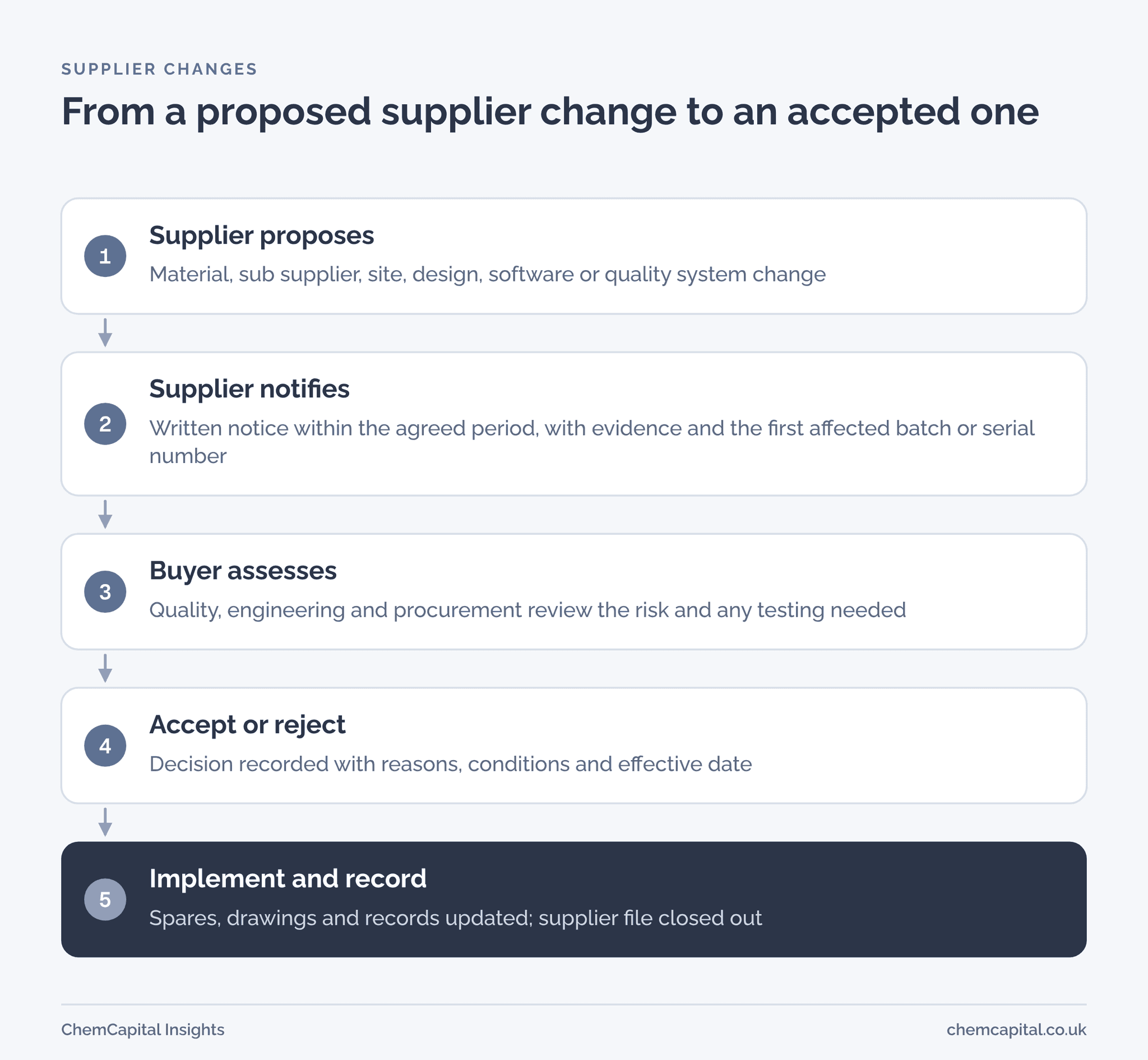
In this illustrative example, a diaphragm valve supplier plans to change the EPDM compound used in its diaphragms because the compound maker has withdrawn the old grade. Under the quality agreement this is a class A change with 120 days' notice. The supplier sends the notice with an updated compliance declaration and extraction test results.
The buyer's quality and engineering teams review the evidence, ask for one batch of diaphragms to be trialled on a non product contact line first, and then accept the change with a stated first batch number. Procurement updates the spares list so old and new diaphragms are not mixed, and the supplier file records the decision.
Where ChemCapital fits
ChemCapital keeps supplier records in one place. Suppliers maintain profiles with technical specifications and compliance approvals, alerts go out 30 days before a certification record expires, and buyers manage an approved vendor list with statuses of preferred, approved, conditional and suspended, recording the reason and evidence for each change. Each purchase order also has its own message thread, so a change notice and its decision stay with the order. See ChemCapital for suppliers, and for how approval starts, read about supplier prequalification and getting on an approved vendor list.
Ready to keep supplier changes and decisions on record? Start free with ChemCapital.
Frequently asked questions
What is a supplier change notification?
It is a supplier's formal advance notice of a change that could affect what it supplies, such as a new material, sub supplier, manufacturing site, design or software version. It gives the buyer time to assess the change before it reaches the plant.
Which supplier changes need the buyer's approval?
Changes that could affect product quality, safety or a validated state, such as product contact materials, manufacturing site, critical design or control software. Agree the classes in a quality agreement: approve first, notify only, or record at the supplier.
How much notice should a supplier give of a change?
Enough for the buyer to assess and, if needed, test. Many buyers ask for several months for major changes such as materials or site moves and less for minor ones, with any safety related change notified at once.
Continue reading
Informational only, not procurement or legal advice. Cited names, frameworks, and statistics belong to their respective owners.
Join ChemCapital to streamline sourcing and connect with verified partners
Whether you're buying or supplying, ChemCapital gives you the tools to manage the complete procurement cycle in one platform.
Get started freeRelated articles
Lead Generation for Industrial Equipment Manufacturers
Practical lead generation for makers of process equipment without a big marketing team: being found, spotting projects early, meeting buyers and following up well.

Pharma and Process Industry Trade Shows 2027: Which Stands Are Worth the Money, and What to Do Afterwards
Verified 2027 dates for ACHEMA, INTERPHEX, CPHI and the other pharma and process shows, what a stand really costs, and a six step plan for the leads.
How to Find Distributors and Agents for Process Equipment in New Markets
Agent or distributor, where to find candidates, how to vet them, what the agreement must cover and how to make the partnership deliver.