
Lead Generation for Industrial Equipment Manufacturers
Practical lead generation for makers of process equipment without a big marketing team: being found, spotting projects early, meeting buyers and following up well.
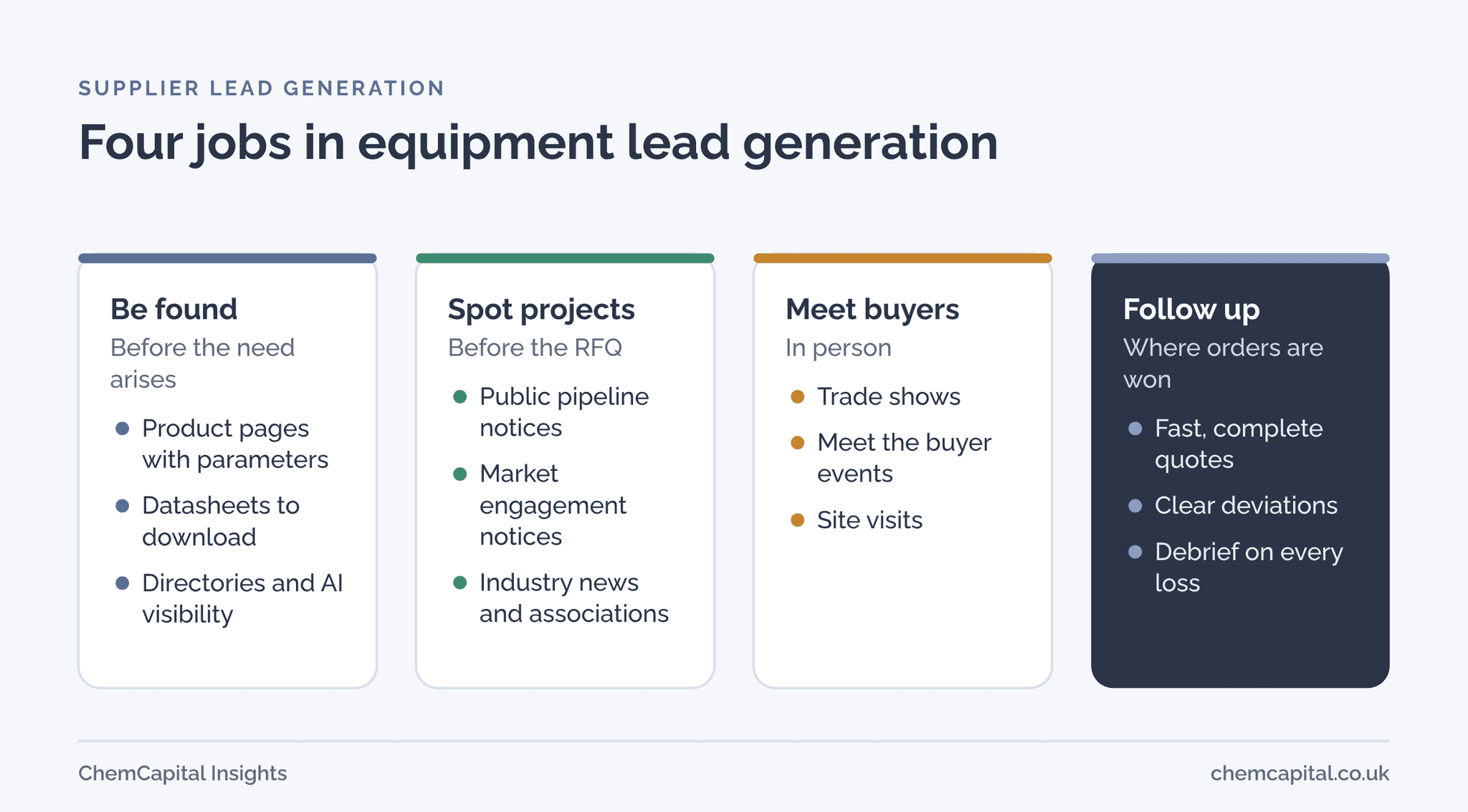
For makers of process equipment, lead generation comes down to four jobs: being found where engineers and buyers search, spotting projects before the RFQ is written, meeting buyers in person, and following up every enquiry quickly and completely. Without a big marketing team, the answer is to choose three or four channels that suit your products, do them well, and measure which ones lead to orders.
The good news is that buyers are actively looking. The bad news is that many of them now start with a search box or an AI assistant, and a supplier that cannot be found there is not on the long list.
Why this matters now
Buyers want more suppliers, not fewer. In Deloitte's 2025 survey of chief procurement officers, 74% named finding alternative supply sources as the most effective way to reduce supply risk [1]. That opens doors for suppliers who are easy to find and easy to check.
Public projects have also become easier to see early. Under the Procurement Act 2023, contracting authorities expecting to spend more than £100 million in a financial year must publish a pipeline notice of contracts above £2 million that they plan to advertise over the following 18 months [2].
Access real procurement opportunities from global buyers
Join ChemCapital to get discovered by verified procurement teams across pharmaceutical, chemical, and industrial manufacturing.
Be findable where buyers search
Your own website. Engineers search by parameter: pressure, temperature, materials, sizes, codes. Product pages that state these clearly, with downloadable datasheets and application notes, are the cheapest lead source most manufacturers have. They also feed AI assistants, which can only recommend what they can find and understand; our article on how buyers ask AI who to shortlist covers this in detail.
Directories. General and specialist directories still bring enquiries, especially for standard products. Choose a few where your buyers actually search; our guide on where to list a process equipment business compares the options.
Trade associations. Membership puts you in front of buyers who use association lists as a starting point. The British Pump Manufacturers Association, for example, represents over 100 UK and Irish pump suppliers [3].
Spot projects early
- Public pipelines and notices. Pipeline notices show planned public contracts. Registering on the government's Central Digital Platform, where Find a Tender sits, is the first step for suppliers wanting public work [4].
- Market engagement. Public buyers often talk to the market before a tender, and UK guidance says publishing a preliminary market engagement notice should be standard practice [5]. Taking part is a chance to shape a requirement fairly and be known before the tender.
- Industry news. Plant investments, planning applications and expansions are usually announced long before equipment is bought.
Meet buyers in person
Trade shows are expensive but still work for engineered equipment, where buyers want to see build quality and talk to engineers. ACHEMA runs in Frankfurt from 14 to 18 June 2027, and its 2024 edition drew 106,001 participants [6]. Smaller events, including government "meet the buyer" days [4], cost less and often bring more focused conversations.
Channels compared
| Channel | Cost | Lead quality | Time to results |
|---|---|---|---|
| Website with technical product pages | Low, mostly time | High, buyers arrive with a need | Months |
| Directories | Low to medium | Mixed | Weeks |
| Trade associations | Membership fee | Medium | Months |
| Trade shows | High | High for engineered items | Months, follow up decides it |
| Public tenders | Low to find, high to bid | High but competitive | Depends on pipeline |
| Distributors and agents | Margin share | High in their region | Months to set up |
| RFQ platforms | Varies | Buyers already looking | Weeks |
| Referrals and installed base | Low | Highest | Ongoing |
Distributors and agents
For export markets, a good distributor or agent can be worth more than any campaign. They bring local relationships, speak the buyer's language, hold spares and can visit sites quickly, all of which matter to buyers choosing between a local and a foreign supplier. The cost is margin and some loss of control. Choose partners who already sell to your target industries, agree territories and lead sharing in writing, and give them the same technical content you give your own team.
Make it easy to check you
Buyers vet new suppliers before they invite them to quote: certificates, references, finances and sanctions. Make that work easy. Publish your quality certificate number and certification body, a reference list of similar supplies, your design codes and pressure equipment approvals, and a named technical contact. A buyer who can check you in ten minutes is more likely to add you to the RFQ list than one who has to chase you for a week.
What to measure
Track every enquiry from first contact to order, and record where it came from. Three numbers tell you most of what you need: enquiries per channel, cost per enquiry, and cost per order won. Review them every quarter and move money towards the channels that win orders, not just the ones that produce the most contacts.
Follow up is where orders are won
Leads are wasted without disciplined follow up. Answer RFQs completely and on time, state deviations clearly rather than hiding them in small print, ask technical questions early, and request a debrief when you lose. Our article on how suppliers win industrial contracts goes further.
Practical example
In this illustrative example, a UK vessel fabricator with two sales engineers tracks enquiries for a year.
| Channel | Spend | Enquiries | Orders won |
|---|---|---|---|
| Website and application notes | £6,000 | 40 | 4 |
| Trade show | £18,000 | 25 | 2 |
| Directory listings | £3,000 | 15 | 1 |
| Public tenders | £2,000 in bid time | 5 | 1 |
| RFQ platform | £1,500 | 10 | 1 |
| Total | £30,500 | 95 | 9 |
The website produced the most orders for the least money, at £1,500 per order won, while the trade show cost £9,000 per order. The trade show still earned its place, because both orders were large and came from new customers, but the numbers tell the team where to put next year's effort: more application notes, one smaller show, and faster follow up on platform RFQs.
Where ChemCapital fits
ChemCapital lets suppliers create a company profile and product listings with technical specifications, compliance approvals, target industries and supporting documents, seen by procurement teams in pharmaceutical, chemical, biotech and industrial sectors. Suppliers receive RFQs that set out specifications, quantities, delivery requirements and deadlines, and reply through a single form with line items, assumptions and attachments. Suppliers can start free, and the first three RFQs opened for full review cost nothing; paid options after that are set out on the pricing page. See ChemCapital for suppliers.
Ready to be found by buyers searching for your equipment? List your company on ChemCapital. It is free to start.
Frequently asked questions
How do industrial equipment manufacturers generate leads?
By being findable where engineers and buyers search, including their own website, directories and AI assistants; by spotting projects early through public pipelines and industry news; by meeting buyers at trade shows and events; and by following up every enquiry and RFQ quickly and completely.
What is the cheapest lead source for equipment makers?
Usually your own website, if product pages give the parameters engineers search for, such as pressure, temperature, materials and sizes, with downloadable datasheets. It costs time rather than money and keeps working between trade shows.
Should equipment manufacturers use RFQ platforms?
They can be a useful extra channel, because buyers on them are already looking for suppliers. Check the costs, who the buyers are, and whether the platform lets you respond with full technical detail rather than a price alone.
Continue reading
Informational only, not procurement or legal advice. Cited names, frameworks, and statistics belong to their respective owners.
Access real procurement opportunities from global buyers
Join ChemCapital to get discovered by verified procurement teams across pharmaceutical, chemical, and industrial manufacturing.
List your companyRelated articles

Supplier Change Notification: What Equipment Vendors Must Tell You
Which supplier changes a regulated buyer needs to hear about, how to write the clause into a quality agreement or order, sensible notice periods, and a template.
Pharma and Process Industry Trade Shows 2027: Which Stands Are Worth the Money, and What to Do Afterwards
Verified 2027 dates for ACHEMA, INTERPHEX, CPHI and the other pharma and process shows, what a stand really costs, and a six step plan for the leads.
How to Find Distributors and Agents for Process Equipment in New Markets
Agent or distributor, where to find candidates, how to vet them, what the agreement must cover and how to make the partnership deliver.