
The Supplier Qualification Questionnaire: How an Equipment Vendor Answers It Without Losing Weeks
What GMP buyers check in a supplier questionnaire, what evidence to attach to each section, and an answer kit that returns 120 questions in five working days.
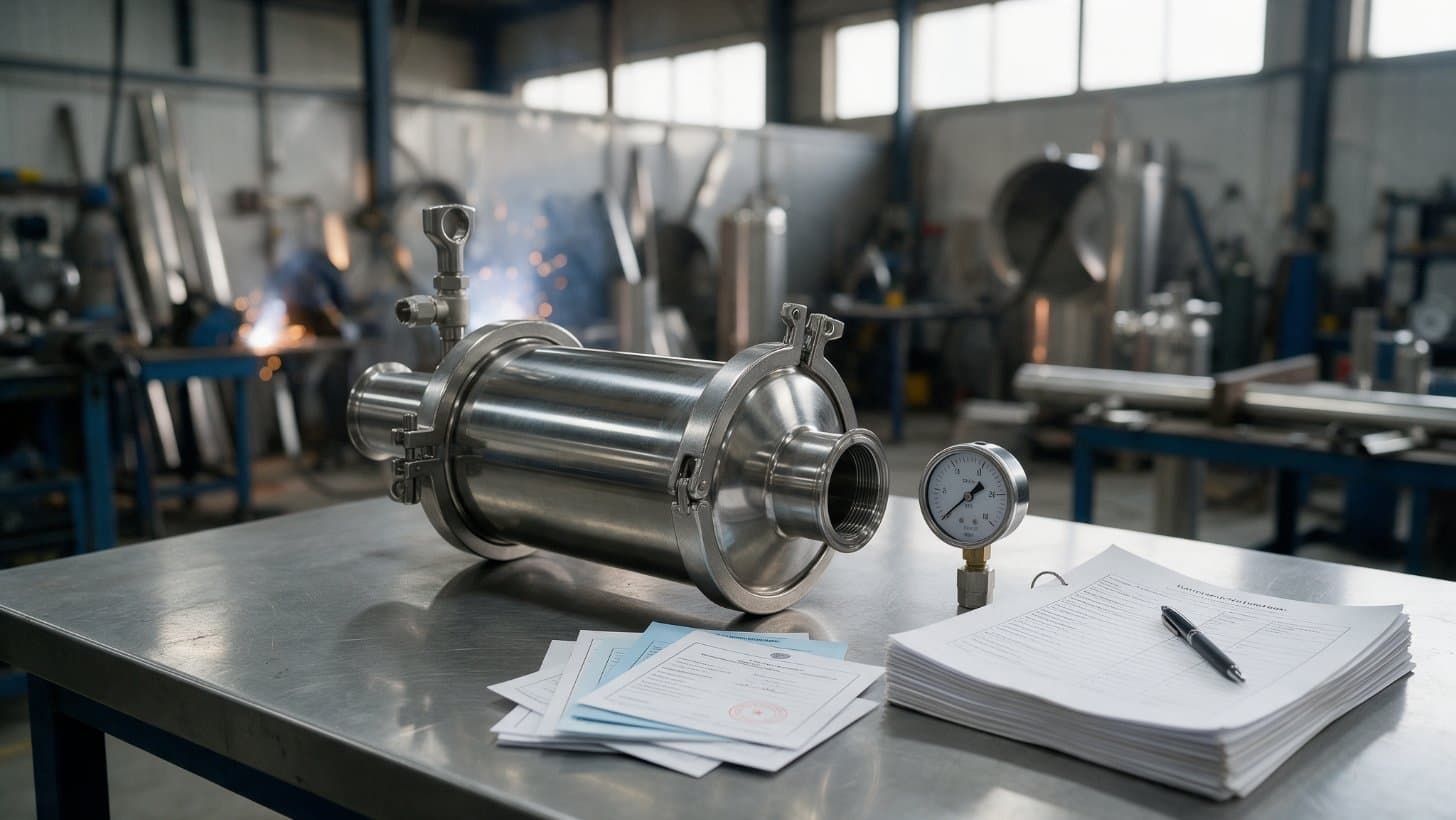
A supplier qualification questionnaire is a desk assessment. The buyer's quality team uses your answers to decide three things: whether you can be approved on paper, whether an audit is needed first, and what the quality agreement must cover. Most equipment vendors lose weeks because nobody owns the document, the answers are written from scratch each time, and blanks are left where an honest "no, planned by March" would have scored better. The fix is an answer kit: a controlled master file, an evidence index, a named owner per section and a 48 hour acknowledgement.
Why this matters now
GMP (Good Manufacturing Practice) buyers do not send questionnaires for fun. EU GMP Chapter 7 requires a pharmaceutical manufacturer to assess the "legality, suitability and the competence" of any party it outsources work to before it signs a contract, and to keep monitoring that party afterwards [1]. Chapter 5 adds that the selection, qualification, approval and maintenance of suppliers of starting materials must be documented in the pharmaceutical quality system, with supervision proportionate to the risks the materials pose [2]. That clause is written for material suppliers rather than equipment vendors, but buyers apply the same documented, risk based logic to everyone they approve. The PIC/S guide used by inspectorates outside the EU carries equivalent chapters.
ICH Q9(R1), the quality risk management guideline revised in January 2023, sets the tone. Its second principle is that the effort, formality and documentation of risk management should be "commensurate with the level of risk" [3]. That is why a maker of stainless steel filter housings receives a lighter questionnaire than an active ingredient manufacturer, and why a questionnaire often replaces an audit for lower risk supplies. Guidance from consultancy PharmOut puts it plainly: the questionnaire is used to decide whether an on site or remote audit is required before approval [4].
For you as the supplier, the questionnaire is the gate between being an interesting quotation and being an approved vendor. Answer it well and purchase orders can flow. Answer it late or thinly and your quotation sits in a queue behind a vendor who already has an approved status.
Access real procurement opportunities from global buyers
Join ChemCapital to get discovered by verified procurement teams across pharmaceutical, chemical, and industrial manufacturing.
What a GMP questionnaire actually asks
Published questionnaires are remarkably consistent. The K+S supplier self assessment runs to about 50 questions in five blocks: general information, purchasing, production, quality control and the quality management system. Several questions are flagged as knock out criteria, including whether the supplier agrees to an on site audit [5]. The Sparta Systems questionnaire has 52 rated questions across contract review and document control, purchase controls, training, continuous improvement, process and production controls, and packaging, storage and shipping [6]. A pharmaceutical supplier questionnaire template hosted by the Lower Saxony trade inspectorate runs to roughly 125 questions and includes a direct question on how customers are informed of changes and whether the supplier will sign a change control agreement [7].
Put those together and you get the sections below. The table shows what the buyer is really checking, what to attach, and the mistake we see most often.
| Section | What they are really checking | Evidence to attach | Common mistake |
|---|---|---|---|
| Company and quality system | That a certified system exists and its scope covers what you sell them | ISO 9001 certificate, scope statement, quality manual index | Certificate scope covers a different site or product line |
| Organisation and training | That quality can act independently of production and people are trained for their tasks | Organisation chart, training matrix for welders and inspectors | Naming the sales manager as quality contact |
| Document and change control | That procedures are controlled and that you will tell the customer before a change | Document control SOP, change control SOP, a written notification commitment | Leaving the "will you notify us of changes" box blank |
| Supplier and sub supplier control | That your own suppliers (castings, seals, gaskets) are approved and inspected | Approved supplier list excerpt, incoming inspection SOP | "Our suppliers are all ISO certified" with no list |
| Calibration and measurement | That test equipment is calibrated and traceable to national standards | Calibration register, sample certificate with traceability chain | Calibration overdue on the pressure gauge used for the test |
| Manufacturing and inspection records | That each unit has a build record and final inspection | Sample travel card, final inspection report, pressure test record | Records exist but cannot be retrieved by serial number |
| Material traceability | That wetted parts are traceable to a heat number | EN 10204 type 3.1 certificates, heat number marking procedure | Certificates kept by the steel stockist, not by you |
| Non conformance and CAPA | That failures are recorded and root causes fixed, not just reworked | NCR log summary, CAPA SOP, one closed example | "No non conformances in the last three years" |
| Complaints and recalls | That a field problem would be traced back to the affected serials | Complaint SOP, mock recall or traceability exercise | No way to say which customers received a batch of seals |
| Data integrity and software | That any data you generate or supply is attributable, legible, contemporaneous, original and accurate | Electronic record controls, audit trail description, GAMP 5 category of supplied software | Treating this section as "not applicable" because you make hardware |
| Environment, safety, continuity, confidentiality | That you will still exist, still be legal and still keep their drawings private | ISO 14001 or policy, insurance summary, business continuity statement, NDA template | Attaching 40 pages of policy instead of a one page summary |
Three of these deserve more words.
Change notification is the most common gap. Buyers need to know about changes before they happen so they can assess the impact on a validated process and, where a licence is involved, inform the regulator. The Lower Saxony template asks it outright [7], the Sparta Systems questionnaire rates whether customers are notified of specification or product changes [6], and Chapter 7 requires the contract to define communication processes between the two parties [1]. If your change control procedure does not include customer notification, say so and give a date by which it will.
Material traceability means paperwork you control. A type 3.1 inspection certificate to EN 10204 gives the actual test results for the material delivered. Buyers expect you to hold these against the heat numbers stamped on the wetted parts, not to ask the stockist for them later.
Data integrity is not just for software companies. The MHRA guidance on GxP data integrity defines ALCOA, the expectation that data are attributable, legible, contemporaneous, original and accurate, and adds that they should be complete, consistent, enduring and available. It states the expectations apply to paper and electronic records alike, and that the effort spent on data integrity should match the risk of a failure [8]. Your pressure test records and material certificates are data in this sense. If you supply a control panel with software, state its GAMP 5 category (the ISPE classification of software by how much it is configured or custom written) and offer the functional specification.
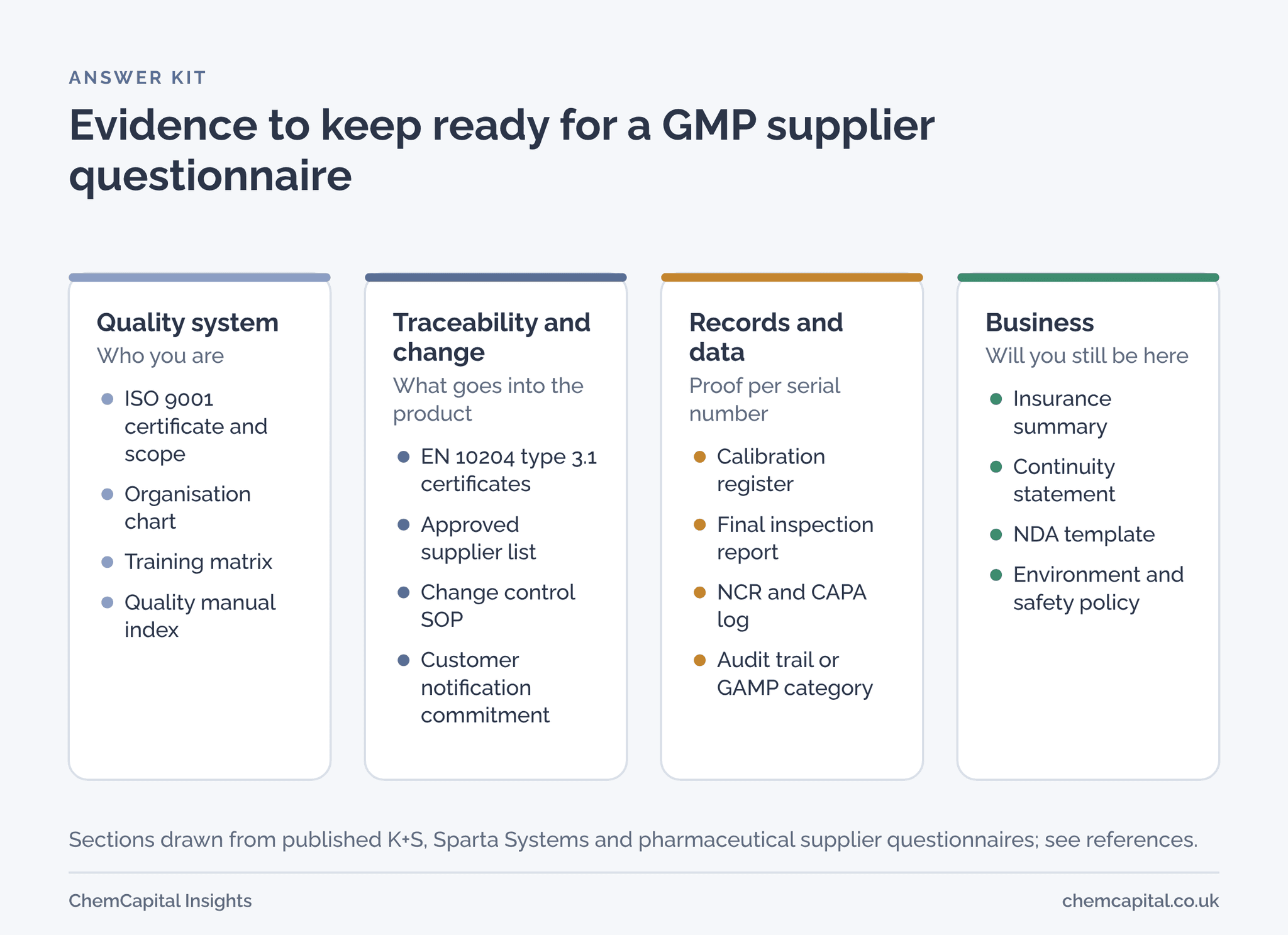
The answer kit
The vendors that turn questionnaires round in days rather than weeks all run some version of the same kit.
A controlled master answer file. One document, under your own document control, with a model answer for each of the eleven sections above. Every new questionnaire is answered by adapting the master, not by starting again. Review it twice a year and after any change to your certificates.
An evidence index. A numbered list of every attachment you might send: certificate, scope, organisation chart, SOP titles and revision numbers, sample records. The questionnaire answer then says "see attachment 7" instead of promising to send something later.
A named owner per section. Quality owns the system questions, production owns records and calibration, purchasing owns sub suppliers, the managing director owns continuity and confidentiality. One coordinator, usually the quality manager, assembles the pack.
A 48 hour acknowledgement. Reply within two working days to confirm receipt, name the coordinator and give a return date. Buyers' quality teams rarely chase; they simply move to the next vendor.
Honest answers instead of blanks. The Sparta Systems questionnaire scores each question from 1 (no procedure exists) to 3 (thoroughly documented and tracked), then divides the total by the maximum possible to give an audit rating [6]. A documented "2, under review, target date June" scores more than an empty box, which reads as a 1 and invites an audit. The questionnaire does not publish a pass mark, and most buyers treat thresholds as internal, so any figure you hear is a rule of thumb rather than a standard.
Keep certificates current. ISO 9001:2026 was published on 16 September 2026 and replaces the 2015 edition; ISO says the standard is used by more than one million organisations [9]. Expect questionnaires to start asking which edition your certificate is against and what your transition plan is.
Practical example
An illustrative maker of sanitary filter housings, 35 staff, ISO 9001 certified, receives a 120 question questionnaire from a biopharmaceutical buyer on a Monday. The buyer wants it back in ten working days. The plan below returns it in five.
| Day | Action | Owner |
|---|---|---|
| 1 (Mon) | Acknowledge, name coordinator, promise Friday return. Map the 120 questions to the 11 master sections | Quality manager |
| 2 (Tue) | Adapt master answers; flag 14 questions with no existing answer | Section owners |
| 3 (Wed) | Resolve the 14: nine answered from records, five answered as "planned by" with dates | Quality manager and MD |
| 4 (Thu) | Build attachment pack from the evidence index: 18 files, each named to the question number | Quality coordinator |
| 5 (Fri) | MD review, sign declaration, submit with covering note listing the five planned items | MD |
In this example the five "planned by" items were: customer change notification added to the change control SOP (eight weeks), a documented mock recall (twelve weeks), a written business continuity statement (four weeks), a GAMP category statement for the level transmitter software (two weeks) and a calibration certificate with a visible traceability chain for the test gauge (one week).
In our editorial judgement, from reading the published questionnaires above, the three answers most likely to trigger an audit are: no commitment to notify the customer of changes; no evidence that sub suppliers of wetted components are approved and inspected on receipt; and calibration or test records that cannot be linked to the serial number on the housing. In our view all three are fixable within a quarter for a few days of a quality engineer's time. The example and its figures are illustrative, not drawn from any single supplier or from published statistics.
Keep the evidence where buyers can find it
Most of the answer kit is a set of documents that go stale: the ISO certificate expires, the calibration register rolls over, the organisation chart changes. On ChemCapital you keep certifications and supporting documents on your human verified supplier profile, buyers can download the brochures and datasheets you attach, and automated certification expiry alerts notify you 30 days before a record lapses. Buyers using AI supplier discovery can find your profile and invite you to quote even if they have never heard of you, and a profile with current certificates saves you resending the same documents by email each time a buyer asks. If the questionnaire arrives after the quotation, the article on supplier prequalification in pharmaceutical procurement explains what the buyer side is doing with your answers.
This is general information, not legal advice.
Ready to be found by the buyers already looking for what you make? List your company on ChemCapital. It is free to start.
Frequently asked questions
Does a supplier qualification questionnaire replace an audit?
Often, for lower risk supplies. Under the risk based approach in ICH Q9 the buyer qualifies a supplier in proportion to risk, so a complete questionnaire with good evidence can be enough, while thin or missing answers are the usual reason an audit follows.
What should an equipment supplier answer if it has no procedure for something?
Say so, state what is in place today, and give a date by which the procedure will exist. Scored questionnaires give more credit to a documented plan than to a blank, and a blank is read as a failed question.
Which questionnaire section do equipment vendors most often fail?
Change control, specifically the commitment to notify the customer before a change to materials, design, process or sub suppliers. Published pharmaceutical questionnaires ask this directly and buyers need it to protect a validated process.
Continue reading
Informational only, not procurement or legal advice. Cited names, frameworks, and statistics belong to their respective owners.
Access real procurement opportunities from global buyers
Join ChemCapital to get discovered by verified procurement teams across pharmaceutical, chemical, and industrial manufacturing.
List your companyRelated articles

How to Get on a Pharmaceutical Company's Approved Vendor List (and Stay On It)
What an approved vendor list is, how pharma buyers qualify equipment suppliers, what to have ready, why vendors stall, and how to get invited in the first place.
User Requirement Specification for Process Equipment: URS Template
How to write a user requirement specification that suppliers can quote against: URS vs FS and DS, testable requirements, a URS template and a jacketed vessel example.
IQ OQ PQ Explained: What to Require from Equipment Vendors
DQ, IQ, OQ and PQ explained from the buyer's side: what EU GMP Annex 15 expects, what the equipment vendor should supply, and how to write it into the purchase order.