
AMP8 for Equipment Suppliers: How Water Companies Buy, 2025 to 2030
AMP8 is the 2025 to 2030 investment period for water companies in England and Wales, with £104bn approved. Here is how the money is spent, how water companies buy through frameworks and delivery partners, and how equipment suppliers get in.
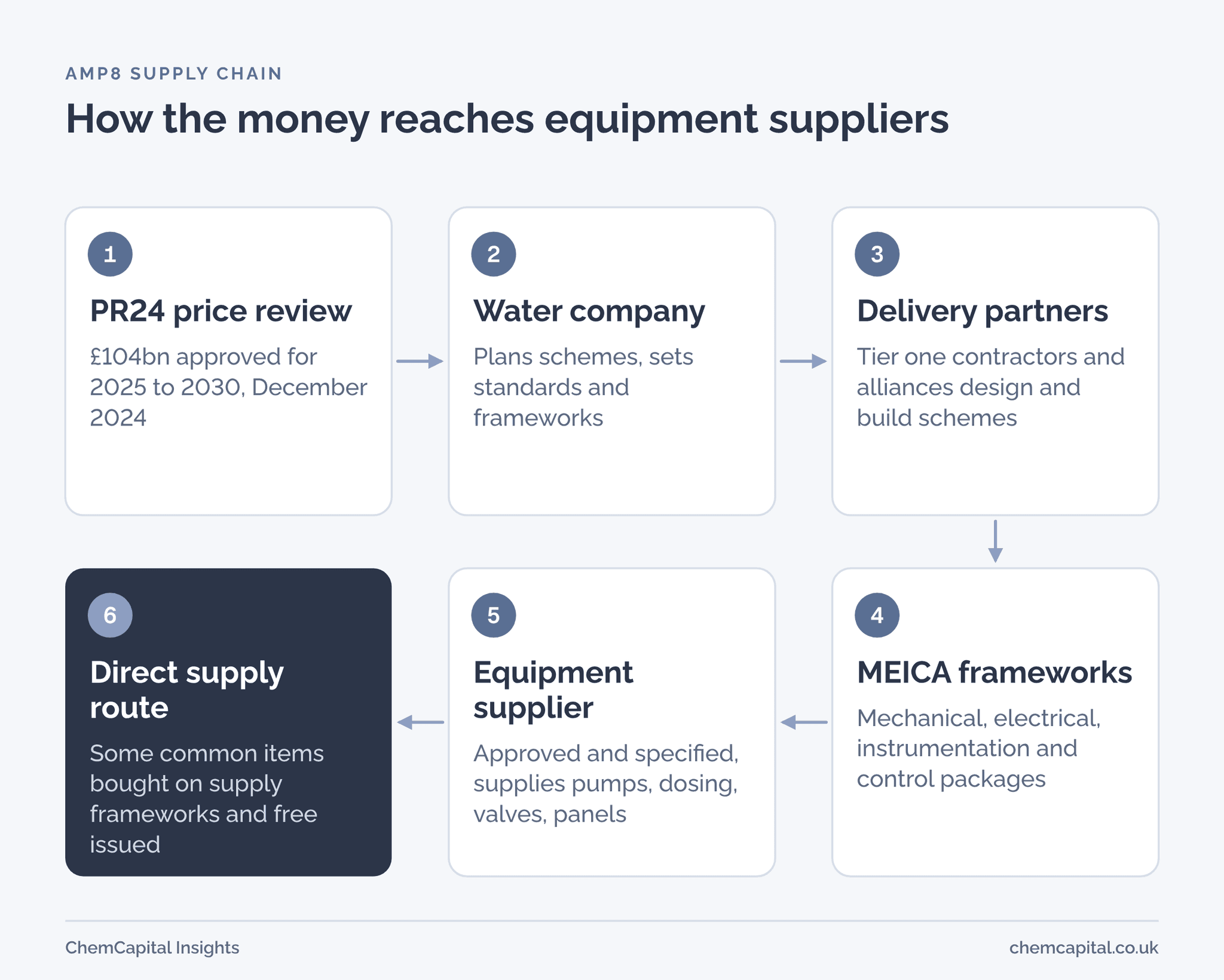
AMP8 is the asset management period from 2025 to 2030 for water and wastewater companies in England and Wales, set by Ofwat's PR24 price review, which approved £104bn of investment in December 2024 [1]. For equipment suppliers the money mostly flows through water company frameworks and their delivery partners, so the way in is to get specified and approved with the tier one contractors and MEICA partners who design and build the schemes, not just to watch for tenders.
Why this matters now
AMP8 is the largest water investment programme in England and Wales for a generation. Companies proposed about £106bn, Ofwat's draft in July 2024 allowed £88bn, and the final determinations on 19 December 2024 approved £104bn for treatment works, sewers and pipes, both new and maintenance [1]. Lawyers advising the sector describe it as roughly four times the previous level of new investment, with priorities including pollution and spill reduction, capacity and replacing ageing assets [2].
Five companies, Anglian, Northumbrian, South East, Southern and Wessex, appealed to the Competition and Markets Authority. Its final determinations on 10 March 2026 added £463m of revenue across the five, 17% of the roughly £2.7bn they sought, including £289m more enhancement expenditure, and moved six enhancement schemes into gated processes where funding is released once costs are clearer [3]. So as of November 2026 the appeals for those five companies are decided and delivery is under way across the sector. This is a fast moving area, so check the latest Ofwat and company publications before relying on any figure.
Access real procurement opportunities from global buyers
Join ChemCapital to get discovered by verified procurement teams across pharmaceutical, chemical, and industrial manufacturing.
Where the money goes
| Area | What it means for equipment suppliers |
|---|---|
| Wastewater treatment and storm overflows | Screens, pumps, aeration, blowers, mixers, chemical dosing, storage tanks, instrumentation |
| Water treatment | Filtration, disinfection, dosing, membranes, pumps, valves |
| Networks and pumping stations | Pump sets, valves, kiosks, telemetry, control panels |
| Large water resource schemes | Major civil works with large pumping and treatment packages |
| Maintenance of existing assets | Replacement pumps, valves, motors and spares, often on framework call offs |
The largest schemes follow a separate route. Strategic resource options, such as new reservoirs and transfers, go through the regulators' RAPID gated process, with up to £2.15bn of PR24 funding for ten solutions [2]. Large discrete projects above £200m whole life cost default to Direct Procurement for Customers, where a separate provider designs, builds, finances and operates the asset; about £14bn of such projects are expected over the next decade [2].
How water companies buy
Most AMP8 delivery runs through long frameworks set up at or before the start of the period:
- Capital delivery partners. Tier one contractors or alliances that design and build schemes across a region.
- MEICA frameworks. Mechanical, electrical, instrumentation, control and automation partners for above ground assets. One water company, for example, appointed two MEICA framework suppliers for its AMP8 and potentially AMP9 non infrastructure work [4].
- Minor works frameworks. Smaller mechanical and electrical works, often split into lots; one company's AMP8 framework has three lots and a five year term with a three year option [5].
- Direct supply agreements. Some companies buy common items, such as pumps, valves or chemicals, directly on supply frameworks and free issue them to contractors.
Water companies are utilities, so their regulated procurements follow utility procurement rules, and many qualify suppliers through shared utility qualification systems. Notices appear on Find a Tender; one MEICA framework notice listed water pumps and water filtering machinery among its codes [4].
How equipment suppliers get in
- Know who delivers for each water company. Find the capital delivery partners and MEICA framework holders from contract award notices and company announcements. They are your real customers for most schemes.
- Get on their approved supplier lists. Delivery partners keep their own vendor lists and technical standards. Prequalify with each one; our guide to EPC contractor vendor registration covers the paperwork.
- Get approved against the water company's standards. Many water companies publish their own mechanical and electrical specifications and product approvals. Approval against those standards is often what puts a product on the designer's drawing.
- Register where the water companies look. Utility qualification systems and supplier portals, kept up to date.
- Show value over the asset life. Ofwat and the CMA both scrutinise efficiency, with the CMA applying efficiency challenges of 10 to 30% to some enhancement requests [3]. Products that cut energy use or maintenance are easier to justify. Our article on life cycle cost in equipment quotes shows how to present it.
- Plan for capacity. The supply chain is busy and expected to tighten as the investment ramps up [2]. A credible lead time and a stock policy can win work on their own.
What delivery partners look for
A delivery partner choosing between two compliant pumps or dosing skids is managing its own risk on a fixed programme. In practice it is weighing:
- Compliance with the client's standards without a list of exceptions to manage.
- Lead time it can trust, stated per item and held. A late pump on a storm overflow scheme can hold up a regulatory deadline.
- Documentation on time: datasheets for design, then manuals, test certificates and spares lists for handover.
- Support at commissioning, including who attends site and how quickly.
- Spares and service across the life of the asset, because the water company will operate it for decades.
- A sensible commercial position: firm prices for the framework period or a clear adjustment mechanism, and realistic liabilities.
Most of those are about reliability, not price. A supplier that can show it delivered similar equipment on time, with complete documentation, has an advantage that is hard to undercut.
Timing across the five years
Activity is not spread evenly. The first year of a period is often spent on design and approvals, with procurement and construction building through the middle years. Equipment for early schemes is being specified now; approvals and framework places secured in the first half of the period carry through to the end. Schemes moved into gated funding processes, such as those the CMA identified [3], may come to market later than the rest once their costs are confirmed.
If you are new to the water sector
Start narrow, because the sector rewards depth of relationship more than breadth of coverage and each water company has its own standards, approvals and preferred delivery partners. Pick one region, find out which delivery partners and MEICA contractors hold the frameworks there, and ask what approvals they need for your product type. Water industry buyers value proven performance on their own assets, so a first reference site, even a small one, is worth more than a long brochure. Be ready for detailed questions on materials in contact with drinking water, hazardous area requirements around sewage, and energy efficiency, and have the certificates to hand. Expect the first approval to take months rather than weeks, and plan your sales effort around that timescale so the work is not abandoned just before it pays off.
Practical example
Illustrative figures. A pump maker targets one region's capital delivery partner, which expects to deliver 40 pumping station schemes over the period, each with a duty and a standby pump.
| Step | Number |
|---|---|
| Schemes in the delivery partner's programme | 40 |
| Pumps at 2 per scheme | 80 |
| Share specified with the maker's products after approval | 25% |
| Pumps supplied over the period | 20 |
None of those orders appears as a public tender for pumps. They come from being approved by the delivery partner and specified by its designers, scheme by scheme.
The same logic applies to maintenance spend. Replacement pumps, valves and motors on existing sites are often bought on call off contracts from approved suppliers, so a product approval secured for capital schemes can also open years of replacement and spares business. Track both routes, because they are often managed by different teams inside the same water company.
Where ChemCapital fits
Delivery partners and MEICA contractors search for suppliers who can meet water industry specifications and lead times. A free ChemCapital listing lets them find your products and approvals through Supplier Discovery and send RFQs directly. See what suppliers get from ChemCapital, and our UK and Ireland process projects article for the wider pipeline.
Ready to reach the contractors delivering AMP8? List your company on ChemCapital. It is free to start.
Frequently asked questions
What is AMP8?
The asset management period from 2025 to 2030 for water and wastewater companies in England and Wales, funded through Ofwat's PR24 price review, which approved £104bn of investment in December 2024.
How do water companies buy equipment in AMP8?
Mostly through long frameworks: capital delivery partners, MEICA partners and minor works contractors who design and build schemes, plus some direct supply frameworks for common items such as pumps and valves.
How can an equipment supplier get into the AMP8 supply chain?
Prequalify with the delivery partners and MEICA framework holders, get products approved against water company standards, register on the utility qualification systems they use, and show life cycle value and reliable lead times.
What did the CMA decide on PR24?
On 10 March 2026 the CMA added £463m of revenue across the five appealing companies, 17% of what they sought, and moved six enhancement schemes into gated funding processes.
Continue reading
Informational only, not procurement or legal advice. Cited names, frameworks, and statistics belong to their respective owners.
Access real procurement opportunities from global buyers
Join ChemCapital to get discovered by verified procurement teams across pharmaceutical, chemical, and industrial manufacturing.
List your companyRelated articles
How to Find Tenders for Pumps, Valves and Process Equipment
Public tenders for process equipment are published free on Find a Tender in the UK, TED in the EU and SAM.gov in the US. Here is how to set alerts with the right CPV codes and where utility frameworks fit.
Framework Agreements for Pumps, Valves and Instruments: When They Beat Project Buying
A frame agreement for pumps, valves or instruments pays off when you buy the same types repeatedly. Here is when it beats project by project buying, what to put in it, and a worked example.
How to Get Your Equipment Specified by Engineers on Process Projects
On process projects the specification and the vendor list decide who gets the RFQ. Here is how specifications are built, from industry standards to owner specs and datasheets, and what equipment makers do to get on them.