
How to Get Your Equipment Specified by Engineers on Process Projects
On process projects the specification and the vendor list decide who gets the RFQ. Here is how specifications are built, from industry standards to owner specs and datasheets, and what equipment makers do to get on them.
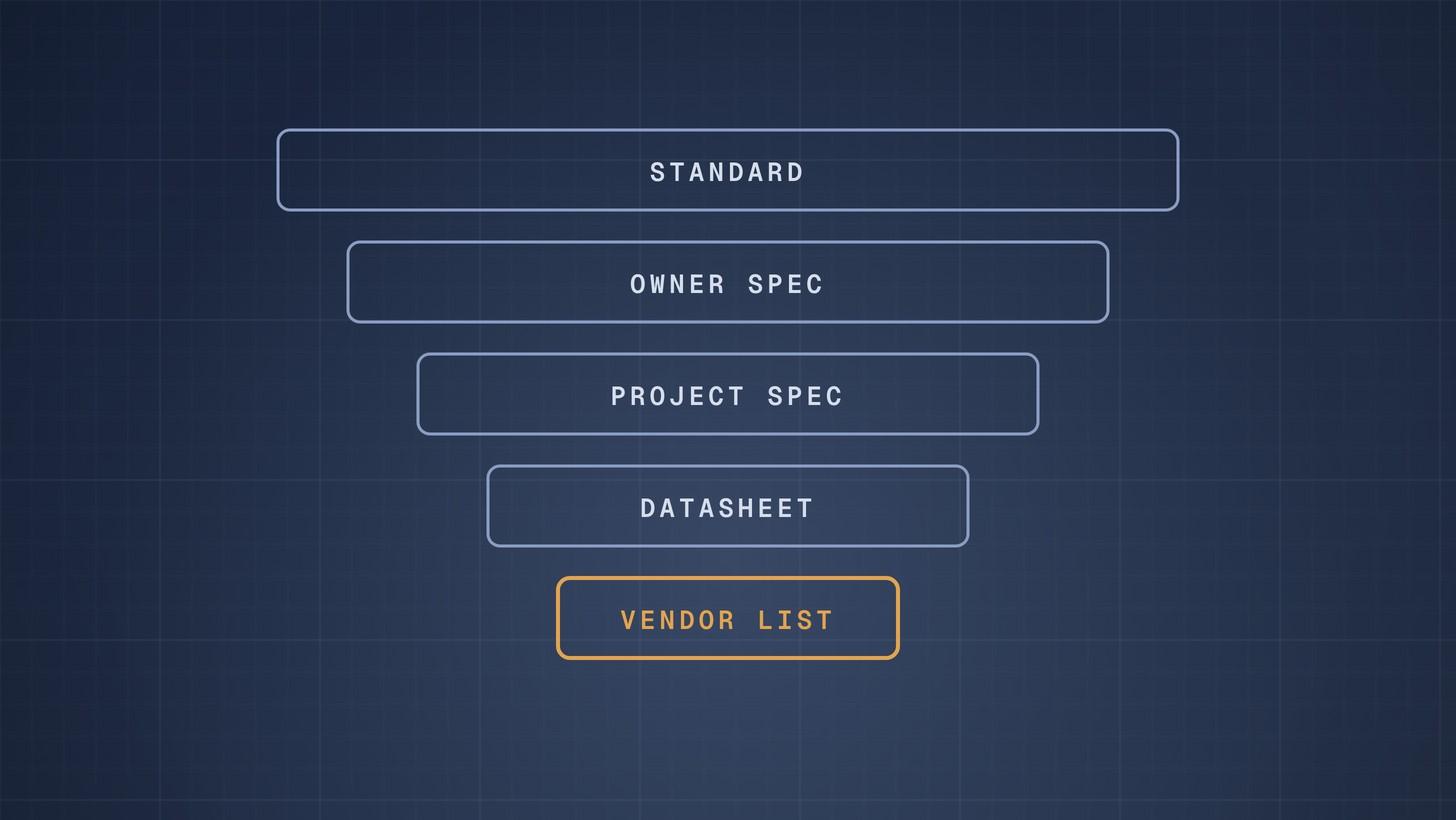
To get your equipment specified, you need to be on the documents engineers write before the RFQ: the owner's or contractor's specification, the equipment datasheet and the approved vendor list. Make that easy by meeting the standards they use and saying so clearly, supplying data in the formats they work in, getting on vendor lists early, and being the supplier who helps with sizing before anyone asks for a price.
Why this matters now
By the time a process equipment RFQ is issued, most of the decision has been made. The datasheet fixes the type, materials, ratings and options. The vendor list fixes who is allowed to quote. A supplier who first hears about the project at RFQ stage is competing on price against whoever helped write the specification.
Two trends make this more important. Large owners are standardising their specifications, so getting your product to comply once now pays off across many projects. And engineers increasingly shortlist through search and AI assistants before they talk to anyone, so the technical information you publish is what gets you on the long list. Our article on how buyers ask AI who to shortlist covers that side.
Access real procurement opportunities from global buyers
Join ChemCapital to get discovered by verified procurement teams across pharmaceutical, chemical, and industrial manufacturing.
How specifications are built on process projects
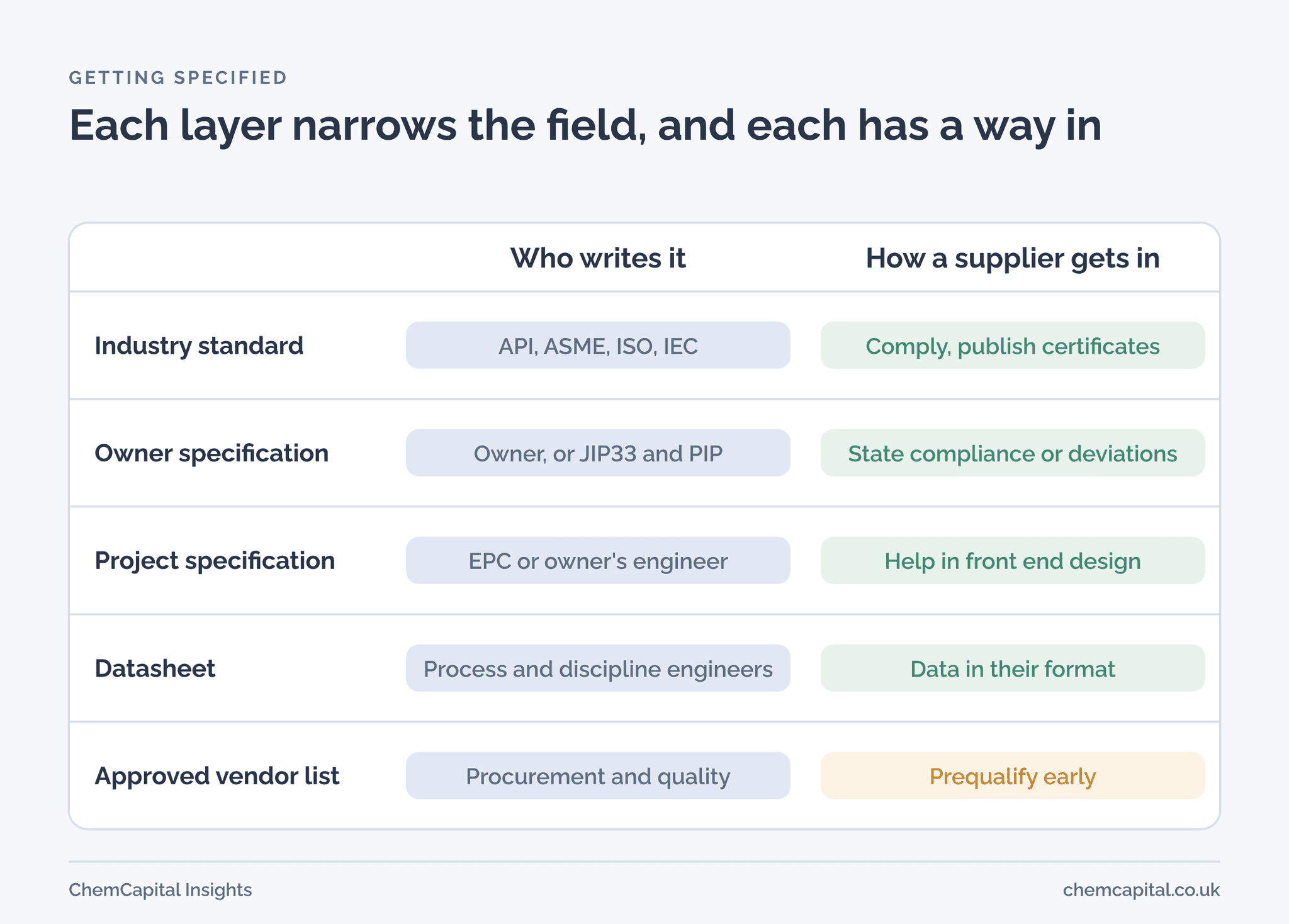
Think of a stack of documents, each narrowing the one above it.
| Layer | Written by | What it fixes |
|---|---|---|
| Industry standard | Standards bodies, such as API, ASME, ISO, IEC | Design, materials, testing |
| Owner or company specification | The owner, often adding to the industry standard | Preferences beyond the standard, documentation, inspection |
| Project specification | The EPC contractor or owner's engineer | Site conditions, project choices |
| Datasheet | Process and discipline engineers | The duty, sizing, materials and options for one tag |
| Approved vendor list | Procurement, engineering and quality | Who may be invited to quote |
Owner specifications are where suppliers lose most time. Operators have long written their own requirements on top of industry standards, so a supplier can receive different specifications for the same equipment, sometimes from the same operator. That adds cost and delay; one operator reported evaluation periods of over a year for major rotating equipment [1].
That is changing. The IOGP's JIP33 programme, started in 2016, has published 60 standardised procurement specifications that its twelve operator sponsors, including bp, Shell, ExxonMobil and TotalEnergies, use instead of writing their own [2]. Each one has four parts: a supplementary specification to an industry standard, an information requirements specification listing the documents and data the supplier must deliver, a quality requirements specification, and a procurement data sheet with the buyer's chosen options [2]. In the wider process industries, Process Industry Practices, a consortium of more than 100 owners and EPC contractors, publishes more than 500 harmonised practices across fourteen disciplines [3].
For a supplier, that is good news. If your standard product meets the common specification, you can say so once and be credible to every owner who uses it.
Six ways to get specified
1. Map your products to the standards engineers cite. For each product line, publish which standards it meets, with edition and any exceptions, and the certificates that prove it. If your customers use JIP33 or PIP documents, state compliance against the specific specification number, or list your deviations honestly.
2. Supply data in the buyer's format. Engineers fill in datasheets; give them data that drops straight in. For process instruments, IEC 61987 defines lists of properties describing operating conditions and the device itself, so that data can be exchanged electronically in enquiries and proposals without retyping [4]. For packages, match the procurement data sheet and the information requirements the owner already uses [2]. Our guide to instrument datasheet templates shows what engineers expect to see.
3. Publish real technical content. Performance curves, materials options, sizing guides, dimensional drawings and installation details. Downloadable 3D models matter too: in one large survey run by a CAD catalogue vendor, 92% of engineers and architects said a 3D preview was important when selecting products [5].
4. Get on the vendor lists early. Approved vendor lists are refreshed at the start of major projects and owner framework reviews. Prequalification takes weeks, so do it before the project needs you. Our guides to EPC contractor vendor registration and getting on a pharma approved vendor list cover the paperwork.
5. Help with sizing before the RFQ. The supplier who checks the duty, flags a material issue or suggests a cheaper configuration during front end design is the one whose model number appears in the datasheet notes. Make it easy to ask: a named application engineer, a fast reply and no sales pressure.
6. Be findable. Engineers search by duty and standard, not brand. Pages that answer "which pump for 30% caustic at 80 °C" get read; pages that only list model numbers do not.
What a compliance statement should contain
Engineers trust a one page statement more than a brochure. For each product line, include:
- The standard and edition, for example the edition of the pump or valve standard you build to.
- Clause level exceptions, stated plainly. An honest exception list is read as competence; a blanket "fully compliant" is read as untested.
- Certificates and their scope: pressure equipment, hazardous area, hygienic design, fire safe, SIL, with certificate numbers and expiry dates.
- Documentation you deliver as standard: datasheets, drawings, material certificates, test reports, manuals, spares lists. This is what an information requirements specification will ask for [2].
- Inspection and test you offer as standard, so the quality requirements are not a surprise.
- Contact details for technical questions, with a real name.
Keep it current. An expired certificate on a published statement does more harm than having no statement at all.
Why suppliers get left off
Most suppliers who never appear on datasheets are not rejected; they are simply not considered. The usual reasons:
- Engineers could not find them when searching by duty, material or standard.
- The data was not usable: a brochure PDF instead of curves, dimensions and materials an engineer can copy into a datasheet.
- They were not on the vendor list when the list was set, and nobody wanted to add a new vendor late in the project.
- Their compliance was unclear, so including them meant extra technical queries.
- They only appeared at RFQ stage, when the specification already favoured someone else.
Each one is fixable before the next project starts.
Practical example
Illustrative. A valve maker sells mostly through distributors and rarely appears on project datasheets. Over a year it:
| Action | Effort |
|---|---|
| Publishes a standards and certificates matrix for its four product lines | 3 days |
| Builds datasheet ready data files for its 20 most common sizes | 10 days |
| Prequalifies with three EPC contractors and two owners active in its region | 5 days each, 25 days |
| Adds 3D models and dimensional drawings to every product page | Outsourced |
| Names one application engineer for front end enquiries | Ongoing |
The investment is about 38 days of internal effort plus the modelling work. The test of success is simple: how many RFQs arrive with the company's model numbers already in the datasheet, compared with the year before.
Expect a lag. Process projects take a year or more to move from front end design to purchase orders, so the datasheets being written today become the RFQs of next year. Track the leading signs in the meantime: front end enquiries from engineers, requests for drawings and models, and prequalification questionnaires received. Those tell you whether the work is landing long before the orders arrive.
If you are the buyer
Specify performance and standards, not brands, unless there is a real technical or spares reason. Where you name a product, add "or equal" and say what equal means. Standardised specifications cut the cost of evaluating bids, because suppliers stop pricing bespoke requirements that add cost without improving safety or performance [1].
Where ChemCapital fits
When procurement teams search for suppliers on ChemCapital, they search by what they need. A free supplier listing with your products, standards and approvals means Supplier Discovery can put you on the shortlist before the specification is closed. See what suppliers get from ChemCapital.
Ready to be found by the engineers writing the specifications? List your company on ChemCapital. It is free to start.
Frequently asked questions
How do I get my product specified on process projects?
Meet the standards engineers cite and publish proof, supply data in the formats they use for datasheets, prequalify for approved vendor lists early, and help with sizing during front end design before the RFQ.
What is JIP33?
An IOGP programme started in 2016 that publishes standardised procurement specifications for equipment, used by major operators instead of their own company specifications. Each has a specification, information and quality requirements, and a procurement data sheet.
What is an approved vendor list?
The list of suppliers a buyer or EPC contractor allows to quote for a category of equipment. If you are not on it when the RFQ is issued, you usually cannot bid.
What does "or equal" mean in a specification?
That a named product is an example, and an alternative meeting the same performance and standards is acceptable. Good specifications say what equal means.
Continue reading
Informational only, not procurement or legal advice. Cited names, frameworks, and statistics belong to their respective owners.
Access real procurement opportunities from global buyers
Join ChemCapital to get discovered by verified procurement teams across pharmaceutical, chemical, and industrial manufacturing.
List your companyRelated articles
AMP8 for Equipment Suppliers: How Water Companies Buy, 2025 to 2030
AMP8 is the 2025 to 2030 investment period for water companies in England and Wales, with £104bn approved. Here is how the money is spent, how water companies buy through frameworks and delivery partners, and how equipment suppliers get in.
How to Find Tenders for Pumps, Valves and Process Equipment
Public tenders for process equipment are published free on Find a Tender in the UK, TED in the EU and SAM.gov in the US. Here is how to set alerts with the right CPV codes and where utility frameworks fit.

Framework Agreements for Pumps, Valves and Instruments: When They Beat Project Buying
A frame agreement for pumps, valves or instruments pays off when you buy the same types repeatedly. Here is when it beats project by project buying, what to put in it, and a worked example.