
How to Check a Supplier's Financial Health Before You Award an Equipment Order
The UK checks that tell you whether an equipment supplier will still be trading when your order is half built: Companies House, charges, Gazette notices and credit reports, plus how to protect advance payments.
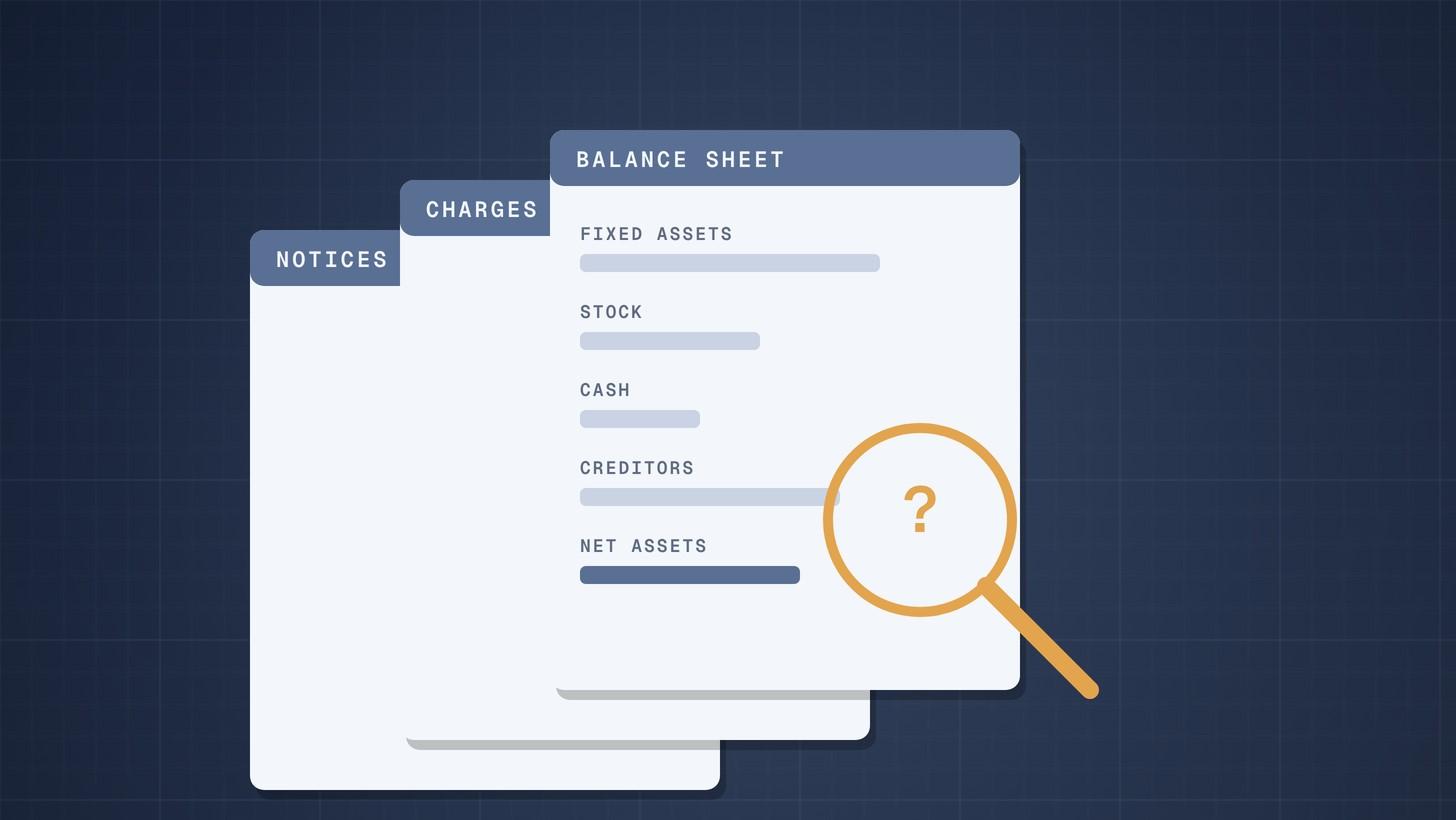
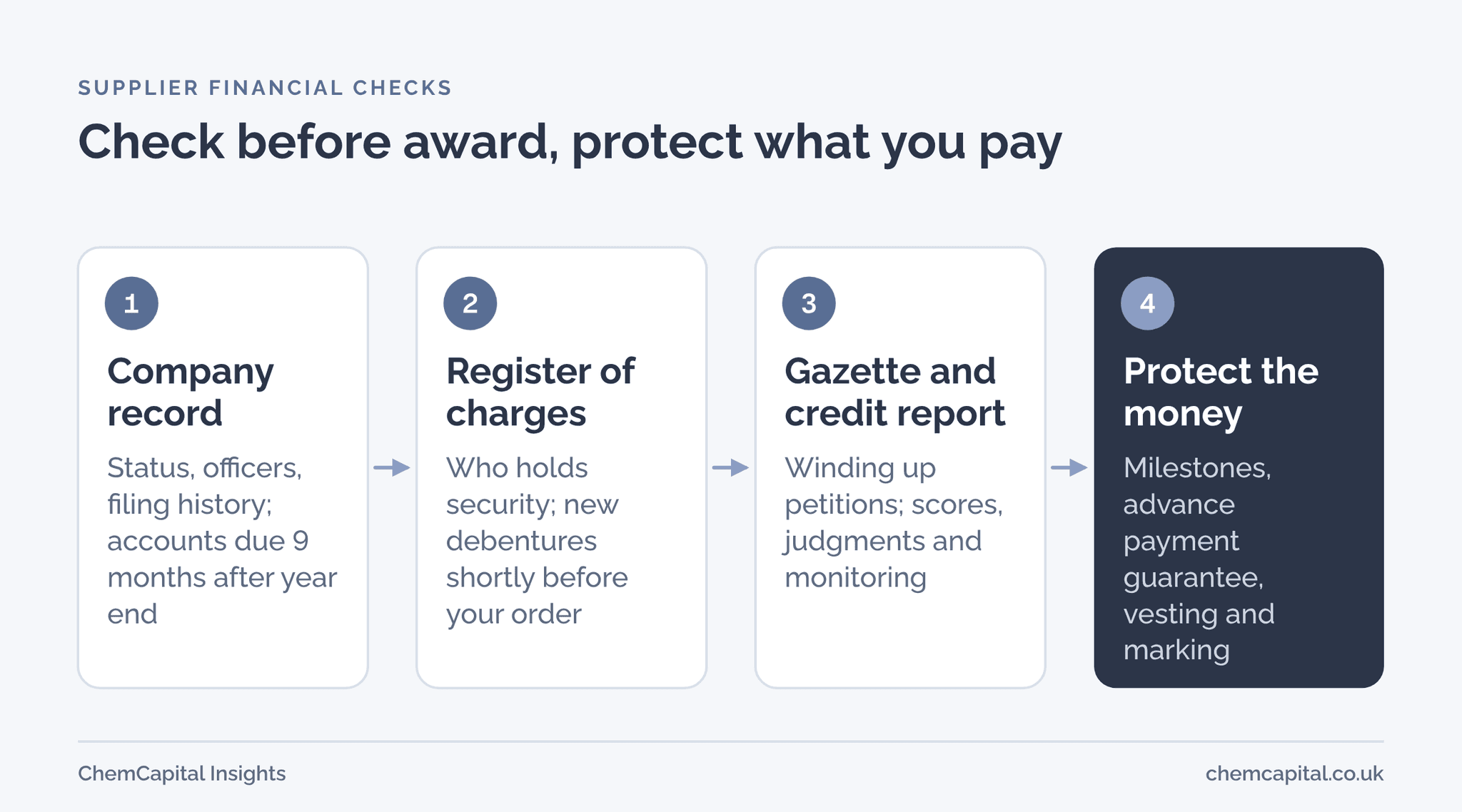
Before you award an equipment order, check that the supplier will still be trading when your skid is half built. In the UK that means four free checks and one paid one: the Companies House record (status, filing history and accounts), the register of charges, insolvency notices in The Gazette, and a credit report. Then match the checks to the size of your exposure, and protect any money you pay before delivery with guarantees, vesting and marking.
Why this matters now
An equipment order often runs for months, and the buyer pays a good part of the price before anything arrives. If the supplier fails in the middle, you can lose the advance, the part built equipment and your place in the schedule all at once.
Company failure is not rare. The Insolvency Service recorded 1,882 company insolvencies in England and Wales in September 2026, and a rate of 49.9 per 10,000 companies over the previous 12 months, about one company in 200. Manufacturing accounted for 1,827 insolvencies in that 12 month period [1]. Many fabrication shops and package suppliers are small private companies, and small companies file the least information.
Create and manage RFQs in minutes
ChemCapital handles the entire procurement cycle, from structured RFQs and supplier comparisons to formal purchase orders and delivery tracking.
The checks
1. Companies House record
Start with the free company record. Check the status (active, or a proposal to strike off), the incorporation date, the officers and any recent changes, and the filing history.
Are the accounts on time? A private company must file its annual accounts within 9 months of its accounting reference date; late filing brings penalties from £150 up to £1,500 [2]. Overdue accounts are not proof of trouble, but a supplier that cannot produce its accounts on time deserves a question.
What do the accounts show? Often less than you want. Small companies do not have to file a profit and loss account or a directors' report, and may file abridged accounts with a reduced balance sheet [2]. This is changing: from 1 April 2028 small companies and micro entities will have to file their profit and loss account, though they may opt out of making it public, and the option to file abridged accounts will end [3]. Until then, for a significant order, ask the supplier directly for full accounts and recent management accounts. A supplier that wants your order will usually provide them under a confidentiality agreement.
From the balance sheet, look at net assets and how they have moved, cash against short term debts, and the trend over two or three years. If the accounts are audited, read the auditor's report for any material uncertainty about going concern.
2. Register of charges
A charge is the security a company gives for a loan, and it should be registered at Companies House within 21 days of being created [4]. The charges tab shows who holds security over the company's assets. A charge paid off is marked satisfied [4].
Charges are normal for a manufacturing business. What deserves attention is a cluster of new charges, for example a new debenture to an invoice finance lender shortly before your order. That can mean the business is short of cash and borrowing against its debtors. It may also mean a lender has first call on the assets, including, possibly, equipment you have paid for.
3. Insolvency notices in The Gazette
The Gazette publishes corporate insolvency notices, including petitions to wind up a company. A creditor owed £750 or more can petition the court, and the petition is advertised in The Gazette at least seven business days after it is served. Once it is public, banks usually freeze the company's account, which in practice stops trading [5]. Search the supplier's name and number before award, and again before each large payment.
4. Credit report
Credit reference agencies combine filed accounts, charges, court judgments and payment data into a score and a suggested credit limit. A report is cheap compared with an advance payment, and most agencies offer monitoring that alerts you if something changes during the order.
5. Behaviour
Numbers lag; behaviour often comes first. Watch for a supplier asking for a larger advance than its competitors, pushing to invoice early, sub suppliers chasing it for payment, sudden changes of key staff or auditor, and deliveries from its own sub suppliers slipping for unexplained reasons. Expediting visits tell you more than any report: an empty shop floor or idle welders on your job is a signal.
Questions to ask the supplier
The direct conversation is often the most useful check, and a confident supplier will not mind it. For a large order, ask:
- Can you share your latest full accounts and your management accounts for the year to date?
- Who are your main lenders, and what do the charges registered against the company secure?
- How much of your order book does our order represent, and how will you fund the work until our first payment?
- Which of our items will you buy from sub suppliers, and on what payment terms?
- Which bank would issue an advance payment guarantee, and has it agreed a facility?
Write down the answers and compare them with what the record shows. Inconsistency matters more than any single figure: a supplier that says it has no borrowing while the register shows a recent debenture has told you something important.
Make the checks proportionate
Not every order needs every check. A useful approach is to tier by exposure and criticality:
| Order | Checks | Protection |
|---|---|---|
| Small, standard, short delivery | Companies House status and Gazette search | Pay on delivery |
| Medium, or a critical item | Add accounts review, charges and a credit report | Milestones tied to progress |
| Large, long delivery, or with an advance | Add full or management accounts and a conversation with the finance director | Advance payment guarantee, vesting and marking, possibly a parent company guarantee |
Record the checks in the supplier file. Our supplier qualification questionnaire guide shows where financial questions fit in prequalification, and vendor risk management covers the wider picture.
Protect the money you pay before delivery
Tie payments to progress. Pay against milestones you can verify, such as approved drawings, material arrival or factory acceptance test, not against dates. Our guide to payment milestones, retention and bonds has typical structures.
Secure the advance. An advance payment guarantee from a bank lets you recover the advance if the supplier fails to perform. It is only as good as the bank that issues it, so check the issuer as well.
Vest and mark the equipment. A vesting clause transfers ownership of materials and part built equipment to you as you pay for them. Law firm BCLP points out the limits: you cannot get better title than the supplier had, so a sub supplier's retention of title can defeat you, and marking mechanisms only help if they are properly administered and flow down the supply chain [6]. Ask for items to be clearly identified as yours, photographed and, where practical, stored separately. BCLP also suggests a bond for valuable off site plant and equipment [6].
Keep an alternative. For critical items, know who else could finish the work, and make sure the drawings and documents you have paid for are delivered as the work progresses, not at the end.
Practical example
Illustrative figures. An £850,000 vessel and skid package is paid 30% on order, 30% when the main materials arrive, 30% on delivery and 10% after commissioning. Six months in, the supplier has received two payments.
| Point in the order | Paid to date | Secured by | Unsecured exposure |
|---|---|---|---|
| After order | £255,000 | Advance payment guarantee for £255,000 | £0 |
| After materials | £510,000 | Guarantee £255,000, plus marked and vested plates and nozzles valued at £180,000 | £75,000 |
| After delivery | £765,000 | Equipment on your site, title transferred | £0 |
The checks before award told the buyer the supplier was sound but thinly capitalised, so the buyer asked for the guarantee and the vesting clause. The remaining £75,000 is a known, accepted risk, monitored through monthly Gazette searches and expediting visits.
Common mistakes
- Checking once and never again. Repeat the Gazette search and credit check before each large payment.
- Relying on a credit score alone for a large order with an advance.
- Paying against dates, not progress.
- A vesting clause with no marking, so nobody can prove which plates were yours.
- Ignoring behaviour, because the accounts filed last year looked fine.
Making these judgements about a named supplier is your decision; this article describes checks, not conclusions about any company. This is general information, not legal advice; check the current text before you rely on it.
Where ChemCapital fits
Financial checks are easier when you have more than one capable supplier to choose from. ChemCapital's Supplier Discovery helps you build a shortlist by category and capability, so a weak result on one supplier does not leave you without an alternative.
Ready to build shortlists with more than one sound option? Start a free 14 day ChemCapital trial, with no credit card needed.
Frequently asked questions
How do I check a supplier's financial health in the UK?
Check the Companies House record (status, filing history and accounts), the register of charges, insolvency notices in The Gazette, and a credit report. For large orders, also ask the supplier for full and management accounts.
What are warning signs that a supplier is in financial trouble?
Overdue accounts, a cluster of new charges, a winding up petition, falling net assets, requests for larger advances or early invoicing, sub suppliers chasing payment, and sudden changes of key staff or auditor.
Do small companies publish a profit and loss account?
Not at present; small companies may omit it at Companies House. From 1 April 2028 small companies and micro entities must file it, though they may opt out of making it public.
How can I protect an advance payment to a supplier?
Tie payments to verifiable progress, ask for an advance payment guarantee from a sound bank, and use a vesting clause with clear marking of materials and part built equipment.
Continue reading
Informational only, not procurement or legal advice. Cited names, frameworks, and statistics belong to their respective owners.
Create and manage RFQs in minutes
ChemCapital handles the entire procurement cycle, from structured RFQs and supplier comparisons to formal purchase orders and delivery tracking.
Start for freeRelated articles
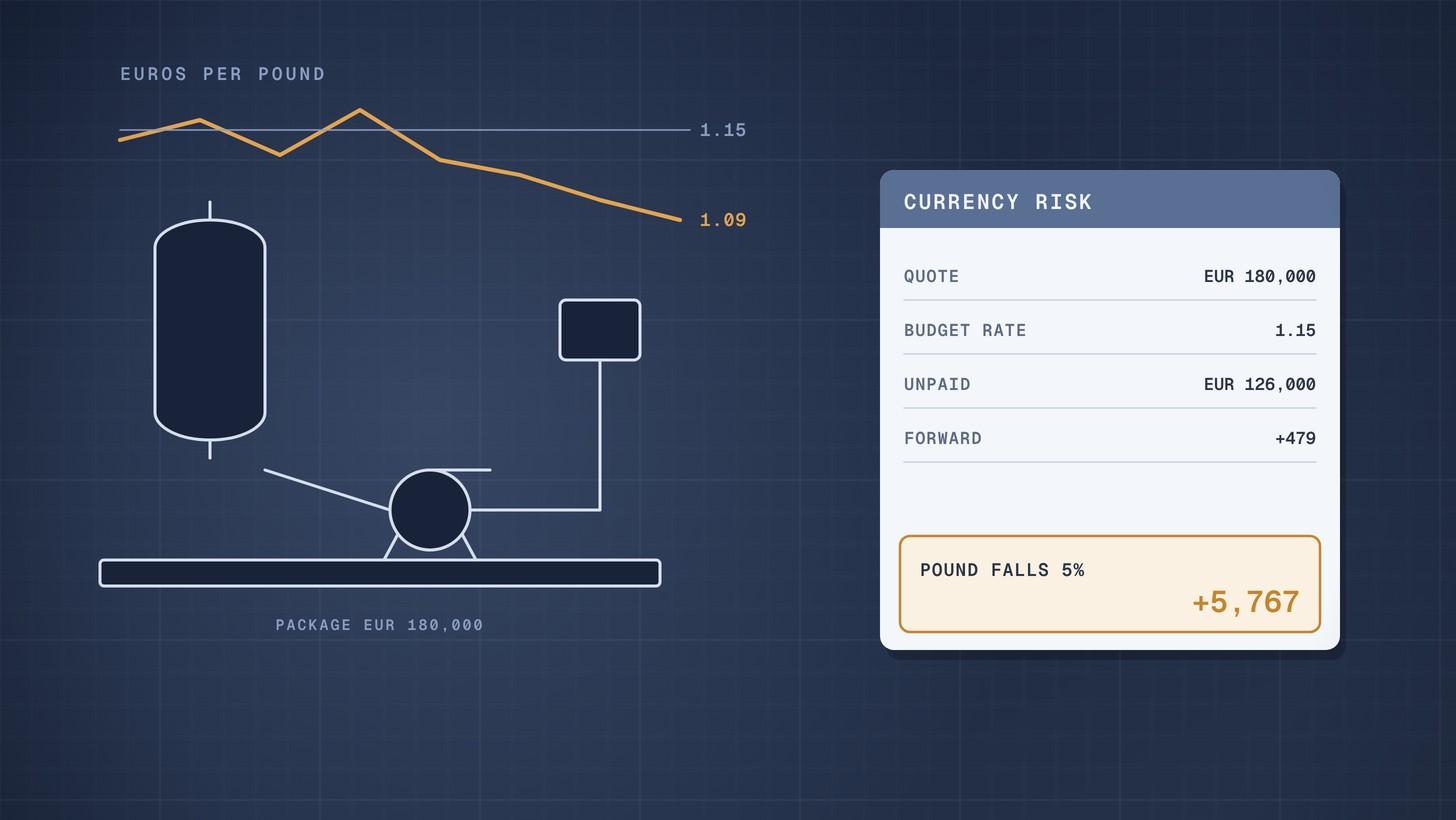
Exchange Rate Risk on Equipment Quotes: Worked Example
How exchange rate risk builds up on a euro or dollar equipment quote between order and final payment, what a 5% move costs, and how forwards and currency clauses limit it.
US Tariffs on Imported Process Equipment in 2026: What UK Suppliers Pay Now
The US tariff position for process equipment as of November 2026: Section 232 metals tariffs and UK rates, the Section 301 tariff that replaced Section 122, the new industrial machinery action, and how to protect a quotation.
Process Equipment Lead Times: Quarterly Tracker, Q4 2026
Lead times for valves, pumps and transformers from named, dated public sources, the UK and US delivery trend this autumn, and how to build lead times into a project schedule. Updated quarterly.