
US Tariffs on Imported Process Equipment in 2026: What UK Suppliers Pay Now
The US tariff position for process equipment as of November 2026: Section 232 metals tariffs and UK rates, the Section 301 tariff that replaced Section 122, the new industrial machinery action, and how to protect a quotation.
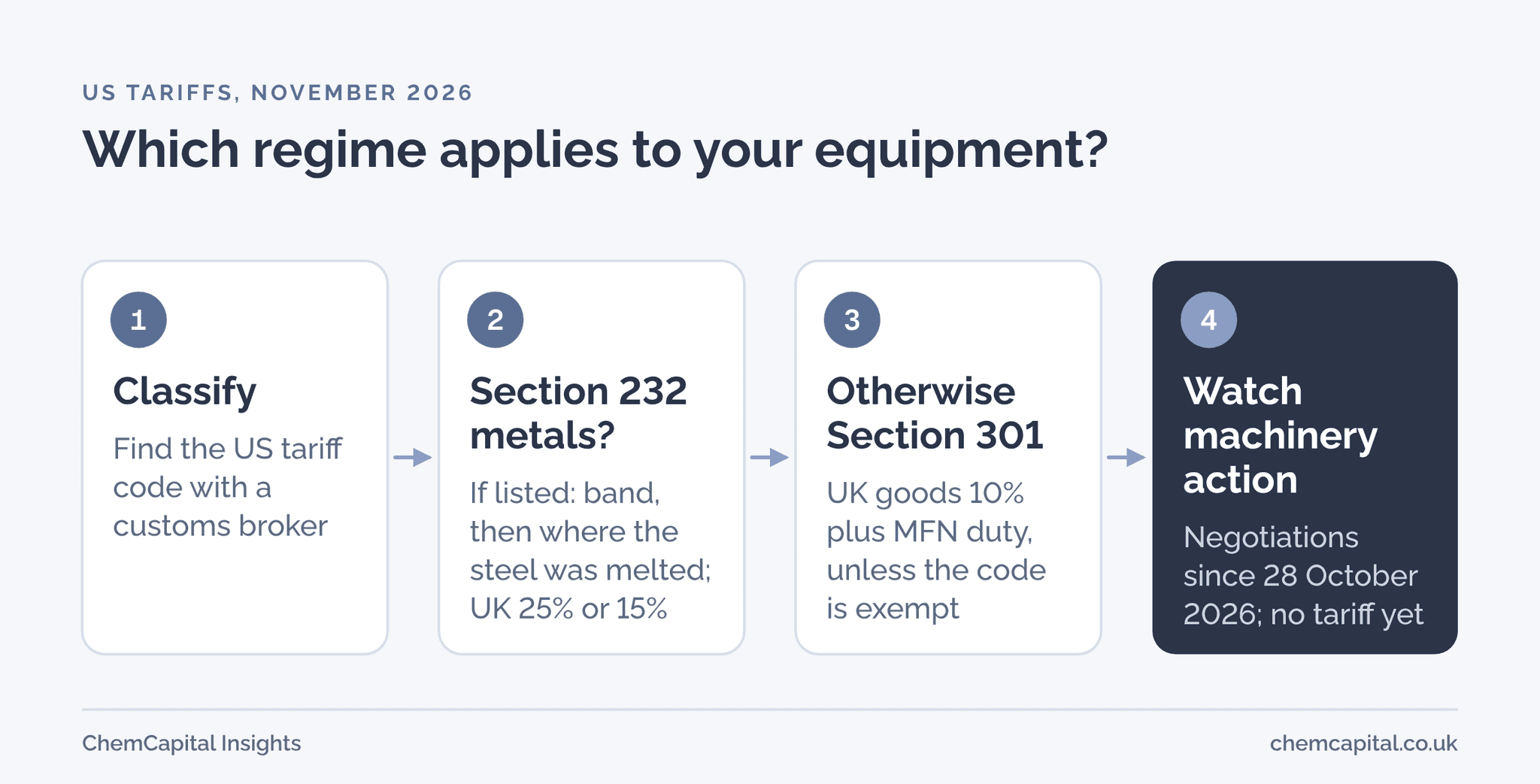
As of 6 November 2026, process equipment imported into the US faces one of two main tariff regimes. Equipment that counts as a steel or aluminium product or derivative falls under the Section 232 metals tariffs, where UK goods made with UK melted steel currently pay 25% or 15% depending on the category. Most other UK goods pay a 10% Section 301 tariff on top of the normal duty, in force since 24 July 2026. A new Section 232 action on industrial machinery, signed on 28 October 2026, directs negotiations but imposes no tariff yet. These rules have changed several times this year; check the current text before you quote.
This article states what the official measures and specialist trade lawyers' summaries say, with dates. It makes no predictions. This is general information, not legal advice; check the current text before you rely on it.
Why this matters now
US tariffs in 2026 have moved faster than most quotation validity periods. A supplier that quoted a US customer in January on a delivered duty paid basis may have seen three different duty regimes apply before shipment. Knowing which regime applies to your product, and writing your quotation so that a change does not wipe out your margin, is now part of selling into the US.
Access real procurement opportunities from global buyers
Join ChemCapital to get discovered by verified procurement teams across pharmaceutical, chemical, and industrial manufacturing.
What changed in 2026
| Date | Measure | What it means for equipment |
|---|---|---|
| 20 February 2026 | US Supreme Court rules that IEEPA does not authorise tariffs | The "reciprocal" and trafficking tariffs imposed under IEEPA fall [1] |
| 24 February 2026 | Section 122 surcharge starts at 15%, for up to 150 days | Applies globally, except to goods under Section 232 tariffs [2] |
| 6 April 2026 | Section 232 metals tariffs restructured | Tariff on full customs value; 50%, 25%, 15% and 10% bands [3] |
| 8 June 2026 | Further Section 232 adjustments | UK rates of 25% and 15%; wider 15% band for industrial equipment [4] [5] |
| 24 July 2026 | Section 122 expires; Section 301 tariffs replace it | 10% for UK goods, on top of the normal duty [6] |
| 28 October 2026 | Section 232 action on robotics and industrial machinery | Negotiations directed; no tariff imposed yet [7] |
The Section 232 metals tariffs
Since 6 April 2026, the steel, aluminium and copper tariffs apply to the full customs value of the product, not only its metal content, and they do not stack where a product contains more than one metal. White & Case summarises the bands: 50% for articles made entirely or almost entirely of these metals, 25% for steel and aluminium derivatives that are not almost entirely metal, and 10% for products made with US melted or smelted metal [3]. Certain steel and aluminium industrial equipment and grid equipment carry a temporary 15% rate until 1 January 2028 [3]. Products with less than about 15% steel, aluminium and copper by weight, outside the core metal chapters, fall outside these tariffs [3].
For the UK, CBP's June 2026 guidance sets 25% for UK origin aluminium or steel articles and 15% for UK origin derivative articles, where at least 95% of the steel was melted and poured in the UK or the aluminium was smelted or last cast there [4]. A separate 15% heading covers derivative steel articles from the UK and several other partners, including the EU, Japan, Korea and Switzerland [4]. The June changes also extended the 15% industrial equipment rate for partners with preferential treatment to mobile industrial equipment, and lowered the US content threshold for the 10% rate from 95% to 85% [5].
The practical consequence: where the steel in your skid or vessel was melted matters as much as where you built it. A UK fabricated vessel made from imported plate may not qualify for the UK rates.
The Section 301 tariff on other goods
When the Section 122 surcharge expired, Section 301 tariffs replaced it from 12:01 am ET on 24 July 2026 and, according to Baker Donelson, will remain in place indefinitely absent amendment [6]. For the UK the rate is 10%, applied on top of the normal most favoured nation (MFN) duty; for EU member states the structure is different, with the combined duty set at 10% [6]. Goods subject to the Section 232 duties on steel, aluminium, copper and several other sectors are excluded, and the UK has a list of tariff codes that are exempt when the goods originate in the UK [6].
The new industrial machinery action
On 28 October 2026 the President signed a Section 232 proclamation on robotics, industrial machinery and their parts and components, finding that imports threaten to impair national security [7]. It directs the Commerce Secretary and the US Trade Representative to negotiate with trading partners and does not impose a tariff now [7]. Thompson Hine notes that an update is due within 180 days, and that the proclamation allows the President to consider tariffs, duties, quotas or fees later [8]. The public summaries we read do not list which tariff codes are in scope, so we cannot say whether pumps, compressors or valves are covered; check the proclamation's annexes.
Refunds of the struck down tariffs
If you or your customer paid IEEPA tariffs before February 2026, refunds may be possible. Holland & Knight noted at the time of the ruling that the Court did not specify whether refunds must be issued or how they would be processed [1]. Ask the importer of record and its broker for the current position before assuming either way, and keep the entry records.
Where to check the current position
Rates in this article will date. The primary places to check are CBP's Cargo Systems Messaging Service, which publishes implementation guidance such as the June 2026 message on the metals tariffs [4]; the Federal Register, where proclamations and notices appear; and the US tariff schedule itself, where the temporary duties sit in chapter 99 headings, for example the 9903.82 headings for the metals tariffs [4]. Specialist trade law firms publish readable summaries within days of each change. Before you quote, note the date of the position you relied on, and put it in the quotation.
How to work out what applies to your product
- Classify the product. The US tariff code decides everything. Use a customs broker or the importer's broker for anything significant; a pump, a pump skid and a pressure vessel can sit in quite different places.
- Check the Section 232 metals annexes. If the code is listed, find which band applies, then establish where the steel or aluminium was melted or smelted. Keep mill certificates that prove it.
- If not under Section 232, apply Section 301. For UK origin goods that is 10% on top of MFN, unless the code is on the UK exemption list.
- Watch the machinery action. Nothing is payable under it today, but it could change pricing for US contracts delivering in 2027.
- Decide who pays. Under DDP, you are the importer and pay the duty; under DAP or FCA, your customer does. Our guide to Incoterms for process equipment explains the choice.
Practical example
Illustrative figures, not a ruling on any product. A UK supplier exports a carbon steel process skid with a customs value of $400,000. The duty depends on how it is classified and where the steel was melted:
| Scenario | Rate applied | Duty |
|---|---|---|
| Section 232 derivative, steel melted and poured in the UK | 15% | $60,000 |
| Section 232 derivative, steel melted outside the UK and other partners | 25% | $100,000 |
| Not under Section 232; Section 301 at 10% plus an assumed 2% MFN duty | 12% | $48,000 |
The spread between the first two rows, $40,000, comes down to where the plate was made. The third row shows why classification matters: the same skid in a different code pays a different regime altogether. Only the importer's broker, working from the actual code and documents, can confirm which applies.
Protect your quotation
- Quote DAP or FCA unless you have priced the duty. If the customer insists on DDP, price the duty separately and state the basis.
- Add a tariff change clause. Say that the price assumes the duties in force on the quotation date and that changes will be passed through, as described in our guide to price adjustment clauses.
- Keep validity short for US quotations, and state the date of the tariff position you used.
- Document metal origin. Mill certificates showing where the steel was melted and poured can be worth a tenth of the price.
- Check the other US requirements early. Electrical compliance often matters as much as duty; see our guide to selling process skids into the US.
Where ChemCapital fits
US buyers compare imported and domestic offers on landed cost. A clear ChemCapital profile on Supplier Discovery shows what you make and where, so buyers can judge you on capability as well as price. See what suppliers get from ChemCapital.
Ready to reach more buyers with offers they can compare fairly? List your company on ChemCapital. It is free to start.
Frequently asked questions
What tariff does UK process equipment pay in the US in 2026?
It depends on classification. Goods under the Section 232 metals tariffs pay 25% or 15% if they meet the UK metal origin test, and up to 50% otherwise. Most other UK goods pay a 10% Section 301 tariff on top of the normal duty, as of November 2026.
Are there US tariffs on industrial machinery?
A Section 232 proclamation on robotics and industrial machinery was signed on 28 October 2026. It directs negotiations and imposes no tariff yet, though tariffs, quotas or fees may be considered later.
What replaced the Section 122 tariffs?
Section 301 tariffs took effect on 24 July 2026 when the 150 day Section 122 surcharge expired. The rate for UK goods is 10% on top of the normal MFN duty, excluding goods under Section 232.
How can a supplier protect a US quotation from tariff changes?
Quote DAP or FCA unless duty is priced, state the tariff position and date used, add a clause passing through tariff changes, keep validity short and keep proof of where the metal was melted.
Continue reading
Informational only, not procurement or legal advice. Cited names, frameworks, and statistics belong to their respective owners.
Access real procurement opportunities from global buyers
Join ChemCapital to get discovered by verified procurement teams across pharmaceutical, chemical, and industrial manufacturing.
List your companyRelated articles
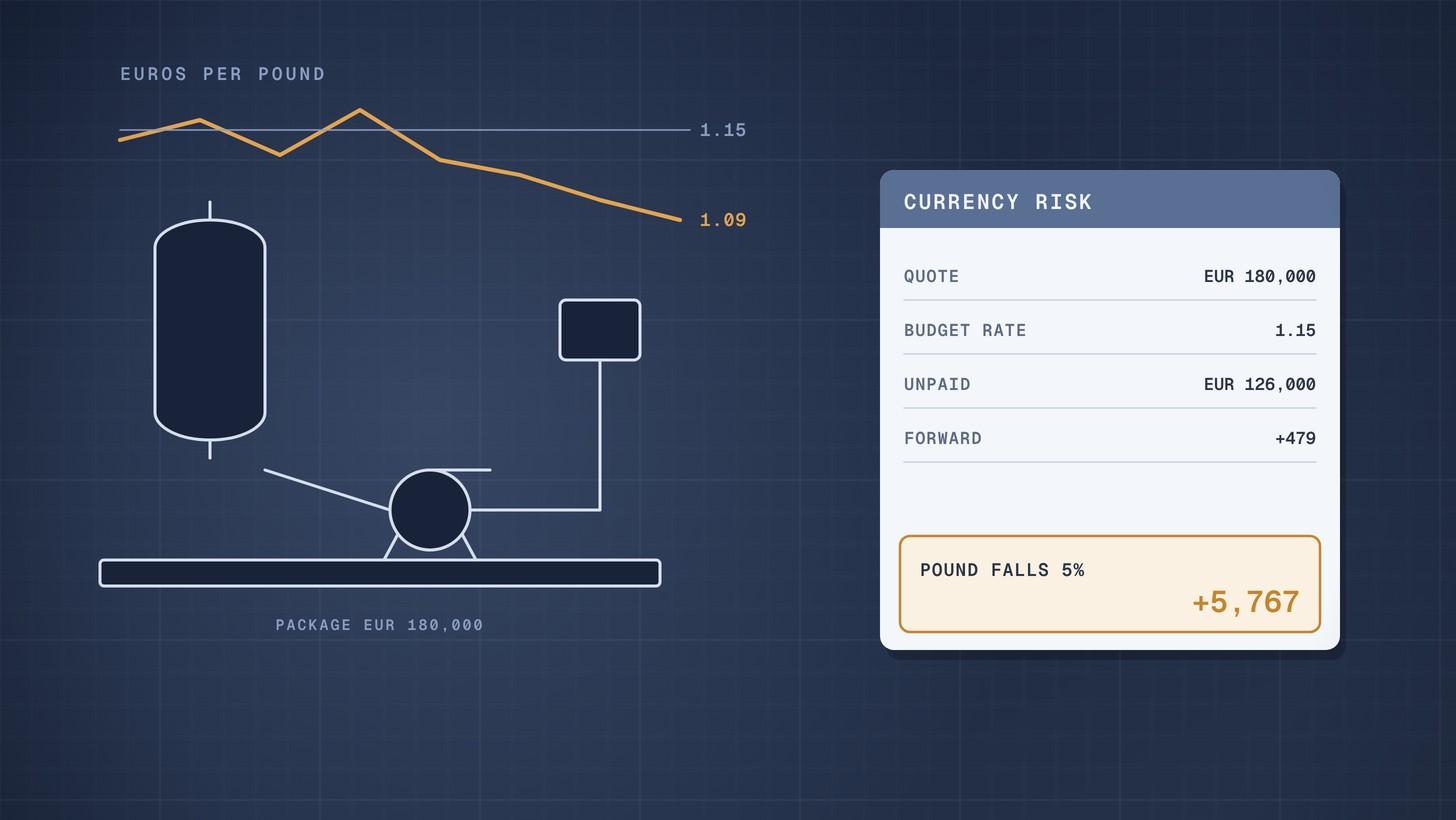
Exchange Rate Risk on Equipment Quotes: Worked Example
How exchange rate risk builds up on a euro or dollar equipment quote between order and final payment, what a 5% move costs, and how forwards and currency clauses limit it.
How to Check a Supplier's Financial Health Before You Award an Equipment Order
The UK checks that tell you whether an equipment supplier will still be trading when your order is half built: Companies House, charges, Gazette notices and credit reports, plus how to protect advance payments.
Process Equipment Lead Times: Quarterly Tracker, Q4 2026
Lead times for valves, pumps and transformers from named, dated public sources, the UK and US delivery trend this autumn, and how to build lead times into a project schedule. Updated quarterly.