
Payment Milestones, Retention and Bonds on Process Equipment Orders
How to tie payment milestones to evidence on process equipment orders, when to hold retention, and what advance payment guarantees, bonds and PCGs secure.
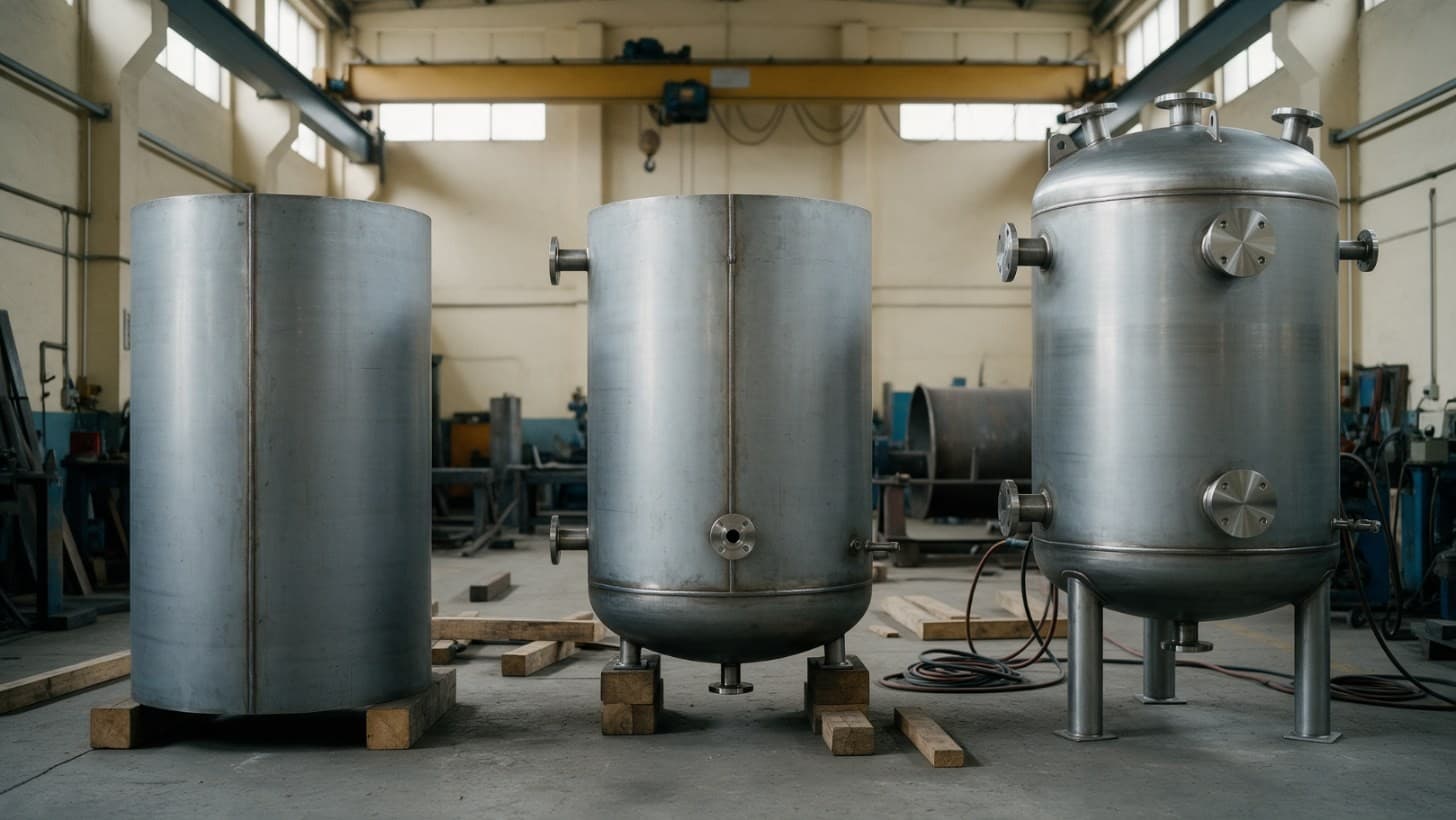
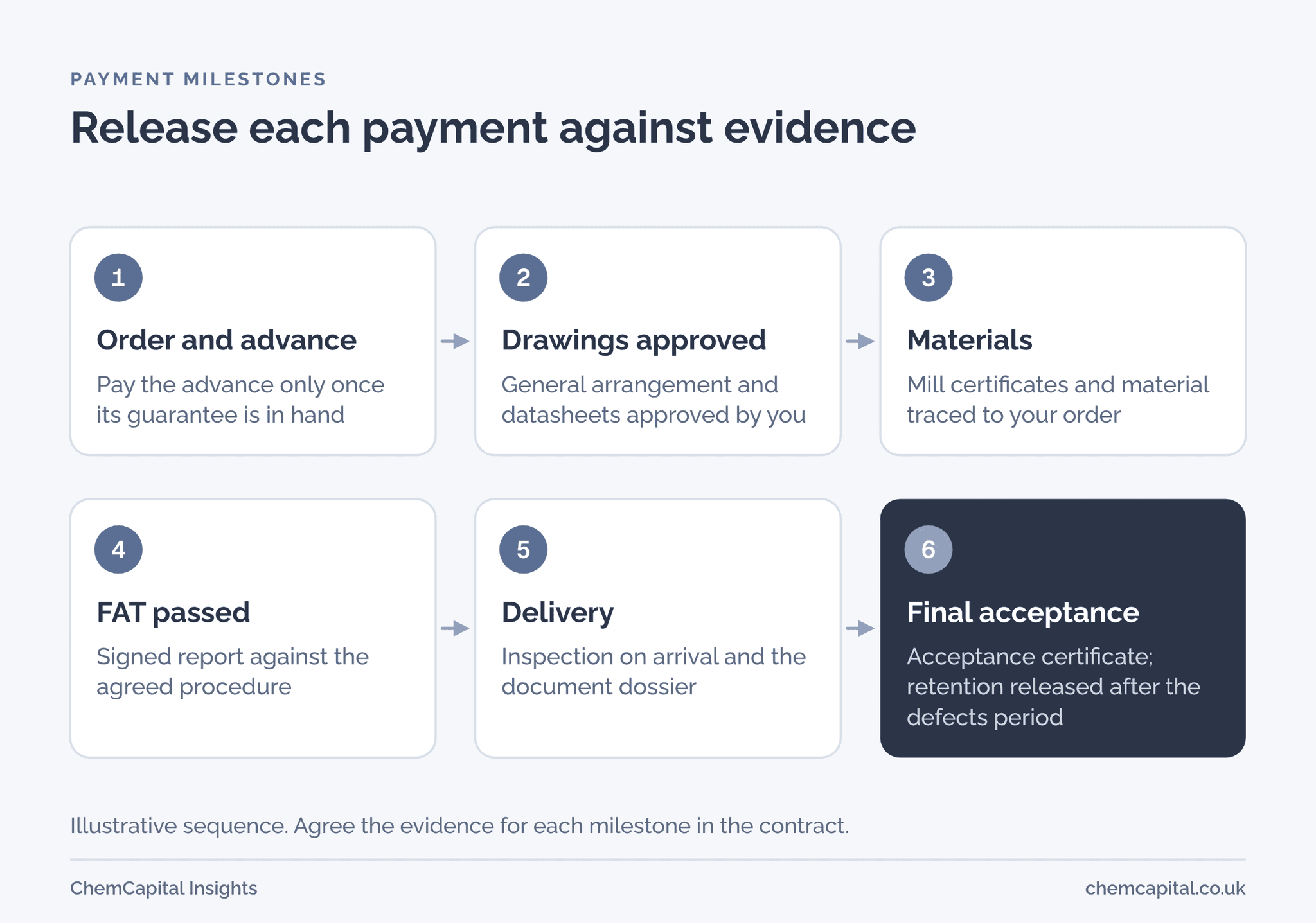
On an engineered equipment order, the buyer normally pays in stages, and each payment should be released against evidence: a confirmed order, approved drawings, materials in the shop, a passed factory acceptance test (FAT), delivery and final acceptance. Money paid ahead of delivery is commonly secured by an advance payment guarantee from the supplier's bank, performance by a performance bond or parent company guarantee, and the last part of the price by retention held until defects are put right.
Under the Housing Grants, Construction and Regeneration Act 1996 (the Construction Act), a contract only to make and deliver plant is not a construction contract. The Act's stage payment, payment mechanism and adjudication rules do not apply, so those exist only if your contract provides for them [1, 2]. Statutory interest on late payment between businesses still applies under the Late Payment of Commercial Debts (Interest) Act 1998, unless the contract gives a substantial remedy instead [3].
Why this matters now
Payment terms change what a bid really costs. Two quotes at similar prices can tie up different amounts of your cash, for different times, with different sums at risk if the supplier fails.
The rules are also moving. On 24 March 2026 the government said it intends to stop retention being withheld under construction contracts [4]. As of October 2026, the Commercial Payments Bill, which includes a ban on retention clauses in the construction sector, has completed its House of Lords stages, with third reading on 20 October 2026, and passes to the House of Commons [7]. It is not yet law and its wording may change. The ban targets the construction sector, so a supply only order that the Construction Act excludes may fall outside it; check the final text.
Create and manage RFQs in minutes
ChemCapital handles the entire procurement cycle, from structured RFQs and supplier comparisons to formal purchase orders and delivery tracking.
How a milestone schedule is built
A milestone is a point where a defined piece of work is finished and can be checked. A good schedule pays for progress you can verify, not for time passing.
| Milestone | Evidence before you pay | What protects you |
|---|---|---|
| Order and advance | Signed order acknowledgement; guarantee received and its wording checked | Advance payment guarantee covering the full advance |
| Drawings approved | General arrangement drawings and datasheets approved by you | Design fixed; later changes become priced variations |
| Materials | Mill certificates; materials identified against your order in the shop | Pay only for material you can see and trace, under a clause passing ownership to you on payment |
| FAT passed | Signed FAT report against the agreed procedure, with open items listed | FAT as a hold point in the inspection and test plan |
| Delivery | Delivery note, inspection on arrival, document dossier | Equipment in your possession |
| Final acceptance | Acceptance certificate after commissioning or a performance test | Final payment and retention held until here |
Seeing material in the shop does not make it yours. Under the Sale of Goods Act 1979, no property passes in unascertained goods until they are ascertained, and property in specific or ascertained goods passes when the parties intend, judged from the contract, their conduct and the circumstances [5]. So ask for a clause passing ownership of paid for material to you on payment, with the material marked as yours.
Pay against documents, not the supplier's word that a stage is done; our FAT checklist shows what a passed test should prove. Keep enough back after delivery to get commissioning faults and the dossier closed out, and set where risk passes in transit with the right Incoterms rule.
Advance payment guarantees, performance bonds and parent company guarantees
An advance payment guarantee secures repayment of money paid before delivery. If the supplier neither delivers nor repays, you demand the money from its bank, stating how the supplier has failed [6]. In the model bank wording we reviewed, the guarantee becomes effective only once the advance reaches the supplier's account with that bank, an optional clause reduces it by a percentage of each delivery's value, and it expires on a fixed date [6]. Set that date after the latest realistic delivery. The wording is issued subject to the ICC Uniform Rules for Demand Guarantees, 2010 revision (URDG 758) [6].
A performance bond pays you if the supplier fails to perform. The key choice is on demand or default:
| On demand bond | Default bond | |
|---|---|---|
| What you must show | No proof of loss; meet the demand conditions [8] | That you have suffered loss; the bondsman can use the supplier's defences [8] |
| Who usually issues it | Banks [9] | Mostly insurance companies [9] |
| Before it pays | A compliant demand; under English law it can be resisted only for clear fraud, or where it is clearly shown that the underlying contract does not allow the call [8] | The bondsman will usually require a binding judgment or award first [8] |
| Cost and availability | Dearer; usually only large, financially strong suppliers can provide one [8] | The more common form on UK projects [8, 9] |
| When it usually ends | As set in the wording | Most expire at the end of the defects period [9] |
A parent company guarantee (PCG) is a promise by the supplier's parent to answer for its subsidiary. Its liability usually lasts as long as the subsidiary's, and the threat of a call often brings the parent in to fix problems. But if the subsidiary fails for financial reasons, the parent may fail too, so a bond from a sound bank or insurer is usually the stronger protection [9]. Ask for the security that matches the risk, and expect the supplier to price it.
Retention and its release
Retention is money you keep back from each payment, or from the price, as security for defects. In UK construction it is commonly around 3% to 5% of amounts due, with half typically released at practical completion and the rest once defects in the defects period are put right [4]. On equipment orders it may be a final payment held until acceptance or to the end of the warranty. Give every release a trigger: the acceptance certificate, then the end of the defects period. A supplier may offer a retention bond instead of cash; Clyde & Co say these are not yet widely used [4].
When the Construction Act applies
Where a contract is a construction contract, the Act's rights, including stage payments and adjudication, are implied as terms if the contract does not deal with them adequately [2]. Two exclusions in section 105(2) matter for process plant [1]:
- Manufacture or delivery to site of plant, machinery, equipment or materials is not a construction operation, unless the contract also provides for installation [1, 2].
- Assembly, installation or demolition of plant or machinery, and steelwork that supports it or gives access to it, is excluded on a site whose primary activity is nuclear processing, power generation, water or effluent treatment, or the production, transmission, processing or bulk storage (other than warehousing) of chemicals, pharmaceuticals, oil, gas, steel or food and drink [1].
So a supply only order sits outside the Act, and a supply and install order on a chemical, pharmaceutical or food plant may too, depending on the site's primary activity [1]. The exclusion names only plant, machinery and its supporting steelwork, so civil and building work on the same site needs its own check [1].
If you want Construction Act style rights in a supply contract, the contract must give them expressly [2]: stage payment due dates, how either side notifies a disputed amount, and a dispute route such as adjudication. Late payment interest needs no clause; the 1998 Act already implies it [3]. This is general information, not legal advice.
Practical example
An illustrative case: two firm bids for the same packaged skid, delivered at month 10, accepted at month 12, with a 12 month defects period. The buyer's cost of capital is taken as 8% a year, and each payment is discounted to its value at the order date.
| Milestone (month) | Bid A: £500,000 | Bid B: £510,000 |
|---|---|---|
| Order and advance (0) | 30%: £150,000 | 10%: £51,000 |
| Drawings approved (2) | 20%: £100,000 | 10%: £51,000 |
| FAT passed (9) | 20%: £100,000 | 30%: £153,000 |
| Delivery (10) | 20%: £100,000 | 30%: £153,000 |
| Final acceptance (12) | 10%: £50,000 | 10%: £51,000 |
| End of defects period (24) | none | 10% retention: £51,000 |
| Paid before delivery | £350,000 | £255,000 |
| Present value at 8% a year | £483,201 | £480,211 |
Bid B costs £10,000 more on paper but about £2,990 less in present value. It also puts £95,000 less in the supplier's hands before delivery, needs a £51,000 advance payment guarantee rather than £150,000, and holds £51,000 for a year after acceptance.
The ranking depends on the rate: below about 6% a year, Bid A becomes cheaper. Bid B's supplier funds most of the build itself, so check it can carry that. Put the schedule beside price and technical scores in your quotation comparison sheet.
Put the payment terms in the RFQ
State your milestones, evidence and securities in the RFQ so every bidder prices the same terms, and ask for any departure as a priced alternative. ChemCapital sends one structured RFQ to all your suppliers at once, issues formal purchase orders that suppliers confirm, and records supplier milestone updates, with every interaction, revision and decision logged with a timestamp. That gives you a dated record to check each payment claim against.
Ready to tie every payment to evidence you can check? Start a free 14 day ChemCapital trial, with no credit card needed.
Frequently asked questions
What are typical payment milestones for an equipment order?
Engineered orders usually pay in stages: an advance on order, then drawings approval, materials, a passed factory acceptance test, delivery and final acceptance. The percentages are a commercial choice, so agree the evidence for each stage as carefully as the amount.
What is the difference between an on demand bond and a default bond?
With an on demand bond the buyer does not have to prove loss to be paid, and under English law a call can be resisted only for clear fraud, or where it is clearly shown that the underlying contract does not allow it. With a default bond the buyer must prove a loss first, and default bonds are the more common form on UK projects.
What does an advance payment guarantee cover?
It secures repayment of money paid before delivery, so the buyer can claim it from the supplier's bank if the supplier neither delivers nor repays. Check when it becomes effective, whether it reduces with each delivery, and that its expiry date falls after the latest realistic delivery.
Does the Construction Act apply to equipment supply contracts?
A contract only to manufacture or deliver plant is excluded from the Act unless it also provides for installation, and installing plant on a site whose primary activity is, for example, producing or processing chemicals, pharmaceuticals or food and drink is also excluded. Where the Act does not apply, its stage payment and adjudication rights exist only if the contract provides for them, though statutory interest on late payment between businesses still applies under the Late Payment of Commercial Debts (Interest) Act 1998 unless the contract gives a substantial remedy instead.
Continue reading
Informational only, not procurement or legal advice. Cited names, frameworks, and statistics belong to their respective owners.
Create and manage RFQs in minutes
ChemCapital handles the entire procurement cycle, from structured RFQs and supplier comparisons to formal purchase orders and delivery tracking.
Start for freeRelated articles
Site Acceptance Test (SAT) Checklist for Process Skids
What a site acceptance test must prove once a skid is installed, how SAT differs from FAT and commissioning, a full SAT checklist and how to handle failed tests.
Recommended Spares List: Commissioning, Operating and Insurance Spares
What a recommended spares list should hold: commissioning, two year operating and insurance spares, criticality, what to ask in the RFQ, and a pump and vessel template.
Punch List Categories and Mechanical Completion for Process Plant
What a punch list is, how category A, B and C items gate mechanical completion, start up and handover, who clears them, and a template for vendor equipment packages.