
Exchange Rate Risk on Equipment Quotes: Worked Example
How exchange rate risk builds up on a euro or dollar equipment quote between order and final payment, what a 5% move costs, and how forwards and currency clauses limit it.
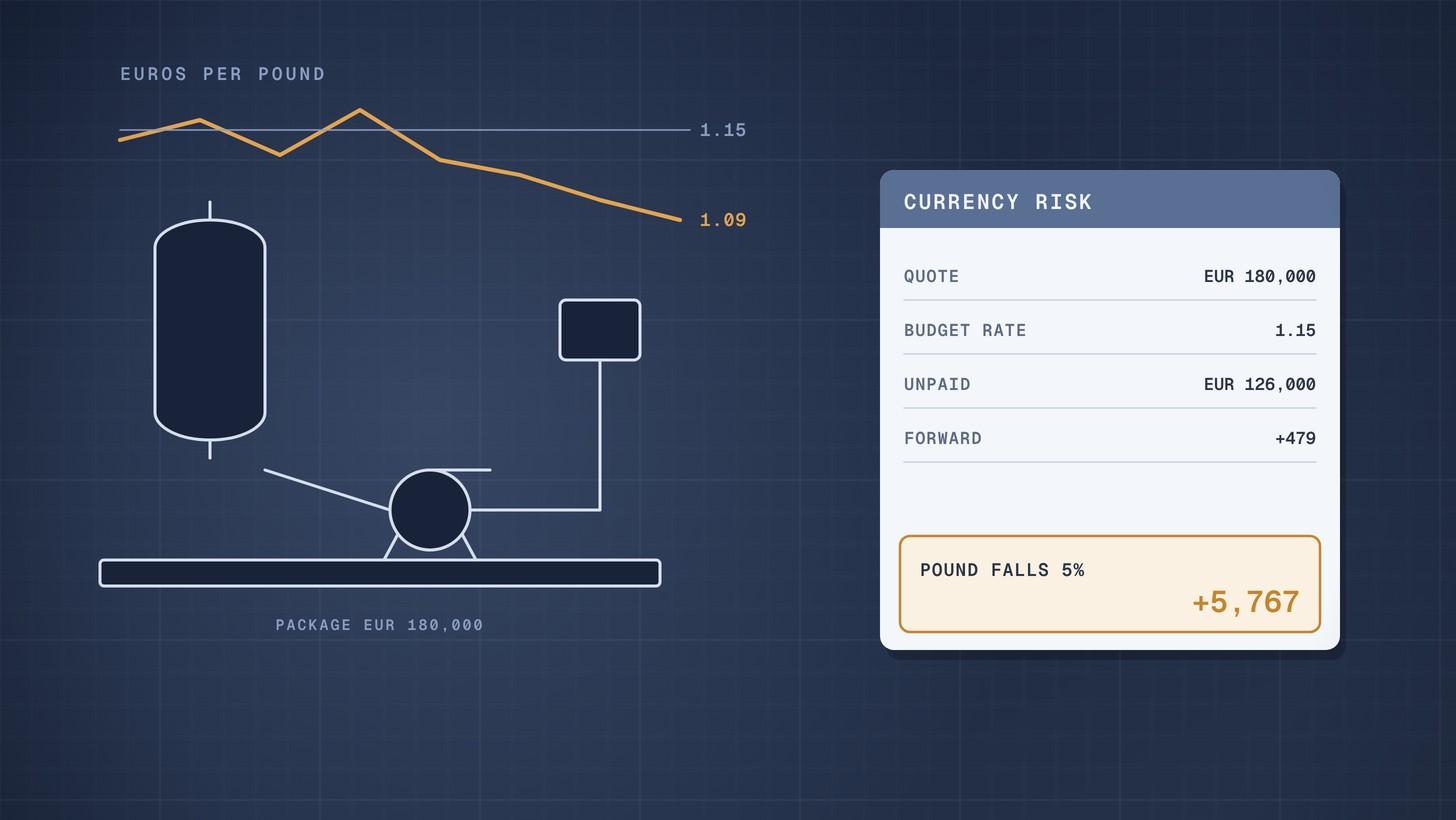
Exchange rate risk on an equipment quote is the chance that the sterling cost of a euro or dollar price changes between the day you budget it and the day you make the last payment. In the worked example below, a €180,000 package budgeted at 1.15 euros to the pound costs £156,522. If the pound falls 5% before the delivery and acceptance payments, those payments cost £5,767 more; a forward contract would have fixed the extra cost at about £480.
The risk is not just the headline price. It is the euro or dollar amount still unpaid, multiplied by how far the rate can move before each payment date.
Why this matters now
Rates move more than most project budgets allow for. On Bank of England figures, the pound ranged from 1.2125 euros in February 2025 to 1.1314 in November 2025, and ended the year about 4.9% lower than it started [1]. Against the dollar it moved the other way, rising about 8.7% over 2025, from a low of 1.2152 in January to a high of 1.3733 in June [2].
On a €180,000 quote, the 2025 range alone is the difference between £148,454 and £159,095. On a $200,000 quote it is the difference between £145,635 and £164,582, almost £19,000, with no change in the supplier's price at all.
The Bank of England publishes these as indicative middle market rates observed in the London market around 4pm, and says they are not official rates [3]. Your bank's rate will include a margin, but the published series is a neutral reference for budgets and contract clauses.
Create and manage RFQs in minutes
ChemCapital handles the entire procurement cycle, from structured RFQs and supplier comparisons to formal purchase orders and delivery tracking.
When the exposure starts and ends
The British Business Bank describes transaction risk as running from the moment a deal is agreed until it is settled [4]. For capital equipment that window is long, because the price is usually paid in milestones over many months. Our guide to payment milestones and retention bonds explains the common patterns.
In practice the exposure starts earlier still: the day you put a sterling figure in the project budget based on a foreign currency quote. Between budget approval and order, the quote is at risk too, so check how long the supplier will hold the price.
Each milestone closes part of the exposure. Once a payment is made at a known rate, that slice is fixed. What remains open is the unpaid foreign currency balance.
Worked example: a €180,000 package
A UK site orders a skid mounted package from a supplier in the eurozone for €180,000. The budget rate is 1.15 euros to the pound. The price, rate, milestones and dates are illustrative.
Step 1: the budget. €180,000 ÷ 1.15 = £156,522.
Step 2: the payment schedule.
| Milestone | Month | Share | Euros | Sterling at 1.15 |
|---|---|---|---|---|
| Order | 0 | 30% | €54,000 | £46,957 |
| Delivery | 7 | 60% | €108,000 | £93,913 |
| Acceptance | 9 | 10% | €18,000 | £15,652 |
| Total | €180,000 | £156,522 |
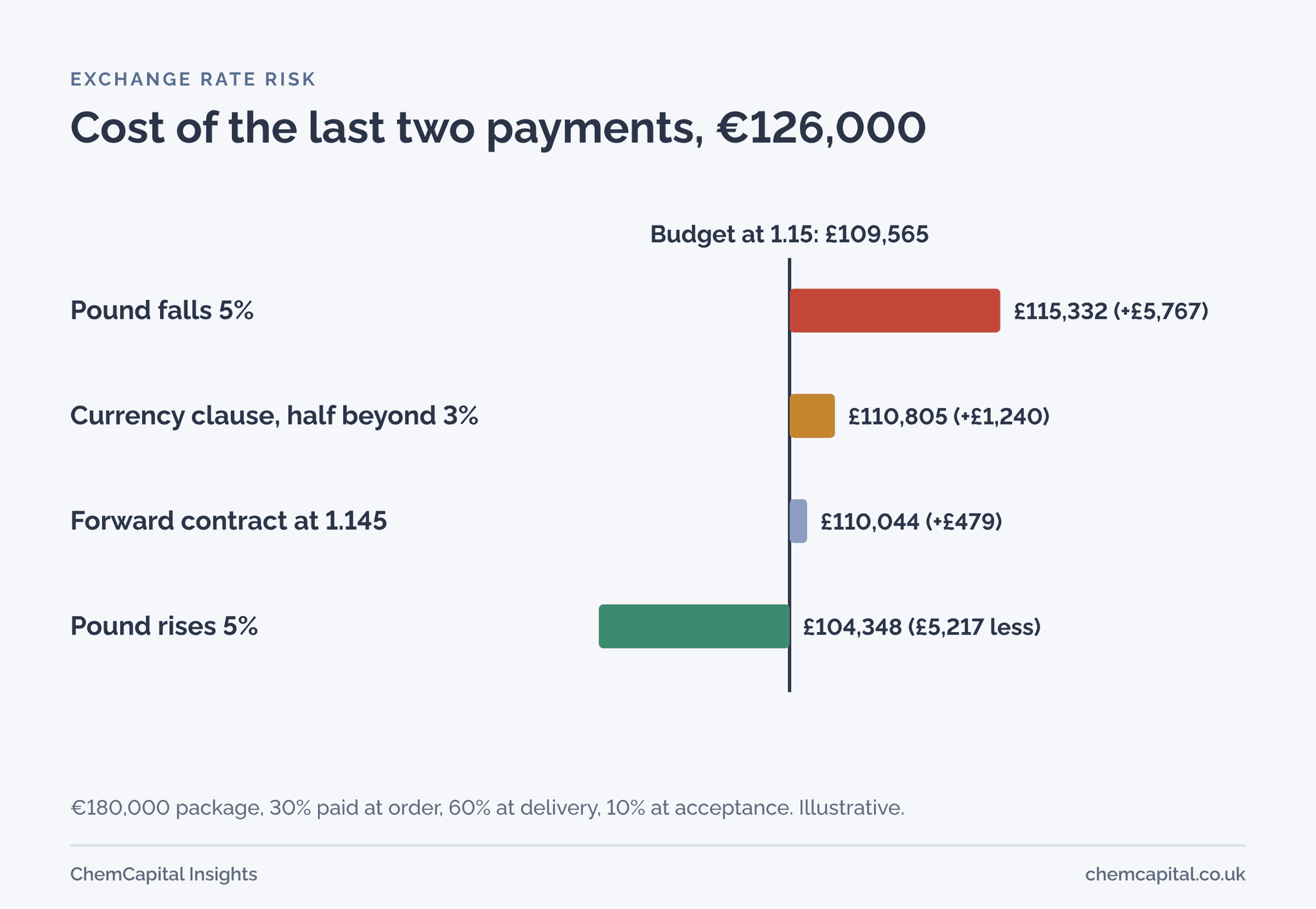
The order payment is made straight away at a known rate. The open exposure is the other €126,000, budgeted at £109,565, for seven to nine months.
Step 3: what a 5% move does. A 5% fall in the pound takes the rate from 1.15 to 1.0925 euros. A 5% rise takes it to 1.2075.
| Rate for the last two payments | Sterling cost | Against budget |
|---|---|---|
| Budget, 1.15 | £109,565 | nil |
| Pound falls 5%, 1.0925 | £115,332 | £5,767 more |
| Pound rises 5%, 1.2075 | £104,348 | £5,217 less |
The two sides are not equal. A 5% fall in the pound raises the sterling cost of the euros by about 5.3%, while a 5% rise lowers it by about 4.8%. On the whole project, the fall adds 3.7% to the budget: real money on a package where the contingency may already be committed to other risks.
The British Business Bank gives a simpler version of the same arithmetic: €100,000 converted at 1.15 costs £86,957, and at 1.10 it costs £90,909, a difference of £3,952 [4].
Ways to manage it
Ask for a sterling price. If the supplier quotes and invoices in pounds, the risk moves to them. The British Business Bank notes this needs bargaining power [4], and nibusinessinfo warns that a supplier may raise its price to cover the risk or refuse altogether [5]. Compare the sterling price with the euro price at the budget rate to see what premium you are paying for the certainty.
Use a forward contract. A forward contract fixes the rate today for a payment on a future date. The British Business Bank says forwards suit predictable transactions, typically from about £5,000 upwards, that the provider's margin is built into the rate, and that the provider may ask for security [4]. Milestone payments with fixed dates are a good fit, though delivery dates can slip, so ask your provider how a forward can be extended or drawn early.
In the example, suppose a forward rate of 1.145 for the last two payments (illustrative; the real rate depends on interest rates in both currencies and the provider's margin). The €126,000 then costs £110,044, about £480 more than budget, whatever happens to the pound.
Consider a currency option. nibusinessinfo lists options alongside forwards [5]. An option gives a worst case rate but lets you benefit if the rate moves in your favour, for an upfront premium.
Match currency in and out. If your business earns euros, a euro currency account lets you pay euro invoices from euro income, a natural hedge the British Business Bank describes [4].
None of these remove longer term risk: nibusinessinfo points out that a hedge covers a transaction, not the next order [5]. That matters if you buy from the same overseas supplier year after year.
Quote currency clauses
A contract can share the risk instead of putting all of it on one side. A Morgan Lewis sourcing note sets out the common approaches: naming the payment currency, a fixed rate reconciled periodically once the difference passes a threshold, prices indexed to a spot or average rate, a move outside a fixed range triggering renegotiation, and a surcharge or reserve [6].
Cambridge Currencies, a currency broker, describes the parts of a clause in more detail [7]:
- A band. It suggests symmetric bands of about 3% for contracts of three to six months, 5% for six to twelve months and 7% to 10% beyond that.
- Sharing. Its own example absorbs moves within 5% and caps the pass through at 50%.
- A named reference rate. For example the Bank of England 4pm spot rate or the ECB reference rate, not a vague "prevailing market rate".
- A baseline. The rate on the signing date, or an average of the 30 days before it.
The example with a clause. Suppose the supplier quotes in sterling at the 1.15 baseline, and the contract says that if the sterling cost of the euro price moves by more than 3%, the price adjusts by half of the move beyond 3%. If the pound falls 5%, the sterling cost of the remaining €126,000 rises 5.3%. The move beyond the band is 2.3%; half of it is about 1.1%, so the buyer pays about £1,240 more, and the supplier absorbs the rest. If the pound rises, the adjustment works the same way in the buyer's favour.
Comparing quotes in different currencies
When one bidder quotes in euros, another in dollars and a third in sterling, convert them all at the same rate, from the same source, on the same date. A bid can look cheaper simply because it was converted on a better day.
Then look past the headline. Check the payment milestones each bidder asks for, because a larger deposit fixes more of the cost early and leaves less exposure open. Check which costs are in which currency: freight, duty and site work may be in sterling while the equipment is not. Our guide to Incoterms for process equipment shows which party pays for what.
Finally, add a line for currency risk in the bid evaluation: either the cost of a forward, or a sensitivity showing what a 5% move would do. That turns an invisible risk into a number the evaluation panel can weigh.
What to put in the RFQ
- The quote currency you prefer, and whether you will accept others.
- A price validity period long enough to cover your approval process.
- The payment milestones you propose, so bidders price the same schedule.
- Any currency clause you want: band, sharing, reference rate and baseline.
- A request to split the price by currency if parts of the supply are bought in different currencies.
ChemCapital's AI quotation comparison extracts each bid's price, currency, milestones and validity into one table, so you can convert on the same basis and see which quotes carry the most exchange rate risk.
This is general information, not financial advice. Speak to your bank or a regulated currency provider before entering into a forward contract or option.
Ready to compare overseas equipment quotes on the same basis? Start a free 14 day ChemCapital trial, with no credit card needed.
Frequently asked questions
What is exchange rate risk on an equipment quote?
It is the chance that the sterling cost of a price in euros or dollars changes between budgeting the purchase and making the last payment. The exposure at any moment is the foreign currency amount still unpaid, so it shrinks as each payment milestone is made.
How much can a 5% currency move change an equipment price?
In the worked example, a 5% fall in the pound adds £5,767 to the delivery and acceptance payments on a €180,000 package, or 3.7% of the whole budget. In 2025 the pound moved about 6.7% against the euro between its high and low.
How does a forward contract protect an equipment purchase?
It fixes today the exchange rate for a payment on a future date, so the sterling cost of a milestone payment is known in advance. The provider's margin is built into the rate, the provider may ask for security, and you lose the benefit if the rate later moves in your favour.
What is a currency clause in a supply contract?
It is a term that adjusts the price if the exchange rate moves beyond a set band from a baseline rate. A typical clause names the reference rate, the baseline date, the band and how any move beyond the band is shared between buyer and supplier.
Continue reading
Informational only, not procurement or legal advice. Cited names, frameworks, and statistics belong to their respective owners.
Create and manage RFQs in minutes
ChemCapital handles the entire procurement cycle, from structured RFQs and supplier comparisons to formal purchase orders and delivery tracking.
Start for freeRelated articles
US Tariffs on Imported Process Equipment in 2026: What UK Suppliers Pay Now
The US tariff position for process equipment as of November 2026: Section 232 metals tariffs and UK rates, the Section 301 tariff that replaced Section 122, the new industrial machinery action, and how to protect a quotation.
How to Check a Supplier's Financial Health Before You Award an Equipment Order
The UK checks that tell you whether an equipment supplier will still be trading when your order is half built: Companies House, charges, Gazette notices and credit reports, plus how to protect advance payments.
Process Equipment Lead Times: Quarterly Tracker, Q4 2026
Lead times for valves, pumps and transformers from named, dated public sources, the UK and US delivery trend this autumn, and how to build lead times into a project schedule. Updated quarterly.