
CIP Skid Design: What to Specify Before You Ask for Quotes
How a clean in place system works, the design choices that set its price and performance, and a CIP skid checklist to put in your RFQ so quotes compare like for like.
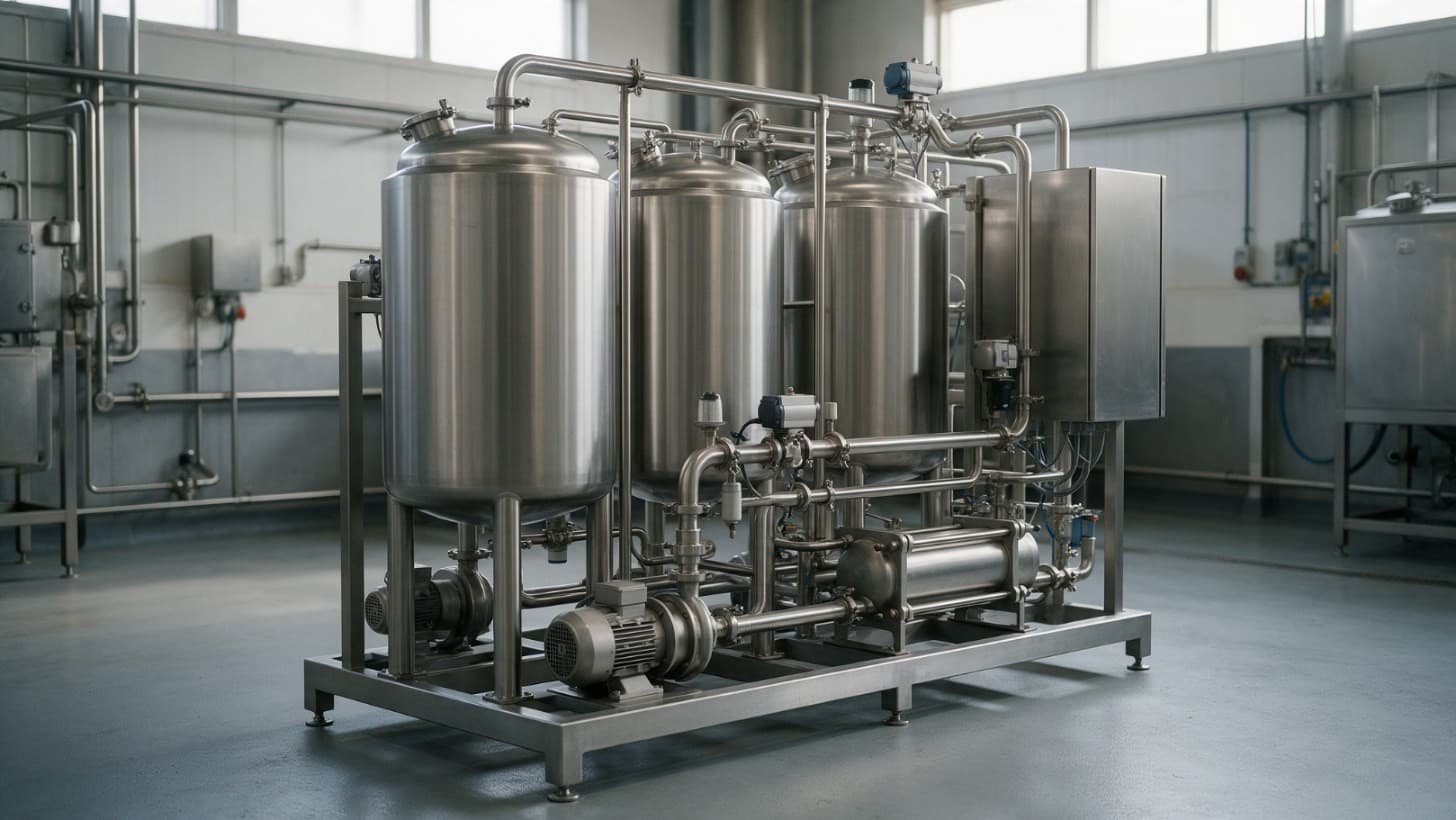
A CIP skid is the packaged unit of tanks, pumps, heater, chemical dosing and instruments that makes up cleaning solutions, pumps them round your plant and then recovers or drains them. Clean in place (CIP) means cleaning the inside of pipes, vessels and heat exchangers without taking them apart. Before you ask for quotes, fix five things: what each circuit must clean, whether solutions are used once or recovered, the flow each circuit needs, how solution gets back to the skid, and how the skid records each clean.
Leave those open and you compare scopes, not prices. The checklist below turns each into a request for quotation (RFQ) line.
Why this matters now
The reference documents are moving. EHEDG (the European Hygienic Engineering and Design Group) published guideline GL 50 on hygienic design of CIP installations in July 2019, and its working group is now updating it [1]. ASME lists a 2026 edition of its BPE standard for bioprocessing equipment [2].
Regulation (EC) No 852/2004, as it applies in Great Britain, requires food contact equipment to be effectively cleaned, built so it can be kept clean, and installed so it can be cleaned adequately [3]. For medicines, the US Food and Drug Administration (FDA) tells inspectors that large CIP systems "represent significant concern" and expects written cleaning procedures and validation protocols [4]. This is general information, not legal advice.
Join ChemCapital to streamline sourcing and connect with verified partners
Whether you're buying or supplying, ChemCapital gives you the tools to manage the complete procurement cycle in one platform.
How a clean in place system works
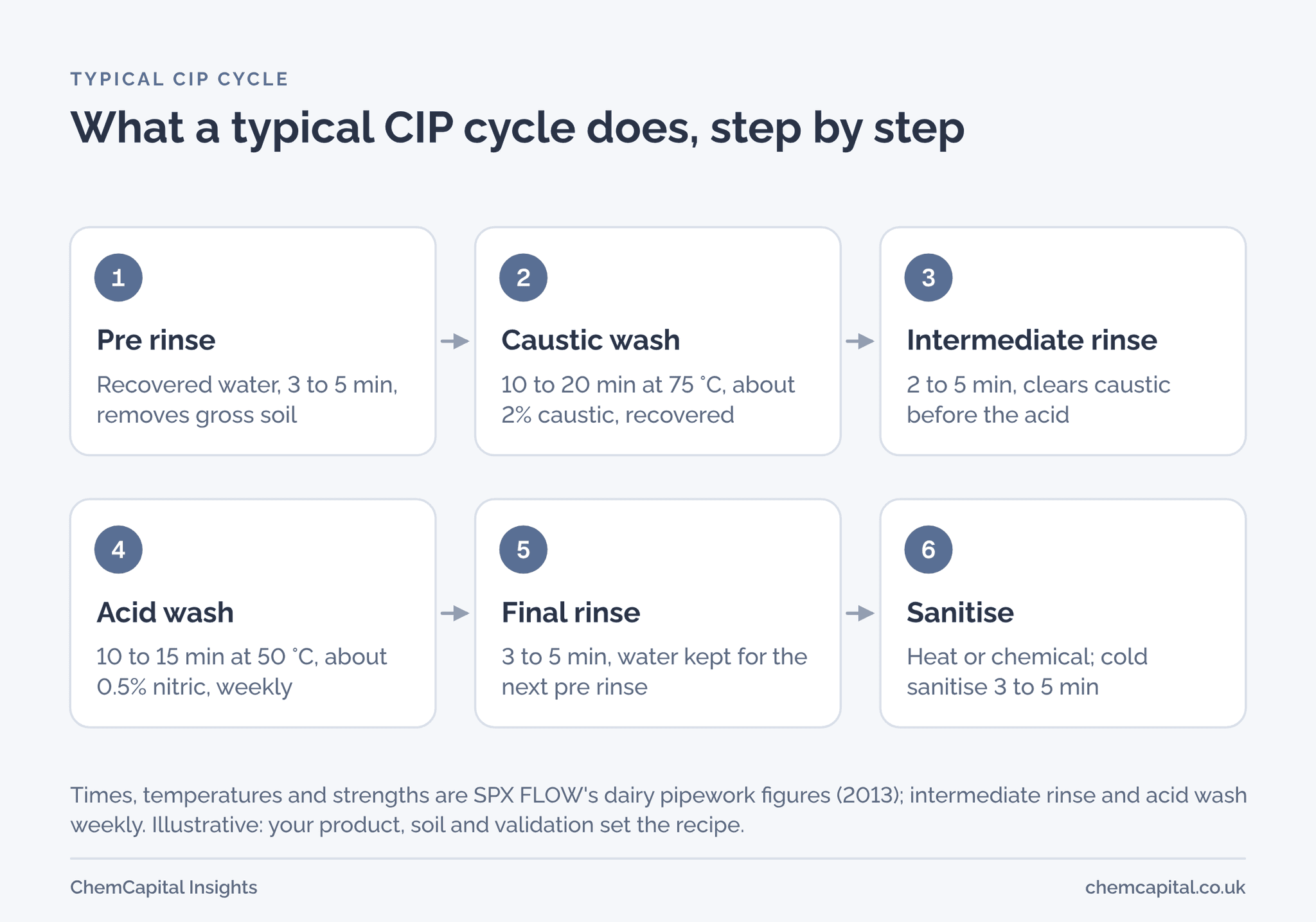
In SPX FLOW's dairy pipework example, after product is recovered, the daily clean is a 3 to 5 minute rinse, caustic at 75 °C for 10 to 20 minutes, a 3 to 5 minute final rinse and a 3 to 5 minute cold sanitise. Weekly, it adds a 2 to 5 minute intermediate rinse and an acid wash at 50 °C for 10 to 15 minutes [5].
Typical chemistry in that guide is about 2% caustic soda at up to 85 °C, up to 4% for heavy fouling, and about 0.5% nitric acid at up to 50 °C [5].
Single use or recovery
In dairy and food, SPX FLOW treats single use as the exception, worth its higher chemical, water and effluent cost mainly where one area must not contaminate another. Recovery is the norm there, and the final rinse becomes the next clean's first rinse [5]. Pharmaceutical plants usually work the other way. Emerson notes they typically run multi tank skids as single use, draining the tanks between programmes to limit cross contamination [6].
| Single use | Recovery | |
|---|---|---|
| Solution | Used once, then drained | Returned, topped up and reused |
| Tanks | One; SPX FLOW's single use units have 400 to 1,250 litres | Fresh water, recovered water and caustic, with acid and hot water optional |
| Main risk | Cost | Soil builds up; solutions are monitored and dumped after about 100 cleans in SPX FLOW's guide |
Design decisions that drive price and performance
Circuits and tanks
A circuit is one cleaning route: the vessels and lines cleaned together. SPX FLOW suggests no more than six circuits per supply pump, and sizes bulk tanks by adding the capacity of the worst case circuit on each supply pump and doubling the total [5].
Flow and velocity in lines
Pipework is cleaned by fast flow scouring the pipe wall. Alfa Laval recommends at least 1.5 m/s [7]. A Pharmaceutical Technology guide to bioreactor CIP uses 5 ft/s, the same figure [8], and SPX FLOW gives 1.5 to 2.1 m/s as usual [5]. Treat 1.5 m/s as a rule of thumb for enough shear at the wall: water in a CIP line is already turbulent at far lower speeds. So the largest bore in a circuit, or the spray devices if they need more, sets the supply pump flow.
Spray devices for vessels
Static spray balls run at low pressure, about 1 to 2 bar [5, 8]. In SPX FLOW's guide they suit vessels up to 3 m in diameter, rotating jet devices at about 5 bar handle heavy fouling or larger vessels, and a top mounted agitator calls for two spray balls [5]. SPX FLOW's flow rule for a vertical vessel, in litres per hour, is diameter in metres × 3.14 × 1,490 [5]. That is one supplier's rule; Pharmaceutical Technology uses 3 US gallons per minute per foot of circumference, about 2,240 l/h per metre [8]. Makers publish their own cleaning diameters, flows and pressures, so ask for each device's data. Pressure counts at the device: in one Alfa Laval example, 5 bar at a rotary jet head needed about 7.5 bar at the pump outlet [7].
Return pumping
SPX FLOW specifies self priming liquid ring return pumps for this scavenging duty, with capacity 10% above the supply pump [5]. That is one maker's rule. Pharmaceutical Technology offers a liquid ring pump or an eductor, either of which clears water and air so solution does not pool in the vessel [8].
Chemical dosing and heating
Conductivity, how easily a solution carries current, tracks chemical strength [6], so SPX FLOW monitors caustic and acid with conductivity transmitters. Its smaller units heat through a shell and tube heater, and systems with many circuits put recirculation heaters on the bulk tanks [5].
A safety point: Alfa Laval notes brewery tanks usually get cold caustic because hot caustic risks implosion as the tank cools [7]. If you want hot cleaning of a closed vessel, ask how it is protected against vacuum.
Instruments and verification
SPX FLOW's minimum for a bulk unit is temperature control on caustic and acid, return temperature probes so the wash timer starts only at set point, and return conductivity probes to detect the change from rinse water to chemical [5].
Records show the recipe ran; they do not prove the plant is clean. Alfa Laval suggests microbiological or ATP testing (a rapid swab test for organic residue) to verify CIP [7]. The FDA says indirect tests such as conductivity can help with routine monitoring once cleaning is validated, that stagnant water must never remain after cleaning, and that CIP piping should be sanitary, without ball valves [4]. Drainability belongs in the specification.
Hygienic design references
EHEDG GL 50 covers CIP installations directly [1]. 3A Sanitary Standards, a not for profit body that began with dairy equipment, sets hygienic design criteria for individual machines and for complete processing systems; its 3A Symbol, in use since 1956, requires an independent third party inspection [9]. ASME BPE covers materials, design, fabrication, inspection, testing and certification of bioprocessing equipment [2].
CIP skid specification checklist for your RFQ
| Item | What to state |
|---|---|
| Objects | Every vessel (diameter, agitator), line (bore, length) and heat exchanger, by circuit |
| Circuits | How many, and how many run at once |
| Recipe | Product and soil; steps, strengths, temperatures and times, or ask for a proposal |
| Philosophy | Single use or recovery; tank volumes; dump criteria |
| Flow | Minimum line velocity; flow and pressure at each spray device |
| Return | Return method (pump or eductor) and its capacity relative to supply |
| Heating and dosing | Heating medium, heat up time, dosing method |
| Instruments and records | Supply flow and pressure, return temperature and conductivity, records, action on a missed set point |
| Hygienic design | EHEDG, 3A or ASME BPE; materials, finish, drainability |
| Documents | Drawings, recipe listing, calibration certificates, factory acceptance test (FAT) scope |
Practical example
The figures below are illustrative. A dairy dessert maker wants a two circuit recovery skid: a 2.4 m diameter vertical vessel with spray balls, and a transfer line with a 60 mm bore. The specification asks for at least 1.5 m/s in the line, return pump capacity at least 10% above supply, and a 1,500 litre caustic tank heated from 10 °C to 75 °C in 30 minutes.
The line's bore area is 0.002827 m², so 1.5 m/s needs 1.5 × 0.002827 × 3,600 = 15.3 m³/h. The vessel needs 2.4 × 3.14 × 1,490 = 11,229 l/h by the SPX FLOW rule, so the line sets the supply pump. On Pharmaceutical Technology's higher rule the vessel needs about 16.9 m³/h and sets the pump instead; Bids B and C still clear that. Treating dilute caustic as water, heating takes 1,500 kg × 4.18 kJ/kg K × 65 K = 407,550 kJ, or 113 kWh: about 226 kW over 30 minutes, before losses.
| Check | Target | Bid A | Bid B | Bid C |
|---|---|---|---|---|
| Supply flow | 15.3 m³/h or more | 15 m³/h (1.47 m/s) | 20 m³/h (1.96 m/s) | 18 m³/h (1.77 m/s) |
| Return pump capacity | At least 10% above supply | 17 m³/h (13% above) | 20 m³/h (0% above) | 20 m³/h (11% above) |
| Caustic heater | About 226 kW | 150 kW (45 min) | 240 kW (28 min) | 250 kW (27 min) |
Bid A narrowly misses the velocity target and stretches heat up to 45 minutes. Bid B's return pump only matches supply, with no margin. Only Bid C meets every line; compare prices from there.
Getting comparable CIP skid quotes
Next, find builders who actually work to your hygienic standard. Supplier Discovery takes a plain description such as "two circuit recovery CIP skid, EHEDG hygienic design, UK or EU builder", searches the web and extracts the parameters suppliers publish, with source links and a fit verdict. Certifications are shown as claimed, not verified, and nothing is sent automatically. Before shipment, our factory acceptance test checklist for process skids covers what to witness.
Ready to send one clear CIP specification to the right skid builders? Start free with ChemCapital.
Frequently asked questions
What is a CIP skid?
A CIP skid is a packaged clean in place unit holding the tanks, pumps, heater, chemical dosing and instruments needed to make up cleaning solutions, circulate them through process equipment and recover or drain them. It cleans pipes, vessels and heat exchangers without taking them apart.
What flow velocity is needed for CIP of pipework?
Alfa Laval recommends at least 1.5 m/s for pipework, and SPX FLOW gives 1.5 to 2.1 m/s as the usual range. It is a rule of thumb for enough scouring at the pipe wall, so the largest bore in a circuit, or the spray devices if they need more, sets the supply pump flow.
What is the difference between single use and recovery CIP?
A single use system sends each solution to drain after one clean, which costs more in chemicals, water and effluent but carries nothing from one clean to the next. A recovery system returns caustic, acid and final rinse water to tanks, restores their strength and reuses them, so the solutions need monitoring and periodic replacement. Food and dairy plants mostly recover; pharmaceutical plants usually run single use to limit cross contamination.
Which hygienic design standard applies to a CIP system?
There is no single one: EHEDG GL 50 covers hygienic CIP installations, 3A Sanitary Standards sets hygienic design criteria for food and dairy machines and process systems, and ASME BPE covers bioprocessing equipment. Name the one your sector and customers expect and check its current edition.
Continue reading
Informational only, not procurement or legal advice. Cited names, frameworks, and statistics belong to their respective owners.
Join ChemCapital to streamline sourcing and connect with verified partners
Whether you're buying or supplying, ChemCapital gives you the tools to manage the complete procurement cycle in one platform.
Get started freeRelated articles
Where to Find Pharma and Chemical Plant Projects Before They Go to Tender: the 2027 Pipeline
Twenty pharma and chemical plant projects checked against owner or government announcements, the buying timeline on each, and where to watch for the next ones for free.
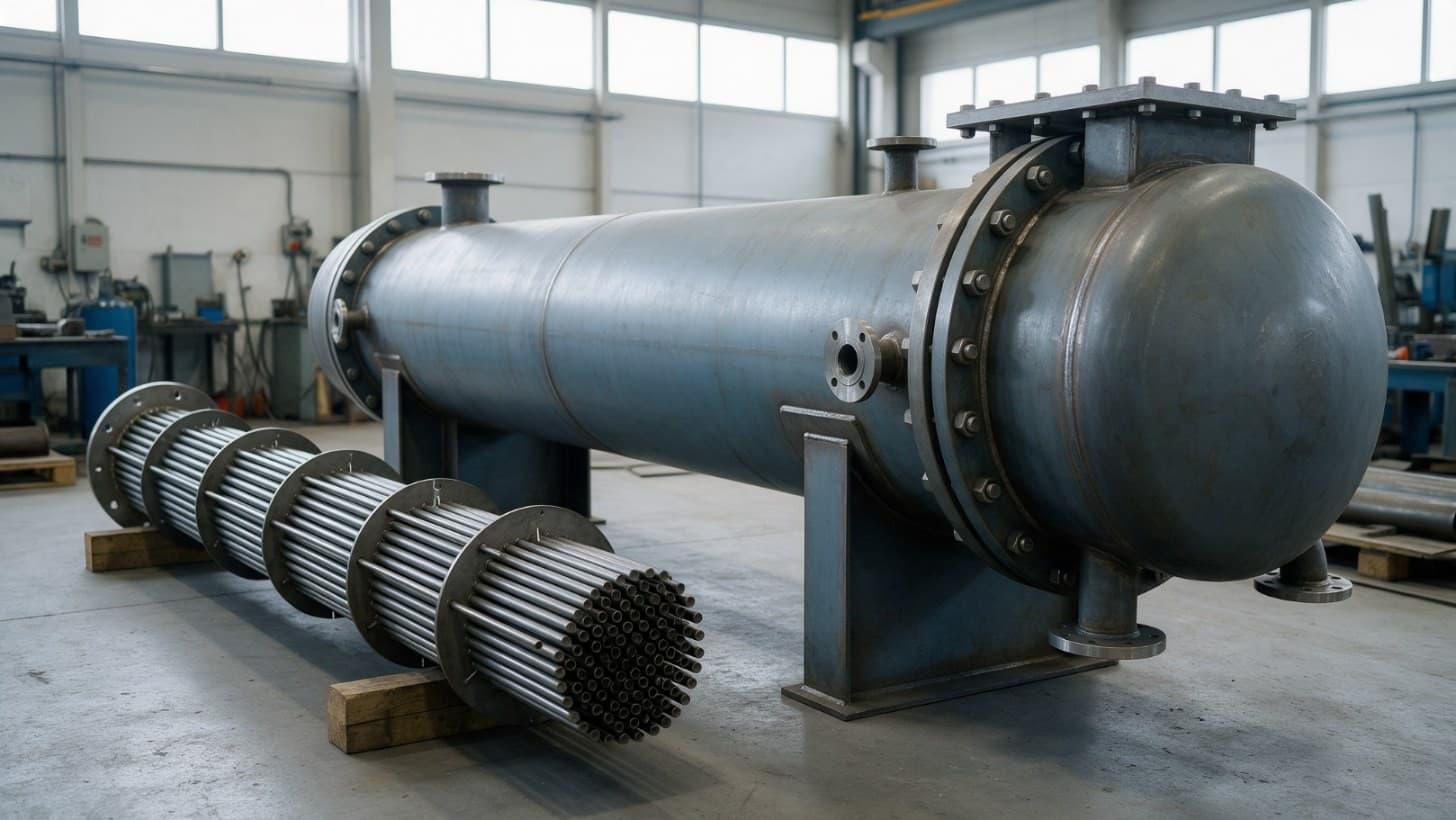
TEMA Heat Exchanger Types: How to Read AES, BEM and AEU
How to decode the three letter TEMA type, what AES, BEM, AEU and other common types mean for cleaning, expansion, leaks and cost, and how to compare bids that differ.
Safety Valve vs Relief Valve vs Bursting Disc: How to Choose
How safety valves, relief valves and bursting discs differ, when to fit a disc under a valve, the pressure terms that matter, GB duties and what to put in the RFQ.