
Safety Valve vs Relief Valve vs Bursting Disc: How to Choose
How safety valves, relief valves and bursting discs differ, when to fit a disc under a valve, the pressure terms that matter, GB duties and what to put in the RFQ.
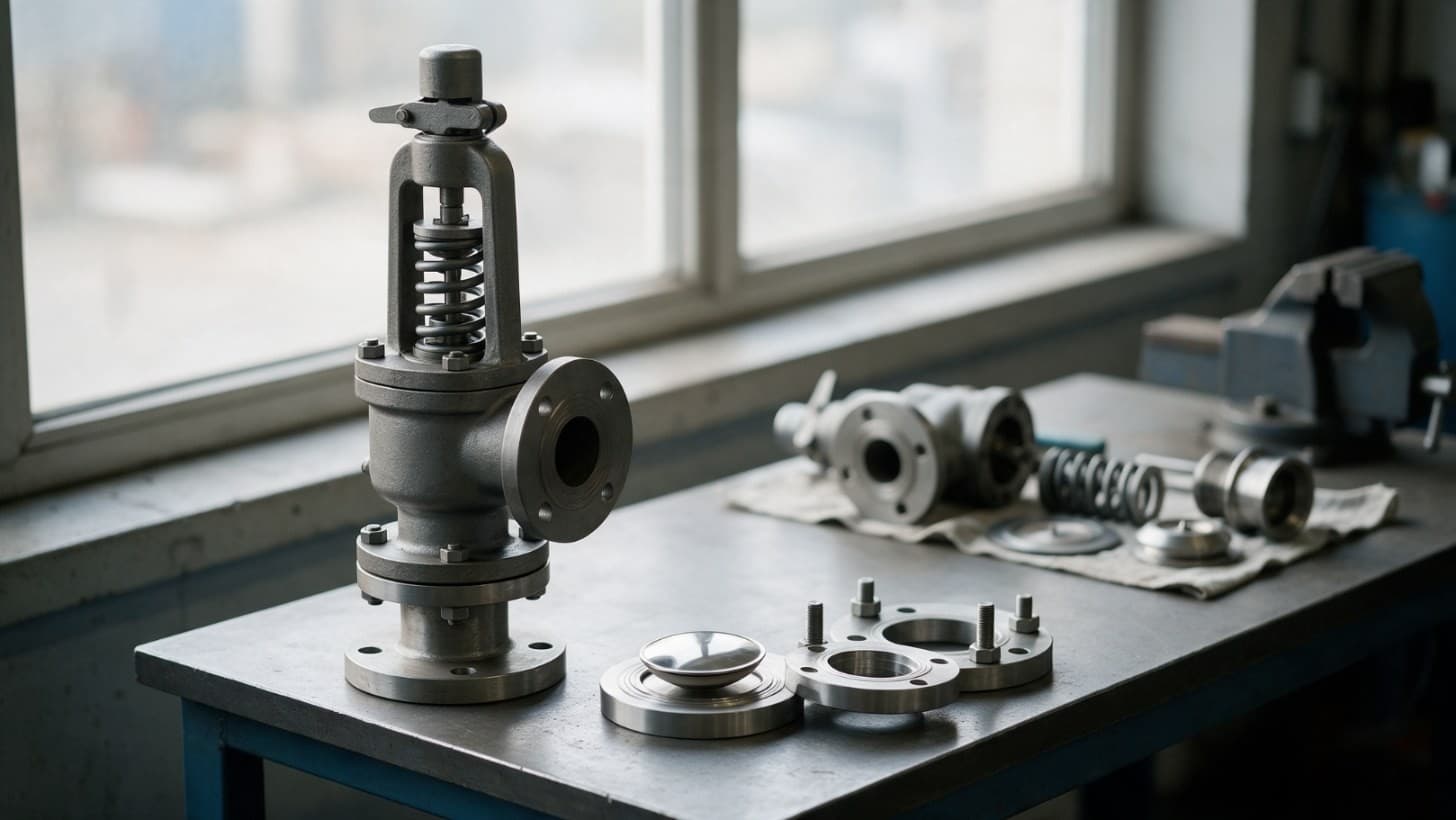
Safety valves and relief valves both open on rising pressure and reclose; they differ in how they open. In the ASME definitions, a safety valve pops open and is used mainly for steam, air and other gases; a relief valve opens gradually, broadly in proportion to the pressure rise, and is normally used for liquids [1, 3]. A bursting disc, or rupture disc, is a membrane that bursts at a set pressure: leak tight and cheap, but it does not reclose and must be replaced after every burst [4].
Relief sizing and selection must be done by a competent engineer, working from the design code and your plant's relief cases.
Why this matters now
In EN ISO 4126 Part 1, used in the UK and Europe, "safety valve" covers any valve opened only by the fluid's energy, which Americans call a "safety relief valve" or "pressure relief valve" [1]. So a UK enquiry for a "safety valve" can draw bids to different codes.
ISO confirmed ISO 4126 Part 3:2020, on valves and discs used together, as current in 2026 [7]. In Great Britain, a written scheme of examination under the Pressure Systems Safety Regulations 2000 (PSSR) must cover all protective devices, bursting discs included [8]; see our PSSR written scheme of examination guide.
Create and manage RFQs in minutes
ChemCapital handles the entire procurement cycle, from structured RFQs and supplier comparisons to formal purchase orders and delivery tracking.
The terms: PRV, safety relief valve and PSV
Pressure relief valve (PRV) is the general term for a valve that opens on inlet pressure and recloses once normal conditions return [1, 3]; on steam plant it can also mean pressure reducing valve, so spell it out. A safety relief valve pops on gas and opens in proportion on liquid [1]. PSV is a drawing tag, pressure safety valve; it says nothing about how the valve lifts.
Valve designs and bursting discs compared
| Device | How it works | Suits | Watch for |
|---|---|---|---|
| Conventional spring valve | Spring holds the disc shut [2, 3] | Back pressure low or constant | Superimposed back pressure adds closing force; total back pressure changes blowdown and reseat [2] |
| Balanced bellows valve | Bellows matching the seat area, so back pressure barely affects opening [2] | Varying back pressure; keeping corrosive fluid off the spring [2] | Vent must breathe freely; a failed bellows can shift set pressure and capacity; costs more [2] |
| Pilot operated valve | System pressure, through a pilot, holds the main valve shut [2, 3] | Operating close to set pressure; large capacities [2] | Small pilot pipes can block with dirt or condensate [2] |
| Bursting disc | Membrane bursts and stays open [4] | Leak tight duty; fast, unrestricted relief; gas, liquid or two phase [4] | Replace after each burst; cannot be tested in service, but needs no recalibration [4] |
A forward acting disc takes process pressure on its concave side, in tension; a reverse acting disc on its convex side, in compression [5]. ZOOK rates the operating ratio, the highest operating pressure as a percentage of minimum burst pressure, at 95% for its reverse acting series and 50% to 90% for forward acting [6]. Exceeding the ratio can shorten disc life or cause an early burst; ASME sets a burst tolerance of ±5% at 40 psig (2.8 barg) and above [5].
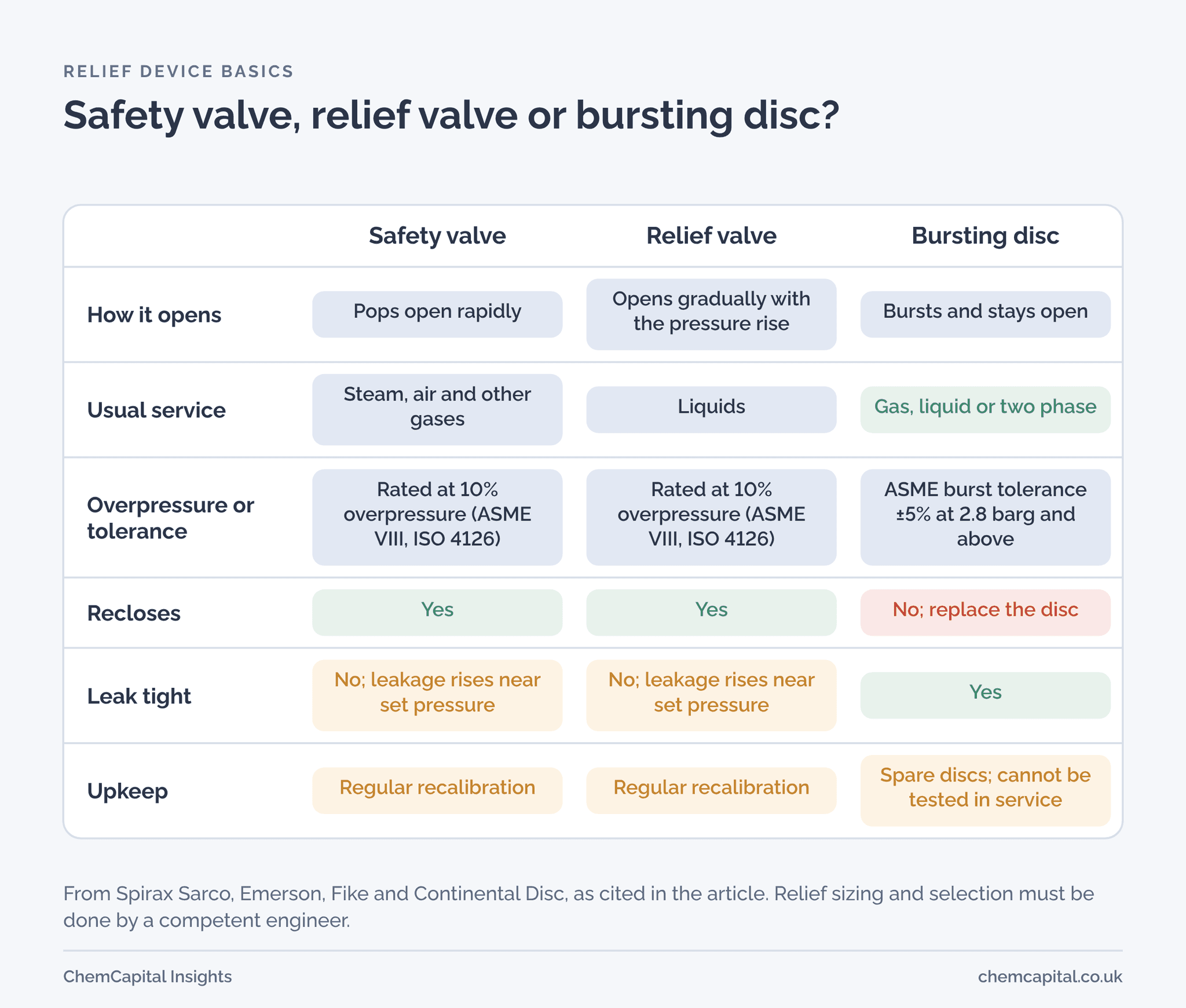
Fitting a bursting disc under a valve
A disc upstream isolates the valve from the process, preventing plugging, corrosion and leakage, allowing testing in place, and letting a standard material valve cut first cost and spares [4]. The rules:
- ISO 4126 Part 3 covers a disc within five pipe diameters upstream of the valve inlet, and the combination discharge factor used in sizing [7].
- Without a tested factor, the valve's rated capacity is cut by 10%, a factor of 0.9; under ISO 4126 Part 3, only if the disc petals stay in the holder [3, 4].
- The disc must not fragment, as loose pieces could block the valve [4].
- Both devices respond to differential pressure, so the space between them must be monitored or vented, typically with a gauge or indicator, try cock and free vent; a gauge alone on a closed space is not enough [4].
- Fike's summary of ISO 4126 Part 3, which predates the 2020 edition, puts disc burst at 90% to 110% of valve set pressure (or 0.1 bar, if greater, for the upper limit) [4].
- For ASME designs, Fike cites API 520: disc burst and valve set should share one nominal value; ASME combination tests need marked burst at 90% to 100% of set [4].
Set pressure, overpressure, accumulation and blowdown
Set pressure is where the device starts to open. Overpressure is the rise above set pressure, as a percentage of it; accumulation is the rise above the vessel's maximum allowable working pressure (MAWP). Blowdown is the gap between set and reseat pressure [3].
| Item | What the source states |
|---|---|
| Set pressure, single device, ASME VIII | Not above MAWP [3] |
| Set pressure tolerance, ASME VIII | ±2 psi up to 70 psig; ±3% above [3] |
| Accumulation, ASME VIII | 10% over MAWP with one device, 16% with several, 21% in a fire [3] |
| Overpressure at rated capacity, gas and liquid | Usually 10% (or 3 psi) under ASME VIII; 10% (or 0.1 bar, if greater) under ISO 4126 [3] |
| Reseat, ASME VIII | No production blowdown test; valves with adjustable blowdown typically reseat 7% to 10% below set [3] |
| Blowdown, ISO 4126 | Gas and steam 2% to 15%, liquids 2.5% to 20%, or 0.3 bar and 0.6 bar if greater [3] |
| Pressure Equipment (Safety) Regulations 2016 (PE(S)R), new equipment in GB | Pressure must not permanently exceed the maximum allowable pressure, PS; a momentary surge may reach no more than 10% above PS [9] |
Emerson's handbook reflects the 2013 ASME code, so check the current edition [3]. Fike notes the European limit is 110% of design pressure where ASME allows 116% with several devices [4]. Keep operating pressure sufficiently below set pressure to avoid premature operation [8] and leakage, which rises as pressure nears set [4].
PSSR and PE(S)R duties in Great Britain
Under PSSR regulation 4, whoever designs, manufactures, imports or supplies a pressure system must fit the protective devices needed to prevent danger, with any release made safely, so far as is practicable; equipment supplied under PE(S)R is excepted [8]. HSE's Approved Code of Practice, L122, adds:
- fit at least one relief or limiting device as close as practicable to any item that could exceed its safe operating limits
- give devices enough capacity to reach full discharge within a set accumulation, discharging to a safe place
- examine devices at least as often as the plant they protect
- isolate devices only in very exceptional cases, and replace a vessel's only relief device immediately if removed
- investigate repeated discharge [8]
For new equipment, PE(S)R also requires the safety device set pressure in the marking, where relevant [9]. This is general information, not legal advice.
What to put in the datasheet and RFQ
- Fluid, phase, molecular weight or density, relieving temperature, solids and corrosives
- The governing relief case and required rate from the engineer's study, for example to API 520 (sizing and selection) and API 521 (relieving systems) [1]
- MAWP, set pressure, allowable overpressure, design code and conformity marking
- Superimposed and built up back pressure
- For a disc: forward or reverse acting, burst pressure, tolerance, operating ratio and vacuum support
- For a combination: a tested combination factor or the default 0.9, and the telltale
- Connections, materials, a seat tightness test such as API 527 [1], certificates, spares and lead time
Ask each bidder for certified capacity at the stated overpressure, so the technical bid evaluation runs on one basis.
Practical example
Take an illustrative reactor: MAWP 10.0 barg, operating up to 8.5 barg with corrosive vapour, needing 4,000 kg/h of relief, with no fire case; all rates and prices are illustrative.
One valve under ASME VIII is set at 10.0 barg (about 145 psig); at ±3% it may lift at 9.7 to 10.3 barg. Accumulation is limited to 10%, or 11.0 barg, matching the PE(S)R surge limit if PS is 10 bar. A reseat 7% to 10% below set, 9.0 to 9.3 barg, stays above operating pressure.
| Check | Option A: alloy valve alone | Option B: alloy disc under a stainless valve |
|---|---|---|
| Opening pressure | 9.7 to 10.3 barg | Disc marked 10.0 barg bursts at 9.5 to 10.5 barg (±5%) |
| Disc burst versus valve set | Not applicable | Same nominal 10.0 barg, as API 520 advises; also inside the ISO window of 9.0 to 11.0 barg |
| Operating pressure | 8.5 barg, below the 9.0 barg lowest reseat | Reverse acting, 95% of 9.5 barg: 9.0 barg, passes. Forward acting at 75%: 7.1 barg, fails |
| Capacity | Smaller size, 4,200 kg/h: passes | Smaller size, 4,200 × 0.9 = 3,780 kg/h: fails. Next size, 6,500 × 0.9 = 5,850 kg/h: passes |
| Price | £8,600 | Valve £3,900, disc £700, holder £1,200, telltale £400, spare disc £700: £6,900 |
Option B is £1,700 cheaper, but only after going up a size for the 0.9 factor, and the engineer must recheck inlet losses and stability for the larger valve. After a burst, the disc must be replaced and the valve cleaned or refurbished [4].
Find suppliers for each option
Once the device is specified, Supplier Discovery searches the web for makers from a plain text description, pasted RFQ or uploaded specification, extracting published parameters with source links and giving each a fit verdict. Certifications are shown as claimed, not verified, and nothing is sent automatically. Try three searches free without signing up.
Ready to find makers of the valve and disc your engineer has specified? Start a free 14 day ChemCapital trial, with no credit card needed.
Frequently asked questions
What is the difference between a safety valve and a relief valve?
In the ASME definitions, a safety valve pops open rapidly and is used mainly for steam, air and other gases, while a relief valve opens gradually, broadly in proportion to the pressure rise, and is normally used for liquids. In EN ISO 4126, used in the UK and Europe, "safety valve" is the general name for any such valve, so the datasheet should say which behaviour you need.
Is a PSV the same as a PRV?
PRV, pressure relief valve, is the general term for a valve that opens on inlet pressure and recloses once normal conditions return. PSV is a drawing tag meaning pressure safety valve; it identifies the item on a P&ID but says nothing about how it lifts or how it is built.
When should you use a bursting disc instead of a relief valve?
A bursting disc suits duties that need a leak tight seal, fast and unrestricted relief, or gas, liquid and two phase flow, and it is cheap to buy, but it does not reclose and must be replaced after every burst. A disc fitted under a valve protects the valve from the process, but without a tested combination factor the valve's rated capacity is cut by 10%.
Who should size a pressure relief valve or bursting disc?
Relief sizing and selection must be done by a competent engineer, working from the design code, the relief cases and the required relieving rate. Buyers should send every bidder that engineer's datasheet and ask for the certified capacity at the stated overpressure.
Continue reading
Informational only, not procurement or legal advice. Cited names, frameworks, and statistics belong to their respective owners.
Create and manage RFQs in minutes
ChemCapital handles the entire procurement cycle, from structured RFQs and supplier comparisons to formal purchase orders and delivery tracking.
Start for freeRelated articles
Where to Find Pharma and Chemical Plant Projects Before They Go to Tender: the 2027 Pipeline
Twenty pharma and chemical plant projects checked against owner or government announcements, the buying timeline on each, and where to watch for the next ones for free.
TEMA Heat Exchanger Types: How to Read AES, BEM and AEU
How to decode the three letter TEMA type, what AES, BEM, AEU and other common types mean for cleaning, expansion, leaks and cost, and how to compare bids that differ.
Quotation Comparison Sheet: Layout and Worked Pump Example
How to build a quotation comparison sheet for process equipment that levels scope, Incoterms, currency, payment terms and energy before ranking, with a worked pump example.