
TEMA Heat Exchanger Types: How to Read AES, BEM and AEU
How to decode the three letter TEMA type, what AES, BEM, AEU and other common types mean for cleaning, expansion, leaks and cost, and how to compare bids that differ.
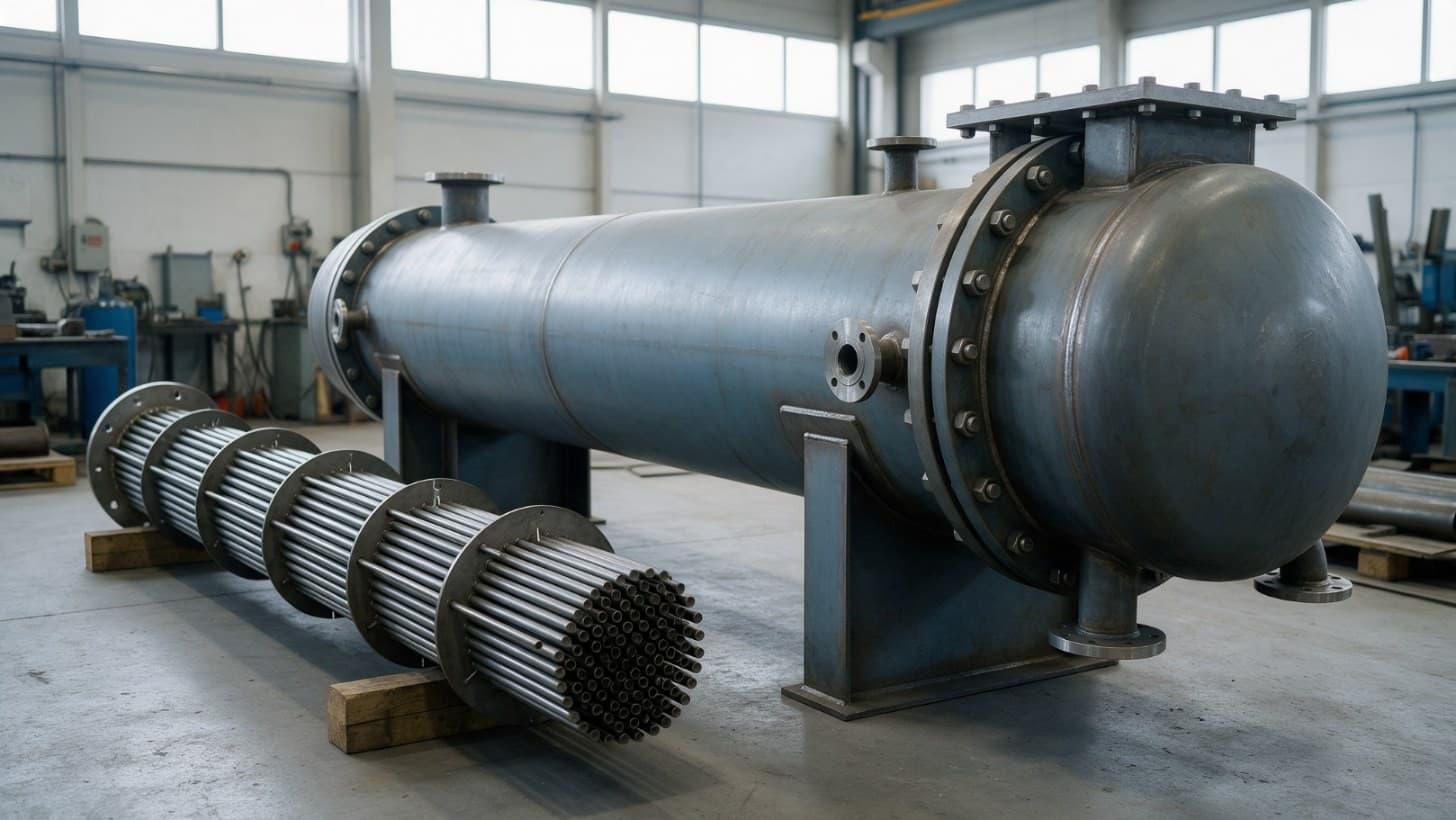
A TEMA type is a three letter code for a shell and tube heat exchanger. The first letter is the front head, where the tube side fluid enters; the second is the shell; the third is the rear head [4]. So AES is a channel with a removable cover, a one pass shell and a floating head; BEM is a bonnet, a one pass shell and a fixed tubesheet; and AEU is a channel with a removable cover, a one pass shell and a bundle of U tubes.
The letters tell a buyer how the unit copes with thermal expansion, which side can be cleaned mechanically, where a joint can leak, and roughly what it costs.
Why this matters now
TEMA, the Tubular Exchanger Manufacturers Association, has set shell and tube construction rules since its founding in 1939 [1]. Its 11th edition, available by October 2024, is sold only as a digital subscription and includes a type selection guide setting out the strengths and weaknesses of the main configurations [3]. TEMA now licenses what it calls the 2026 Edition, which includes a revised specification sheet intended to capture the design requirements more clearly [1].
If an enquiry states only the duty, bidders may offer different types, and the lowest price can come from a type that cannot be cleaned the way your site needs. Reading the letters catches that during technical bid evaluation, not after award.
Join ChemCapital to streamline sourcing and connect with verified partners
Whether you're buying or supplying, ChemCapital gives you the tools to manage the complete procurement cycle in one platform.
How to read the three letters
| Position | Letter | What it is | What it tells a buyer |
|---|---|---|---|
| Front head | A | Channel with removable cover | Tubes reachable without disturbing pipework; two seals [4] |
| Front head | B | Bonnet | Cheapest front head, one seal, better at high pressure; pipework must come off to reach the tubes [4] |
| Front head | N | Channel integral with tubesheet and shell, removable cover | Cheaper than A with the same tube access, but harder to repair [4] |
| Front head | C, D | High pressure heads, with the tube bundle built into the channel | Thermopedia's rough guide is C above about 100 bar and D, the most expensive, above about 150 bar; both are hard to repair [4] |
| Rear head | L, M, N | Fixed tubesheet | Cheapest construction if no expansion joint is needed; tube outsides can only be cleaned chemically [5, 6] |
| Rear head | U | U tube bundle | Free to expand and the bundle pulls out, but tube insides are hard to clean [5] |
| Rear head | S, T | Internal floating head, split ring (S) or pull through (T) | Free expansion and both sides cleanable; the costliest family [4, 5] |
| Rear head | P, W | Packed floating head or tubesheet | Low pressure, non hazardous fluids only; packing can leak [4, 5] |
The middle letter is usually E, a one pass shell and the most common choice [4, 8]. Other shells serve particular duties: F adds a longitudinal baffle for two shell passes and true counterflow, though leakage across that baffle needs care; G and H split the flow; J divides it to cut velocity and vibration; K is the kettle for reboilers; and X gives cross flow where every other shell exceeds the allowable pressure drop [4].
What BEM, AEU, AES and other common types mean in practice
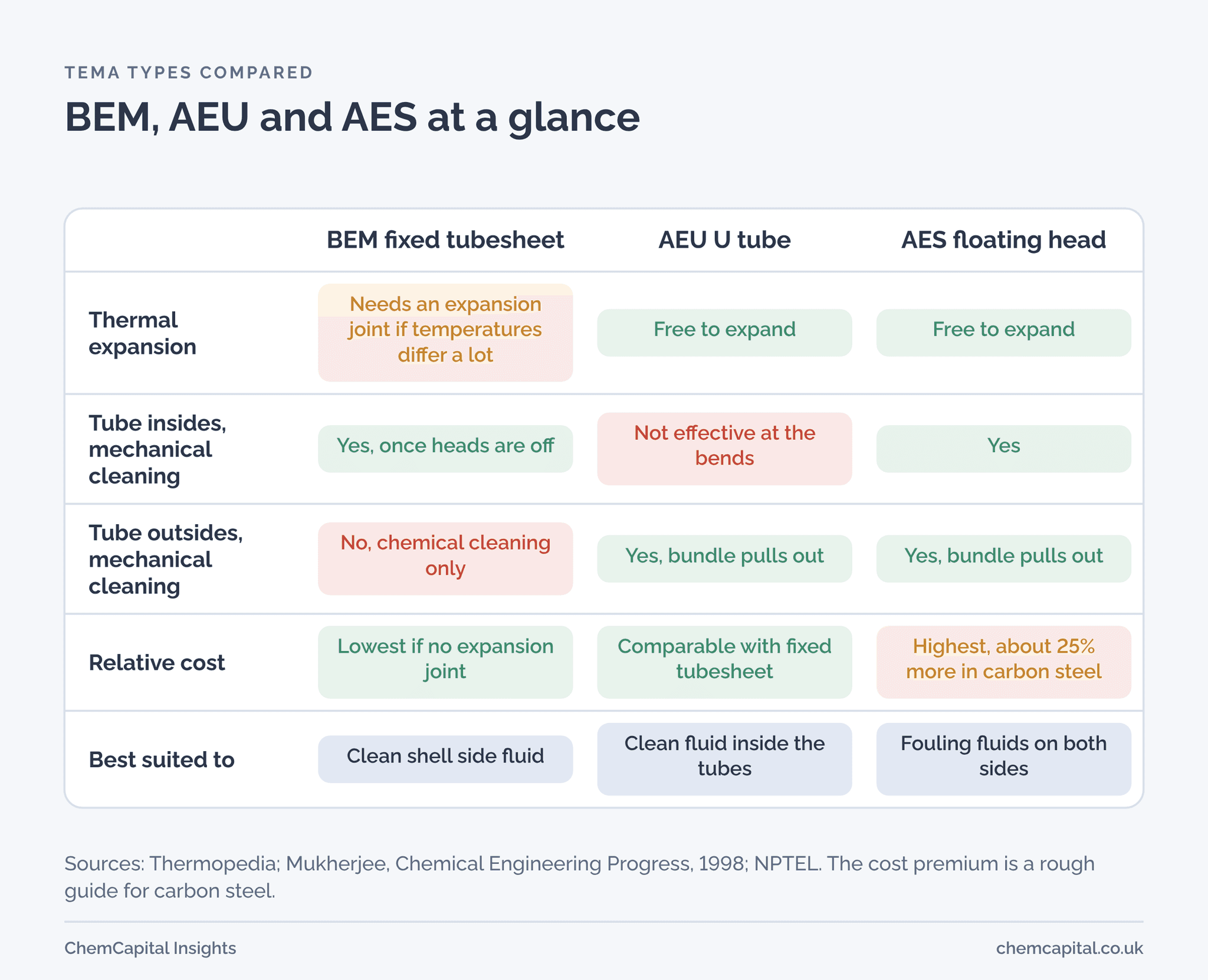
BEM is the fixed tubesheet exchanger, with both tubesheets welded to the shell. It is the simplest and cheapest construction [6], and having no shell side flanged joints keeps shell side leakage to a minimum [5]. But the tube outsides cannot be cleaned mechanically, so the shell side fluid must be clean or chemically cleanable [4]. If shell and tubes run at very different temperatures, an expansion joint may be needed, which takes away much of the cost advantage [5], and bellows are often a weak point in operation [4].
AEU and BEU use one tubesheet and a bundle of U tubes that is free to expand. The bundle pulls out for shell side cleaning, but the insides of the bends cannot be cleaned effectively, so a dirty fluid should not go in the tubes [5]. Individual tubes are hard to replace, and with the usual E shell true counterflow is not possible [6]. The price is usually comparable with a fixed tubesheet [5]; among U tube designs, Enerquip calls BEU by far the most common [8].
AES has an internal floating head: the rear tubesheet moves freely, and its cover is bolted on with a split backing ring inside a larger shell cover [5]. With the bundle out, both sides can be cleaned mechanically, so it is the usual answer when both fluids foul. Writing in 1998, Mukherjee described the S design as the type most often met in chemical plants [5]. Thermopedia puts a floating head at typically around 25% more than an equivalent fixed tubesheet unit in carbon steel [4]. Pulling the bundle means first removing the shell cover, split ring and floating head cover [5].
AKT is a kettle reboiler with a pull through floating head, so the whole bundle comes out from the front [5, 8]. The T head needs the largest bundle to shell clearance of any floating head [4]. Thermopedia says T is cheaper than S, Mukherjee that it costs the most of all [4, 5], so price both.
AEW uses a packed floating tubesheet. It is the cheapest floating head design, but it is limited to low pressure, non hazardous fluids, and the two fluids can mix if the packing leaks [4].
NEN has channels that are integral with the tubesheets and shell, with removable covers [4, 8]: tube access at lower cost than an A head, but harder repair [4].
TEMA classes R, C and B
Class R is meant for the toughest duties, typically refineries and similar hydrocarbon plants; class B is aimed at chemical plant; and class C suits general industrial and commercial units on milder duties [7, 8]. In Enerquip's experience as a manufacturer, class B exchangers are mostly stainless or other alloy, which allows some less critical parts to be slightly thinner [8].
The class is more than a label: design software uses it when computing the minimum tubesheet thickness [7]. A bid that quietly changes class has changed scope.
The TEMA specification sheet has separate fields for the TEMA type, the TEMA class (R, C or B) and the design code [2]. TEMA is specified alongside a pressure vessel code such as ASME VIII, PD 5500 or EN 13445, not instead of one; our pressure vessel code comparison explains the choice.
How to compare bids that quote different TEMA types
- Fluid allocation against cleaning. Ask which fluid goes in the tubes. A fouling fluid inside U tubes, or on the shell side of a fixed tubesheet unit that cannot be chemically cleaned, is a technical gap rather than a commercial option [4, 5].
- Expansion joint. The specification sheet asks whether one is required and of what type [2]. A fixed tubesheet with bellows is not like for like with a U tube.
- Leak paths. For each gasketed or packed joint, ask where a leak goes: to atmosphere or into the other fluid. Packed P and W heads are limited to non hazardous, non toxic shell side fluids at moderate conditions [5].
- Maintenance access. An A head lets fitters reach the tubes without breaking pipework; a B head does not [4].
- Class and code. Check every bid states the TEMA class and design code your enquiry asked for [2].
Practical example
Illustrative figures. A site needs to cool a clean solvent on the shell side from 120 °C to 40 °C, with cooling water in the tubes. The water side fouls and needs mechanical cleaning yearly. Three carbon steel bids arrive.
| Bidder 1 | Bidder 2 | Bidder 3 | |
|---|---|---|---|
| Type offered | BEM with shell bellows | BEU | AES |
| Quoted price | £41,000 | £38,500 | £51,000 |
| Scope levelling | Change to AEL channels, plus £4,000 | None | Add spare gaskets, plus £1,500 |
| Levelled price | £45,000 | £38,500 | £52,500 |
| Tube side mechanical cleaning | Yes | No, water inside U tubes | Yes |
| Shell side mechanical cleaning | No, chemical only | Yes | Yes |
| Status | Compliant, query the bellows | Excluded until reoffered | Compliant |
The cheapest bid fails the cleaning requirement. Bidder 1's bonnets would have to be unbolted from the water pipework at every clean; the site estimates £800 extra per clean, or £8,000 over ten annual cleans, so the £4,000 for removable channel covers at both ends pays for itself.
On headline price the AES is 24% above the BEM, close to Thermopedia's rough 25% [4]. After levelling, the gap narrows to £7,500, about 17%, because the fixed tubesheet bid has picked up two channel covers on top of its bellows. If the solvent stays clean, the AEL does the job for less; if it may foul, or the site wants no bellows, the AES earns its £7,500.
Putting the TEMA type into your next enquiry
Either specify the type, or state what decides it: which fluid fouls, how each side will be cleaned, the temperature difference between shell and tubes, the class and the design code. Then ask each bidder for a completed TEMA specification sheet so the quotes compare like for like.
ChemCapital's AI Quotation Comparison sets supplier quotes side by side across commercial, technical, delivery, compliance and risk, extracts price, lead time, materials and scope for you to review, and keeps quotes with mandatory gaps out of the ranking. The decision stays with you, and you can try it on up to three quotes without signing up.
Ready to compare exchanger bids on a like for like basis? Start free with ChemCapital.
Frequently asked questions
What does AES mean on a heat exchanger?
AES means an A front head (a channel with a removable cover), an E shell (one pass) and an S rear head (a floating head held by a split backing ring). The bundle can be removed so both sides can be cleaned mechanically, and the floating head allows free thermal expansion, but it costs more than a fixed tubesheet unit.
What is the difference between BEM and AEU?
A BEM has bonnets at both ends and both tubesheets welded to the shell, so it is cheap but the tube outsides can only be cleaned chemically and a large temperature difference may need an expansion joint. An AEU has a channel with a removable cover and a U tube bundle that expands freely and pulls out for shell side cleaning, but the insides of the U tubes cannot be cleaned effectively.
What are TEMA classes R, C and B?
Class R is meant for the toughest duties, typically refineries and similar hydrocarbon plants; class B is aimed at chemical plant; and class C suits general industrial and commercial units on milder duties. The class feeds into design calculations such as tubesheet thickness, so bids to different classes are not like for like.
Which TEMA type is the cheapest?
A fixed tubesheet type such as BEM is usually the cheapest when no expansion joint is needed, and a U tube unit is often comparable. Floating head types cost more, typically around 25% more than an equivalent fixed tubesheet unit in carbon steel according to Thermopedia.
Continue reading
Informational only, not procurement or legal advice. Cited names, frameworks, and statistics belong to their respective owners.
Join ChemCapital to streamline sourcing and connect with verified partners
Whether you're buying or supplying, ChemCapital gives you the tools to manage the complete procurement cycle in one platform.
Get started freeRelated articles
Where to Find Pharma and Chemical Plant Projects Before They Go to Tender: the 2027 Pipeline
Twenty pharma and chemical plant projects checked against owner or government announcements, the buying timeline on each, and where to watch for the next ones for free.
Safety Valve vs Relief Valve vs Bursting Disc: How to Choose
How safety valves, relief valves and bursting discs differ, when to fit a disc under a valve, the pressure terms that matter, GB duties and what to put in the RFQ.
Quotation Comparison Sheet: Layout and Worked Pump Example
How to build a quotation comparison sheet for process equipment that levels scope, Incoterms, currency, payment terms and energy before ranking, with a worked pump example.