
Where to Find Pharma and Chemical Plant Projects Before They Go to Tender: the 2027 Pipeline
Twenty pharma and chemical plant projects checked against owner or government announcements, the buying timeline on each, and where to watch for the next ones for free.
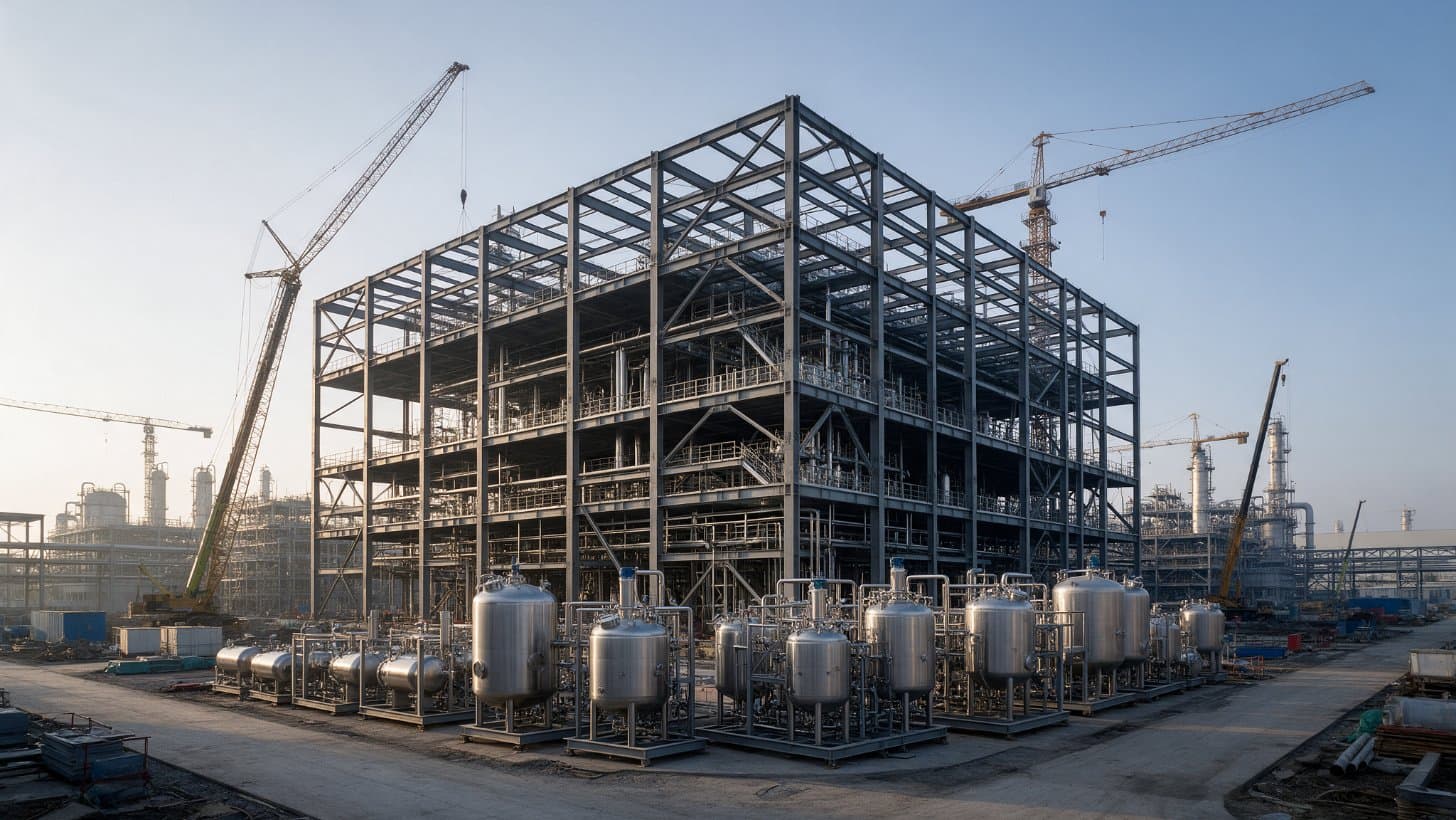
Most of the pharma and chemical plants that will buy equipment in 2027 have already been announced. The 2025 to 2026 wave of US pharma investment alone covers more than a dozen named sites with published budgets and target start up dates, and Europe and Asia add several more. Below is a list of 20 projects, each checked against the owner's own announcement or a government announcement, followed by the buying timeline a supplier should expect on each, and where to watch for the next ones without paying for a database.
Why this matters now
The programme totals are large and the dates are close. Lilly puts its US capital commitments since 2020 at $50 billion [2]. AstraZeneca announced a $50 billion US programme in July 2025 [9]. Johnson & Johnson is spending more than $55 billion in the US over four years [5]. Novartis has a $23 billion US plan [3]. GSK plans $30 billion in US research and development and supply chain infrastructure over five years [11]. In chemicals, BASF expects capital expenditure of about €3 billion in 2026 and about €13 billion over 2026 to 2029 [16].
Most of the sites in these programmes have target start up dates between 2027 and 2030. Equipment is bought well before start up, so the orders for a 2028 plant are placed in 2026 and 2027. A supplier who first hears about a project when the equipment list is published has usually missed the first round of enquiries.
One caution before the list. Announced is not the same as built. Novo Nordisk announced a DKK 8.5 billion finished product facility and warehouse in Odense in December 2024, with completion scheduled for 2027 [26]. In May 2026, in a statement reported by AFP, the company said the building would serve as a warehouse and storage rather than a manufacturing facility, citing capacity planning based on the current market situation [21]. At the time of writing we found no release on the company's own newsroom about the change, so the May 2026 position rests on press reporting. Check the owner's latest statement before you spend sales time on a project.
Access real procurement opportunities from global buyers
Join ChemCapital to get discovered by verified procurement teams across pharmaceutical, chemical, and industrial manufacturing.
The 2027 pipeline: 20 projects checked against owner announcements
Figures and dates are as published by the owner at the time of the announcement. "Not published" means the owner's page does not give the figure. Target dates are the owner's stated expectations, not guarantees.
| Owner and site | What it makes | Announced investment | Dates published by the owner | Source |
|---|---|---|---|---|
| Lilly, Houston, Texas | Small molecule APIs (active pharmaceutical ingredients), including orforglipron, an oral obesity medicine | $6.5 billion | Announced September 2025; operation expected within five years | [1] |
| Lilly, Goochland County, Virginia | APIs and drug product for antibody drug conjugates (ADCs) and monoclonal antibodies | $5 billion | Announced September 2025; completion expected within five years | [2] |
| Novartis, Denton, Texas | Radioligand therapy doses, 46,000 square feet | Not published (part of $23 billion US plan) | Construction from 2026; fully operational 2028 | [3] |
| Novartis, Winter Park, Florida | Radioligand therapy doses, 35,000 square feet | Not published | Announced January 2026; online by 2029 | [4] |
| Johnson & Johnson, Wilson, North Carolina | Biologics for cancer, immune and neurological diseases, 500,000 square feet | $2 billion | Ground broken March 2025; operation date not published | [5] |
| Johnson & Johnson, Montgomery County, Pennsylvania | Cell therapy manufacturing | More than $1 billion | Announced February 2026; dates not published | [6] |
| AbbVie, North Chicago, Illinois | Two API plants for neuroscience and obesity medicines, after a first chemical synthesis plant that broke ground in September 2025 | $380 million for the two new plants | Construction from spring 2026; fully operational 2029 | [7] |
| Bayer, New Albany, Ohio | Drug substance and drug product for oncology, cardiovascular and renal medicines | $2.2 billion | Announced October 2026; first module (drug substance) operational 2031, second module (drug product) planned for 2034 | [8] |
| AstraZeneca, Albemarle County, Virginia | Drug substance for weight management and metabolic medicines, and ADCs | $4.5 billion | Increase to $4.5 billion announced October 2025 with work to start immediately; operation within four to five years | [9] |
| Novo Nordisk, Clayton, North Carolina | Second fill and finish facility for injectable medicines, 1.4 million square feet | $4.1 billion | Announced June 2024; finished in stages 2027 to 2029 | [10] |
| GSK, Upper Merion, Pennsylvania | Biologics flex factory for respiratory and cancer medicines | Within a $1.2 billion package | Construction planned to start 2026 | [11] |
| Kyowa Kirin, Sanford, North Carolina | Biologic drug substance, including next generation antibodies | Up to $530 million | Announced June 2024 with groundbreaking planned for the second half of 2024; completion planned 2027 | [12] |
| Amgen, New Albany, Ohio | Biologics manufacturing expansion next to the existing site | $900 million planned; at least $822 million committed ($614 million building, $208 million machinery and equipment) | Announced April 2025; construction completion expected 2027 | [13] |
| Merck, Wilmington, Delaware | Biologics centre with laboratory, manufacturing and warehouse, including ADCs, 470,000 square feet | $1 billion | Construction started April 2025; laboratory operational 2028; investigational production by 2030 | [14] |
| Roche and Genentech, Holly Springs, North Carolina | Metabolic medicines including obesity treatments, 700,000 square feet | More than $700 million | Ground broken August 2025; operational by 2029 | [15] |
| BASF, Ludwigshafen, Germany | Semiconductor grade sulphuric acid plant and electronic grade ammonium hydroxide plant | Not published | Both start up planned 2027 | [16] |
| Novo Nordisk, Kalundborg, Denmark | API capacity (170,000 m²) plus packaging, multiproduct | More than DKK 42 billion | Finished gradually from end 2025 through 2029 | [17] |
| Novo Nordisk, Athlone, Ireland | Tabletting facility for oral obesity and diabetes medicines | €432 million | Construction under way March 2026; finished from end 2027 through 2028 | [18] |
| Lonza, Visp, Switzerland | Commercial scale highly potent API and ADC payload linker manufacturing inside an existing GMP facility | Not published | Announced June 2026; operational 2028 | [19] |
| Lotte Biologics, Songdo, South Korea | Plant 1 of a planned three plant biologics campus, 120,000 litres | Not published | Completion 2026; commercial production first half of 2027 | [20] |
For contrast, BASF's Zhanjiang Verbund site in China, with total capital expenditure of about €8.7 billion, started producing from its core plants in late 2025 [25]. Its equipment buying window closed years ago. The projects in the table are the ones where the window is open now or opens in 2027. Bayer's New Albany site is included even though its first module is not due to operate until 2031, because on a programme of that size the front end engineering and the vendor list that goes with it are typically settled two to three years before the long lead orders, which puts the first budgetary enquiries in 2027 and 2028.
The buying timeline from announcement to start up
Every project in the table will pass through the same stages. The names vary between pharma and chemicals, but the sequence does not. The stage descriptions and the month ranges below are drawn from the editorial team's experience of process plant projects, not from a published standard; they are typical and illustrative, and each owner runs its own schedule.
Announcement and concept. The owner's board approves the programme and the press release goes out. The only purchases are studies and site work. Nobody is buying equipment, but the owner's engineering group is already listing the main process steps.
FEED (front end engineering design). Also called basic engineering or FEL 3 (front end loading stage 3). The owner appoints an engineering firm to define the plant well enough for a firm cost estimate. The outputs include an equipment list, datasheets for the main items and budget prices. This is when suppliers are asked for budgetary quotations, and when the vendor list for the project is first drawn up. A supplier who is not on that list at FEED is rarely added later. See budgetary quote versus firm quote for how to answer these enquiries without committing to a price you cannot hold.
EPC or EPCM appointment and final investment decision. EPC means one contractor takes engineering, procurement and construction as a lump sum. EPCM means the contractor manages engineering, procurement and construction on the owner's behalf, and the owner signs the purchase orders. The distinction matters to you because it decides whose purchasing department sends the RFQ (request for quotation).
Long lead equipment. Items with long manufacturing times are ordered first, often before the EPC contract is signed: reactors, bioreactors, fermenters, lyophilisers, filling lines, large pressure vessels, columns, compressors, chillers, centrifuges, air handling units and electrical switchgear. These orders are typically placed 12 to 24 months before start up, and for custom items sometimes earlier. The buyer is usually the owner directly, under the owner's own specifications, or the EPC acting for the owner. Our guide to long lead items on process plant projects covers the typical lead times by equipment type.
Bulk equipment and instruments. Pumps, valves, instruments, heat exchangers, filters, pipework, insulation and small vessels are bought during detailed design, typically 6 to 15 months before mechanical completion. The buyers here are the EPC or EPCM contractor, the skid integrators who build packaged units and buy the pumps, valves and instruments inside them, and the mechanical contractors.
Commissioning and start up. Spares, consumables, calibration and service contracts. The buyer is the owner's site team, and the vendor list is whoever supplied the installed equipment.
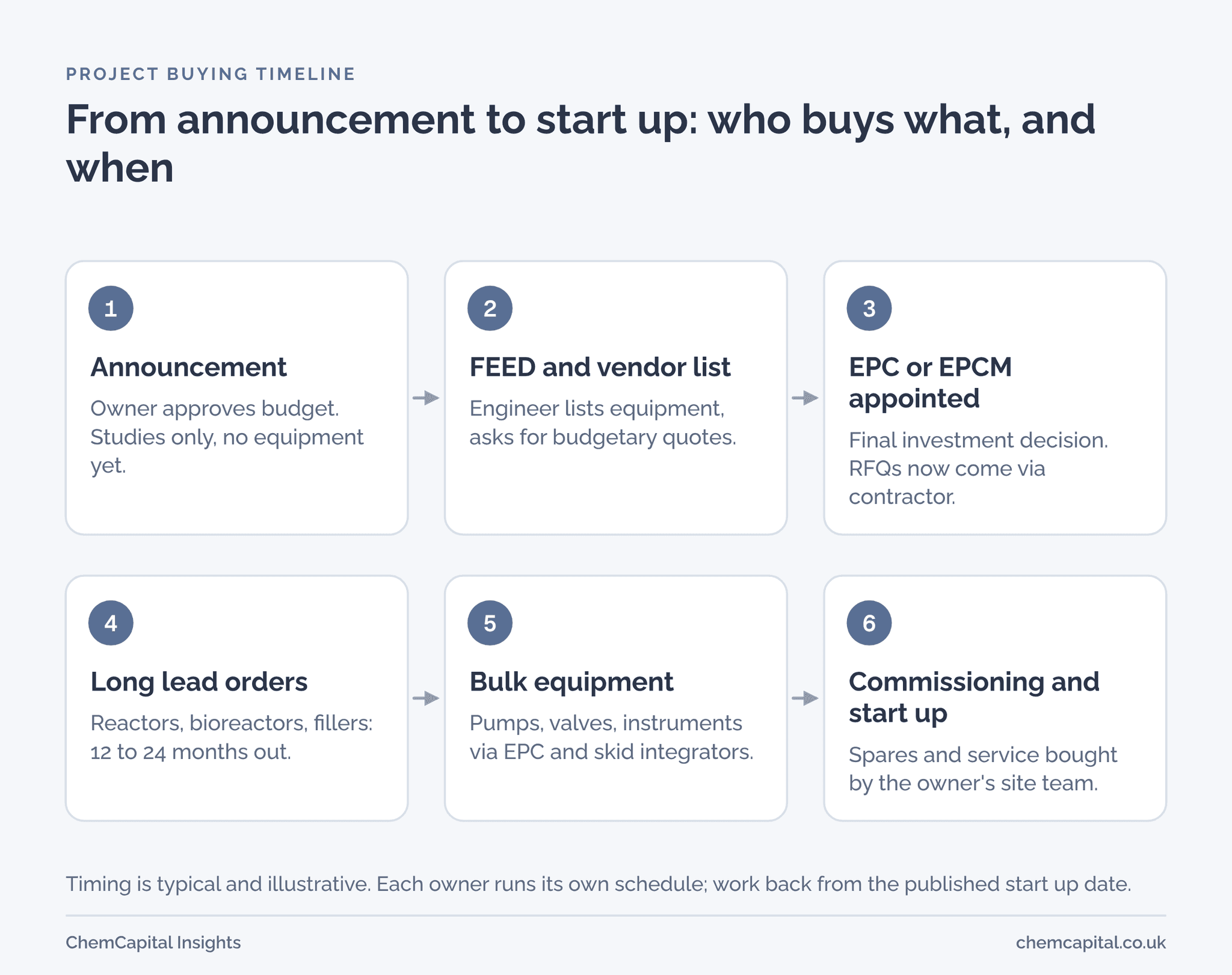
Work back from the owner's start up date. For a 2029 start up, long lead orders go out in 2027 to early 2028, bulk orders through 2028, and the FEED enquiries that decide the vendor list happen in 2026 and early 2027. That is why the list above is a 2027 pipeline even where the plant will not run until 2029.
Where to watch for free, and where free stops
Company newsrooms and investor material. Every project in the table came from the owner's press release or a government announcement. Capital markets days and annual reports give the multiyear capex plan before the individual sites are named; BASF's investor page gives the plan by year and names the plants under construction [16]. Set alerts on the newsroom pages of the 20 to 30 owners who matter to you.
State and national government announcements. Economic development agencies sometimes publish detail the owner does not, because the grant is tied to the figures. JobsOhio's note on the Amgen expansion gives the committed figure, the split between building ($614 million) and machinery and equipment ($208 million) and the 2027 completion date [13]. IDA Ireland, the UK Department for Business and Trade and US state agencies do the same.
Planning portals. Planning applications and environmental permits are public and are often filed before the press release. Local council planning portals in the UK and county permit records in the US show site layouts and sometimes the main equipment.
Public tender portals. Find a Tender is where UK public sector buyers publish procurement notices, and for new procurements started from 24 February 2025 under the Procurement Act 2023 it carries both above and below threshold notices, except below threshold notices in Scotland [22]. TED (Tenders Electronic Daily) is the EU portal for public procurement notices published in the Official Journal supplement [23]. These matter for public and research sites: universities, hospitals, national laboratories, state owned manufacturers and publicly funded pilot plants. Private pharma and chemical owners do not tender through them, so do not expect to find Lilly or BASF there.
ISPE and trade press. ISPE (International Society for Pharmaceutical Engineering) conferences and its facility awards are where project teams present what they built and who built it. Trade press repeats announcements quickly and is useful as an alert, but check the figures against the owner before you quote them to a customer.
Where free stops. Free sources give you the owner, the site, the budget and the target date. They rarely give you the engineering contractor, the equipment package list, the buyer's name or the bid dates. That is what paid project databases sell. Industrial Info Resources, for example, says its database tracks more than 258,000 projects and lists for each the EPC and contractor involvement, equipment needs, project contacts where available and milestone dates including long lead equipment and equipment RFQ dates [24]. Other providers sell comparable databases. Whether a subscription pays depends on your order size and how many projects you can realistically chase.
Practical example
A pump maker with hazardous area process pumps and hygienic pumps maps three projects from the table against the timeline above. All dates in this example are illustrative estimates worked back from the owner's published target; the owners have not published their procurement schedules.
| Project | Owner's published date | Likely mechanical completion (illustrative) | Long lead window (illustrative) | Bulk pump window (illustrative) | Likely buyer | Action in October 2026 |
|---|---|---|---|---|---|---|
| Kyowa Kirin, Sanford [12] | Completion 2027 | Late 2026 to early 2027 | 2025 | Late 2025 to mid 2026 | EPC and skid integrators | Window closed. Approach the site team for spares and the second phase. |
| AbbVie, North Chicago [7] | Construction from spring 2026; operational 2029 | 2028 | 2026 to 2027 | 2027 to early 2028 | EPCM contractor for the owner; skid integrators for synthesis packages | Get on the engineering contractor's vendor list now; prepare budgetary quotes for sealless and metering pumps. |
| Lilly, Houston [1] | Operation within five years of September 2025 | 2029 to 2030 | 2027 to 2028 | 2028 | Owner for critical process pumps; EPC for utilities | Identify the FEED contractor; submit budgetary pricing and references for API service in 2026 to 2027. |
The arithmetic is simple. The pump maker has one project where the window has passed, one where bulk purchasing starts within about a year, and one where the vendor list is being formed now. The sales effort goes to the second and third, in that order. A supplier without this map would most likely have chased the first, because it is the one with visible construction.
Be on the list before the enquiry goes out
Two things decide whether a supplier is asked to quote on these projects: knowing about the project early enough, and being findable when the engineering contractor or owner starts sourcing.
A supplier profile on ChemCapital with detailed product listings means buyers using AI supplier discovery can find and invite you to quote even if they have never heard of you. Structured RFQs arrive with specifications, quantities, delivery requirements and deadlines, and you answer budgetary or firm quotations with line items, assumptions and attachments in one form, with revision history.
Ready to be found by the buyers already looking for what you make? List your company on ChemCapital. It is free to start.
Frequently asked questions
How early should an equipment supplier contact a newly announced pharma plant project?
During FEED (front end engineering design), which in our experience usually starts within a year of the announcement, because that is when the vendor list and budget prices are set. For a plant with a 2029 start up, that typically means 2026 to early 2027.
Who buys the pumps, valves and instruments on a large pharma or chemical plant?
Usually the EPC or EPCM contractor and the skid integrators building packaged units, not the owner. The owner typically buys only the critical long lead process equipment directly, under its own specifications.
Can I find private pharma plant tenders on Find a Tender or TED?
No. Those portals carry public sector procurement, so they are useful for universities, hospitals, national laboratories and state owned sites. Private owners such as Lilly or BASF source through their engineering contractors, so watch company newsrooms and government announcements instead.
Continue reading
Informational only, not procurement or legal advice. Cited names, frameworks, and statistics belong to their respective owners.
Access real procurement opportunities from global buyers
Join ChemCapital to get discovered by verified procurement teams across pharmaceutical, chemical, and industrial manufacturing.
List your companyRelated articles
TEMA Heat Exchanger Types: How to Read AES, BEM and AEU
How to decode the three letter TEMA type, what AES, BEM, AEU and other common types mean for cleaning, expansion, leaks and cost, and how to compare bids that differ.
Safety Valve vs Relief Valve vs Bursting Disc: How to Choose
How safety valves, relief valves and bursting discs differ, when to fit a disc under a valve, the pressure terms that matter, GB duties and what to put in the RFQ.
Quotation Comparison Sheet: Layout and Worked Pump Example
How to build a quotation comparison sheet for process equipment that levels scope, Incoterms, currency, payment terms and energy before ranking, with a worked pump example.