
Site Acceptance Test (SAT) Checklist for Process Skids
What a site acceptance test must prove once a skid is installed, how SAT differs from FAT and commissioning, a full SAT checklist and how to handle failed tests.
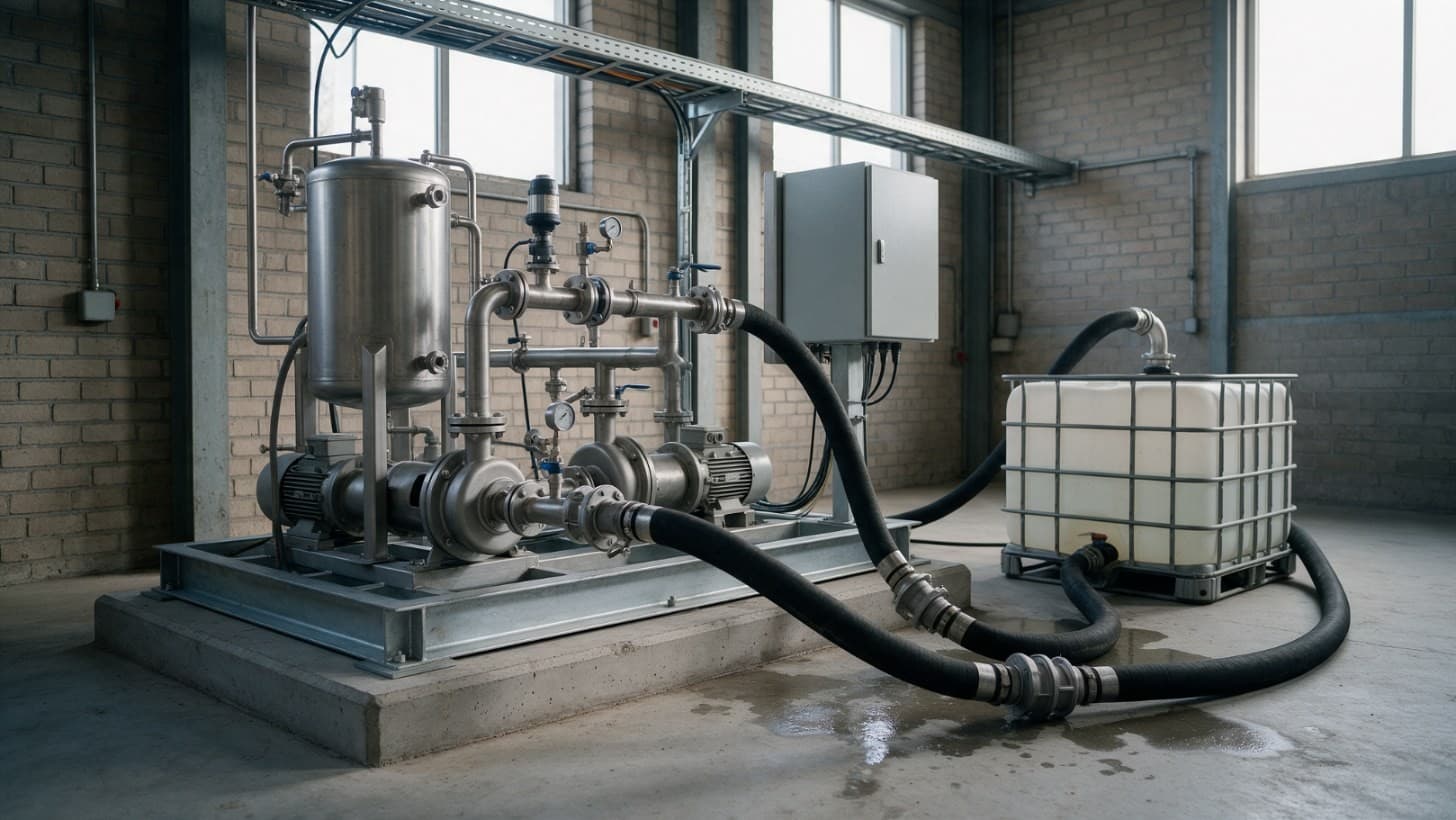
A site acceptance test (SAT) is the documented test, carried out once a skid is installed at your site, that shows it arrived undamaged, has been connected correctly and works on your utilities and control system as the order requires. The factory acceptance test (FAT) proved the skid at the supplier's works. The SAT proves it again after a road journey, a crane lift and site connections, and covers what no works test can: site steam, your control system and your own product.
Below is a SAT checklist you can turn into a protocol. For the works test, see our FAT checklist for process skids.
Why this matters now
Site testing sits next to the signatures that move money and risk. In one Environment Agency contract pack for MEICA (mechanical, electrical, instrumentation, control and automation) work on MF/1 conditions, taking over starts a 12 month defects liability period, and half of the retention (money held back from payments) is released within 30 days of the Taking Over Certificate being presented [1]. Before signing on site, know what each signature triggers.
Under the Provision and Use of Work Equipment Regulations 1998 (PUWER), where the safety of work equipment depends on how it is installed, the employer must have it inspected after installation and before first use, and record the result [2, 3]. A SAT that covers those safety points, carried out by a competent person, can form part of that record. This is general information, not legal advice.
Poorly recorded checks get done twice: an ISPE article cites a commissioning and qualification team repeating an electrical vendor's loop checks that lacked proper documentation [4].
Create and manage RFQs in minutes
ChemCapital handles the entire procurement cycle, from structured RFQs and supplier comparisons to formal purchase orders and delivery tracking.
SAT, commissioning and performance tests
BS EN IEC 62381:2024 sets out checklists for the FAT, SAT and site integration test (SIT) of process automation systems, partly so that owner, buyer and vendor agree who does what. It leaves loop checks and commissioning outside its scope [5], so your contract has to place them.
| Test | Where and when | What it proves | Usually run by |
|---|---|---|---|
| FAT | Supplier's works, before shipment | Built to the order; functions work on test media | Supplier, witnessed by the buyer |
| SAT | Your site, after installation and connection | Nothing changed in transit; connected correctly; works on site utilities | Supplier's engineer, witnessed and signed by the buyer |
| Commissioning | Your site, from first utilities to running plant | The system is brought into safe operation | Owner's team with supplier support |
| Performance test | Your site, on real feed and product | Guarantees such as capacity and product quality are met [6] | Purchaser, with the contractor invited to witness [6] |
IChemE's model contracts avoid "mechanical completion" and "commissioning" as contract terms, and use completion of construction, take over and performance tests as the stages instead [6]. Define each stage and what it triggers.
In pharma, EU GMP Annex 15 lets a SAT, run after the equipment arrives at the manufacturing site, add to the FAT [7]. Our IQ OQ PQ guide covers how Annex 15 applies in Great Britain and when vendor records count towards IQ and OQ.
Before the skid ships
Agree these in the purchase order:
- An approved protocol. Every test, its method, the record sheet and a measurable acceptance criterion. In pharma, Annex 15 expects each protocol to name what is critical and the acceptance criteria for it [7].
- Named people. The supplier's engineer; your process, electrical and control engineers; operations; and in pharma, quality. Name who signs and who can accept a deviation. In the risk based approach the ISPE article describes, quality approves the test strategy, acceptance criteria and the acceptance and release reports [4].
- Utilities at the battery limits (the edges of the supplier's scope): power, instrument air, water, steam, nitrogen and drains at datasheet conditions, with site pipework and cabling finished.
- Calibration. Certificates for the skid's instruments and any test instruments used to judge acceptance.
- The FAT punch list, so every open item is closed or retested at SAT.
- Engineer days. Days included, the rate for extra days, and who pays for a retest caused by either side. Emerson, for one, sells help with site and performance acceptance tests [8].
The SAT checklist
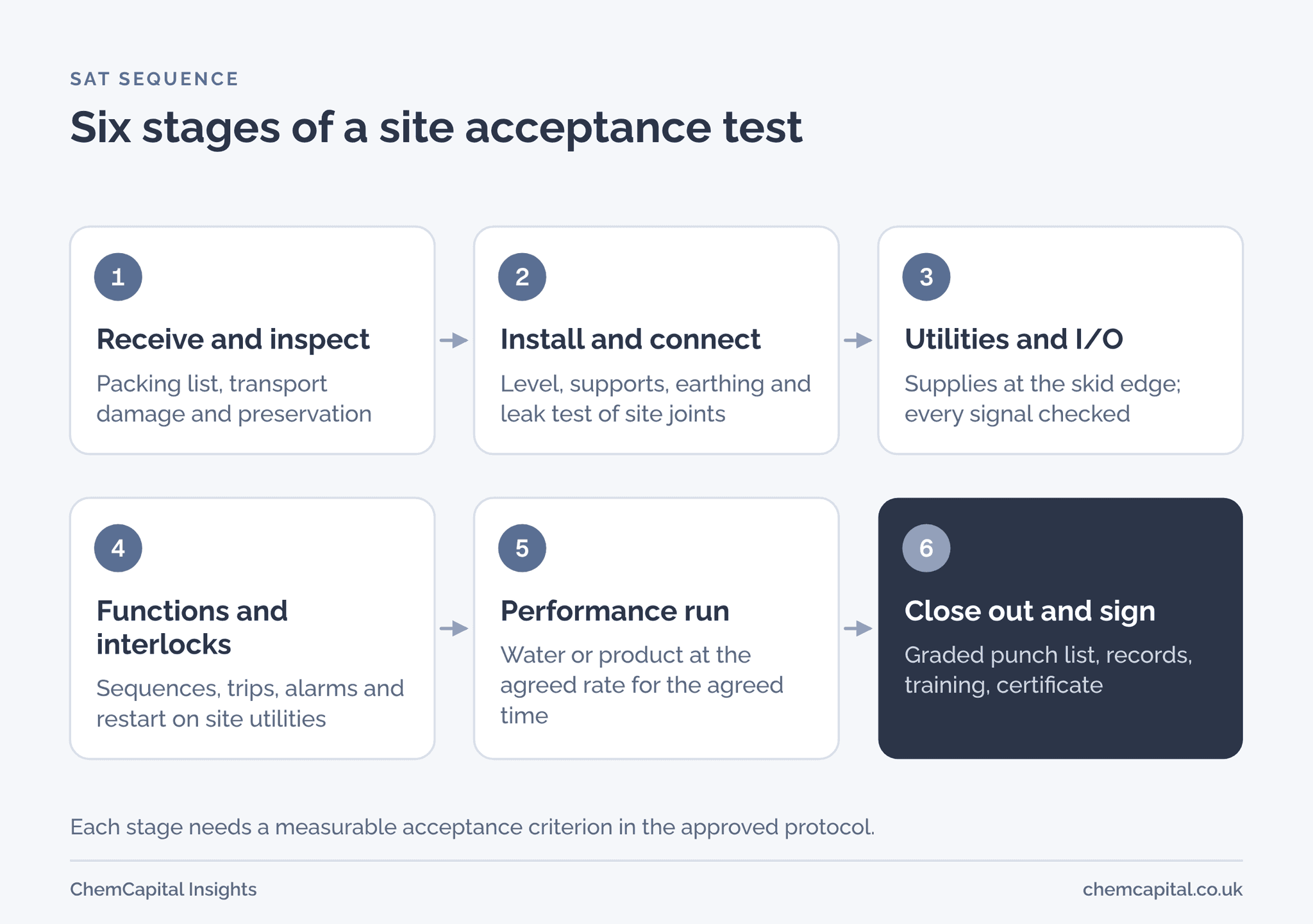
| Stage | Check | Evidence |
|---|---|---|
| Receipt and damage | Delivery against packing list; transport damage; preservation such as end caps, desiccant or nitrogen still in place | Receipt record with photographs |
| Installation | Level, anchoring and supports; battery limit joints, gaskets, bolting and leak test; drain slopes; maintenance access; tags against the P&ID | Marked up installation checklist |
| Utilities | Pressure, temperature and voltage measured at the skid edge; earthing and bonding; motor rotation | Utility check sheet |
| I/O and loop checks | Every input and output (I/O) signal from field device to control system screen, with range and units as the I/O list | Loop sheet signed for each loop |
| Functions and interlocks | Sequences, interlocks, trips, emergency stop and restart after power loss, on site utilities | Test sheets against the protocol |
| Performance | Run on water or product at the agreed rate for the agreed time | Logged data and calculation |
| Alarms | Each alarm raised at its set point and seen locally and in the control room | Alarm test sheet |
| Documents and training | As built drawings, manuals, certificates, software version and backup; operator and maintenance training | Document index and training records |
| Punch list | Every open item graded, with an owner and a date | Punch list signed by both parties |
The Environment Agency pack splits site testing into a pre commissioning SAT of the plant and its interface connections, a post commissioning SAT of satisfactory operation, and a test of telemetry and site alarm settings. It lists them as performance tests, timed from taking over [1].
Safety instrumented systems need more than a SAT; IEC 61511 sets the requirements for checking and validating them [5]. A pressure system, such as a steam heated skid, also needs a written scheme of examination before use under the Pressure Systems Safety Regulations 2000 [9]; a SAT does not replace it.
Acceptance criteria and deviations
Write each criterion as a number, a tolerance and a method. "Runs satisfactorily" invites argument; "15 m³/h plus or minus 5% on the skid flow meter for four hours" does not (illustrative). The IChemE article recommends specifying measurement methods and tolerances for performance tests and, where useful, corrections for conditions that differ from the design case [6].
When a test fails, record it as a deviation, find the cause and assess the impact before anyone retests. Annex 15 expects failed results to be recorded as deviations and investigated, and any significant change to approved acceptance criteria during the test to be recorded and justified [7]. It also allows conditional approval to move to the next qualification stage where a documented assessment shows no significant impact on it [7].
Then grade the punch list. A items block safe operation and are closed and retested before signature. B items (close before product is introduced) and C items (close when convenient) are listed on the certificate with owners and dates. Sign "accepted subject to the attached punch list", not plain "accepted". If a later performance test fails, the IChemE article has the contractor find the cause and correct the plant, and recommends liquidated damages (a sum fixed in the contract) of no more than a genuine advance estimate of the purchaser's loss [6].
Practical example
All figures are illustrative. A UK chemical site buys a caustic dilution skid for £185,000: a mixing tank, two transfer pumps, a flow meter, a conductivity analyser and a local programmable logic controller (PLC). The order includes three engineer days for the SAT, then £1,100 per extra day, with retest days charged to whoever caused them.
| Day | Work | Result |
|---|---|---|
| 1 | Receipt, damage and installation checks | 3 B items: paint damage, a missing tag plate, a loose support shim |
| 2 | Utilities and 48 I/O loop checks | Two A items: pump P2 ran backwards (site contractor's wiring, fixed that day); flow meter set to 0 to 20 m³/h but PLC scaled 0 to 10 m³/h (supplier) |
| 3 | Interlocks, alarms, four hour water run at 15 m³/h | Interlocks and alarms passed; run stopped when the rescaled flow loop would not hold steady; 4 B items |
| 4 | Retune, then retest flow loop and water run | Passed; 3 C items; certificate signed |
The SAT logged 12 items: 2 A, 7 B and 3 C, with both A items closed and retested before signature. The fourth day traced back to the supplier's scaling error, so it cost the buyer nothing; without the retest clause it could have cost £1,100.
| Payment milestone | Share | Amount |
|---|---|---|
| With order | 30% | £55,500 |
| Delivery after approved FAT | 50% | £92,500 |
| Signed SAT certificate, no A items open | 15% | £27,750 |
| Retention, end of 12 month defects period | 5% | £9,250 |
| Total | 100% | £185,000 |
Put the SAT in the order
A SAT goes smoothly when its protocol, engineer days and retest terms were priced at RFQ stage. ChemCapital sends one structured RFQ to all your suppliers at once, so every bidder prices the same site test scope you specify, and lines the replies up side by side. After award, suppliers confirm purchase orders and post milestone updates, and an audit trail logs every interaction, revision and decision with a timestamp.
Ready to make site testing part of every quote? Start a free 14 day ChemCapital trial, with no credit card needed.
Frequently asked questions
What is the difference between FAT and SAT?
A FAT proves the skid at the supplier's works before it ships, usually on test media. A SAT proves it again once it is installed and connected, on your utilities and control system, and its signature can release a payment, so write its pass criteria into the order.
What should a site acceptance test checklist include?
Receipt and damage inspection, installation checks, utilities, I/O and loop checks, functions and interlocks, a performance run on water or product, alarms, documents and training, and a graded punch list. Each check needs a measurable acceptance criterion and a signed record.
Who signs a site acceptance test?
Usually the supplier's engineer who ran the tests and the buyer's named representative who witnessed them; in pharma, quality also approves the acceptance criteria and the report. The protocol should name who signs and who can accept a deviation before testing starts.
Is a site acceptance test the same as commissioning?
No. A SAT is a defined set of acceptance tests against the order, while commissioning brings the plant into safe operation and usually continues after it, followed by performance tests on real product. IEC 62381 leaves loop checks and commissioning outside its scope, so the contract has to say where they sit.
Continue reading
Informational only, not procurement or legal advice. Cited names, frameworks, and statistics belong to their respective owners.
Create and manage RFQs in minutes
ChemCapital handles the entire procurement cycle, from structured RFQs and supplier comparisons to formal purchase orders and delivery tracking.
Start for freeRelated articles
Factory Acceptance Test (FAT) Checklist for Process Skids
A practical factory acceptance test checklist for process skids: what to agree first, what to check, why FATs slip and how FAT and SAT fit together.
Recommended Spares List: Commissioning, Operating and Insurance Spares
What a recommended spares list should hold: commissioning, two year operating and insurance spares, criticality, what to ask in the RFQ, and a pump and vessel template.
Punch List Categories and Mechanical Completion for Process Plant
What a punch list is, how category A, B and C items gate mechanical completion, start up and handover, who clears them, and a template for vendor equipment packages.