
Budgetary Quote vs Firm Quote: What Each One Commits You To
A budgetary quote is for planning; a firm quote is an offer you can accept. What each covers, why prices move between them and how to use both safely.

A budgetary quote is a supplier's price for planning: a fair number on limited information that neither side expects to place an order against. A firm quote is an offer you can accept, with a defined scope, price, delivery, terms and validity. Treat the first like the second and your estimate, your schedule or your contract will catch you out.
Why this matters now
Most capital projects collect both kinds of quote, months apart, for the same equipment. Budgetary prices feed the early estimate. Firm quotes arrive when the datasheets are frozen and the project is ready to buy.
The gap between them is often large, and it is usually not the supplier "putting the price up". It is scope becoming real: materials of construction, seals, testing, documentation and delivery terms that were never in the first number. AACE International ties estimate accuracy to how mature the project definition is, from a range as wide as 50% below to 100% above at Class 5 down to roughly 10% to 20% below and 10% to 30% above at Class 3 [1]. In practice, replacing budgetary prices with firm ones on the main equipment is a big part of that move.
Volatile material costs make the distinction sharper. Outokumpu, for example, prices stainless steel as a base price, extras and an alloy surcharge, and usually publishes the surcharge month by month to pass on changes in alloy costs [5]. A price that was right in March may not be right in September.
Create and manage RFQs in minutes
ChemCapital handles the entire procurement cycle, from structured RFQs and supplier comparisons to formal purchase orders and delivery tracking.
What each one commits you to
| Budgetary quote | Firm quote | |
|---|---|---|
| Purpose | Estimating and feasibility | Placing an order |
| Basis | Duty point or outline scope | Frozen datasheet and specification |
| Typical content | One price, a rough lead time | Scope, exclusions, delivery terms, lead time, payment, warranty |
| Validity | Often not stated | Stated, often short for alloy equipment |
| Can you accept it? | Not intended to be | Intended to be, on its terms |
| Where it belongs | Class 4 and 5 estimates | Class 3 estimates and the purchase order |
Whether a binding contract exists, and on what terms, depends on what the parties communicated by words or conduct, judged objectively [2]. A label such as budgetary or subject to contract counts, but conduct can override it, as it did in that case. A "budgetary" quote that names a scope, a price, a delivery date and says "valid for 60 days" starts to look like an offer. A "firm" quote that says "subject to final engineering review" starts to look like it is not.
The terms that decide the real price
When a firm quote arrives, these lines matter as much as the headline number:
- Exclusions. Commissioning, site supervision, spares, special tools and documentation are the usual gaps.
- Delivery terms. The Incoterms 2020 rule on the quote sets who pays for and carries the risk of transport [4]. An ex works price and a delivered price are not comparable until freight is added.
- Lead time basis. Weeks from order and weeks from drawing approval are not the same clock, and on engineered items the gap is often several weeks.
- Price adjustment. Check for alloy surcharge clauses and escalation formulae, and what date they are calculated on.
- Validity. Note whether price, lead time and surcharge each have their own validity. They often do.
Whose terms win
When your purchase order says one thing and the supplier's quote or acknowledgement says another, English courts usually look at the sequence of offer, counter offer and acceptance. In one Court of Appeal case, a supplier's acknowledgement that was "subject to" its own terms counted as a counter offer, and the buyer accepted it by going ahead with the deal, so the supplier's terms applied [3]. The practical lesson for both sides: read the acknowledgement, and reject conflicting terms in writing before work starts.
This is general information, not legal advice. For anything with real money at stake, ask your legal team.
Practical example
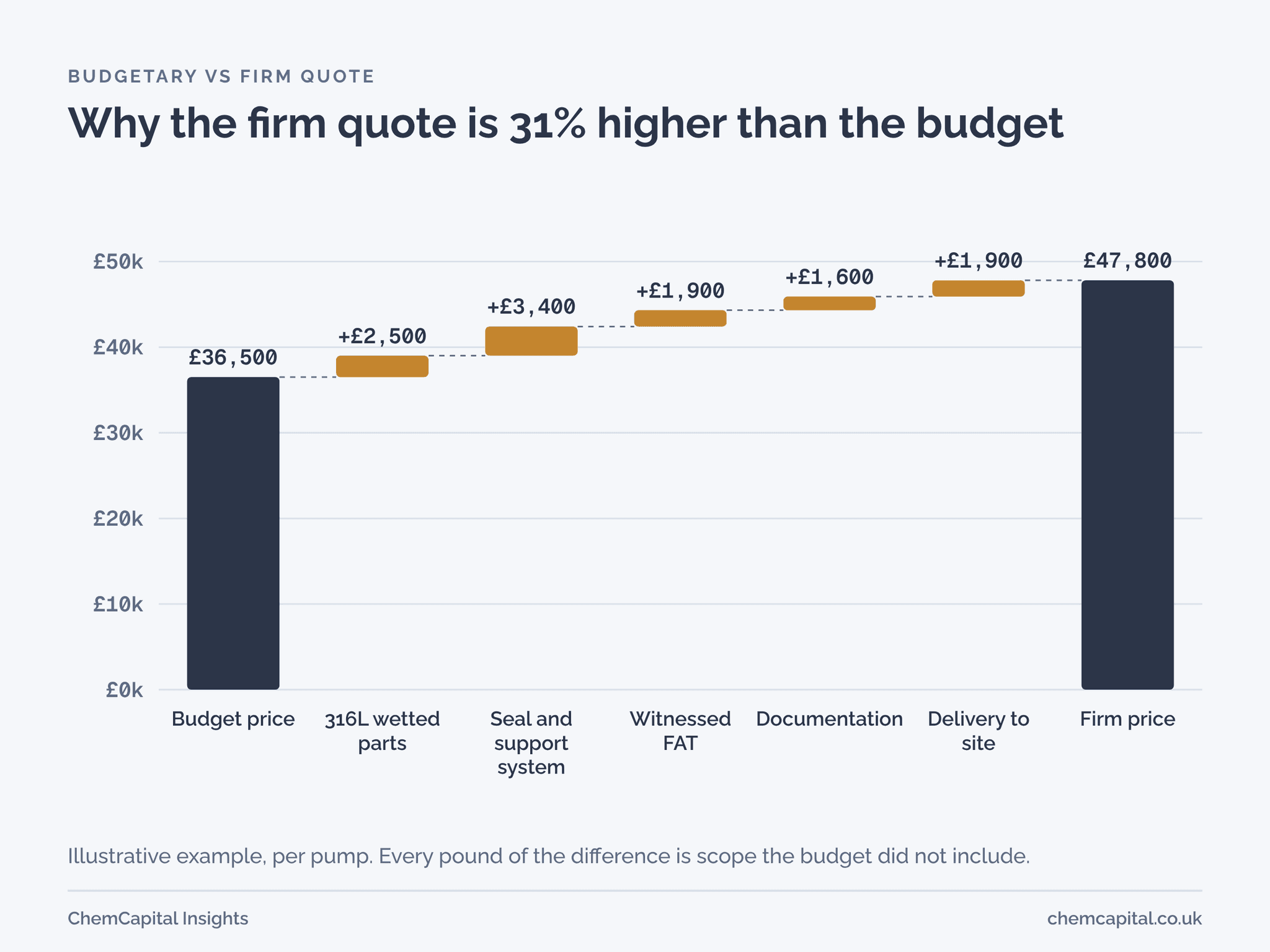
In March, a project team asks for budget prices on two process pumps, P101A/B, for a feasibility estimate. In September, with the datasheet frozen, the same supplier sends a firm quote.
| Line, per pump | Budgetary (March) | Firm (September) |
|---|---|---|
| Pump and motor | £36,500, carbon steel assumed | £39,000, 316L wetted parts |
| Mechanical seal and seal support system | Not included | £3,400 |
| Witnessed factory acceptance test | Not included | £1,900 |
| Documentation package | Not included | £1,600 |
| Delivery | Ex works | £1,900, delivered to site |
| Total | £36,500 | £47,800 |
| Validity | Not stated | 30 days |
| Lead time | About 16 weeks | 22 weeks from drawing approval |
The firm price is 31% higher, and every pound of the difference is scope the budget never contained. The mistake is not the budget quote. The mistake is carrying £36,500 into a Class 3 estimate as if it were firm.
Label every price by what it is
The simplest fix is discipline: every price in an estimate carries its basis, its date and its source, and budget numbers are replaced by firm ones before the estimate is used to approve spend.
That is how ChemCapital's Project Costing works. Each line is marked as a firm quotation, a budgetary quote, a historical quote adjusted for date or an indicative figure, so anyone reading the total can see what it rests on. When it is time to go firm, a structured RFQ asks every supplier for the same scope, exclusions, delivery and validity, so the answers can be compared on one basis. For the wider picture of estimate maturity, see our guide to AACE estimate classes.
Ready to get firm, comparable quotes on your next package? Start a free 14 day ChemCapital trial, with no credit card needed.
Frequently asked questions
Is a budgetary quote legally binding?
Usually not, because it is not meant to be accepted. Whether a binding contract exists depends on what both sides communicated by words or conduct, judged objectively. This is general information, not legal advice.
How long should a quotation be valid?
No law sets a standard period. The supplier states the validity, and an offer with no stated validity lapses after a reasonable time. For engineered equipment, check whether price, lead time and any alloy surcharge each have their own validity date.
Can budgetary quotes go into a Class 3 estimate?
Only with care. A Class 3 estimate is used to approve spend, so the main equipment should be on firm prices, or any budget price should be clearly marked as such.
Continue reading
Informational only, not procurement or legal advice. Cited names, frameworks, and statistics belong to their respective owners.
Create and manage RFQs in minutes
ChemCapital handles the entire procurement cycle, from structured RFQs and supplier comparisons to formal purchase orders and delivery tracking.
Start for freeRelated articles

Where to Find Pharma and Chemical Plant Projects Before They Go to Tender: the 2027 Pipeline
Twenty pharma and chemical plant projects checked against owner or government announcements, the buying timeline on each, and where to watch for the next ones for free.
TEMA Heat Exchanger Types: How to Read AES, BEM and AEU
How to decode the three letter TEMA type, what AES, BEM, AEU and other common types mean for cleaning, expansion, leaks and cost, and how to compare bids that differ.

Safety Valve vs Relief Valve vs Bursting Disc: How to Choose
How safety valves, relief valves and bursting discs differ, when to fit a disc under a valve, the pressure terms that matter, GB duties and what to put in the RFQ.