
Export Controls on Chemical Process Equipment: A Guide for Suppliers
Which reactors, tanks, heat exchangers, columns, valves and pumps are controlled as dual use items, how materials and size decide it, when unlisted items still need a licence, and how to build it into quotes.
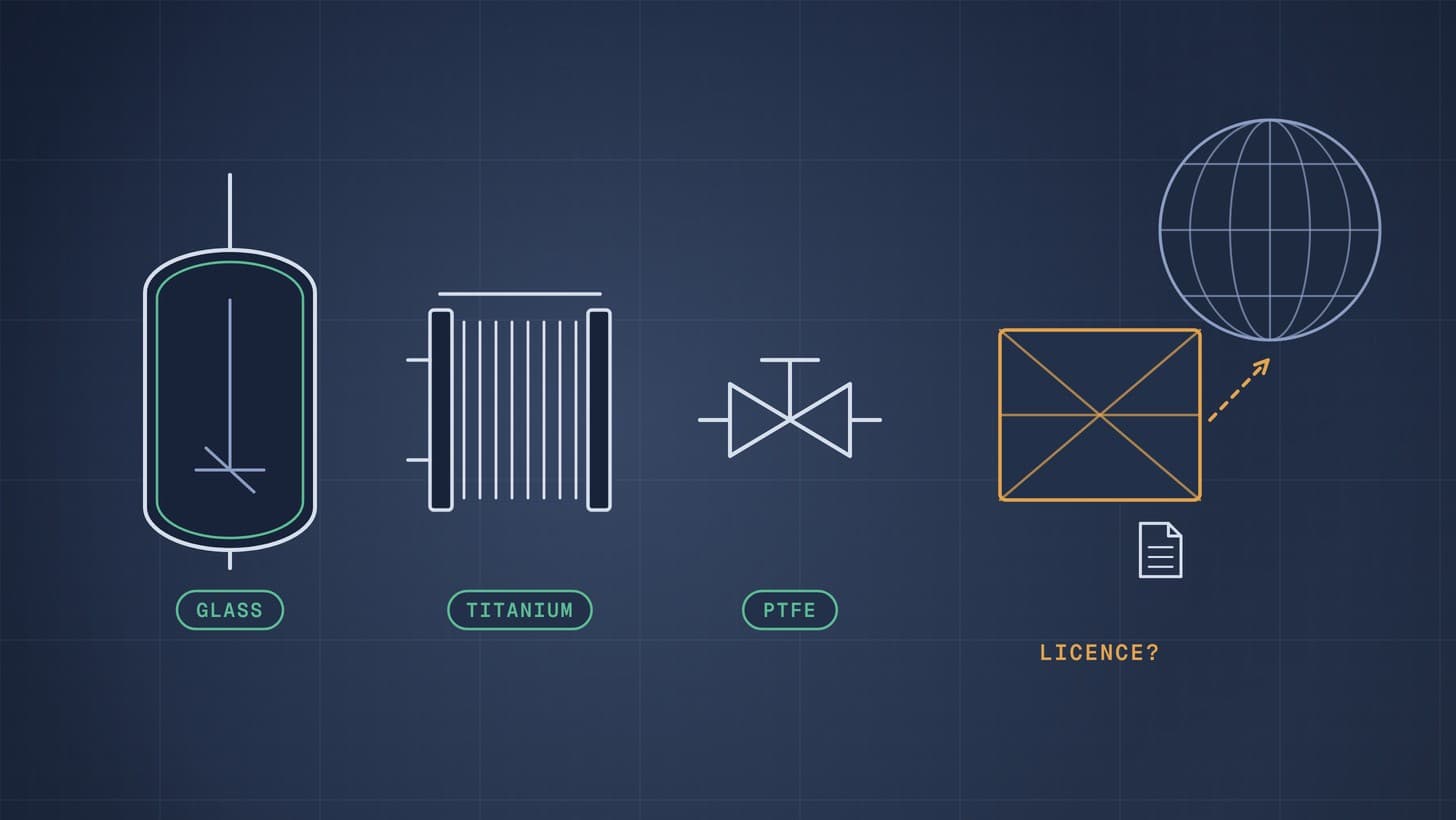
A good deal of the equipment that chemical process suppliers make every day is controlled as "dual use", meaning it has civil uses but could also help produce chemical weapons. Under the Australia Group's common control list, reaction vessels, storage tanks, heat exchangers, distillation columns, valves, pumps and multi walled piping can need an export licence when their wetted surfaces are made of listed corrosion resistant materials and they fall within set size ranges [1]. The listed materials include nickel and high nickel alloys, high nickel chromium alloys, fluoropolymers, glass and glass lined surfaces, and tantalum, titanium, zirconium and niobium [1]. The EU list carries them under entry 2B350, chemical manufacturing facilities, equipment and components [2], and the US list uses the same number [3].
Equipment that is not on any list can still need a licence. In the UK you need one if you know, suspect or have been told by the government that items may be used for weapons of mass destruction, and you have a legal duty to tell the Export Control Joint Unit (ECJU) if you suspect it [4].
Why this matters now
The lists change. The EU updates its dual use list regularly; the latest full replacement came in November 2025 through Delegated Regulation (EU) 2025/2003 [5], and the Australia Group list used here is dated March 2026 [1]. A product range you classified five years ago may need a fresh look.
Routes have changed too. Since Brexit, controlled dual use items going from Great Britain to the EU need a licence, although an open general export licence for EU member states may cover them; from Northern Ireland to the EU no licence is needed [6]. For suppliers of glass lined reactors, alloy heat exchangers or lined valves, export controls are now a routine part of quoting, not an exception.
This is general information, not legal advice.
Access real procurement opportunities from global buyers
Join ChemCapital to get discovered by verified procurement teams across pharmaceutical, chemical, and industrial manufacturing.
Which equipment is listed
The Australia Group list sets out the equipment types and thresholds that its members, including the EU and UK, implement in their national lists:
| Equipment | Controlled when wetted surfaces are of listed materials and |
|---|---|
| Reaction vessels, reactors and agitators | Internal volume above 0.1 m³ and below 20 m³; agitators, impellers, blades and shafts designed for them are also covered |
| Storage tanks, containers and receivers | Internal volume above 0.1 m³ |
| Heat exchangers and condensers | Heat transfer area above 0.15 m² and below 20 m², plus tubes, plates, coils and cores; graphite, silicon carbide and titanium carbide are also listed materials here |
| Distillation and absorption columns | Internal diameter above 0.1 m, plus distributors and collectors |
| Filling equipment | Remotely operated, with wetted surfaces of high nickel or nickel chromium alloys |
| Valves | Nominal size above DN 10; valves from DN 25 to DN 100 with interchangeable closure elements; their casings and preformed liners; certain ceramics are also listed materials |
| Multi walled piping | With a leak detection port |
| Pumps | Multiple seal or seal less pumps rated above 0.6 m³/h; vacuum pumps rated above 5 m³/h; casings, liners, impellers, rotors and jet nozzles |
Source: Australia Group control list, March 2026 [1]. The list also covers equipment for destroying chemical warfare agents and certain toxic gas monitoring systems [1].
The materials. The general list of wetted materials is: nickel or alloys with more than 40% nickel; alloys with more than 25% nickel and 20% chromium; fluoropolymers with more than 35% fluorine; glass, including vitrified or enamelled coatings and glass lining; tantalum, titanium, zirconium and niobium and their alloys; and, where listed, graphite or carbon graphite [1]. Where an alloy is named without a percentage, the named metal must be the largest element by weight [1].
Three notes that matter in practice. Interchangeable gaskets and seals do not decide whether an item is controlled [1]. The list includes a statement of understanding that equipment designed for civil uses and unsuitable for chemical weapons or precursor work falls outside the controls [1]; national authorities apply this, so take advice rather than exempting yourself. And for valves, nominal size means the smaller of the inlet and outlet port diameters [3].
The controls also cover software and technology, not just physical goods [6]. Sending design data for a controlled item to another country can itself be an export.
How to classify an order
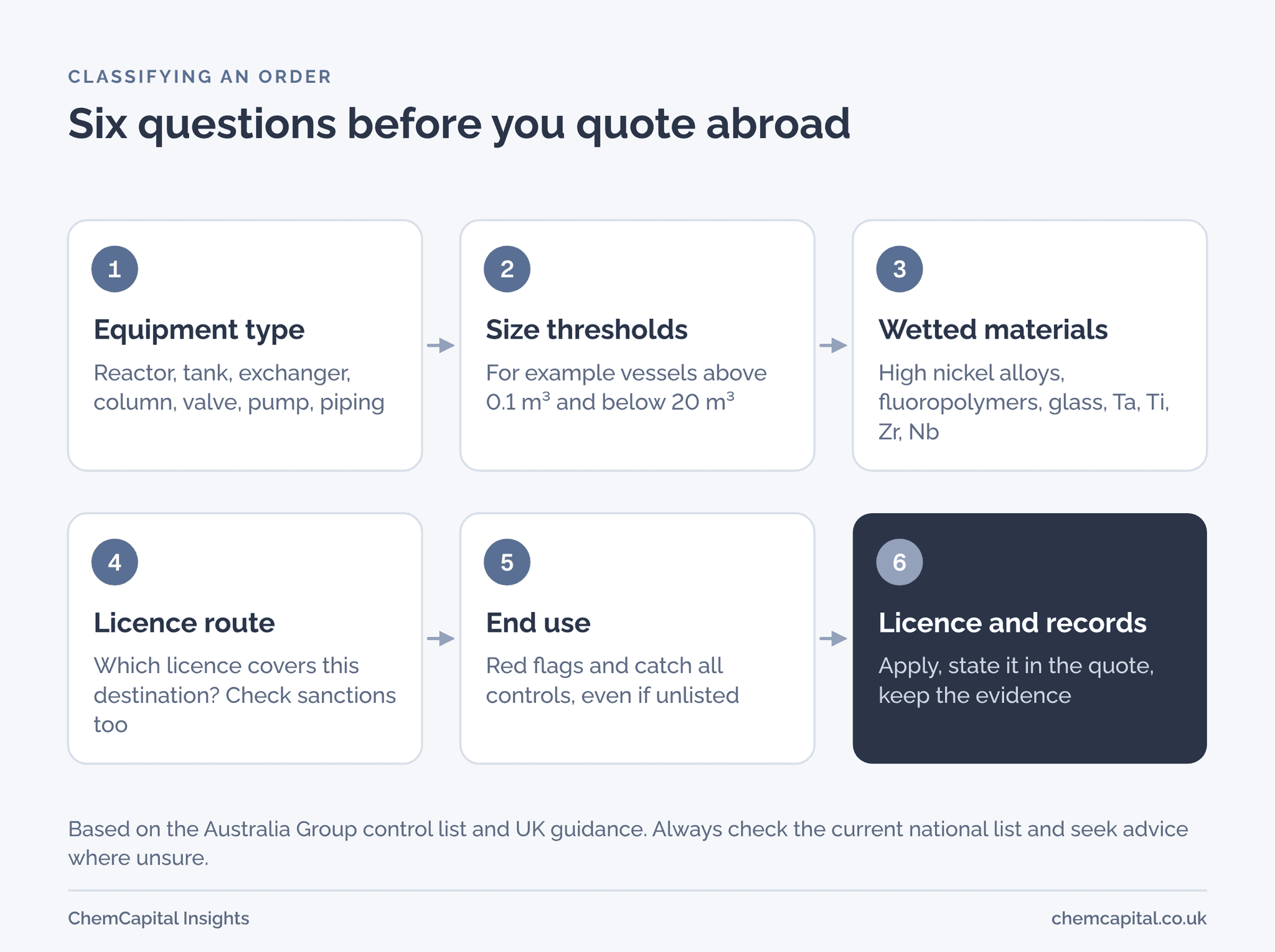
Work through the questions for every line item, not just the main vessel. A non controlled carbon steel skid can carry a controlled titanium heat exchanger or a set of PTFE lined valves. Record the result, the rating, the wetted materials from the material certificates, and the dimensions that put the item inside or outside the thresholds. Our guide to jacketed vessels and glass lined reactors covers the construction details that affect wetted materials.
In the UK, check goods against the consolidated UK Strategic Export Control Lists using the open general export licence (OGEL) and goods checker tools, or ask the control list classification advice service. Standard individual export licences are applied for through the GOV.UK service for exporting controlled goods, while open general licences and other types are handled through SPIRE [6]. The dual use list for Great Britain comes from assimilated Regulation (EC) 428/2009, and for Northern Ireland from Regulation (EU) 2021/821 [6].
If you export from the US, or your product contains enough US origin parts or technology to bring it under US rules, the US Export Administration Regulations have their own entry, ECCN 2B350, with licence requirements for many destinations [3].
When unlisted equipment needs a licence
Catch all controls apply to items that are not on any list. Under the EU dual use regulation, an authorisation is required where the authorities have told the exporter that items may be intended for use in connection with chemical, biological or nuclear weapons or their delivery systems, or for a military end use in a country under an arms embargo, and an exporter who knows of such a use must alert the authorities [7]. UK guidance is direct: apply for a licence even if your items are not on a list if you know, suspect or have been told they might be used for weapons of mass destruction, and inform ECJU if you suspect a sale could be used that way [4]. The UK also has a military end use control under Article 12A of the Export Control Order 2008 [6].
UK guidance lists warning signs [4]:
- The customer is reluctant to explain the end use, or evasive about the final destination.
- You are asked to deliver to a forwarding address in the UK.
- Quantities exceed what the stated use needs.
- The customer declines routine installation, training or maintenance.
- Payment terms are unusually favourable, such as a higher price or a lump sum in cash.
- The end user is a military or government research body, or new to you with incomplete information.
Building it into quotes and contracts
- Ask early. Request the end user, end use and final destination at the RFQ stage, not after the order.
- Classify before you quote. Know whether each line item is controlled, which licence applies for that destination, and whether sanctions or an arms embargo apply, before you commit to a delivery date.
- State the condition. Make the quote and order subject to any export licence required, and say how licence time affects delivery.
- Watch the delivery terms. Who exports, and from where, depends on the Incoterm; see our guide to Incoterms for process equipment.
- Control technical data. Drawings and process data for controlled items can need a licence before they leave the country [6].
- Keep records. Classification decisions, certificates, licences and end use statements for each order.
- Stop and ask. If a red flag appears, pause the sale and seek advice, and remember the UK duty to inform ECJU [4].
Practical example
In this illustrative example, a UK fabricator receives two RFQs in the same week.
The first, from a new customer outside the EU, is for a 6.3 m³ glass lined reactor with an agitator, eight PTFE lined DN 50 valves with replaceable plugs, a titanium plate heat exchanger with 12 m² of transfer area, and a 316L stainless steel holding tank. Working through the list: the reactor is between 0.1 and 20 m³ and glass lined, so it and its agitator are within the reaction vessel entry; the valves are within the DN 25 to DN 100 range with interchangeable closure elements, and their PTFE lining, with a repeating unit of C2F4, is about 76% fluorine by weight, well above the 35% threshold; the heat exchanger is between 0.15 and 20 m² and titanium [1]. The 316L tank is outside the list: 316L contains 10% to 14% nickel and 16% to 18% chromium [8], well below the thresholds, and the fabricator records this from the material certificates. The quote goes out with the export licence as a stated condition and a delivery date that allows for it. The customer also asks to deliver to a UK freight forwarder and to skip installation and training. Those are two of the red flags in UK guidance [4], so the fabricator pauses and takes advice before going further.
The second RFQ is the same reactor for a long standing customer in Germany. It is still a controlled item, so a licence is needed from Great Britain to the EU, but the open general export licence for EU member states may cover it [6]. The fabricator confirms it is registered and meets the conditions, records the decision, and quotes normally.
Where ChemCapital fits
ChemCapital does not classify goods or apply for licences, but it helps suppliers see what they need early and keep the record. Suppliers receive structured RFQs with specifications, quantities, delivery requirements and deadlines, rather than unformatted emails, so the destination and equipment details are clear before you price. Quotations go back with line items, assumptions and attachments, which is where a licence condition belongs. Purchase orders are confirmed with your own reference and dates, and you can flag exceptions; every RFQ and order has its own message thread, so end use answers stay with the order they relate to. See how suppliers benefit.
Ready to receive RFQs with the details you need before you quote? List your company on ChemCapital. It is free to start.
Frequently asked questions
Is a glass lined reactor a dual use item?
It can be. The Australia Group list controls reaction vessels with an internal volume above 0.1 m³ and below 20 m³ whose wetted surfaces are of listed materials, which include glass and glass lined surfaces. National lists implement this under entry 2B350. Check the current list for your country and the exact design.
Do I need a licence to export controlled dual use equipment from Great Britain to the EU?
Yes, a licence is needed for controlled dual use items going from Great Britain to the EU, although the open general export licence for EU member states may cover them if you register and meet its conditions. From Northern Ireland to the EU, no licence is needed.
What if my equipment is not on a control list?
End use controls can still apply. In the UK you need a licence if you know, suspect or have been told by the government that items may be used for chemical, biological or nuclear weapons or their delivery systems, and you have a legal duty to inform the Export Control Joint Unit if you suspect this.
Continue reading
Informational only, not procurement or legal advice. Cited names, frameworks, and statistics belong to their respective owners.
Access real procurement opportunities from global buyers
Join ChemCapital to get discovered by verified procurement teams across pharmaceutical, chemical, and industrial manufacturing.
List your companyRelated articles
ATEX and DSEAR for Equipment Buyers: Zones, Categories and Ex Marking
How hazardous area zones set the equipment category you must buy, how to read an Ex marking such as II 2G Ex db IIB T4 Gb, why pumps and gearboxes count too, and what to put in the RFQ.
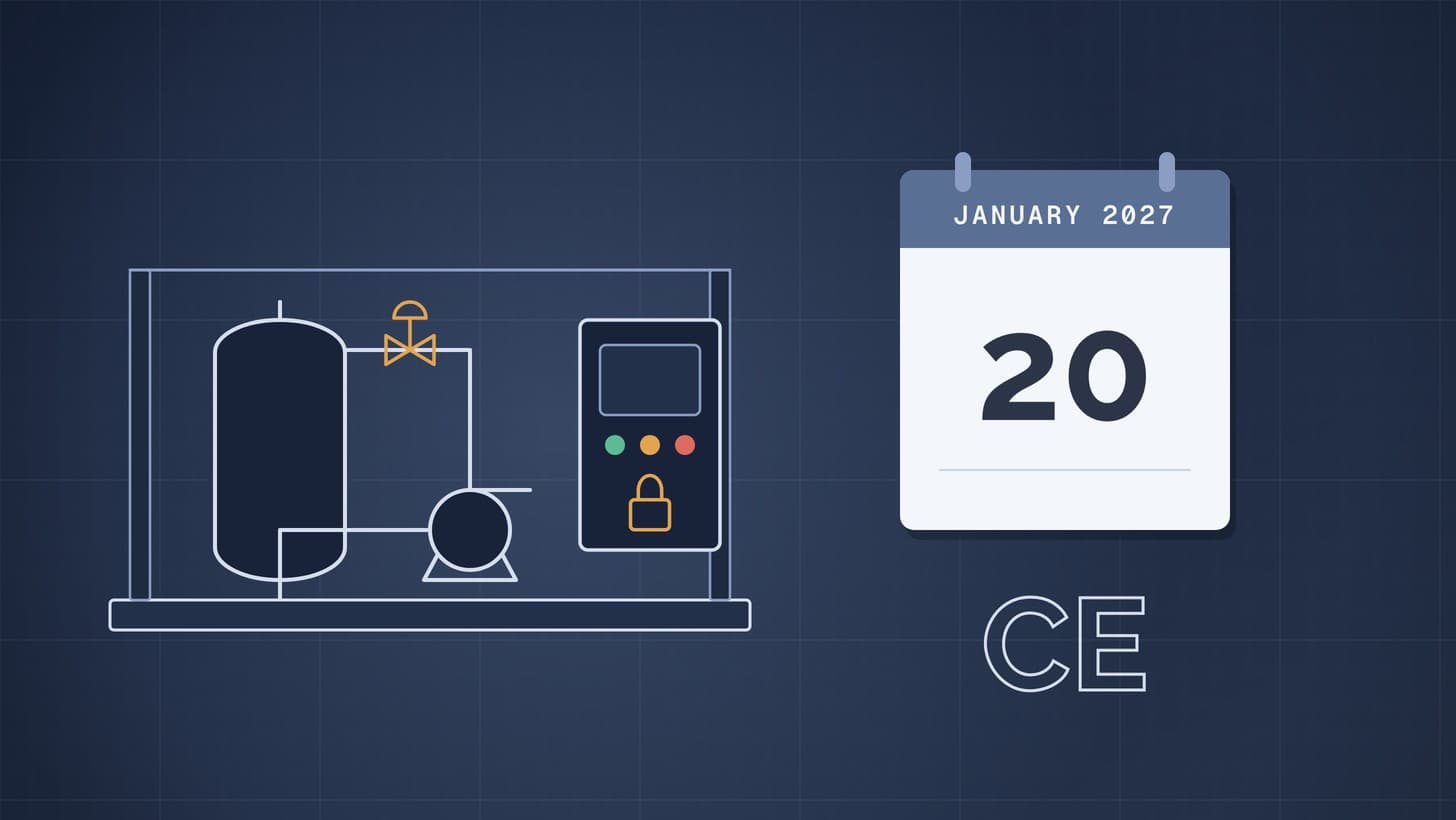
EU Machinery Regulation 2023/1230: What Changes for Process Skids in January 2027
The Machinery Regulation replaces the Directive from 20 January 2027. What changes for skid buyers and builders: market placement, modifications, cybersecurity, digital instructions and the GB position.
Single Source and Sole Source Justification for Equipment (Template)
The difference between sole source and single source, valid reasons in equipment buying, the evidence to attach, the risk of not testing the market, and a template.