
ATEX and DSEAR for Equipment Buyers: Zones, Categories and Ex Marking
How hazardous area zones set the equipment category you must buy, how to read an Ex marking such as II 2G Ex db IIB T4 Gb, why pumps and gearboxes count too, and what to put in the RFQ.
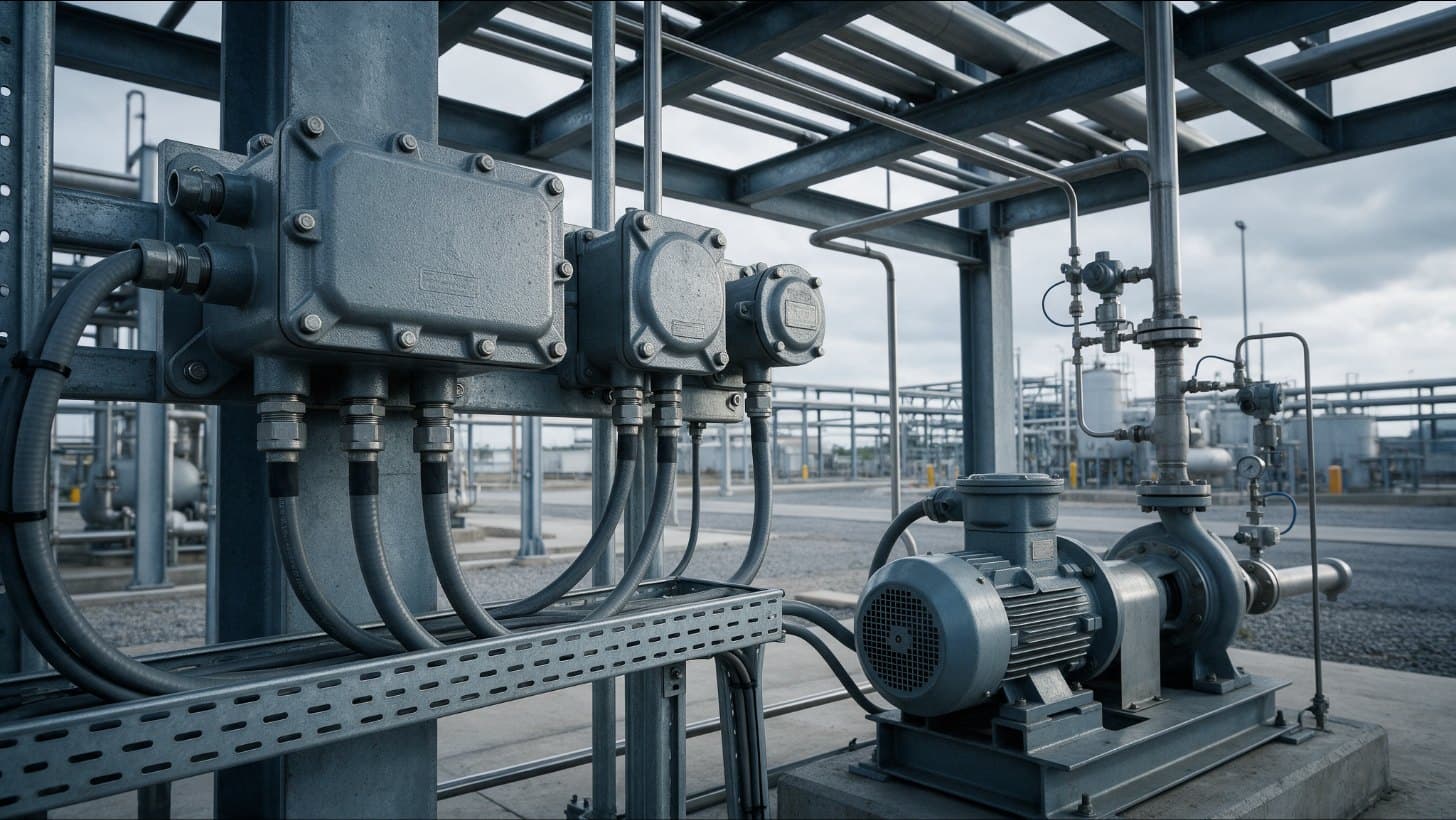
Under DSEAR, the site classifies every place where an explosive atmosphere may occur into zones, and any equipment used in a zone must be suitable for it. The rule is straightforward: category 1 equipment for zone 0 or 20, category 2 for zone 1 or 21, and category 3 for zone 2 or 22 [1]. The equipment's Ex marking tells you whether it fits. In a marking such as II 2G Ex db IIB T4 Gb, "2G" is the category and the type of atmosphere, "Ex db" is the type of protection, "IIB" is the gas group and "T4" is the temperature class, a maximum surface temperature of 135 °C [2].
So before a buyer asks for a single price on equipment for a hazardous area, three facts must come from the site: the zone, the gas or dust group, and the temperature class. With those in the RFQ, every bidder quotes the same protection. Without them, the cheapest quote is often the one that cannot be installed.
Why this matters now
The Dangerous Substances and Explosive Atmospheres Regulations 2002, known as DSEAR, put the duties on the employer. HSE's guidance, updated in January 2026, lists them: classify areas where hazardous explosive atmospheres may occur into zones; select equipment and protective systems for those zones that meet the 2016 equipment regulations; mark zone entry points with the "EX" sign where necessary; provide suitable anti static clothing; and, before a workplace with zoned areas first operates, have a competent person confirm its overall explosion safety [3].
That last step is where buying mistakes surface. If a motor, an instrument or a pump arrives with the wrong marking, the verification should catch it, usually weeks before start up and long after the order was placed. The fix is a replacement on a lead time you do not have.
Two further points catch buyers out. First, the rules are not only about electrical equipment. Pumps, gearboxes, couplings, brakes, fans and compressors can carry their own ignition sources, and they are designed, tested and marked under their own standards [4]. Second, the marking regime in Great Britain has settled after several years of uncertainty: since 1 October 2024, legislation has allowed equipment covered by the 2016 regulations to continue to be placed on the GB market under EU requirements and CE marking, with the earlier expiry date removed [5] [6].
Create and manage RFQs in minutes
ChemCapital handles the entire procurement cycle, from structured RFQs and supplier comparisons to formal purchase orders and delivery tracking.
Step 1: the zone comes from the site, not the supplier
A zone describes how likely an explosive atmosphere is and how long it lasts. DSEAR defines six [7]:
| Zone | Atmosphere | Definition in DSEAR | Equipment category | Equipment protection level (EPL) |
|---|---|---|---|---|
| 0 | Gas, vapour or mist | Present continuously, for long periods or frequently | 1G | Ga |
| 1 | Gas, vapour or mist | Likely to occur in normal operation occasionally | 2G, or 1G | Gb, or Ga |
| 2 | Gas, vapour or mist | Not likely in normal operation, and if it occurs, persists for a short period only | 3G, or 2G or 1G | Gc, or higher |
| 20 | Combustible dust cloud | Present continuously, for long periods or frequently | 1D | Da |
| 21 | Combustible dust cloud | Likely to occur in normal operation occasionally | 2D, or 1D | Db, or Da |
| 22 | Combustible dust cloud | Not likely in normal operation, and if it occurs, persists for a short period only | 3D, or 2D or 1D | Dc, or higher |
The category columns come from HSE's ATEX definitions, and the protection levels from manufacturer guides that map each level to the zones it may serve [1] [2]. Equipment with a more protective category, a lower number, can serve a less hazardous zone of the same atmosphere type, provided its group and temperature class also suit, but not the other way round. Phoenix Contact describes the three levels in terms of faults: very high protection stays safe with two independent faults, high protection with a single fault, and normal protection is not designed to be safe after a fault [8].
Some guidance gives indicative durations: more than 1,000 hours a year for zone 0, 10 to 1,000 hours for zone 1, and less than 10 hours for zone 2. HSE notes that none of these figures has been officially adopted, so treat them as a sense check, not a rule [9]. DSEAR also requires layers, deposits and heaps of combustible dust to be considered like any other source that can form an explosive atmosphere [7].
Area classification itself is the site's job. It starts with the sources of release, then considers ventilation, release rates and dispersion, and the main standards are IEC 60079 10 1 for gases and IEC 60079 10 2 for dusts [9] [2]. Two things follow for a buyer. Classification covers foreseeable releases, not catastrophic failures, which belong in hazard studies such as a HAZOP, a hazard and operability study [9]. And the zone may differ inside and outside a piece of equipment: the vapour space of a solvent tank can be zone 0 while the floor around it is zone 2. Ask for the area classification drawing, and the zone at each equipment location and inside the equipment where relevant, before you write the RFQ. Our guide to the user requirement specification is the natural place to record them.
Step 2: read the marking
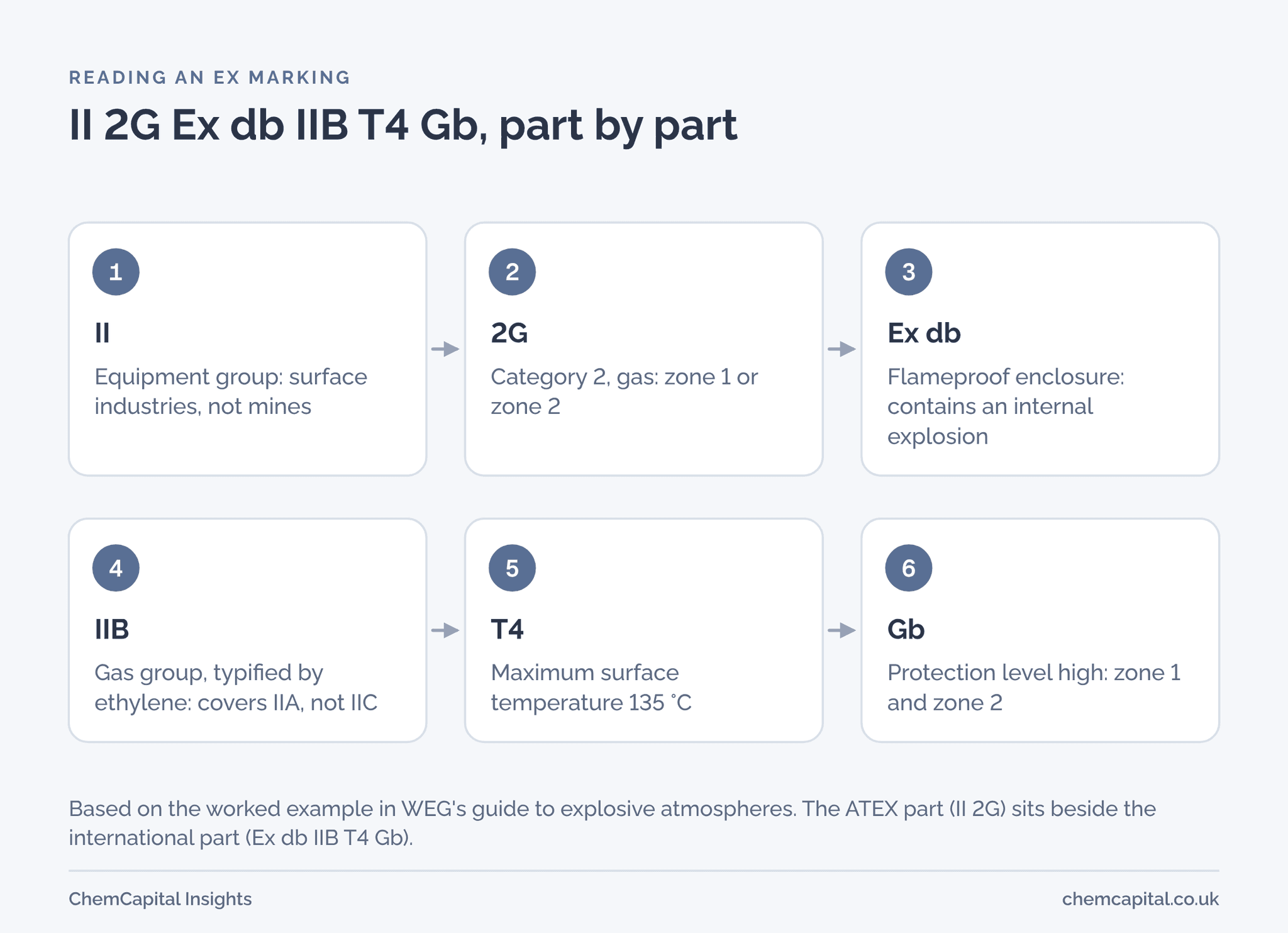
Ex markings combine two systems. The European part, such as II 2G, gives the equipment group, category and atmosphere. The international part, such as Ex db IIB T4 Gb, gives the protection type, gas group, temperature class and equipment protection level [2] [8]. Take each in turn.
Equipment group. Group I is for mines, where firedamp and coal dust are the hazard. Group II covers every other place liable to explosive atmospheres, which includes chemical, pharmaceutical and food plants [1].
Category and atmosphere. The number is the category from the zone table above, and the letter is G for gas or D for dust. A marking of II 2G suits zone 1 or zone 2 gas areas [2].
Type of protection. This is how the equipment avoids igniting the atmosphere. The common types are:
| Code | Name | How it works | Typical zones |
|---|---|---|---|
| Ex db | Flameproof enclosure | Contains an explosion inside the enclosure and stops the flame spreading | Zone 1 and 2 |
| Ex eb | Increased safety | No arcs, sparks or hot surfaces in normal use | Zone 1 and 2 |
| Ex ec | Increased safety, level c | As above, for the lower hazard | Zone 2 |
| Ex ia | Intrinsic safety | Energy in the circuit is too low to ignite the atmosphere | Zone 0, 1 and 2 |
| Ex pxb, pyb, pzc | Pressurised enclosure | Keeps the atmosphere out with a protective gas under pressure | Zone 1 (pxb, pyb), zone 2 (pzc) |
| Ex tb, tc | Protection by enclosure | Keeps combustible dust out | Zone 21 (tb), zone 22 (tc) |
| Ex h | Non electrical equipment | Constructional safety, control of ignition sources or liquid immersion | Depends on the category |
The flameproof, increased safety, pressurised and dust enclosure entries are from WEG's guide; intrinsic safety from Phoenix Contact and HSE; and Ex h from the ISO 80079 standards for non electrical equipment [2] [8] [9] [4]. The final letter, a, b or c, follows the protection level: "ia" for the highest, "eb" for zone 1, "ec" for zone 2 [2] [8].
Gas or dust group. Gas groups rank gases by how easily they ignite: a device may be used only if the energy it could release is below the minimum ignition energy of the gas [8]. IIA is typified by propane, IIB by ethylene, and IIC by hydrogen and acetylene [2]; Phoenix Contact also lists carbon disulphide in IIC [8]. Equipment marked IIC also covers IIB and IIA, and IIB covers IIA [2]. Dust has its own groups: IIIA for combustible flyings, IIIB for non conductive dust such as grain or flour, and IIIC for conductive dust such as metal [2] [8].
Temperature class. This is the maximum surface temperature the equipment can reach. Equipment may be used only if its class temperature is lower than the ignition temperature of the gas [8]:
| Class | Maximum surface temperature | Gas ignition temperature it suits | Example from Phoenix Contact |
|---|---|---|---|
| T1 | 450 °C | Above 450 °C | Hydrogen, carbon monoxide |
| T2 | 300 °C | Above 300 °C | Acetylene, butane |
| T3 | 200 °C | Above 200 °C | Petrol, hydrogen sulphide |
| T4 | 135 °C | Above 135 °C | Acetaldehyde, diethyl ether |
| T5 | 100 °C | Above 100 °C | None listed |
| T6 | 85 °C | Above 85 °C | Carbon disulphide |
Temperatures are from WEG's guide and Phoenix Contact [2] [8]. A T6 device suits all gases on temperature. Note that gas group and temperature class are separate tests: hydrogen is in the most demanding gas group, IIC, but in the least demanding temperature class, T1 [8]. Dust is different again. There are no temperature classes for dust; equipment is marked with its maximum surface temperature in degrees Celsius instead [8], and the site's assessment of the dust sets the limit it must stay under.
Equipment protection level. The closing Ga, Gb, Gc, Da, Db or Dc repeats the protection level in international terms, and should agree with the category [2].
The certificate number. Two letters at the end of an ATEX or IECEx certificate number matter to a buyer. "X" means the equipment has special conditions for safe use, which are set by the certifying body and appear in the instructions; they can cover things like temperature limits or exposure to aggressive chemicals, and the installer must follow them [10]. "U" means an Ex component, such as an empty flameproof junction box, which must not be used alone; whoever builds it into a finished product has to certify the result [10]. A quote that offers "U" certified parts as if they were finished equipment is not like for like.
Non electrical equipment counts too
Many buyers check the motor and forget the pump. The international standards ISO 80079 36 and ISO 80079 37 set out how to design, build, test and mark non electrical equipment, and the marking is Ex h with one of three types of protection: "c" for constructional safety, which guards against hot surfaces, sparks and compression heating from moving parts; "b" for control of ignition sources, using devices that stop a potential ignition source becoming effective; and "k" for liquid immersion [4]. Typical products include bearings, couplings, pumps, gearboxes, brakes, hydraulic and pneumatic units, fans and compressors [4].
The core of the method is a formal, documented ignition hazard assessment, which identifies every potential ignition source and the measures that control it. Manufacturers prepare it alongside design documents, test results and the installation, operation and maintenance instructions [4]. It normally sits in the manufacturer's technical file, so make it, or a summary, a deliverable in the RFQ rather than asking after delivery.
Combinations need care too. Europump's ATEX guideline explains that when a pump and motor together create at least one new ignition hazard, they form an assembly that must be assessed as a whole; if they create no new hazard, each item can keep its own declaration of conformity [11]. It also warns that if a component of an assembly is changed without the pump maker's involvement, whoever made the change becomes the manufacturer of the assembly, with all the responsibilities that brings [11]. For a buyer, that has two consequences. On a skid, ask which party issues the declaration for the whole unit. And do not let a site team swap a motor or a mechanical seal on certified equipment without the maker's agreement. Europump gives a reminder of why process conditions matter: a self priming pump handling a flammable liquid that is run until its sump is dry can create an explosive atmosphere inside the pump [11]. Our guide to centrifugal pump datasheets and RFQs covers the process data to send with the zone.
ATEX, UKEX and IECEx
Three certification routes appear on quotes, and they are not interchangeable.
ATEX is the European route under Directive 2014/34/EU, which sets the equipment groups and categories used in the zone table above [2]. Equipment for the EU market carries CE marking, and certified equipment shows the identification number of the notified body involved, the independent organisation appointed to assess it; in WEG's example marking it is 0598 [2].
UKEX is the name often used for the Great Britain route under the Equipment and Protective Systems Intended for Use in Potentially Explosive Atmospheres Regulations 2016. HSE summarises the essentials: products must meet essential health and safety requirements and go through conformity procedures; testing and certification usually involve a third party conformity assessment body, although manufacturers can self certify equipment for less hazardous atmospheres; and certified equipment carries a conformity assessment mark and the EX symbol, with information for safe use [3]. Since 1 October 2024, equipment meeting the EU requirements and carrying CE marking can continue to be placed on the GB market, as well as equipment marked UKCA [5] [6]. Northern Ireland follows its own rules, so check the current GOV.UK guidance for equipment going there [6].
IECEx is an international certification scheme governed by the IEC and its member bodies. A certificate of conformity covers a complete item of Ex equipment and needs a type tested sample plus a factory assessment with ongoing surveillance; component certificates cover parts for incorporation into other equipment [12]. The scheme's online certificate system is the test of validity: in IECEx's own words, if equipment is not listed there, it is not IECEx certified [12]. IECEx says its certification is accepted by over 30 member countries, and its test and quality assessment reports can support approvals in jurisdictions with national differences [12]. It is not a substitute for the ATEX or UKEX route when placing equipment on the EU or GB market: for equipment going into service in Great Britain or the EU, ask for the declaration of conformity for that market as well as any IECEx certificate.
This is general information, not legal advice.
Who does what
| Party | Main responsibilities |
|---|---|
| The site, as employer under DSEAR | Classify zones; select equipment that meets the 2016 regulations; mark zone entry points with the EX sign; anti static clothing where needed; verification of explosion safety before first use [3] |
| The equipment manufacturer | Meet the essential health and safety requirements; conformity assessment; marking; instructions for safe use; ignition hazard assessment for non electrical equipment [3] [4] |
| The assembler of a skid or package | Assess whether combining items creates new ignition hazards, and if so take responsibility for the assembly [11] |
| The buyer | Put the site's zone, gas or dust group and temperature data into the RFQ; check every quote's marking and certificates against them; collect the documents the site needs for verification |
The last row is not set by law, but it is where procurement adds most value. The site knows the zones. The suppliers know their equipment. The RFQ is where the two meet.
What to put in the RFQ
- The zone at each location: the area classification drawing reference, the zone around the equipment and, where relevant, inside it.
- Gas or dust group and temperature class: state them, or list the flammable substances with their ignition temperatures and ask the bidder to confirm the group and class. For dust, give the dust group and any surface temperature limit.
- Required category and protection level, for example "category 2G, EPL Gb minimum".
- The certification route: ATEX with CE marking, UKCA, or both, plus IECEx if the equipment may be used elsewhere.
- Non electrical equipment: Ex h marking and the ignition hazard assessment for pumps, agitators, gearboxes, couplings and fans.
- Assemblies: who issues the declaration of conformity for a skid or package, and which items keep their own. Our modular process skids buyer's guide covers the wider scope questions.
- Certificates with an X: the special conditions for safe use, before order placement, so the site can confirm it can meet them.
- Site conditions: the ambient temperature range and any aggressive chemicals the equipment will be exposed to, which can affect both the rating and the special conditions.
- Documents: declarations of conformity, certificates, instructions and assessments in the vendor document list, so they arrive in time for the site's verification.
Practical example
In this illustrative example, a fine chemicals plant is adding a hydrogenation reactor. The site's area classification puts the area around the reactor in zone 1, and the flammable gas is hydrogen. Hydrogen is in gas group IIC and temperature class T1 [8], so, after checking every other flammable substance present, including the reaction solvent, which in this case needs no stricter group or temperature class, the site asks for category 2G, EPL Gb, gas group IIC and a temperature class of T1 or better for every motor, instrument and mechanical item on the skid.
Three bids for the agitator drive motor come back. The prices are illustrative.
| Bidder A | Bidder B | Bidder C | |
|---|---|---|---|
| Price | £18,400 | £21,900 | £14,700 |
| Marking offered | II 2G Ex db IIB T4 Gb | II 2G Ex db IIC T4 Gb | II 3G Ex ec IIC T3 Gc |
| Category for zone 1 | Yes, 2G | Yes, 2G | No, 3G is for zone 2 only |
| Gas group for hydrogen | No, IIB does not cover IIC | Yes, IIC | Yes, IIC |
| Temperature class | Yes, T4 is stricter than T1 | Yes, T4 is stricter than T1 | Yes, T3 is stricter than T1 |
| Result | Fails on gas group | Meets the requirement | Fails on category |
Ranked on price, bidder C wins, then bidder A. Neither motor could be installed. Bidder A's flameproof enclosure is certified for ethylene type gases, not hydrogen, and bidder C's motor is built for zone 2. Bidder B, the most expensive on paper, is the only compliant offer.
The buyer also checks the agitator's mechanical seal and gearbox. The agitator maker offers an Ex h marking for the gearbox and supplies its ignition hazard assessment, and the buyer asks the maker to confirm that the temperature class still holds at the highest process temperature on the datasheet. One certificate ends in X; its special conditions limit the ambient temperature, which the site confirms it can meet before the order is placed.
Without the zone, gas group and temperature class in the RFQ, this would have been discovered at the explosion safety verification, with the reactor built and a new motor on order.
Where ChemCapital fits
Hazardous area requirements are a classic case where the lowest price can be a non compliant one. ChemCapital sends one structured RFQ with line items and attachments, so every bidder receives the same area classification data and datasheets. The AI quotation comparison extracts price, lead time, materials, certifications and scope from each quote, and keeps the source text beside every extracted field, so the marking a supplier actually offered is there to read. It checks quotes for missing fields and scope differences, and a quote that fails a mandatory requirement you set, such as category 2G or gas group IIC, is flagged and left out of the ranking. People make the final call, and checking the certificate itself, for example on the IECEx online system, stays with your engineers.
Ready to compare hazardous area equipment quotes on the same basis? Start a free 14 day ChemCapital trial, with no credit card needed.
Frequently asked questions
What equipment category do I need for zone 1?
Category 2 equipment for gas (2G), or category 1, which is also suitable. In the international scheme the matching equipment protection level is Gb, with Ga also acceptable. For dust, zone 21 takes category 2D, equipment protection level Db.
What does Ex db IIB T4 mean?
Ex db is a flameproof enclosure, which contains an internal explosion and stops the flame escaping. IIB is the gas group, typified by ethylene, so the equipment also covers IIA gases but not IIC gases such as hydrogen. T4 means the maximum surface temperature is 135 °C.
Does ATEX apply to pumps and other mechanical equipment?
Yes. Non electrical equipment with its own potential ignition sources, such as pumps, gearboxes, couplings and fans, is assessed against ISO 80079 36 and 37 and marked Ex h. The manufacturer documents an ignition hazard assessment; ask for it, or a summary, as a contract deliverable.
Continue reading
Informational only, not procurement or legal advice. Cited names, frameworks, and statistics belong to their respective owners.
Create and manage RFQs in minutes
ChemCapital handles the entire procurement cycle, from structured RFQs and supplier comparisons to formal purchase orders and delivery tracking.
Start for freeRelated articles
Export Controls on Chemical Process Equipment: A Guide for Suppliers
Which reactors, tanks, heat exchangers, columns, valves and pumps are controlled as dual use items, how materials and size decide it, when unlisted items still need a licence, and how to build it into quotes.
EU Machinery Regulation 2023/1230: What Changes for Process Skids in January 2027
The Machinery Regulation replaces the Directive from 20 January 2027. What changes for skid buyers and builders: market placement, modifications, cybersecurity, digital instructions and the GB position.
Single Source and Sole Source Justification for Equipment (Template)
The difference between sole source and single source, valid reasons in equipment buying, the evidence to attach, the risk of not testing the market, and a template.