
Jacketed Vessel Types and Glass Lined Reactors: How to Specify Them
Conventional, dimple and half pipe jackets compared on pressure, heat transfer and cost, plus glass lined reactor limits, spark testing and what to put in an RFQ.
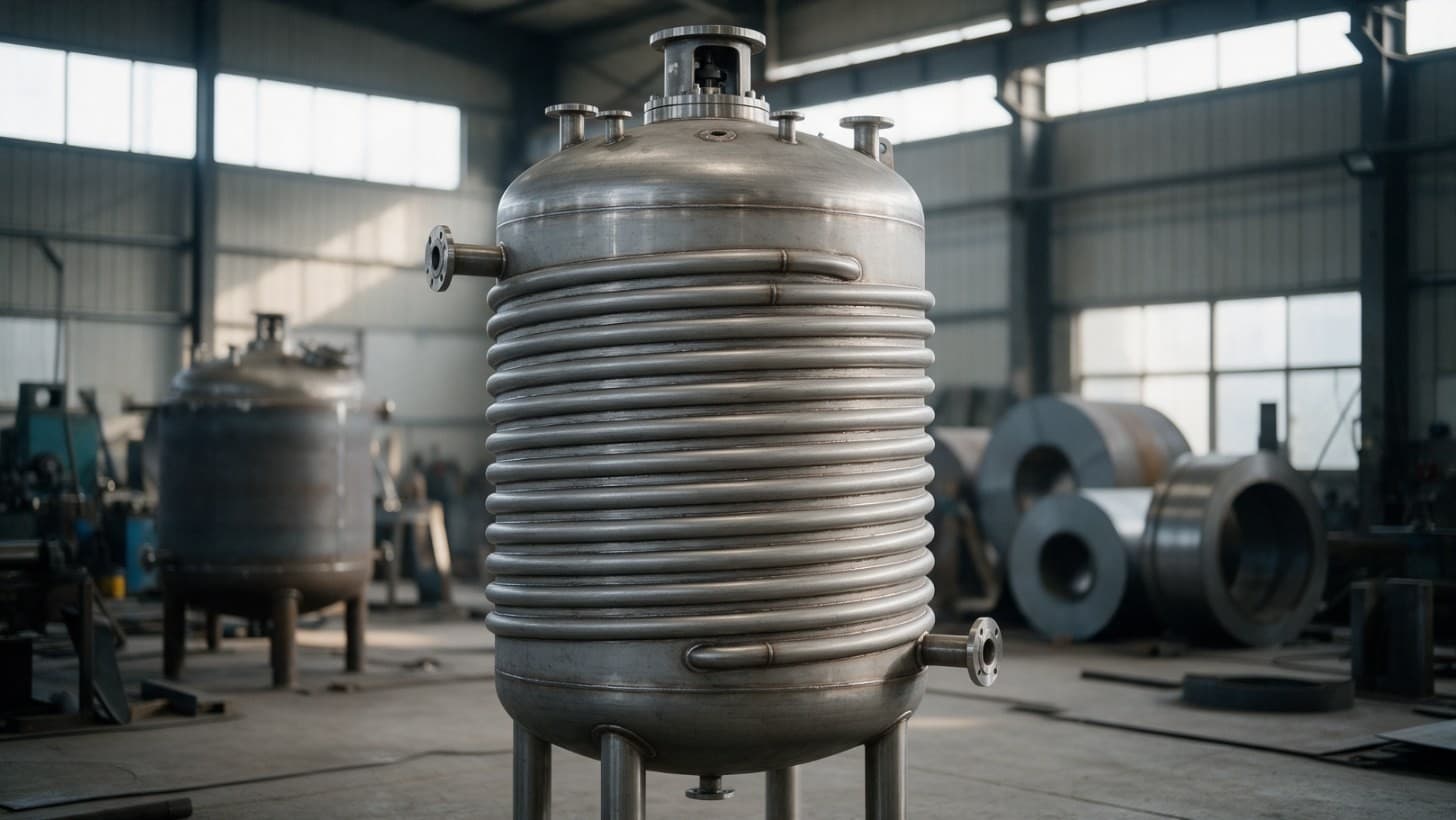
A jacketed vessel is a tank or reactor with a second skin welded around its wall. Steam, water, thermal oil or brine flows through the space between the two to heat or cool the contents. There are three common external jackets: the conventional jacket, a second shell with an open annular gap; the dimple jacket, a thin stainless sheet plug welded to the shell in a regular pattern; and the half pipe coil, a pipe cut in half along its length and welded to the outside of the shell in a spiral [1].
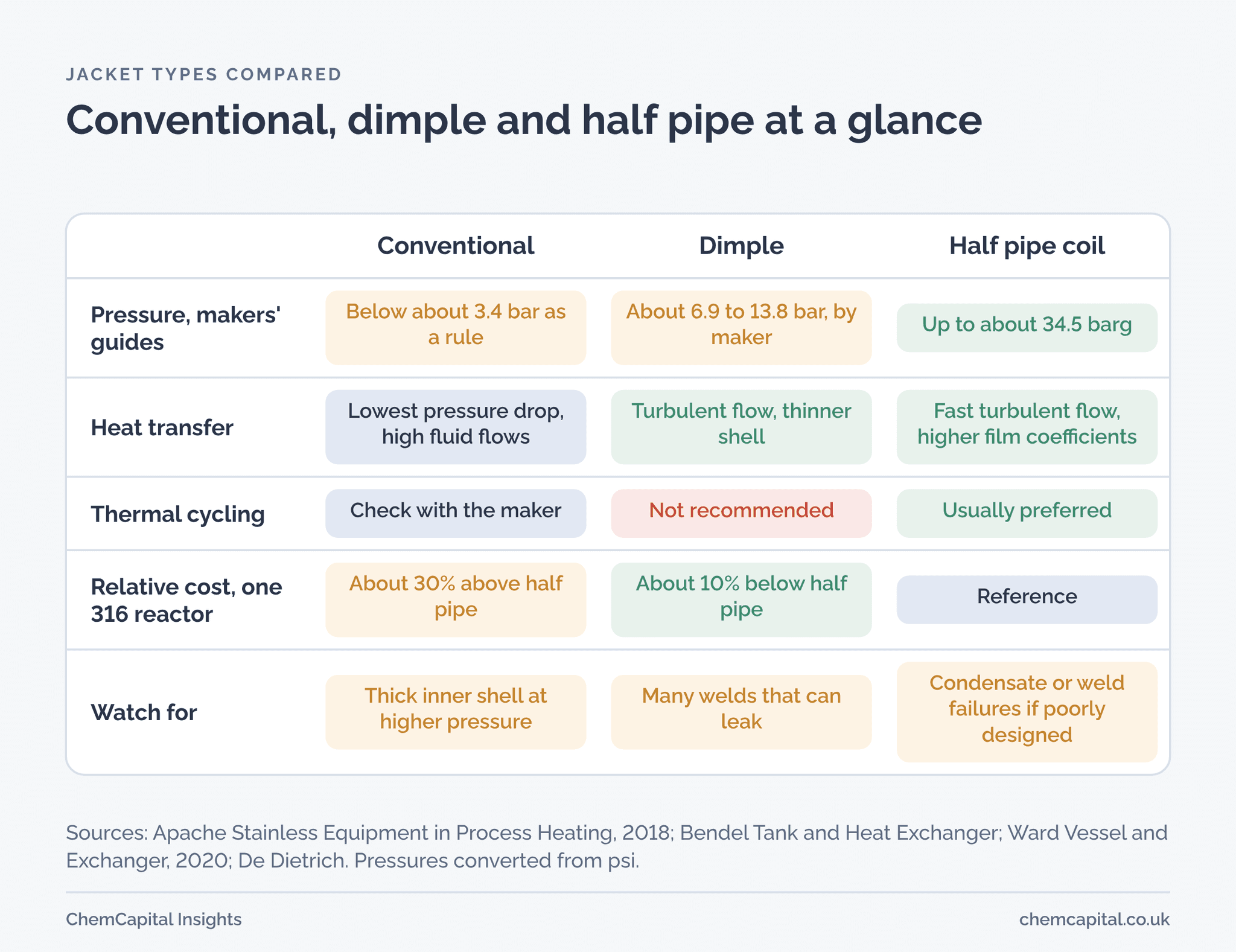
The biggest difference is the pressure each can hold, and makers' guides differ. Apache, a stainless vessel maker, puts a conventional jacket below 50 psi (about 3.4 bar) as a rule, a dimple jacket up to 200 psig (about 13.8 barg, meaning bar above atmospheric) and a half pipe coil up to 500 psig (about 34.5 barg) [1]. Bendel, another maker, does not recommend dimple jackets above 100 psi, about 6.9 bar [3].
A glass lined reactor is a carbon steel vessel with glass fused to the inside, chosen for its resistance to acids and many other corrosive chemicals [4]. Its limits are temperature swings, impact, alkaline service and a few aggressive acids [6, 7, 9].
Why this matters now
A jacket is hard to change once the vessel is built. On a glass lined reactor, a half coil has to be welded on before the vessel is glassed, while a conventional jacket can be added afterwards [4]. So the choice is fixed when you place the order.
Glass linings also need care: De Dietrich's manual names thermal shock as one major cause of vessel failure [7]. When bidders offer different jackets for one duty, catch the difference during technical bid evaluation, not at commissioning.
Join ChemCapital to streamline sourcing and connect with verified partners
Whether you're buying or supplying, ChemCapital gives you the tools to manage the complete procurement cycle in one platform.
Conventional, dimple and half pipe jackets compared
A conventional jacket gives the lowest pressure drop and suits duties with a high flow of jacket fluid [1, 2]. Its weakness is pressure: the inner wall has no reinforcement across the gap, so higher jacket pressure means a thicker, dearer inner shell [1, 2].
A dimple jacket stirs up turbulence in the jacket fluid and allows a thinner shell than a conventional jacket [1]. It is not recommended for thermal cycling, where the stronger half pipe is usually preferred [1], and Bendel likewise advises against dimples where steam and cooling water alternate [3]. Its many welds take labour and may be more prone to leaks [2].
In a half pipe coil, only the narrow pipe has to contain the jacket pressure, not a tall unbraced section of shell, so the coil can run at much higher pressures than a conventional jacket [4]. The jacket fluid travels quickly and turbulently along the coil. That raises film coefficients (how readily heat crosses the fluid layer next to the wall) above those of a conventional jacket and lets the circuit empty quickly [4]. Poor design can still lead to condensate or weld failures [2].
| Conventional jacket | Dimple jacket | Half pipe coil | |
|---|---|---|---|
| Pressure, makers' guides | Below about 3.4 bar as a rule | About 6.9 to 13.8 bar, by maker | Up to about 34.5 barg |
| Relative cost, one 316 stainless reactor | About 30% above half pipe | About 10% below half pipe | Reference |
| Watch for | Thick inner shell at higher pressure | Not for thermal cycling; many welds | Condensate or weld failures if poorly designed |
Pressures are from Apache [1] and Bendel [3]; costs are from Ward's example of a 90 inch, 316 stainless reactor [2]. Cost ranking also shifts with size: on small vessels the conventional jacket is cheapest [1].
Internal coils can be hard to clean properly where sanitation matters [1]. Jackets themselves foul with deposits, and on glass lined equipment De Dietrich forbids acid cleaning of the jacket, inhibited or not [7].
When to choose a glass lined reactor, and its limits
Glass lined steel is chosen for broad corrosion resistance and for a smooth surface that sticky or viscous products struggle to cling to, which makes cleaning easier [4]. The exceptions De Dietrich names are hydrofluoric acid and hot concentrated phosphoric acid [6].
Alkaline duty is the other weak spot. THALETEC says standard glass linings perform less well under basic conditions, and it offers a special glass for processes that run well above pH 7 for long periods [9]. Caustic cleaning is alkaline too, so check the whole recipe, cleaning chemicals included, against the maker's resistance data.
De Dietrich's standard DIN reactors, from 63 to 40,000 litres, are designed for minus 1 to plus 6 bar and minus 25 to 200 °C [5]. Separately, De Dietrich gives minus 29 °C to 260 °C as the range for a standard glass lined steel reactor, with special models down to minus 60 °C [4, 7]. The nameplate rating always governs [7].
The limits to plan around:
- Thermal shock. The higher the operating temperature, the smaller the safe difference between wall and charge [7]. In the manual's example for its 3009 glass, with the wall or jacket fluid at 150 °C (302 °F in the manual), material between 0 °C and 250 °C could be charged safely, and for larger vessels the manual says to ask De Dietrich [7]. ISO 28721 Part 3, the standard on thermal shock in glass lined plant, last confirmed in 2022, treats shock on the glass side, from charging, separately from shock on the steel side, from heating or cooling, and covers minus 25 °C to 230 °C [8]. Never put full pressure steam into a cold vessel; raise steam pressure in stages [7].
- Mechanical damage. Rigging knocked against the outside can damage the glass inside, and agitator blades should be checked for erosion and corrosion, especially along their leading edge [7].
- The steel side. Acid spilt on unjacketed outer steel can cause hydrogen damage that ends in loss of the glass lining [7].
Spark testing passes a high voltage over the glass to find any break in the lining through to the steel. De Dietrich's 2004 maintenance manual calls for a 5 to 6 kV tester, never above 6,000 V, after installation, and warns that even an unrepaired pinhole can let the steel beneath corrode [7]. The manual also suggests inspecting every six months at first, and contacting the manufacturer when the glass is down to 0.028 inch, about 0.7 mm [7]. Confirm current test voltages and limits with the maker of your vessel.
What to put in an RFQ for a jacketed reactor
| Item | What to state | Why it matters |
|---|---|---|
| Volume | Nominal, working and minimum stirred volume | Sets the reactor size and jacket area |
| Design conditions | Pressure and temperature for vessel and jacket separately, including full vacuum | De Dietrich's standard series stop at plus 6 bar and 200 °C [5] |
| Jacket service | Each medium, its supply pressure and temperature, and whether steam and cooling water alternate | Decides the jacket type; dimples are not recommended for cycling [1, 3] |
| Jacket protection | A suitable pressure relief valve on the jacket, and who supplies it | De Dietrich's manual treats a missing jacket relief valve as a danger [7] |
| Duty | Required heating and cooling times | Lets you compare heat transfer area, not just price |
| Chemistry | Full chemical list with pH and temperature, including any hydrofluoric or hot concentrated phosphoric acid and any alkaline or caustic cleaning | Those acids attack glass, and standard glass is weaker in alkaline service [6, 9] |
| Thermal shock | The manufacturer's diagram for the glass offered | Sets safe charging and jacket temperatures [7, 8] |
| Inspection and test | Spark test voltage, witnessed at works and after installation | Finds defects before your product does [7] |
Name the pressure vessel code too; our guide to ASME VIII, PD 5500 and EN 13445 explains that choice.
Practical example
Illustrative figures. A plant needs a 5,000 litre vessel in 316L stainless steel. Each batch is heated with 7 barg steam, then cooled with water. The engineer sets the jacket design pressure at 8 barg, about 116 psig. Three bids arrive.
| Bidder A | Bidder B | Bidder C | |
|---|---|---|---|
| Jacket offered | Dimple | Half pipe coil | Conventional |
| Quoted price | £83,700 | £93,000 | £120,900 |
| Scope levelling | Add insulation, £6,500 | Add insulation, £6,500 | Included |
| Levelled price | £90,200 | £99,500 | £120,900 |
| Pressure against the guides | Within Apache's 200 psig, above Bendel's 100 psi | Within 500 psig | Above 50 psi, so a thicker inner shell |
| Status | Query, or exclude | Compliant | Compliant |
The cheapest bid is the one the duty rules out: dimple jackets are not recommended for thermal cycling [1, 3], and at 8 barg this jacket is above one maker's dimple guide [3]. Unless Bidder A can justify its design, Bidder B is the lowest compliant bid at £99,500.
The quoted prices mirror Ward's cost ratios [2]. Levelling narrows the gap between B and C from 30% to about 22%, or £21,400.
Finding fabricators for your jacketed vessel
Ask every bidder to state the jacket type, its rated pressure and the heat transfer area.
ChemCapital's Supplier Discovery uses AI to search the web for suppliers from a plain text description, a pasted RFQ or an uploaded spec. It extracts published product parameters with source links and gives each supplier a fit verdict of Strong, Partial, Information Missing or Rejected. Certifications are shown as claimed, not verified, and nothing is sent automatically. You can try three searches without signing up.
Ready to find fabricators who build the jacket your duty needs? Start free with ChemCapital.
Frequently asked questions
What is the difference between a dimple jacket and a half pipe jacket?
A dimple jacket is a thin dimpled sheet plug welded to the shell. Makers rate it from about 100 psi (6.9 bar) to 200 psig (13.8 barg), and it is not recommended where steam and cooling water alternate. A half pipe coil is a pipe cut in half and welded round the vessel, rated up to 500 psig, about 34.5 barg, in Apache's guide, and in one manufacturer's example the dimple jacket was about 10% cheaper.
What temperature can a glass lined reactor handle?
De Dietrich gives minus 29 °C to 260 °C for a standard glass lined steel reactor, with special models down to minus 60 °C, while its standard DIN reactors are designed for minus 25 °C to 200 °C. The nameplate rating governs, and thermal shock limits apply too: the safe temperature difference between wall and charge shrinks as temperature rises.
What voltage is used to spark test a glass lined reactor?
De Dietrich's 2004 maintenance manual calls for a 5 to 6 kV tester and warns against exceeding 6,000 V. Confirm the current figure with your vessel's maker, spark test after installation and at inspections, and repair any damage found, however small.
Which chemicals attack glass lined steel?
Standard glass linings resist most acids, but hydrofluoric acid and hot concentrated phosphoric acid attack them, and they perform less well in alkaline service, especially over long periods well above pH 7. Check every chemical in the recipe and the cleaning regime, including any caustic, against the maker's resistance data before ordering.
Continue reading
Informational only, not procurement or legal advice. Cited names, frameworks, and statistics belong to their respective owners.
Join ChemCapital to streamline sourcing and connect with verified partners
Whether you're buying or supplying, ChemCapital gives you the tools to manage the complete procurement cycle in one platform.
Get started freeRelated articles
Where to Find Pharma and Chemical Plant Projects Before They Go to Tender: the 2027 Pipeline
Twenty pharma and chemical plant projects checked against owner or government announcements, the buying timeline on each, and where to watch for the next ones for free.
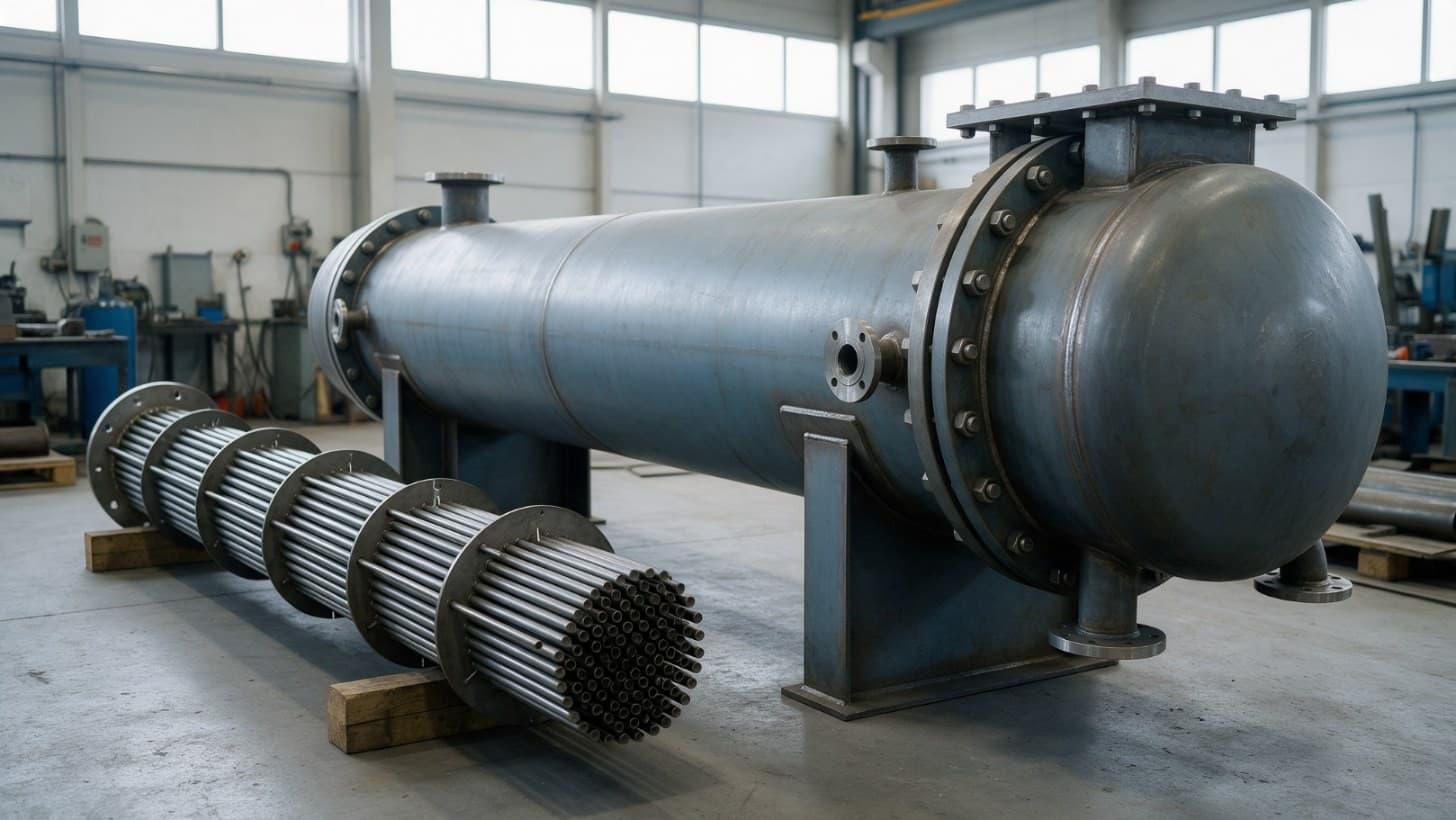
TEMA Heat Exchanger Types: How to Read AES, BEM and AEU
How to decode the three letter TEMA type, what AES, BEM, AEU and other common types mean for cleaning, expansion, leaks and cost, and how to compare bids that differ.
Safety Valve vs Relief Valve vs Bursting Disc: How to Choose
How safety valves, relief valves and bursting discs differ, when to fit a disc under a valve, the pressure terms that matter, GB duties and what to put in the RFQ.