
Incoterms for Process Equipment: EXW, FCA, DAP and DDP into the UK
Which Incoterms rule suits a skid or vessel shipped into the UK: who loads, who clears customs, where risk passes and who pays import VAT, with a levelled quote example.
Incoterms rules are the three letter trade terms published by the International Chamber of Commerce (ICC). They set who pays for each stage of a delivery, who clears customs, and where the risk of loss or damage passes to the buyer. The current edition is Incoterms 2020. ICC's 2026 workplan plans to start work on the next revision, aimed at Incoterms 2030, but ICC has published no new edition or date for one, so orders placed now should still name Incoterms 2020 [1].
For a skid or vessel coming into the UK, FCA (free carrier) at the seller's works is usually cleaner than EXW (ex works), because the seller loads and clears export. DAP (delivered at place) to your site is usually simpler than DDP (delivered duty paid) for a VAT registered buyer, because you stay the importer and can use postponed VAT accounting [2, 3, 6].
Incoterms do not decide when you own the equipment or when you pay; the contract does that [4]. The customs and VAT points below are for Great Britain; goods moving from the EU into Northern Ireland follow different rules [6]. This is general information, not legal advice.
Why this matters now
Quotes for one package often arrive on different rules: one EXW in euros, another DAP to your site in sterling. They only compare once you add what each rule leaves with you, as our quotation comparison sheet shows.
Duty matters too: ICC's April 2025 tariff guidance shows the buyer clearing the import and paying the duty under every rule except DDP, so a tariff change lands on you unless DDP applies [3].
HM Revenue and Customs (HMRC) guidance updated in April 2026 still says CIP needs only minimum insurance cover [5], while ICC's checklist for the 2020 rules calls for all risk cover, Institute Cargo Clauses (A) [2]. Write "Incoterms 2020" after the rule and the named place.
Create and manage RFQs in minutes
ChemCapital handles the entire procurement cycle, from structured RFQs and supplier comparisons to formal purchase orders and delivery tracking.
The seven rules that suit process equipment
Incoterms 2020 has eleven rules: seven for any mode of transport, and four, FAS, FOB, CFR and CIF, for sea and inland waterway transport [3, 5]. FOB keeps the risk with the seller until the goods are on board, a poor fit when cargo waits at a terminal first; FCA passes it earlier [4].
- EXW: the seller makes the goods available at its works and need not load them or clear them for export [5]. Risk passes at that moment, before loading, and ICC calls EXW suitable mainly for domestic trade [2].
- FCA: named as the seller's works, the seller loads your haulier's vehicle and clears export [2]. HMRC advises naming the exact point, because risk passes there [5].
- CPT (carriage paid to) and CIP (carriage and insurance paid to): the seller pays the freight to your named place, but risk passes when the goods are handed over in the seller's country [2, 5]. CIP adds all risk insurance, Clauses (A); CIF needs only the minimum, Clauses (C) [2].
- DAP: the seller carries the risk to your site and delivers on the arriving vehicle, ready for unloading. It does not unload [2, 5].
- DPU (delivered at place unloaded): as DAP, but the seller unloads, and delivery happens once unloaded [2, 5].
- DDP: as DAP, but the seller also clears the goods into Great Britain, pays the import duty and handles the customs paperwork at both ends [5].
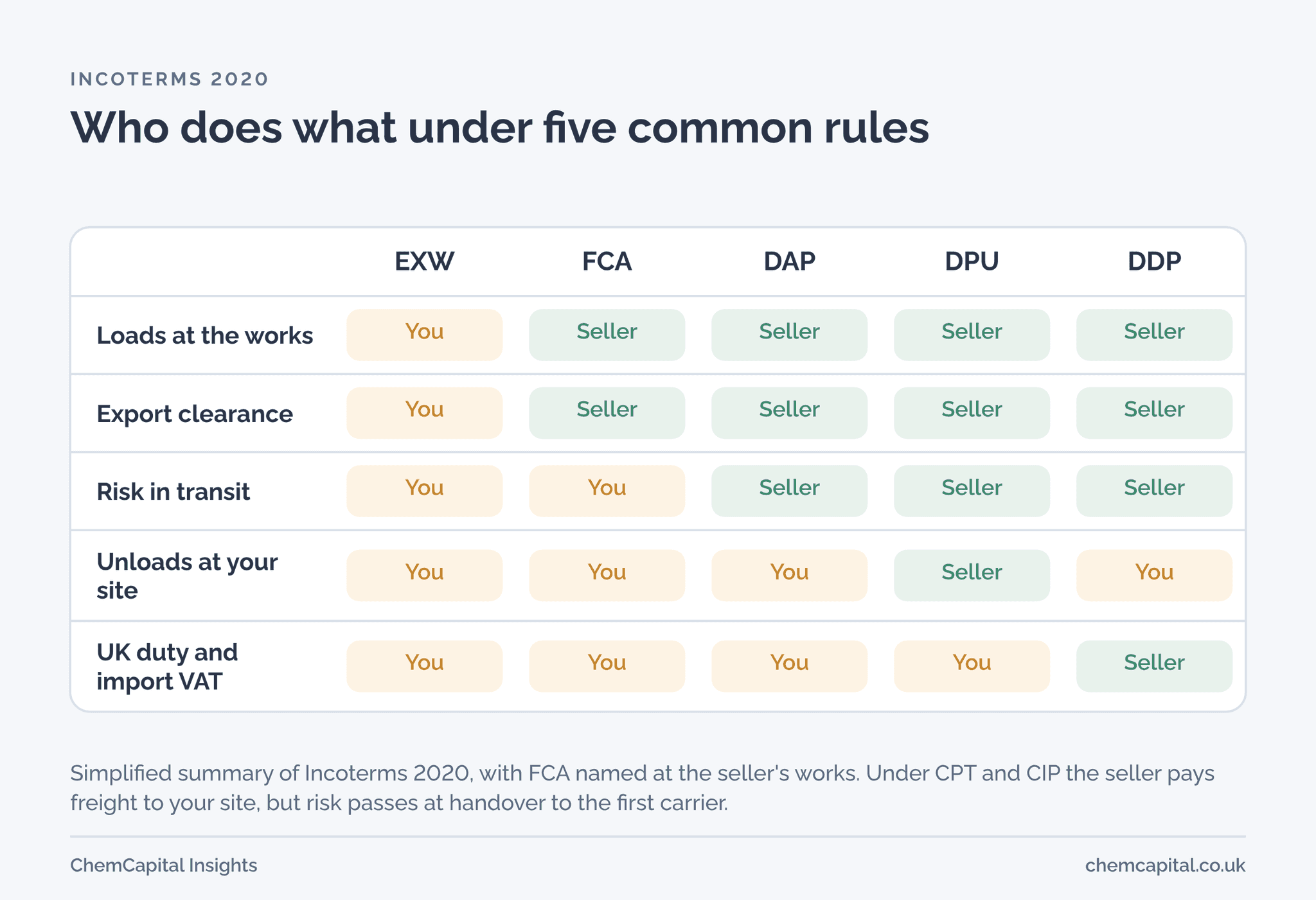
| Rule | Loads at the works | Export clearance | Risk passes to you | Unloads at your site | UK import clearance and duty |
|---|---|---|---|---|---|
| EXW | You | You | When made available at the works, before loading | You | You |
| FCA, seller's works | Seller | Seller | Once loaded on your haulier's vehicle | You | You |
| CPT | Seller | Seller | On handover to the first carrier | Check the freight contract | You |
| CIP | Seller | Seller | On handover to the first carrier | Check the freight contract | You |
| DAP | Seller | Seller | On arrival at your site, before unloading | You | You |
| DPU | Seller | Seller | Once unloaded at your site | Seller | You |
| DDP | Seller | Seller | On arrival at your site, cleared for import | You | Seller |
Clearance columns follow ICC's tariff guidance [3]. Under CPT, CIP and the D rules the seller loads because it contracts and pays for the carriage [5].
DDP: who is the importer and who pays import VAT
Under DDP the seller is normally the importer, the party named as importer on the customs declaration. It, or its customs agent, clears the goods and pays the duties and import taxes, import VAT included [2, 3]. ICC tells sellers to choose DDP with caution and to ask first whether they can recover the import VAT [2]. HMRC ties recovery to owning the imported goods and holding the import VAT statement, and says a forwarding agent cannot usually reclaim it [6].
Under DAP you are the importer and choose the customs agent, and postponed VAT accounting lets a VAT registered buyer declare the import VAT and reclaim it on the same VAT return [6]. ICC itself suggests DAP in place of DDP to spare the seller import exposure [3].
If you do accept DDP, agree in writing:
- who is named as importer, and whose GB EORI number (Economic Operators Registration and Identification) goes on the declaration
- whether the seller is registered for UK VAT, and whether the price includes it
Practical points for crated vessels and skids
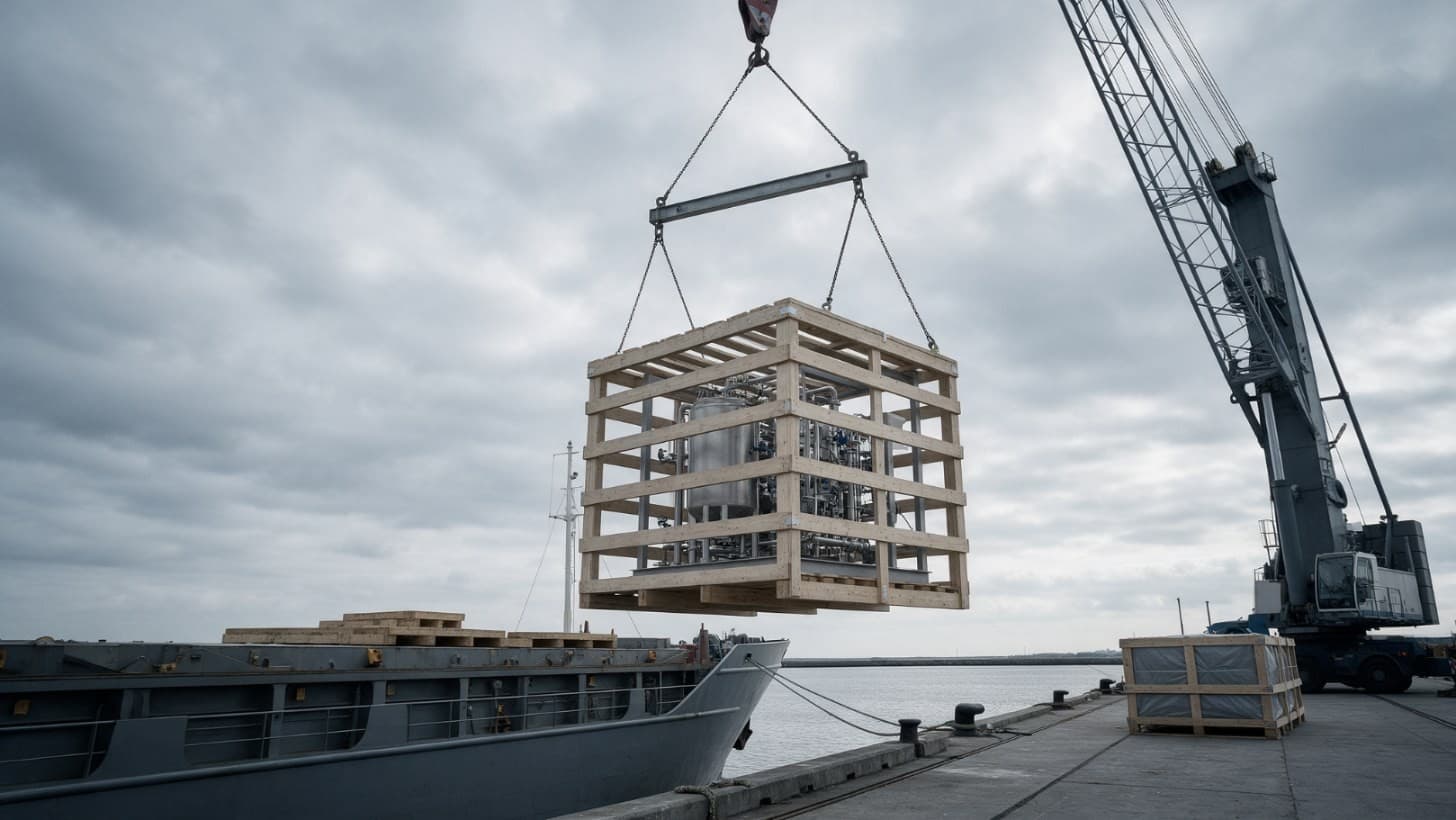
Loading at the works. Under EXW the risk passes before the lift, so a skid dropped onto your trailer is your loss unless the order says otherwise [2]. ICC notes that loading and unloading charges cause many disputes [2]. FCA at the seller's works puts the lift on the seller. Under any rule, ask for a lifting drawing showing weight, centre of gravity and lifting points.
Origin documents. Under the UK and EU trade agreement, goods that meet the rules of origin pay no duty, and preference can be claimed with the exporter's statement on origin, which can go on the invoice [9]. Ask for it in the order.
Out of gauge transport. National Highways treats a vehicle as an abnormal load if, among other limits, it weighs more than 44,000 kg, is wider than 2.9 m or has a rigid length over 18.65 m. Whoever is responsible for transporting it must give the police, highway and bridge authorities whatever advance notice the regulations require for its size and weight, which hauliers do through the ESDAL online system [7]. Under EXW and FCA that is your haulier; under CPT, CIP and the D rules, the seller's.
Site unloading and cranes. Under DAP and DDP you unload, so the site crane is yours to arrange. With plain crane hire, the customer provides the Appointed Person (the competent person who plans the lift) and the lifting team, and supervises the work. A contract lift passes the planning and most of the liability to the crane company, and its cover can include the lifted goods [8]. DPU moves unloading to the seller, so its crane must reach the named place and follow your site rules.
Damage claims. Damage found on the trailer before unloading is the seller's problem under DAP, DPU and DDP. Under EXW, FCA, CPT and CIP it is yours, claimed on your own cargo insurance or, under CIP, on the cover the seller bought against your risk [5]. Inspect before signing, note damage on the paperwork, photograph the crate and any tilt or shock indicators, and tell the carrier and insurer promptly.
Practical example
Take two illustrative quotes for a crated jacketed reactor skid, 3.2 m wide, above the 2.9 m abnormal load width [7]. Supplier A in Germany quotes €412,000 EXW its works. Supplier B, elsewhere in the EU, quotes £372,500 DAP your site. Both leave import clearance, duty and offloading with you.
Every figure is illustrative: €1 = £0.85, transit insurance at 0.3% of goods plus freight, and 2% duty, assuming the goods do not qualify for preferential origin under the UK and EU agreement, which would make it zero [9]. Your customs agent sets the real customs value; for simplicity, A's duty is on goods, freight and insurance (£371,110) and B's on its whole price.
| Item | A: EXW Germany | B: DAP UK site |
|---|---|---|
| Quoted price | £350,200 (€412,000) | £372,500 |
| Loading at the works | £2,600 | In price |
| German export clearance | £400 | In price |
| Road freight, ferry and abnormal load arrangements | £19,800 | In price |
| Transit insurance at 0.3% | £1,110 | Seller's risk |
| UK import clearance | £350 | £350 |
| Import duty at 2% | £7,422 | £7,450 |
| Offloading by contract lift | £6,500 | £6,500 |
| Levelled cost at your site | £388,382 | £386,800 |
Supplier A looked £22,300 cheaper. Levelled, it costs £1,582 more, and you carry the transit risk and the abnormal load booking. Import VAT is left out: you are the importer in both cases, and a VAT registered buyer can usually recover it through postponed VAT accounting [6].
Level the quotes before you compare them
Put every offer on one basis, usually delivered and offloaded at your site, before ranking anything. ChemCapital's Project Costing reprices stored quotes for Incoterms, currency, age and geography, and shows every adjustment. AI Quotation Comparison sets offers side by side on commercial, technical, delivery, compliance and risk terms, and flags quotes with mandatory gaps such as excluded scope.
Ready to compare equipment quotes on the same delivered basis? Start a free 14 day ChemCapital trial, with no credit card needed.
Frequently asked questions
What is the difference between DAP and DDP?
Under both rules the seller delivers to your named place, ready for unloading, and carries the risk until it arrives. Under DDP the seller also clears the UK import and pays the duty and import taxes, so it is normally the importer; under DAP you are.
Is EXW or FCA better for importing equipment?
For goods crossing a border, FCA at the seller's works is usually cleaner: the seller loads your haulier's vehicle and clears export, and risk passes once the goods are loaded. Under EXW you load and clear export yourself, and ICC describes EXW as suitable mainly for domestic trade.
Who pays import VAT under DDP?
Under DDP the seller, normally as importer, is responsible for UK import duty and import taxes, including import VAT. HMRC ties recovery of import VAT to owning the goods and holding the import VAT statement, so agree in writing who is named as importer and how UK VAT will be invoiced.
Which version of Incoterms is current in 2026?
Incoterms 2020 is still the current edition. ICC's 2026 workplan plans to start work towards Incoterms 2030, but no new edition has been published, so contracts should name Incoterms 2020.
Continue reading
Informational only, not procurement or legal advice. Cited names, frameworks, and statistics belong to their respective owners.
Create and manage RFQs in minutes
ChemCapital handles the entire procurement cycle, from structured RFQs and supplier comparisons to formal purchase orders and delivery tracking.
Start for freeRelated articles
Site Acceptance Test (SAT) Checklist for Process Skids
What a site acceptance test must prove once a skid is installed, how SAT differs from FAT and commissioning, a full SAT checklist and how to handle failed tests.
Recommended Spares List: Commissioning, Operating and Insurance Spares
What a recommended spares list should hold: commissioning, two year operating and insurance spares, criticality, what to ask in the RFQ, and a pump and vessel template.
Punch List Categories and Mechanical Completion for Process Plant
What a punch list is, how category A, B and C items gate mechanical completion, start up and handover, who clears them, and a template for vendor equipment packages.