
EPC vs EPCM: Who Buys the Equipment?
How EPC and EPCM contracts differ, who places equipment orders under each, where cost and schedule risk sit, and what it means for owners, suppliers and long lead items.

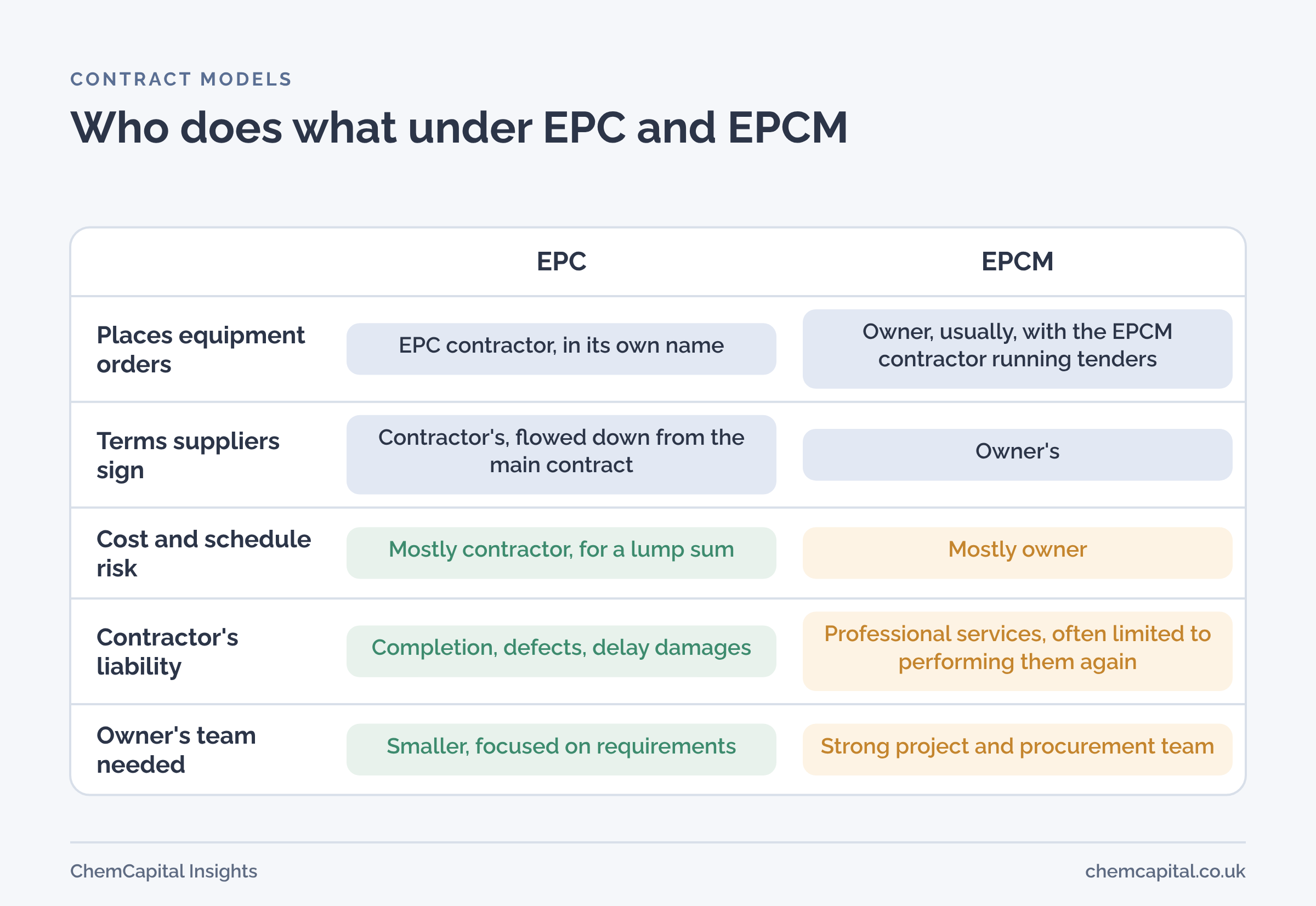
Under an EPC contract (engineering, procurement and construction), one contractor designs, buys and builds the plant, usually for a fixed price and completion date, so it places the equipment orders in its own name and carries most of the cost and schedule risk. Under an EPCM contract (engineering, procurement and construction management), the contractor provides professional services: it designs, runs procurement and manages construction for the owner, but the owner usually places the equipment orders and construction contracts directly. Who buys the equipment follows from that difference, and so do the terms suppliers sign, the vendor lists they must be on, and who carries the risk if an order goes wrong.
Why this matters now
EPCM now has its own standard form. IChemE published the Blue Book in 2023, the first standard form EPCM contract from a major industry body, drafted for international use with flexible pricing [1]. EPCM, once mainly a mining model, has also become more common in other sectors as market conditions strengthened contractors' bargaining power, while EPC contracts increasingly use target cost incentives rather than pure lump sums [2]. Owners, contractors and suppliers are all seeing more mixed models, so it pays to be clear about who buys what.
Join ChemCapital to streamline sourcing and connect with verified partners
Whether you're buying or supplying, ChemCapital gives you the tools to manage the complete procurement cycle in one platform.
Who places the equipment orders
Under EPC, the contractor buys. Equipment suppliers sell to the EPC contractor's procurement team, on the contractor's terms, with the owner's requirements flowed down from the main contract. IChemE's Yellow Book, for example, is a subcontract form that runs back to back with its main contracts and covers significant equipment for the plant [3].
Under EPCM, the owner usually buys. Most EPCM arrangements have the owner contract directly with suppliers and trade contractors, with the EPCM contractor running the tenders [2]. Under the Blue Book, works contractors are engaged by the purchaser rather than the EPCM contractor [4]; the EPCM contractor proposes each package's scope and tender list, and the purchaser's representative approves each appointment [1].
Where the risk sits
| Risk | EPC (lump sum) | EPCM |
|---|---|---|
| Cost overrun | Mostly contractor, within the contract's adjustment rules | Mostly owner |
| Late completion | Contractor, often with delay damages | Owner; delay damages against the EPCM contractor are rare |
| Equipment defects | Contractor, backed by its suppliers | Owner, backed by its suppliers |
| Supplier failure | Contractor finds a replacement | Owner, with the EPCM contractor's help |
| Contractor's own liability | Completion, performance and defects | Breach or negligence in its services |
A Mayer Brown analysis notes that an EPCM contractor will not usually take full responsibility for delivering the completed project, and that liquidated damages for overall delay are therefore rare [5]. Addleshaw Goddard adds that a common position limits the EPCM contractor's liability to performing its services again [2]. At the other end, FIDIC's Silver Book for EPC and turnkey projects transfers the risks of completion to time, cost and quality to the contractor, and FIDIC says it is only suitable for experienced contractors able to manage that risk [6].
The trade off for owners is control against risk. EPCM gives the owner more say over suppliers, scope and quality, but it needs a strong in house project and procurement team, and budget and schedule tolerance to absorb what the EPCM contractor will not [2].
What it means for suppliers
| Question | EPC | EPCM |
|---|---|---|
| Who is the customer? | The EPC contractor | Usually the owner |
| Whose vendor list? | The contractor's, sometimes plus the owner's | The owner's |
| Whose terms? | Contractor's, with main contract requirements flowed down | Owner's |
| Who evaluates the bid? | Contractor's engineers | EPCM contractor's engineers, for the owner |
| Who pays? | Contractor | Owner |
| Where do documents go? | Contractor, then owner at handover | Owner, often through the EPCM contractor's systems |
Suppliers should find out early which model a project uses, and get onto both the owner's and the likely contractors' vendor lists. On EPC projects, read the flow down clauses carefully: delay damages, warranties and document requirements in the main contract often pass to equipment suppliers in full. On EPCM projects, expect the owner's own purchase terms and approved vendor list, and expect the EPCM contractor's engineers to run the technical evaluation.
Long lead items
Long lead equipment often needs ordering before the main contract is placed. Under EPCM, the owner can simply place those orders itself, with its EPCM contractor's support. Under EPC, owners sometimes place early orders and later transfer them to the EPC contractor at award, so the contractor takes them over as part of its scope. Either way, the order terms must anticipate the handover. Our guide to long lead items covers which equipment usually needs early ordering, and our article on CAPEX procurement strategy covers how to split packages across a project.
Practical example
In this illustrative example, a plant needs a compressor with a lead time of about 60 weeks, roughly 14 months, and mechanical completion is targeted for month 22 of the project.
Under EPC, if the main contract is awarded in month 9 and the contractor orders the compressor in month 10, delivery falls in month 24, two months after the target. If the owner instead orders the compressor in month 3 and transfers the order to the EPC contractor at award, delivery falls in month 17, with five months to spare.
Under EPCM, the owner places the same order in month 3 directly, on its own terms, with the EPCM contractor running the tender. The schedule result is the same; the difference is that the owner keeps the supplier relationship and the risk throughout.
Where ChemCapital fits
ChemCapital supports both models. Owners, EPC contractors and EPCM teams can run structured RFQs to several suppliers, compare quotes in a consistent format, and issue and track purchase orders, with each project, RFQ and order keeping its own message thread and every action logged against the person who took it. See how it works.
Ready to run equipment procurement for your next project in one place? Start free with ChemCapital.
Frequently asked questions
Who buys the equipment under an EPCM contract?
Usually the owner. The EPCM contractor manages engineering, procurement and construction as the owner's agent or adviser, running tenders and recommending suppliers, but the purchase orders and works contracts are normally placed in the owner's name.
Who carries the risk in EPC and EPCM?
Under a lump sum EPC contract the contractor takes most of the risk of cost, time and performance. Under EPCM the owner carries most of the construction risk, and the EPCM contractor is liable mainly for failing to perform its services with professional skill and care.
Which is better for suppliers, EPC or EPCM?
Neither is better in general. Under EPC you sell to the contractor, on its terms and vendor list, with requirements flowed down from the main contract; under EPCM you usually sell to the owner, with the EPCM contractor evaluating your bid. Know who your customer is before you quote.
Continue reading
Informational only, not procurement or legal advice. Cited names, frameworks, and statistics belong to their respective owners.
Join ChemCapital to streamline sourcing and connect with verified partners
Whether you're buying or supplying, ChemCapital gives you the tools to manage the complete procurement cycle in one platform.
Get started freeRelated articles
Change Orders and Variations on Equipment Orders
How changes happen on engineered equipment orders after award, how to request, price and approve them, and how buyers and suppliers both stay protected.

PMI Testing: When to Require It on a Purchase Order
What positive material identification can and cannot detect, when to require it, how much to test, and how to write PMI into a purchase order and inspection plan.

Purchase Order Terms for Capital Equipment, Clause by Clause
The clauses that decide who pays when equipment is late, fails a test or breaks in year two, with what to check and where suppliers usually push back.