
Purchase Order Terms for Capital Equipment, Clause by Clause
The clauses that decide who pays when equipment is late, fails a test or breaks in year two, with what to check and where suppliers usually push back.

A purchase order for capital equipment is the contract between buyer and supplier, and its terms decide who pays when the equipment is late, fails a test or breaks in its second year. The clauses that matter most are scope and order of precedence, price and payment, delivery and Incoterms, title and risk, inspection and testing, documentation, warranty, liquidated damages, limitation of liability, variations, termination and governing law. Most disputes on equipment orders trace back to one of them being vague, missing or contradicted by the supplier's quotation.
This is general information, not legal advice. Take advice from your own legal team on any specific order.
Why this matters now
Many buyers still send engineered equipment orders on general office purchase terms, or on terms so heavily amended that nobody is sure what they say. IChemE has now published a standard form aimed at exactly this gap: the Turquoise Book, a supply of materials contract, first edition 2026, for procuring materials and equipment with optional installation [1].
It is designed for supply only orders and low complexity installation, including process equipment, spares and repairs, and IChemE intends its general conditions to be used without alteration, with project matters handled through schedules and special conditions [2]. Burges Salmon describes it as a structured alternative to ad hoc purchase order terms, and a possible alternative to NEC supply contracts or MF/1 for suitable projects, but not for orders where the supplier carries significant bespoke design, integration or commissioning risk [3]. Whether you adopt it or keep your own terms, it is a useful checklist.
Create and manage RFQs in minutes
ChemCapital handles the entire procurement cycle, from structured RFQs and supplier comparisons to formal purchase orders and delivery tracking.
First, make sure your terms apply
Supplier quotations usually carry the supplier's own conditions. If your order says one thing and the supplier's acknowledgement says another, you have a "battle of the forms", and the last document accepted may win. State on the order that only your terms apply, list the documents that form the contract, and ask for written acceptance of the order as issued.
Know too that standard terms are not untouchable. Under the Unfair Contract Terms Act 1977, where one party deals on the other's written standard terms, that party cannot exclude or restrict its liability for breach unless the term meets a reasonableness test [4].
The clauses, one by one
| Clause | What to check | Common supplier push back |
|---|---|---|
| Scope and order of precedence | Every document listed in order: PO, special conditions, datasheets, specification, closed TQ register | Wants its quotation and assumptions in the list, often near the top |
| Price and payment | Fixed price, currency, milestones tied to evidence such as drawings approved or FAT passed | Larger advance payment; metal surcharges |
| Delivery and Incoterm | A named Incoterms 2020 rule and place, and a delivery date or period | Ex works rather than delivered |
| Title and risk | When ownership passes, separately from risk | Keeps title until paid in full |
| Inspection and testing | Right to inspect at works, inspection and test plan, hold and witness points, FAT | Limits on witnessing and on retests at its cost |
| Documentation | Vendor document list, final data book, certificates as a condition of final payment | Documents "to follow" after delivery |
| Warranty | Period, start trigger, repair or replace at site, warranty on repaired parts | Shorter period, starting at delivery, not start up |
| Liquidated damages | Rate per week of delay and a cap | Lower rate, lower cap, longer grace period |
| Limitation of liability | Overall cap, exclusion of indirect loss, carve outs | Cap at a fraction of order value |
| Variations | Changes only by written instruction, with a pricing basis | Right to stop work until a variation is agreed |
| Termination | For default, and for convenience with costs paid | Payment of full profit on termination for convenience |
| Governing law and disputes | Law of England and Wales, or as agreed; escalation then courts or arbitration | Its home law and courts |
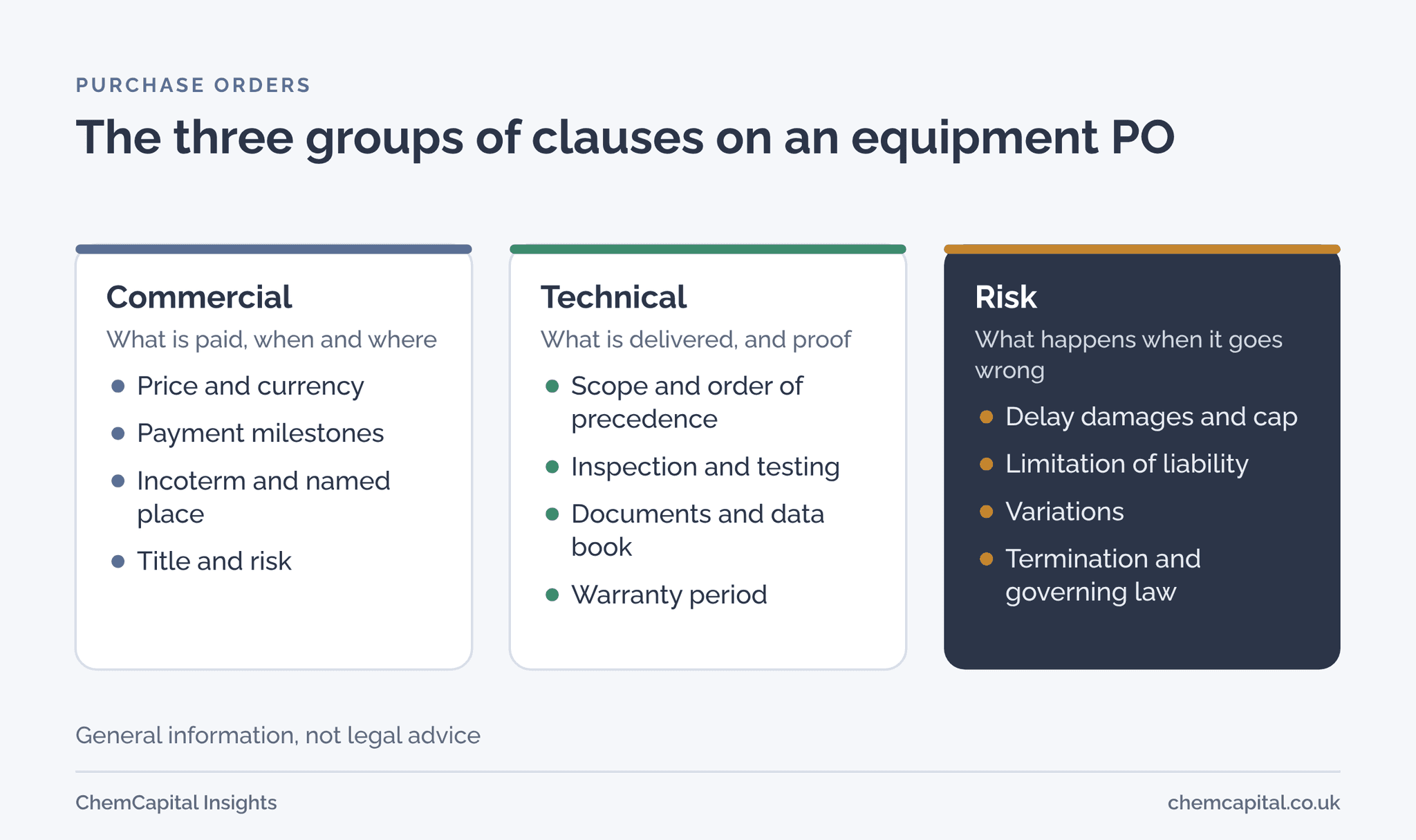
Five clauses that deserve more thought
Delivery and risk. Incoterms 2020, the International Chamber of Commerce rules, set out how obligations, risk and costs are shared between seller and buyer for delivery of goods [5]. They do not deal with ownership, so title needs its own clause. Our guide to Incoterms for process equipment covers which rule fits a heavy, fragile item.
Payment. Tie each milestone to something you can verify. If you pay before delivery, consider vesting of title in the items paid for and an advance payment bond. See payment milestones, retention and bonds.
Warranty. Under the Sale of Goods Act 1979, goods sold in the course of a business must be of satisfactory quality and, where the buyer has made a particular purpose known, reasonably fit for it [6]. Supplier terms often replace those implied terms with an express warranty. That can be fine, but make sure the express warranty covers what you need, starts at a sensible point such as acceptance after start up, and has a longstop date both sides can live with.
Liquidated damages. These are agreed sums payable for late delivery, so you do not have to prove your loss. Since the Supreme Court's 2015 decision in Cavendish v Makdessi, a clause is only an unenforceable penalty if it is out of all proportion to the innocent party's legitimate interest, and properly advised commercial parties are presumed to be the best judges of what is legitimate [7]. Set a rate you can explain from your own project, and a cap.
Limitation of liability. A cap is normal and protects both sides. When a court tests whether a cap is reasonable, it considers the resources the party could expect to have to meet the liability and how far it could have insured [4]. Agree what sits outside the cap, for example fraud, death and personal injury, and often wilful default.
Variations and firm prices
Most equipment orders change after award. Require written instructions for every change and agree in advance how changes will be priced, for example from rates in the quotation. Our article on change orders and variations covers the process. And place the order only against a firm quotation, not a budget figure; see budgetary versus firm quotes.
Practical example
In this illustrative example, a buyer orders a process skid for £400,000. The draft terms set liquidated damages at 0.5% of the order value per week of delay, capped at 10%.
That is £2,000 a week, and the £40,000 cap is reached after 20 weeks. The supplier asks for 0.25% a week with a 5% cap, which would be £1,000 a week and £20,000 in total.
Before negotiating, the buyer checks its own exposure. If a late skid delays a production line start, the lost margin may be far higher than £2,000 a week. Damages at either rate will not cover that loss, so the buyer also negotiates a firm programme with early document milestones and the right to inspect progress, which reduce the chance of delay in the first place. The damages clause is a backstop, not a plan.
Where ChemCapital fits
ChemCapital lets buyers issue formal purchase orders inside the platform and track supplier confirmations. Suppliers confirm an order with their own reference number and dates and can flag exceptions, so a "yes, but" is visible before work starts. Milestone and delivery updates arrive against the order, and each purchase order has its own message thread.
Ready to issue equipment orders with a clear record of what was agreed? Start a free 14 day ChemCapital trial, with no credit card needed.
Frequently asked questions
What terms should be on a purchase order for capital equipment?
At least: scope and order of precedence of documents, price and payment, delivery and the Incoterm, title and risk, inspection and testing, documentation, warranty, liquidated damages for delay, limitation of liability, variations, termination and governing law. This is general information, not legal advice.
Are liquidated damages enforceable in England?
Since the Supreme Court's 2015 decision in Cavendish v Makdessi, a clause is only an unenforceable penalty if it is out of all proportion to the innocent party's legitimate interest. Between properly advised commercial parties, the courts start from the view that the parties are the best judges of what is legitimate.
What is the IChemE Turquoise Book?
It is IChemE's standard form contract for the supply of materials and equipment, with optional installation, first published in 2026. It is meant for supply and low complexity installation rather than complex plant with significant design or commissioning risk.
Continue reading
Informational only, not procurement or legal advice. Cited names, frameworks, and statistics belong to their respective owners.
Create and manage RFQs in minutes
ChemCapital handles the entire procurement cycle, from structured RFQs and supplier comparisons to formal purchase orders and delivery tracking.
Start for freeRelated articles
Hold Point vs Witness Point: What They Mean in an ITP
A hold point stops work until the buyer releases it in writing; a witness point lets work go on if nobody comes. ITP codes, notice and costs, with an example.

EPC vs EPCM: Who Buys the Equipment?
How EPC and EPCM contracts differ, who places equipment orders under each, where cost and schedule risk sit, and what it means for owners, suppliers and long lead items.

Change Orders and Variations on Equipment Orders
How changes happen on engineered equipment orders after award, how to request, price and approve them, and how buyers and suppliers both stay protected.