
Change Orders and Variations on Equipment Orders
How changes happen on engineered equipment orders after award, how to request, price and approve them, and how buyers and suppliers both stay protected.

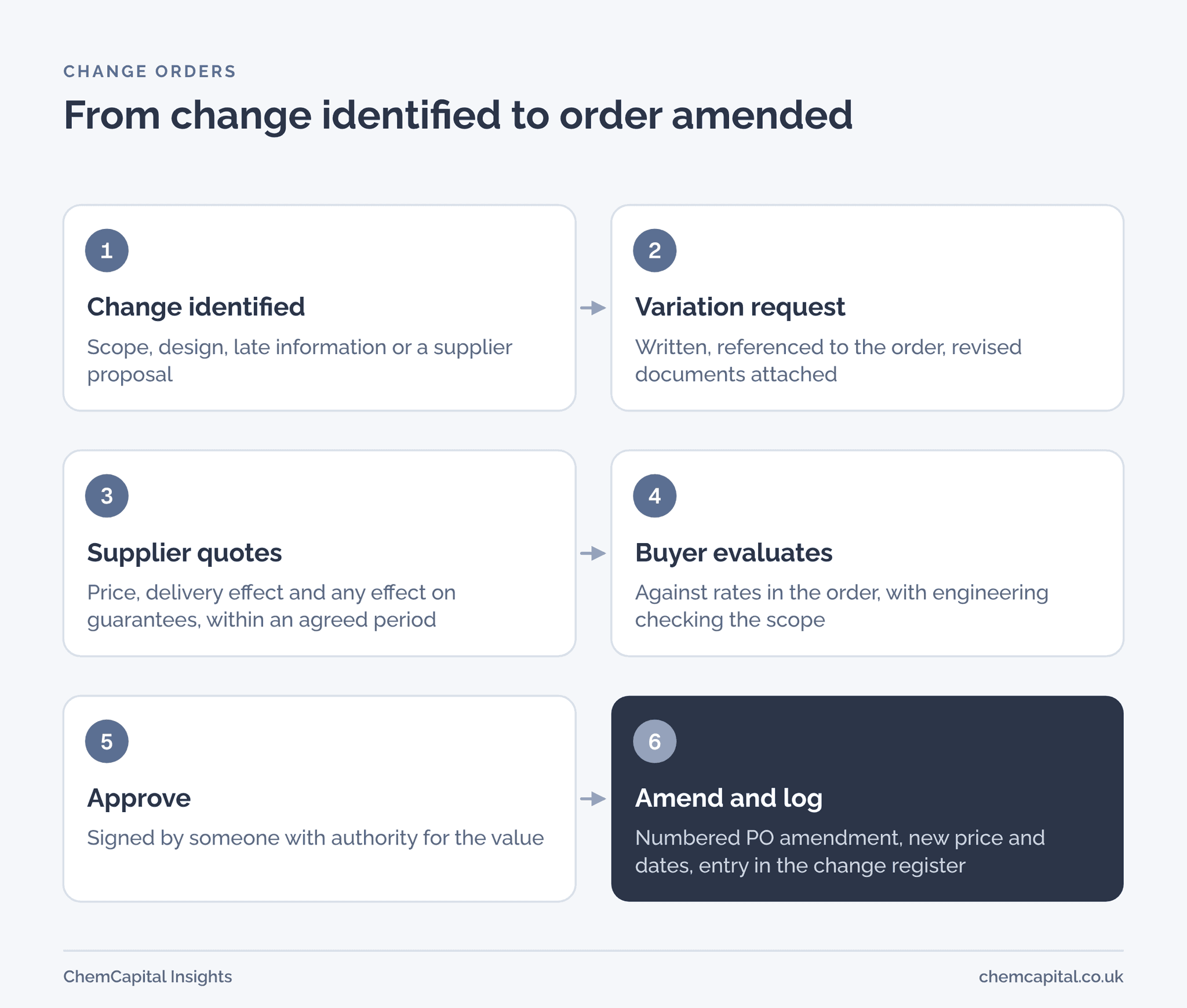
A change order, often called a variation, is a formal written change to an equipment order after award. It can alter the scope, the design, the quantity, the delivery date or the terms, and it records the agreed effect on price and programme before the purchase order is amended. The usual sequence is: change identified, written variation request, supplier quotation, evaluation, approval, then a numbered amendment to the order.
This is general information, not legal advice.
Why this matters now
Changes agreed informally are a growing risk. In 2018 the UK Supreme Court held in Rock Advertising v MWB that a clause requiring changes to be agreed in writing is effective, so an oral variation that ignores it is invalid [1]. Meanwhile, project teams increasingly handle questions through cloud systems, and in November 2024 the Civil Engineering Contractors Association warned that an answer to a technical query can change the scope without the formal instruction it needs [2]. On equipment orders, that is how a casual email about a nozzle becomes a dispute about money.
Join ChemCapital to streamline sourcing and connect with verified partners
Whether you're buying or supplying, ChemCapital gives you the tools to manage the complete procurement cycle in one platform.
Where variations come from
- Buyer scope changes: an extra nozzle, a material upgrade, an added test.
- Late information: a P&ID revision, a changed duty, or vendor data that reveals a clash.
- Rule or site changes: a new hazardous area classification or a different power supply.
- Supplier proposals: a cheaper or faster alternative. NEC contracts let suppliers propose scope changes that reduce the amount payable, and an accepted proposal follows the change procedure [3].
- Delay and acceleration: a request to bring delivery forward is a change too.
Request, price, approve
1. Request in writing. Reference the order, describe the change, and attach revised drawings or datasheets. Be clear whether you are asking for a proposal or instructing the change. Under FIDIC's 2017 contracts, a request for a proposal is not an instruction, so the contractor keeps working to the original design until instructed [4].
2. Ask for price and time. Set a period for the supplier's quotation. The UK Atomic Energy Authority's purchase order conditions, based on the NEC4 Supply Contract, use a two week period for reply [5].
3. Evaluate. Check the price against the agreed pricing basis and ask engineering to confirm the scope, the effect on guarantees and on the vendor document list.
4. Approve within authority. The same UKAEA conditions require its procurement representative to agree any assessment of a change event, which keeps commercial control where it belongs [5].
5. Amend and log. Issue a numbered amendment with the new price and dates, and enter it in a change register. If the order has payment milestones, say whether the change adds to a milestone or has its own.
Pricing bases
| Basis | When it fits | Watch out for |
|---|---|---|
| Rates already in the order | Repeated small items: nozzles, clips, extra tests | Rates only exist if you asked for them at bid stage |
| Rates derived from the order | Similar work at a different size or quantity | Agree the derivation, not just the answer |
| Lump sum quotation | A defined change with clear scope | Hidden time related cost |
| Cost plus agreed margin | Uncertain scope, urgent work | Needs records and an agreed margin |
FIDIC's 2017 contracts use broadly this order: contract rates first, then rates derived from them, then cost plus profit, with a default profit of 5% unless the contract says otherwise [4]. Agreeing a similar hierarchy in your purchase order terms saves argument later.
How suppliers protect themselves
Fairness cuts both ways, and a good change process protects the supplier as much as the buyer.
- Warn early. NEC based conditions require suppliers to notify early warnings promptly, and the UKAEA form puts risks identified in the supplier's quotation straight into the early warning register [5].
- Do not start on a verbal request. If the order requires changes in writing, work done on a phone call may not be paid [1].
- Price the time, not just the work. Under FIDIC 2017 there is no separate right to time related costs, so they must be included when the change is valued [4].
- Object where you must. FIDIC lets a contractor decline a variation it cannot readily obtain the goods for, or one that would compromise health and safety [4].
- Keep queries and changes apart. A technical query is a question, not a change document; if an answer changes scope, raise a change request [6]. See our technical query template.
Practical example
In this illustrative example, a £250,000 order for a reactor skid has three changes in its first four months.
| Change | Pricing basis | Price | Delivery effect |
|---|---|---|---|
| Add one sampling nozzle | Rate in the order | £1,800 | None |
| Upgrade gasket material | Lump sum quote | £4,200 | None |
| P&ID revision adds two instruments and a control valve | Lump sum quote | £18,500 | 3 weeks |
| Total | £24,500 | 3 weeks |
The changes add 9.8% to the order, which becomes £274,500. The buyer issues three numbered amendments, updates the delivery date in the expediting plan, and records the reason for the third change against the P&ID revision that caused it.
Where ChemCapital fits
ChemCapital lets buyers issue formal purchase orders inside the platform and track supplier confirmations. Suppliers confirm with their own reference number and dates and can flag exceptions, each order has its own message thread, and interactions and decisions are logged with timestamps and the person who made them. That gives both sides one written record of what was asked for and what was agreed.
Ready to keep every order change in writing and in one place? Start free with ChemCapital.
Frequently asked questions
What is a change order on a purchase order?
It is a formal written change to an order after award, covering scope, design, quantity, delivery or terms, with the price and schedule effect agreed and the order amended. Without it, a change agreed in a meeting or by email may not be enforceable.
How are variations priced on equipment orders?
Usually from rates already in the order where they fit, then from rates derived from them, and otherwise from a quotation built on cost plus an agreed margin. Agree the basis in the original order so each change is quicker to price.
Should a supplier start changed work before the variation is agreed?
Not without a written instruction that complies with the order's change clause. English courts enforce clauses requiring changes to be in writing, so work done on a verbal request can go unpaid.
Continue reading
Informational only, not procurement or legal advice. Cited names, frameworks, and statistics belong to their respective owners.
Join ChemCapital to streamline sourcing and connect with verified partners
Whether you're buying or supplying, ChemCapital gives you the tools to manage the complete procurement cycle in one platform.
Get started freeRelated articles

EPC vs EPCM: Who Buys the Equipment?
How EPC and EPCM contracts differ, who places equipment orders under each, where cost and schedule risk sit, and what it means for owners, suppliers and long lead items.

PMI Testing: When to Require It on a Purchase Order
What positive material identification can and cannot detect, when to require it, how much to test, and how to write PMI into a purchase order and inspection plan.

Purchase Order Terms for Capital Equipment, Clause by Clause
The clauses that decide who pays when equipment is late, fails a test or breaks in year two, with what to check and where suppliers usually push back.