
PMI Testing: When to Require It on a Purchase Order
What positive material identification can and cannot detect, when to require it, how much to test, and how to write PMI into a purchase order and inspection plan.
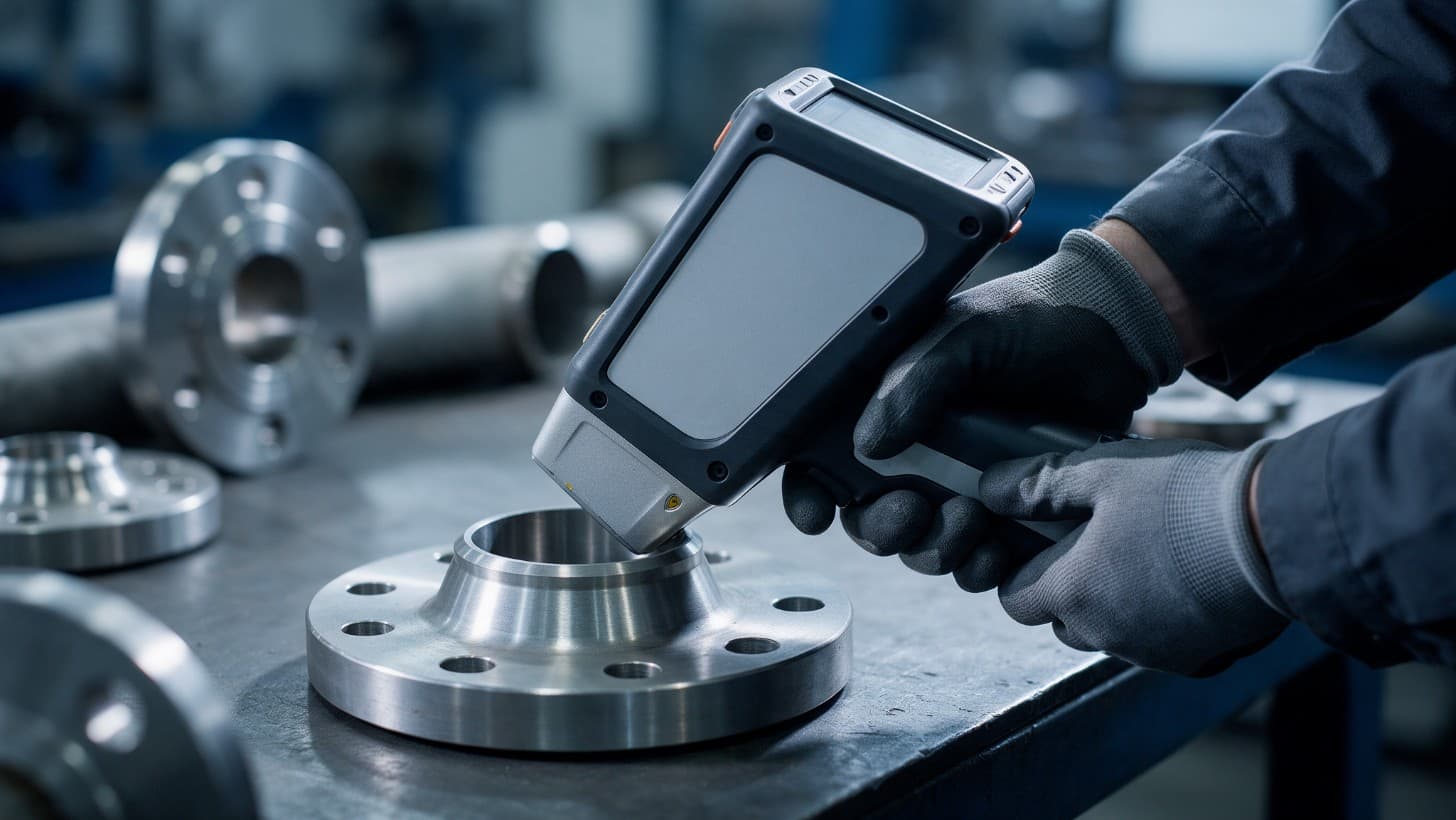
PMI, positive material identification, is a check on the actual component that its alloy matches the specification. It is done with portable instruments, most often handheld X ray fluorescence (XRF), or optical emission spectroscopy (OES) and laser based LIBS where carbon must be measured. PMI confirms which alloying elements are present and in roughly what amounts; it catches mix ups that paperwork alone cannot. Require it on a purchase order for alloy pressure parts and welds in critical service, and state the method, extent, acceptance criteria and who witnesses it.
It does not replace material certificates. The certificate records the mill's full chemistry and mechanical tests; PMI checks that the part in front of you is the alloy that certificate describes.
Why this matters now
API's recommended practice on material verification, RP 578, was reissued in February 2023 with a wider title covering material verification for new and existing assets. It applies to ferrous and non ferrous alloys during construction, installation, maintenance and inspection, including materials bought through distributors, fabricators and contractors [1]. The lessons behind it are well documented. In 2005 at BP's Texas City refinery, a carbon steel elbow fitted in place of an alloy one during maintenance failed in hot hydrogen service, causing a fire and about $30 million in damage; the US Chemical Safety Board said PMI with an XRF device would have caught the error [2]. A CCPS Process Safety Beacon describes a 2013 rupture of a carbon steel pipe that should have been alloy, installed during a 1998 shutdown [3].
Create and manage RFQs in minutes
ChemCapital handles the entire procurement cycle, from structured RFQs and supplier comparisons to formal purchase orders and delivery tracking.
What each method can and cannot detect
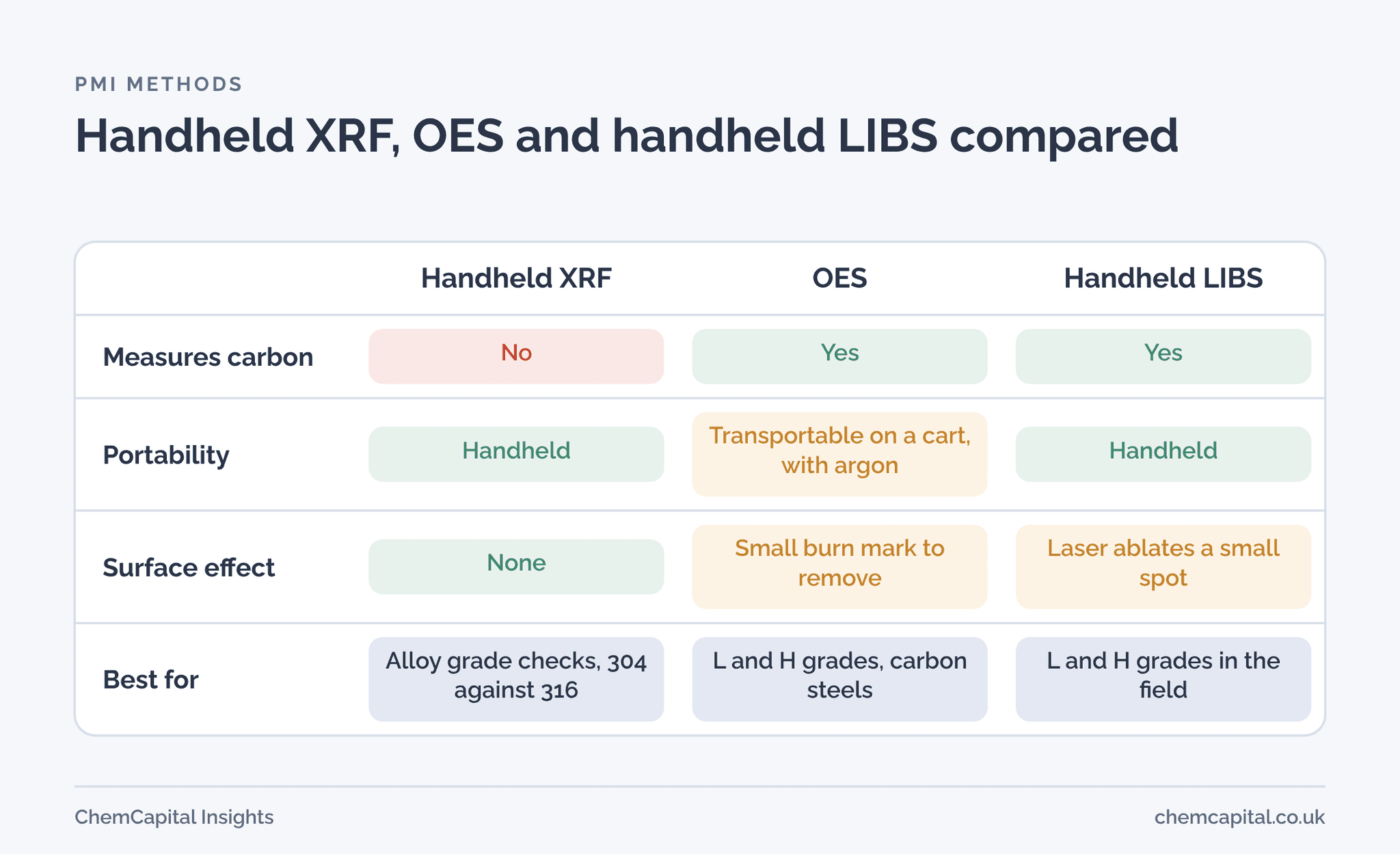
ASTM E1476, the guide to metals identification and sorting, groups XRF and OES as quantitative methods that respond directly to alloying elements, unlike indirect methods such as eddy current or spark testing [4].
The key limit is carbon. Handheld XRF cannot detect elements lighter than magnesium, so it cannot tell 316 from 316L or 316H; OES and handheld LIBS can measure carbon and grade L and H stainless steels [5]. A fabricator's guide makes the same point: XRF cannot distinguish 316 from 316L, while OES can but is larger, more expensive and slower [6]. XRF can, however, tell 304 from 316, because 316 contains molybdenum.
PMI also does not check mechanical properties, heat treatment or grain structure. Those come from the certificates; our guide to EN 10204 3.1 and 3.2 certificates explains what each type proves. For other inspection methods, see NDT methods compared.
When to require PMI
- Alloy pressure parts in critical service, such as hydrogen, high temperature, toxic or strongly corrosive duties.
- Welds made with alloy filler, where the wrong wire is easy to pick up.
- Look alike grades in the same shop, such as 304L and 316L, or carbon and low alloy steel fittings.
- Items bought through distributors or stockists, where traceability passes through more hands.
- Replacements during maintenance. The CCPS Beacon recommends a 100 percent component inspection of replaced items before restart [3].
How much to test, and what counts as a pass
| Item | Typical extent | Method | Acceptance |
|---|---|---|---|
| Alloy pressure components (shells, heads, nozzles, flanges) | 100% | XRF | Elements within the specified grade's ranges |
| L grade components where carbon matters | At least one per heat, or as specified | OES or LIBS | Carbon within the L grade limit |
| Alloy welds | Agreed sample, for example 10% of welds | XRF on weld metal | Weld metal consistent with specified filler |
| Bolting in alloy service | Sample per lot | XRF | Grade as specified |
The extents above are illustrative; set your own by risk. Record each reading against the item, mark tested items so they cannot be confused later, and quarantine anything that fails until it is replaced or dispositioned.
Writing PMI into the purchase order and ITP
Put a short clause in the order and a line in the inspection and test plan:
| ITP field | Example entry |
|---|---|
| Activity | PMI of alloy pressure parts and welds |
| Reference | Buyer specification, with API RP 578 as guidance |
| Method | XRF; OES or LIBS for carbon on L grades |
| Extent | 100% of pressure parts; 10% of welds; one per heat for carbon |
| Acceptance | Composition within the specified grade |
| Record | PMI report with item, heat number, readings and instrument |
| Inspection point | Witness |
| Timing | Before final assembly and before pressure test |
Ask bidders to price PMI as a separate line, so it is not quietly dropped, and to confirm which instruments they will use.
Practical example
In this illustrative example, an order for a heat exchanger with 316L tubes and a duplex stainless channel requires PMI of all alloy pressure parts by XRF, carbon checks by OES on one item per heat of 316L, and 10% of alloy welds.
The fabricator tests 48 items. One weld neck flange reads with no molybdenum, which marks it as 304L, not the specified 316L; it is quarantined and replaced before the pressure test. The carbon checks confirm all 316L heats are within the L grade limit. The PMI line in the order cost far less than finding the wrong flange in service.
Where ChemCapital fits
ChemCapital sends one structured RFQ with line items and attachments, such as your inspection and test plan and PMI requirement, to several suppliers, and incoming quotes are checked for missing fields, compliance gaps and scope differences, which makes an unpriced PMI line easier to spot. After award, purchase orders are issued in the platform and suppliers post milestone updates, with a message thread for each order.
Ready to make sure inspection requirements are priced in every bid? Start a free 14 day ChemCapital trial, with no credit card needed.
Frequently asked questions
What is PMI testing?
Positive material identification is a check on the actual component that its alloy matches the specification, usually with a portable X ray fluorescence or optical emission analyser. It confirms the alloying elements present and catches mix ups that certificates alone cannot.
Can XRF tell 316 from 316L?
No. Handheld XRF cannot measure carbon, so it cannot distinguish low carbon L grades from standard grades. Use optical emission spectroscopy or handheld LIBS where carbon content matters.
Is PMI a replacement for material certificates?
No. Certificates record the full chemistry and mechanical properties from the mill. PMI checks that the part in front of you is the alloy the certificate describes, so the two work together.
Continue reading
Informational only, not procurement or legal advice. Cited names, frameworks, and statistics belong to their respective owners.
Create and manage RFQs in minutes
ChemCapital handles the entire procurement cycle, from structured RFQs and supplier comparisons to formal purchase orders and delivery tracking.
Start for freeRelated articles

EPC vs EPCM: Who Buys the Equipment?
How EPC and EPCM contracts differ, who places equipment orders under each, where cost and schedule risk sit, and what it means for owners, suppliers and long lead items.
Change Orders and Variations on Equipment Orders
How changes happen on engineered equipment orders after award, how to request, price and approve them, and how buyers and suppliers both stay protected.
Purchase Order Terms for Capital Equipment, Clause by Clause
The clauses that decide who pays when equipment is late, fails a test or breaks in year two, with what to check and where suppliers usually push back.