
Flange Types and Ratings: PN vs ASME Class for UK Process Plant
Flange types and faces, what PN and ASME Class ratings mean at temperature, why PN 16 and Class 150 flanges are not interchangeable, and how to specify flanges in an RFQ.
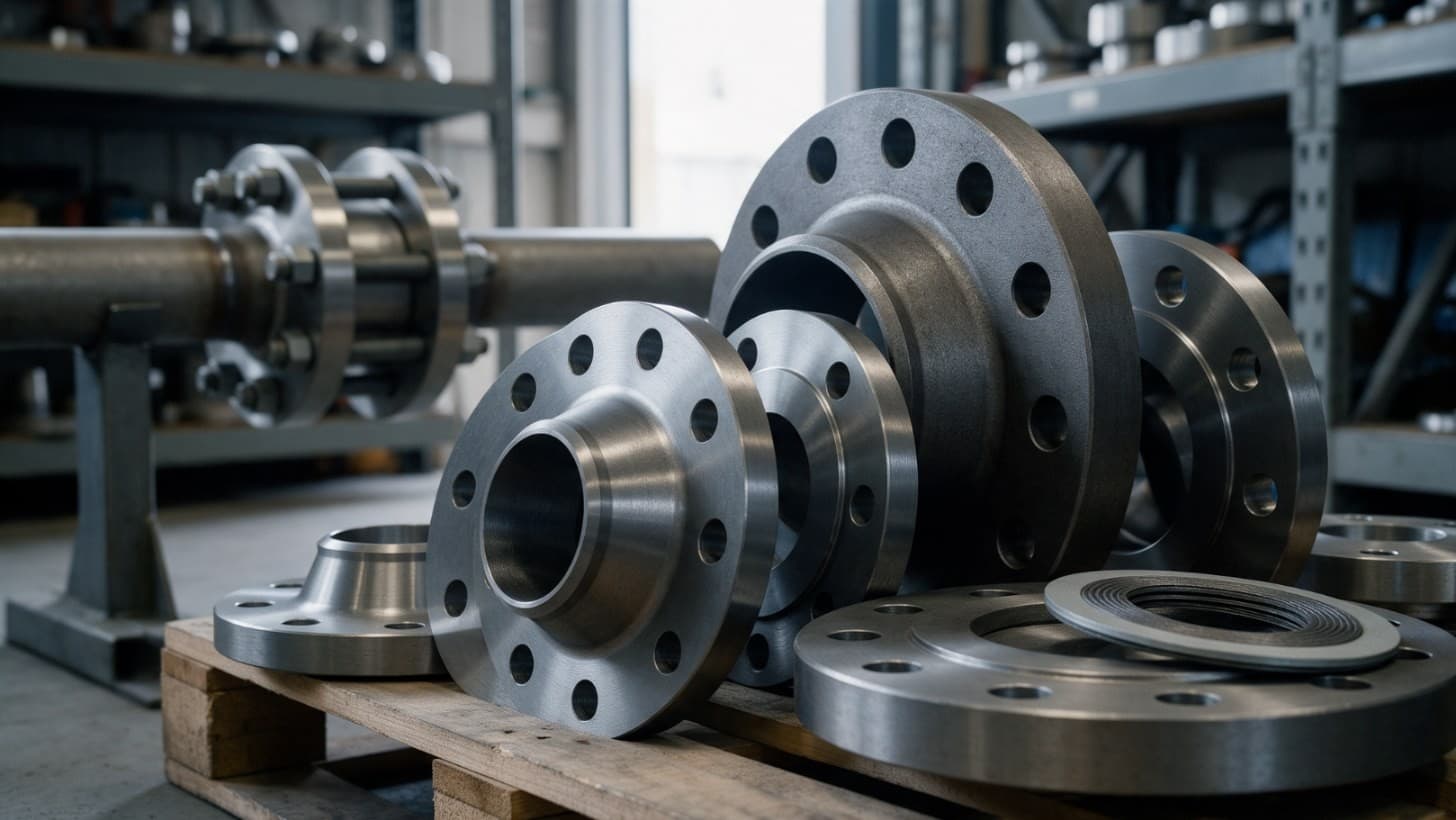
A flange's type is how it joins the pipe: weld neck, slip on, socket weld, lap joint, threaded or blind. Its face is how it seals: raised face, flat face or ring type joint. Its rating is the pressure it holds at a given temperature. Plant built to European standards uses PN ratings from EN 1092 Part 1, which superseded most national standards [3]; vendors working to American practice quote Classes from ASME B16.5.
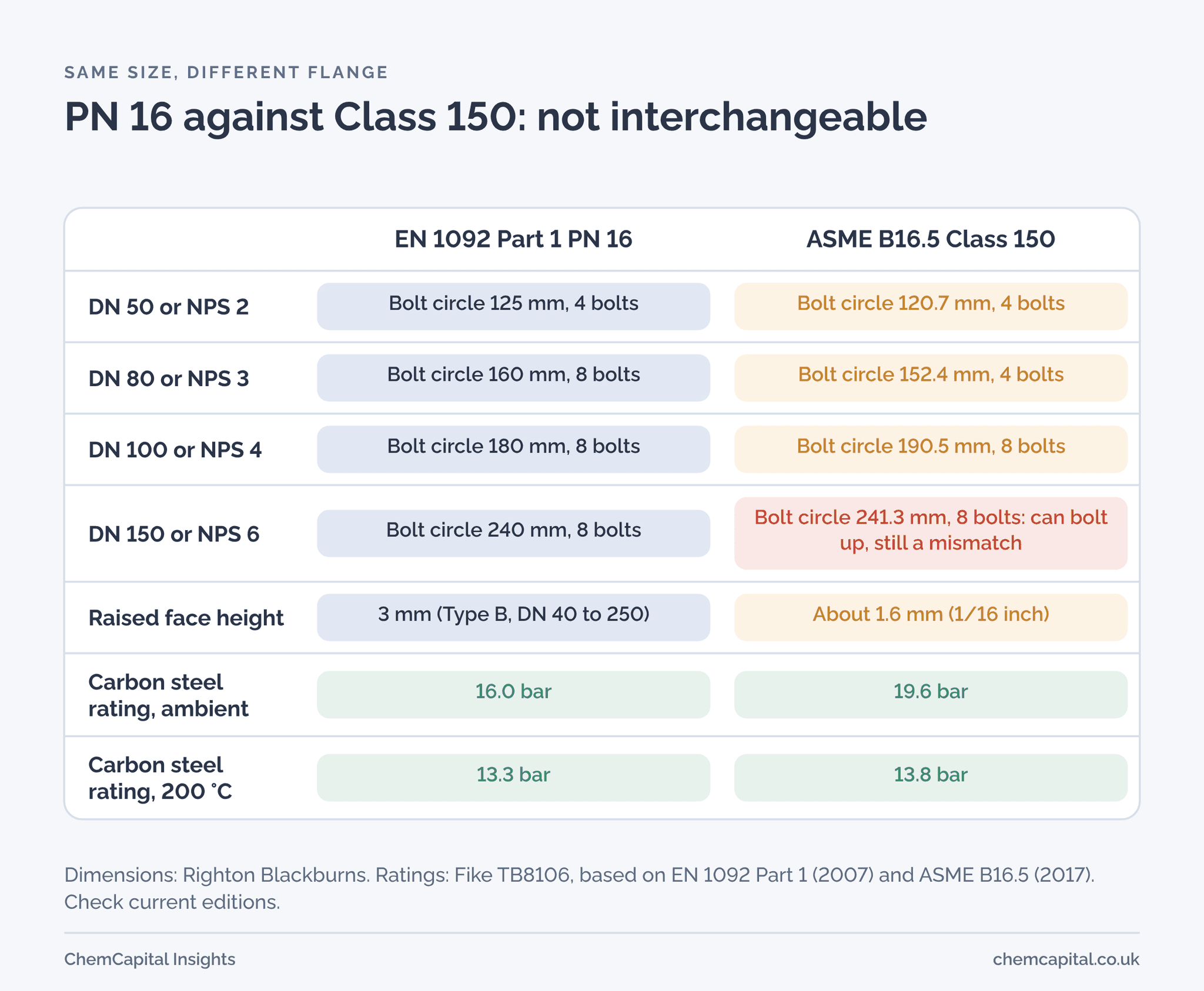
PN 16 and Class 150 sound like neighbours, but they are not interchangeable: at DN 100 the PN 16 bolt circle is 180 mm and the Class 150 one is 190.5 mm [4]. Nor does either number hold at temperature: in one manufacturer's table, a carbon steel PN 16 flange is rated at 13.3 bar at 200 °C [5].
So an RFQ (request for quotation) must name the standard, rating, type, face, bore and material, not just "PN 16" or "150#".
Why this matters now
ASME has published a 2025 edition of B16.5 [2], and BSI lists the 2018 edition of BS EN 1092 Part 1 as current but under review [1]. Older UK plant may still carry flanges to BS 4504, which EN 1092 replaced, or to the older BS 10 [4], and new equipment must match them.
A mismatch missed at bid stage usually surfaces on site, forcing adapter spools, new flanges or delay. Flanges belong in the RFQ, as part of RFQ best practice.
Create and manage RFQs in minutes
ChemCapital handles the entire procurement cycle, from structured RFQs and supplier comparisons to formal purchase orders and delivery tracking.
Flange types: how the flange joins the pipe
EN 1092 Part 1 numbers its flange types; the common numbers are in brackets below [4].
| Type | How it attaches | Where it fits |
|---|---|---|
| Weld neck (Type 11) | Tapered hub with a bevelled weld end [4]; bore matched to the pipe schedule [6] | High pressure, high or sub zero temperature, repeated bending [7] |
| Slip on (Type 12 hubbed, Type 01 plate) | Slides over the pipe and is welded on [4, 7] | Cheap and easy to fit, but weaker and shorter lived in fatigue than a weld neck; lower pressures [7] |
| Socket weld | Pipe enters a socket, leaving a 1/16 to 1/8 inch gap (about 1.6 to 3.2 mm) before welding [7]; bore matched to schedule [6] | Small bore, high pressure piping [7] |
| Lap joint with stub end | Stub end welded to the pipe; a loose flange turns freely behind it [7] | Easy bolt alignment; the loose flange stays out of the fluid |
| Threaded | Screwed on, no welding; needs a thicker pipe wall [7] | Small pipe sizes |
| Blind (Type 05) | Bolted over a nozzle or line end | Closing nozzles, isolating plant |
HSE's isolation guidance, HSG253, says blank flanges closing off open pipework must be suitably rated, with the correct gaskets and bolts [9].
Flange faces: raised face, flat face and ring type joint
- Raised face is the ASME B16.5 default. It stands 1/16 inch (about 1.6 mm) proud on Class 150 and 300 and 1/4 inch (about 6.4 mm) on Class 400 and above [6]. EN 1092 Part 1 calls it Type B, 3 mm high from DN 40 to DN 250 [4].
- Flat face, EN Type A [4], goes against brittle parts such as cast iron or fibreglass, with a full face gasket [6].
- Ring type joint (RTJ) seats a solid metal ring in machined grooves for a metal to metal seal; the ring is oval or octagonal in section and made of soft iron, soft steel or an alloy [6].
The gasket must suit the face, fluid and rating: IChemE's Safety Centre warns that one of the wrong size, shape or material can leak, and advises against reusing gaskets. In one case, mild steel bolts unsuited to nitric acid failed on an absorber tower flange [8].
PN and Class: what the numbers mean
EN 1092 Part 1 covers steel flanges from PN 2.5 to PN 400 and DN 10 to DN 4000 [1]. The PN number equals the maximum pressure in bar at 20 °C [3]. ASME B16.5 covers Classes 150, 300, 400, 600, 900 and 1500 from NPS 1/2 to NPS 24, and Class 2500 up to NPS 12; ASME B16.47 covers NPS 26 to NPS 60 [2].
Both ratings fall as temperature rises. The values below come from a Fike bulletin based on the 2017 edition of ASME B16.5 and the 2007 edition of EN 1092 Part 1; its EN carbon steel values apply up to 50 mm flange thickness [5]. Check current editions.
| Rating and material | Ambient | 100 °C | 200 °C | 300 °C |
|---|---|---|---|---|
| PN 16, carbon steel 1.0460 | 16.0 bar | 14.8 bar | 13.3 bar | 11.0 bar |
| Class 150, carbon steel | 19.6 bar | 17.7 bar | 13.8 bar | 10.2 bar |
| PN 16, stainless 1.4404 (316L) | 16.0 bar | 15.1 bar | 12.7 bar | 11.0 bar |
| Class 150, 316 stainless | 19.0 bar | 16.2 bar | 13.7 bar | 10.2 bar |
Ambient means up to 50 °C for EN 1092 and minus 29 °C to 38 °C for ASME. The ASME stainless row is for grade 316 [5]; check the material group for 316L. Carbon steel Class 150 beats PN 16 when cold but not at 300 °C, and for both materials here, PN 16 no longer means 16 bar at 100 °C.
ISO 7005 has also given American pattern flanges their own PN numbers, such as PN 20 and PN 50 [3]. EN 1759 Part 1 is the European standard for Class designated flanges [3].
Why PN and Class flanges are not interchangeable
Similar ratings do not make flanges interchangeable [4]:
| Size | Flange | Bolt circle | Bolt holes |
|---|---|---|---|
| DN 50 | PN 10 and PN 16 | 125 mm | 4, for M16 bolts |
| NPS 2 | Class 150 | 120.7 mm | 4, 19.1 mm |
| DN 80 | PN 10 and PN 16 | 160 mm | 8, for M16 bolts |
| NPS 3 | Class 150 | 152.4 mm | 4, 19.1 mm |
| DN 100 | PN 10 and PN 16 | 180 mm | 8, for M16 bolts |
| NPS 4 | Class 150 | 190.5 mm | 8, 19.1 mm |
| DN 150 | PN 10 and PN 16 | 240 mm | 8, for M20 bolts |
| NPS 6 | Class 150 | 241.3 mm | 8, 22.4 mm |
At DN 50 the bolt circles differ by only 4.3 mm; at DN 80 the bolt count differs too. At DN 150 the bolt circles differ by just 1.3 mm, 240 mm against 241.3 mm with eight holes each, so the two can be bolted together [4]. A joint that bolts up is not proof of a match: the face, gasket and rating can still be wrong.
PN 10 is a similar trap: it shares PN 16 drilling at these sizes [4], so it bolts straight on while holding less: 8.3 bar against 13.3 bar for carbon steel at 200 °C [5].
How to write flange requirements in an RFQ
As one distributor notes, "6 inch 300# RF weld neck" leaves bore and material open; adding the schedule and grade completes it [6]. For each nozzle, state:
- the standard and edition, and what is installed at the tie in
- the PN or Class, plus the design pressure and temperature it must hold
- the type and face, using EN type numbers or ASME names
- for weld neck and socket weld flanges, the pipe outside diameter and wall thickness or schedule
- the material grade and certificate type (see our guide to EN 10204 3.1 and 3.2 certificates)
- gaskets and bolting: who supplies them, to which standard, in which materials
On returned quotes, especially from overseas vendors, look for:
- Class flanges offered against a PN specification, sometimes written as PN 20 or PN 50 [3]
- "150#" or "PN 16" with no standard, type, face or material
- PN 10 offered as a saving where PN 16 was asked for
- raised face flanges against cast iron flat face connections [6]
- carbon steel bolting where the fluid needs stainless or alloy [8]
Practical example
Take an illustrative carbon steel vessel for a UK site with PN 16 pipework. It has six nozzles, two each at DN 50, DN 80 and DN 100, and a design condition of 12 barg at 200 °C. Ratings are from Fike's tables [5]; prices are illustrative.
| Item | Bid A | Bid B | Bid C |
|---|---|---|---|
| Flanges offered | PN 16 weld neck, Type B face | Class 150 raised face weld neck | PN 10, offered as a saving |
| Rating at 200 °C | 13.3 bar | 13.8 bar | 8.3 bar |
| Against 12 barg | 1.3 bar margin | 1.8 bar margin | 3.7 bar short |
| Drilling matches site pipework | Yes | No | Yes |
| Vessel price | £62,400 | £59,800 | £58,900 |
| Adapter spools, 6 × £550 | None | £3,300 | Not applicable |
| Comparable total | £62,400 | £63,100 | Excluded |
On price alone, Bid C is £3,500 below Bid A and Bid B £2,600 below. Bid C bolts up perfectly but is under rated, so it is excluded. Bid B holds the pressure, but each nozzle needs a spool with Class 150 at one end and PN 16 at the other: six extra gasketed joints, and £700 more than Bid A. Ask Bid B to price PN 16 nozzles before awarding.
Compare flange compliance across every bid
AI Quotation Comparison compares quotes side by side. AI extracts price, lead time, materials, certifications and scope from each quote for you to review, so a Class 150 flange offered against PN 16 is easier to spot. Quotes with mandatory gaps are flagged and kept out of the ranking, and you make the decision. Try it free with up to three quotes, without signing up.
Ready to catch flange mismatches before they reach site? Start a free 14 day ChemCapital trial, with no credit card needed.
Frequently asked questions
Is PN16 the same as Class 150?
No. Their carbon steel ratings are close, 16.0 against 19.6 bar at ambient and 13.3 against 13.8 bar at 200 °C in one manufacturer's table, but the flanges are not interchangeable: at DN 100 the PN 16 bolt circle is 180 mm and the Class 150 one is 190.5 mm. At DN 150 the drilling differs by only 1.3 mm, so the two can be bolted together; treat that as a mismatch, not a fit.
What are the different types of flanges?
The common types are weld neck, slip on, socket weld, lap joint with stub end, threaded and blind. Each comes with a face such as raised face, flat face or ring type joint, chosen for the pressure, temperature, pipe size and the part it mates with.
What does PN16 mean on a flange?
PN is the pressure designation used in EN 1092, and the number equals the maximum pressure in bar at 20 °C. The allowable pressure falls as temperature rises: in a table based on the 2007 edition, a carbon steel PN 16 flange is rated at 13.3 bar at 200 °C.
What is the difference between a raised face and a flat face flange?
A raised face stands proud of the bolting area: 1/16 inch (about 1.6 mm) on ASME Class 150 and 300, and 3 mm on EN 1092 Type B from DN 40 to DN 250. A flat face flange, EN Type A, is used against brittle parts such as cast iron, with a full face gasket.
Continue reading
Informational only, not procurement or legal advice. Cited names, frameworks, and statistics belong to their respective owners.
Create and manage RFQs in minutes
ChemCapital handles the entire procurement cycle, from structured RFQs and supplier comparisons to formal purchase orders and delivery tracking.
Start for freeRelated articles
Where to Find Pharma and Chemical Plant Projects Before They Go to Tender: the 2027 Pipeline
Twenty pharma and chemical plant projects checked against owner or government announcements, the buying timeline on each, and where to watch for the next ones for free.
TEMA Heat Exchanger Types: How to Read AES, BEM and AEU
How to decode the three letter TEMA type, what AES, BEM, AEU and other common types mean for cleaning, expansion, leaks and cost, and how to compare bids that differ.
Safety Valve vs Relief Valve vs Bursting Disc: How to Choose
How safety valves, relief valves and bursting discs differ, when to fit a disc under a valve, the pressure terms that matter, GB duties and what to put in the RFQ.