
IKTVA Score Calculation: A Worked Example for an Equipment Supplier
How an IKTVA score is calculated, line by line, for an illustrative Saudi assembly and service company, and three practical changes that lift it from 28.2% to 40.1%.
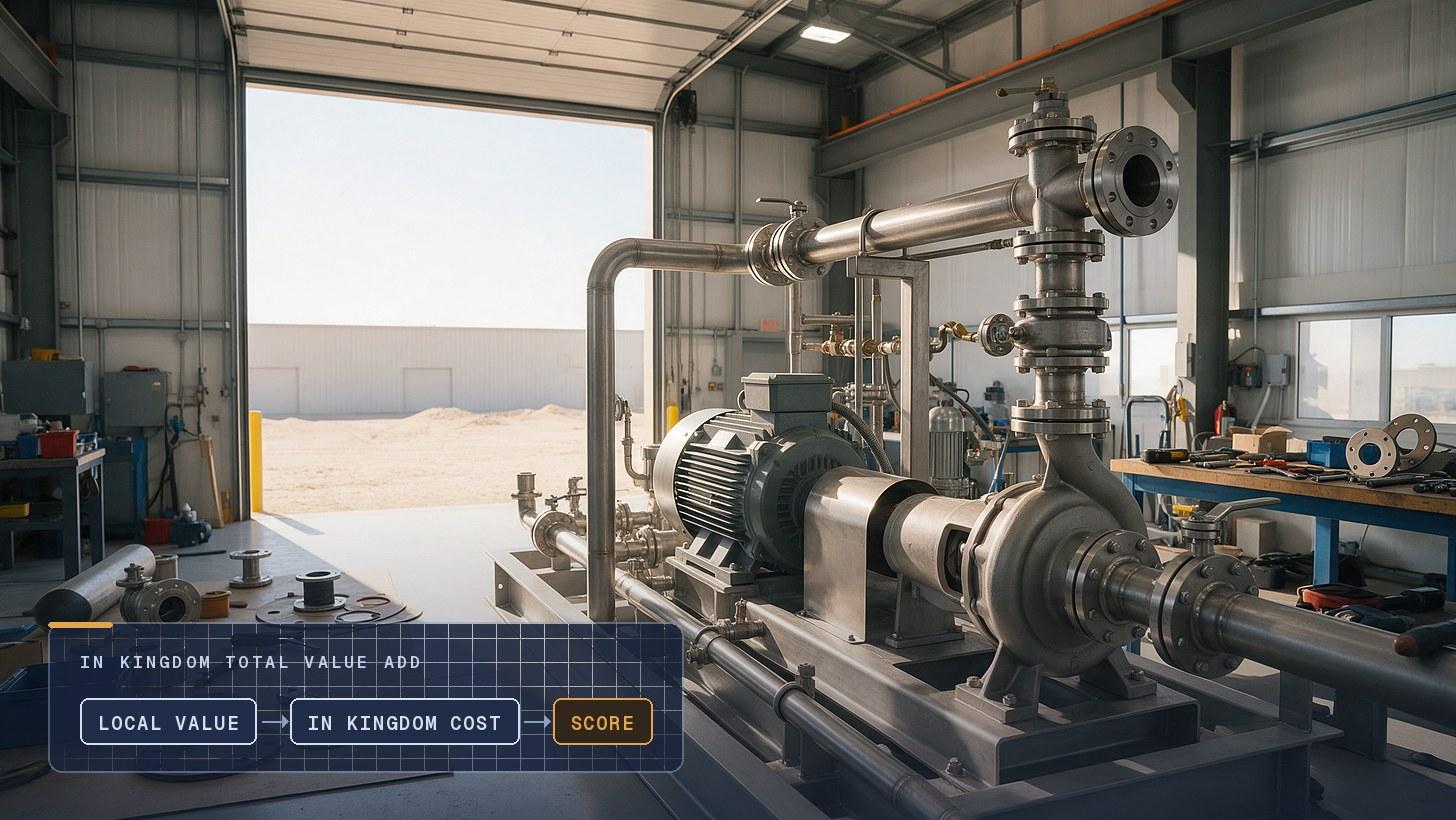
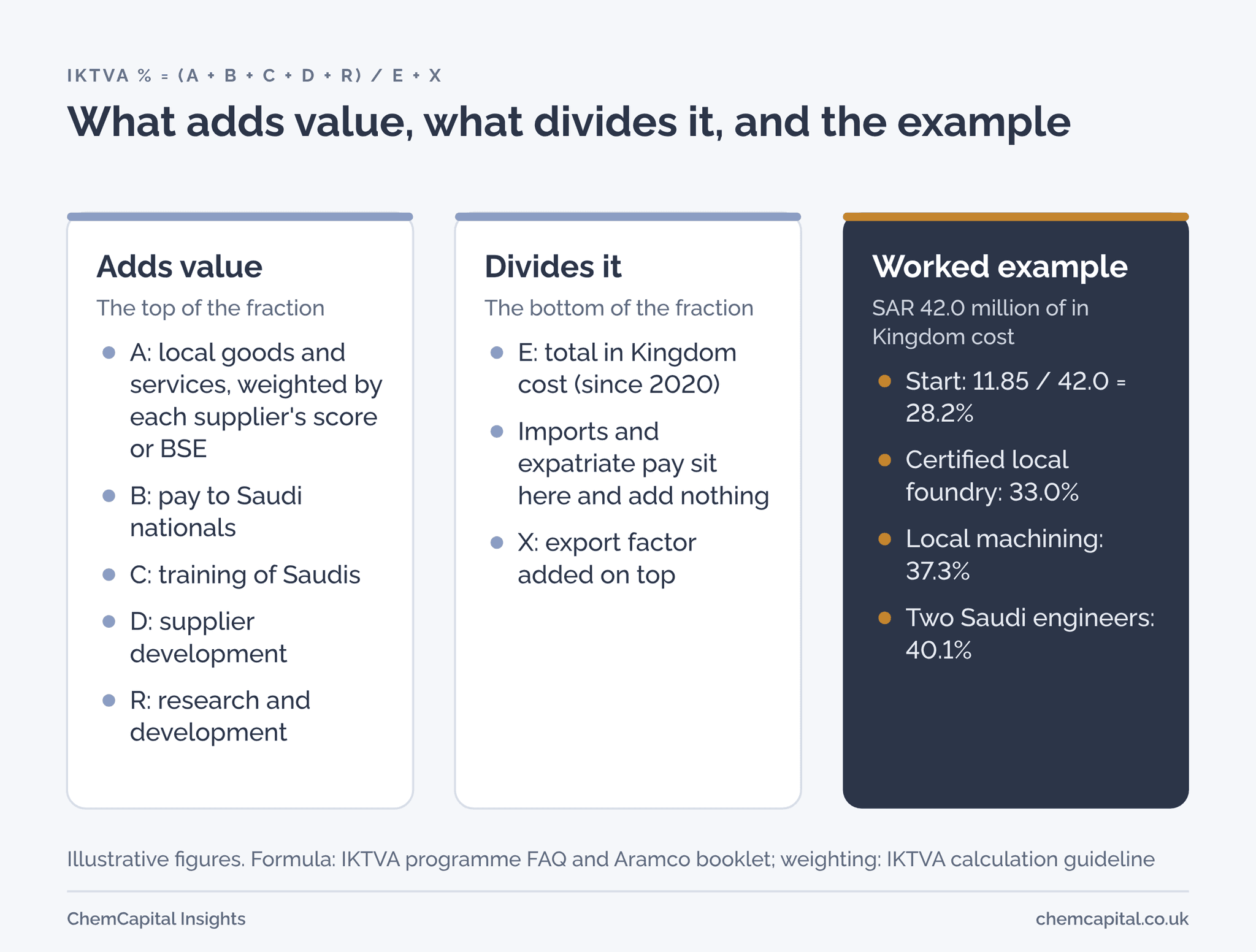
An IKTVA score is the share of a supplier's in Kingdom costs that adds value in Saudi Arabia: localised goods and services (A), pay to Saudi nationals (B), training of Saudis (C), supplier development (D) and research and development (R), divided by total in Kingdom costs (E), plus an export factor (X) [1]. In the worked example below, a Saudi assembly and service company with SAR 42.0 million of in Kingdom costs scores 28.2%, and three practical changes lift it to 40.1%.
ChemCapital is not affiliated with Aramco or the IKTVA programme. Scores are certified through Aramco's own IKTVA process, described below. All figures in the example are illustrative. Checked on 24 November 2026.
IKTVA is Aramco's measure of value kept in the Kingdom
Aramco created the In Kingdom Total Value Add programme to put local content at the heart of its procurement. Suppliers self report figures each year across seven categories: revenue, goods and services, Saudi payroll costs, Saudi training and development, Saudi supplier development, research and development, and export. Aramco requires the numbers to be verified by a third party as part of the annual submission [2].
Participation is not optional for Aramco's suppliers. Aramco's material supplier guide says participation is required for doing business with Saudi Aramco, in two steps: a baseline IKTVA survey that measures your current score, and a five year action plan to raise it across every category [3]. The 2018 Aramco booklet describes the plan's content: targets for Saudisation and investment, quarterly status updates and annual progress reviews [2].
A local content score is built over a five year plan, and it counts for one buyer. List your products free on ChemCapital so buyers everywhere can find you and invite you to quote.
The formula divides value added in the Kingdom by in Kingdom cost
The current formula, as the IKTVA programme states it, is [1]:
IKTVA % = (A + B + C + D + R) ÷ E + X
| Letter | What it counts |
|---|---|
| A | Localised goods and services, plus depreciation and amortisation |
| B | Compensation paid to Saudi nationals |
| C | Training and development of Saudi nationals |
| D | Supplier development spending |
| R | Research and development |
| E | Total in Kingdom costs |
| X | Export revenue factor, added on top of the ratio |
The bottom of the fraction changed in 2020. Earlier versions, including Aramco's 2018 booklet, divided by revenue from Aramco [2]. Since the 2020 update the denominator is total in Kingdom cost, and the programme says that is the only change to the formula [1].
Component A is where most suppliers gain or lose points, because purchases are not counted at face value. Under the calculation guideline, local goods and services count at a weight equal to the supplier's own certified IKTVA score or a business segment estimate (BSE) for that type of supply. A trader that resells goods made outside the Kingdom is treated as an importer, with a BSE of zero [4]. The guideline lets the largest 70% of local purchases take the higher of the BSE and the supplier's actual score [4]. The example below uses a single weight per line to keep the sums readable.
Worked example: a Saudi assembly arm of a UK pump maker scores 28.2%
The company assembles pump packages in Saudi Arabia from kits made by its UK parent, buys castings and machining locally, and services pumps already installed. All figures are illustrative, in SAR million for one year.
| Cost line | In Kingdom cost (E) | Weight | Counts towards | Value added |
|---|---|---|---|---|
| Pump kits imported from the UK parent | 14.0 | 0% | none | 0.00 |
| Castings bought from a local trader who imports them | 5.0 | 0% (importer) | A | 0.00 |
| Machining from local suppliers with certified scores averaging 45% | 8.0 | 45% | A | 3.60 |
| Local services, rent and utilities at an assumed BSE of 50% | 5.5 | 50% | A | 2.75 |
| Pay to Saudi staff | 5.0 | 100% | B | 5.00 |
| Pay to expatriate staff | 4.0 | 0% | none | 0.00 |
| Training of Saudi staff | 0.3 | 100% | C | 0.30 |
| Supplier development | 0.2 | 100% | D | 0.20 |
| Total | 42.0 | 11.85 |
IKTVA = 11.85 ÷ 42.0 = 28.2%. The company does not export, so X adds nothing.
Two lines do most of the damage. The kits from the parent are 33% of in Kingdom cost and add nothing. The castings look local on the invoice but come through an importer, so they count at zero too [4].
Three changes lift the score to 40.1%
Each change below is applied on top of the one before. In Kingdom cost stays at SAR 42.0 million throughout, because each change moves spend rather than adding it.
| Change | Effect on value added | Value added | IKTVA |
|---|---|---|---|
| Starting point | 11.85 | 28.2% | |
| 1. Buy the castings from a Saudi foundry with a certified score of 40% instead of the importer | 5.0 × 40% = +2.00 | 13.85 | 33.0% |
| 2. Move SAR 4.0 million of casing machining from the UK kit to local machining suppliers at 45% | 4.0 × 45% = +1.80 | 15.65 | 37.3% |
| 3. Fill two engineering roles, SAR 1.2 million of pay, with Saudi engineers instead of expatriates | +1.20 to B | 16.85 | 40.1% |
The order matters for a supplier with limited time. The first change costs nothing but a supplier switch and a request for the foundry's certificate. The second needs qualified local machine shops. The third depends on hiring and training, which is also what the five year action plan is meant to show [3].
Your score feeds your customer's score
The same weighting works up the chain. When an Aramco contractor buys from you, its own component A counts that purchase at your certified score or your segment's BSE [4]. A supplier with no certified score hands its customer a low weight; an importer hands over zero.
This is why contractors on Aramco projects favour suppliers inside the Kingdom. Saipem told its suppliers in November 2024 that on its Saudi projects in Kingdom suppliers were about double those outside in number and value, which it put down to Aramco's contract requirements and the IKTVA programme [5].
For a manufacturer that only exports to Saudi Arabia, the formula has nothing to count: with no in Kingdom costs, there is no numerator. The usual routes to a meaningful score are a Saudi entity of your own, local assembly or service, or a Saudi partner with its own certified score. Our article on Aramco vendor registration covers the registration side, and our guide to finding distributors and agents covers choosing a partner.
Common mistakes when estimating a score
- Counting imports bought locally. A local reseller of imported goods is an importer with a BSE of zero [4]. Ask every local supplier for its certified score.
- Using revenue as the denominator. That was the pre 2020 formula. Divide by total in Kingdom cost [1].
- Forgetting verification. Aramco requires third party verification of the figures in the annual submission [2]. An unverified estimate is a planning tool, not a score.
- Treating the score as a one off. The survey is annual and the action plan runs five years [3].
Where ChemCapital fits
Building a Saudi presence and a certified score takes time, and IKTVA only matters to one buyer and its contractors. ChemCapital lets you list your products and say what you can certify, so buyers searching by duty, size, material and certification can find you and invite you to quote, including buyers outside the Gulf.
Ready to be found by buyers while your local content plans take shape? List your company on ChemCapital. It is free to start.
Frequently asked questions
How is the IKTVA score calculated?
IKTVA percentage equals localised goods and services (A), pay to Saudi nationals (B), training of Saudis (C), supplier development (D) and research and development (R), divided by total in Kingdom costs (E), plus an export factor (X). Since 2020 the denominator has been in Kingdom cost rather than revenue.
Do purchases from local traders count towards IKTVA?
Only partly, and sometimes not at all. Local purchases are weighted by the supplier's certified IKTVA score or a business segment estimate, and a trader reselling goods made outside the Kingdom is treated as an importer with an estimate of zero.
Does an overseas manufacturer need an IKTVA score?
Aramco says IKTVA participation is required for doing business with it. A manufacturer that only exports has no in Kingdom costs for the formula to count, so a meaningful score usually needs a Saudi entity, local assembly or service, or a Saudi partner with its own certified score.
Who certifies an IKTVA score?
Aramco requires the figures in the annual IKTVA submission to be verified by a third party. Suppliers report each year and agree a five year action plan to raise the score.
Continue reading
Informational only, not procurement or legal advice. Cited names, frameworks, and statistics belong to their respective owners.
Be found by buyers who search by specification
Create your profile and list your products so buyers can find you and invite you to quote. It is free to start: list up to five products and quote on your first three RFQs at no cost.
List your products freeRelated articles
Achilles UVDB for Equipment Suppliers: What It Is, the Verify Audit and Whether You Need It
What Achilles UVDB is under the Procurement Act 2023, what the subscription and Verify audit cost in 2026, which Verify category fits a manufacturer, and what UVDB does not do.

Becoming an Anglian Water Supplier: Alliances, Frameworks and Scanmarket
Who delivers Anglian Water's £11bn AMP8 programme, how it buys directly on Scanmarket, the prequalification it accepts for goods, the Water Innovation Network for new products, and its payment terms.
Severn Trent Supplier Registration: Registered, Then Qualified
How Severn Trent registers suppliers on SAP Ariba, why qualified supplier status is what puts you in its teams' searches, how its tenders run, what is coming after AMP8, and its payment terms.