
Payment Terms and Letters of Credit for Equipment Exporters
How equipment exporters secure payment: advance payments and guarantees, confirmed letters of credit under UCP 600, avoiding discrepant documents, retentions, and UK Export Finance support for bonds and working capital.
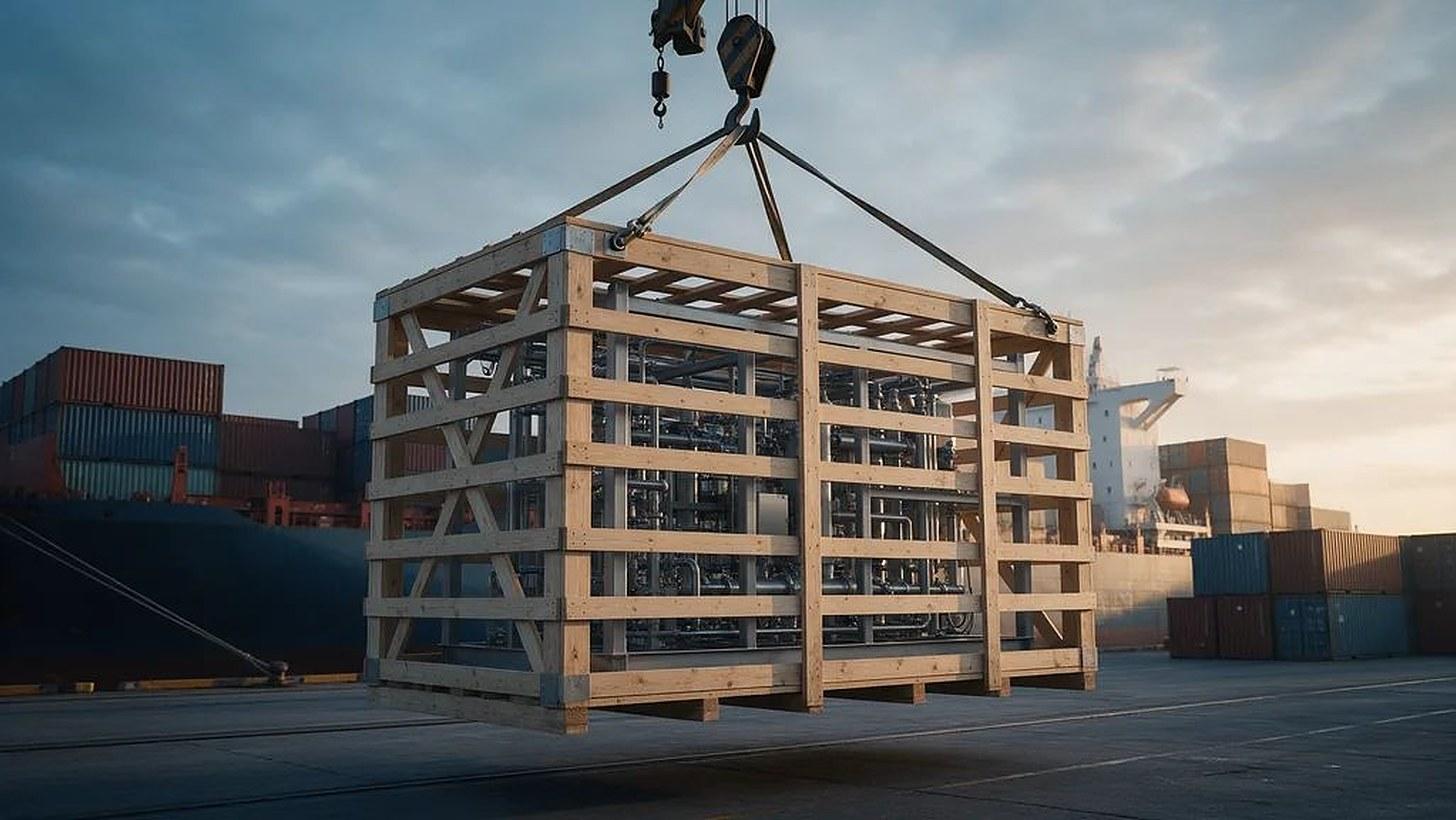
For an equipment exporter, the safest payment structure combines an advance payment, a documentary letter of credit for the main shipment payment, and a small retention released after commissioning. A letter of credit is a bank's promise to pay you when you present documents that comply exactly with its terms, so it protects you from a buyer who will not or cannot pay. It only works if you can produce those documents exactly, on time. This guide explains the payment options, how letters of credit work under UCP 600, the common traps, and the UK government support that can help with bonds and working capital.
This is general information, not financial or legal advice; check the current text before you rely on it.
Why this matters now
An engineered equipment order ties up cash for months. You buy materials, pay staff and sub suppliers, and build, often long before shipment. Selling abroad adds distance, different legal systems and sometimes currency and country risk. A payment structure that leaves most of the price due after delivery, on open account, means you are financing your customer and carrying the risk that it does not pay.
European standard supply terms show the default many makers start from. Orgalime S 2000 sets one third of the price at contract formation, one third when the product is ready, and the rest on delivery, each due within 30 days of invoice [1]. Export buyers often push for less up front. Your job is to agree terms that keep cash flowing and payment secure.
Access real procurement opportunities from global buyers
Join ChemCapital to get discovered by verified procurement teams across pharmaceutical, chemical, and industrial manufacturing.
The payment options, from safest to riskiest for the seller
| Method | How it works | Risk to the seller |
|---|---|---|
| Cash in advance | Customer pays before you build or ship | Lowest; few buyers accept it for large orders |
| Advance payment, secured by a guarantee | Customer pays a share up front; your bank guarantees to refund it if you fail to perform | Low for the advance; depends on how the rest is paid |
| Confirmed letter of credit | Customer's bank promises to pay against documents; a bank in your country adds its own promise | Low, if your documents comply |
| Unconfirmed letter of credit | Only the customer's bank promises to pay | Depends on that bank and its country |
| Documentary collection | Banks pass documents against payment or acceptance, without a payment promise | Medium; the buyer can still refuse |
| Open account | You ship and invoice; the customer pays later | Highest |
Most capital equipment exports use a mix: an advance against a guarantee, a letter of credit for the main payment, and a retention released after commissioning.
How a letter of credit works
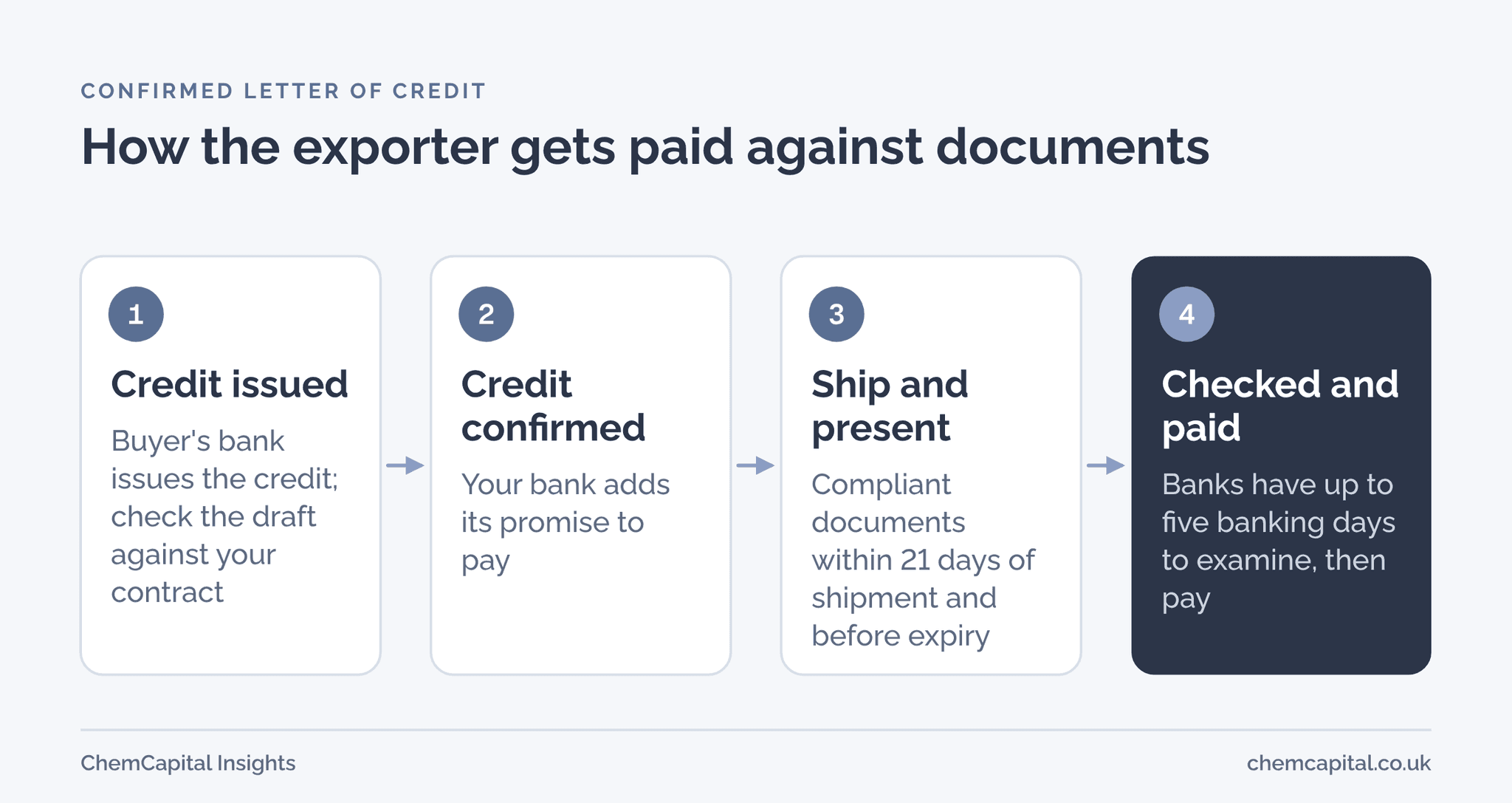
The customer (the applicant) asks its bank (the issuing bank) to issue a documentary credit in your favour (you are the beneficiary). The credit lists the documents you must present, such as a commercial invoice, packing list, bill of lading or air waybill, certificate of origin and inspection certificate, and the dates by which you must ship and present them. When you present complying documents, the bank must pay, or accept or incur a deferred payment undertaking, as the credit states.
Most credits are issued subject to the ICC's Uniform Customs and Practice for Documentary Credits, UCP 600. Four of its rules matter most to an exporter [2]:
- A credit is irrevocable even if it does not say so (Article 3).
- It is separate from your sales contract (Article 4). The bank does not care whether the equipment works; it checks documents.
- Banks deal with documents, not goods (Article 5). A small error in a document can stop payment even if the equipment is perfect.
- Banks have up to five banking days after presentation to decide whether documents comply (Article 14(b)), and documents that include an original transport document must be presented within 21 calendar days after shipment and before the credit expires (Article 14(c)).
A confirmed credit adds the promise of a second bank, usually in your own country, so you are not relying solely on the customer's bank. Ask for confirmation when the issuing bank or its country is a concern.
Where exporters get caught
Discrepant documents are common. An ICC technical advisers' briefing reported discrepancies cited in documents refused on first presentation affecting 65 to 80% of documentary credits, with the most common causes being timing issues: expiry, shipment and presentation period [3]. A refused presentation means delay and fees, and it hands a reluctant buyer a reason not to waive the discrepancy.
To avoid it:
- Check the draft credit before it is issued. Compare it line by line with your contract and with what you can actually do: shipment date, partial shipments, documents required, who issues them, and the expiry date and place.
- Watch for conditions you cannot meet. A certificate that must be signed by the buyer's own inspector puts payment in the buyer's hands. The ICC briefing urges issuing banks to avoid non documentary conditions and beneficiaries to request amendments in time [3].
- Allow realistic dates. Engineered equipment slips. A latest shipment date with no margin, or an expiry soon after shipment, invites a discrepancy. Ask for an amendment early if the schedule moves.
- Use tolerances. Words such as "about" or "approximately" allow a tolerance of up to 10% more or less in amount, quantity or unit price under Article 30 [2].
- Make documents match exactly. Descriptions, quantities, weights and references should match the credit and each other. Prepare them centrally and check them before presentation.
Securing the advance and the retention
Customers who pay an advance will usually want an advance payment guarantee, and some will want a performance bond as well. Bonds tie up your bank facilities. UK Export Finance's Bond Support Scheme gives banks a guarantee of up to 80% of the value of a contract bond, which can free up cash the bank would otherwise hold as collateral [4]. Our guide to payment milestones, retention and bonds covers how to structure them.
The retention, a small share of the price paid after commissioning or a performance test, is the part most likely to be delayed. Tie its release to a clear, objective event, and a long stop date if commissioning is delayed for reasons outside your control.
Financing the build
If the order is larger than your usual working capital can carry, UKEF's Export Working Capital Scheme gives lenders a partial guarantee covering up to 80% of the risk on facilities for specific export contracts, usable before and after shipment [5]. Both UKEF schemes are applied for through your bank, and both apply foreign content, due diligence and sanctions checks [4] [5].
Currency and country risk
Two other risks sit alongside non payment. If you quote in the customer's currency and your costs are in pounds, a currency move between order and payment can erase the margin; either quote in pounds, or ask your bank about forward contracts that fix the rate for each expected payment date. If the customer's country carries political or transfer risk, an unconfirmed credit leaves you exposed even if the customer pays its bank. Confirmation by a bank you trust is the usual answer, and your bank can tell you whether it will confirm credits from that country and at what cost. Price the cost of confirmation, guarantees and hedging into the quotation, not after award, and state who pays bank charges on each side.
Practical example
Illustrative figures. A UK skid maker wins a £600,000 export order. It agrees:
| Payment | Share | Amount | Security |
|---|---|---|---|
| Advance on order | 30% | £180,000 | Advance payment guarantee from the maker's bank |
| On shipment | 60% | £360,000 | Confirmed letter of credit, payable at sight against shipping documents |
| After commissioning | 10% | £60,000 | Retention, released on signed commissioning certificate or within 90 days of delivery, whichever comes first |
If the bank backs the £180,000 guarantee with UKEF's Bond Support Scheme, UKEF guarantees up to 80% of it, £144,000, to the bank [4], which can reduce the cash the bank asks the maker to put up. The £360,000 depends only on presenting compliant documents to a bank the maker trusts, not on the customer's goodwill.
Before you sign
- Agree the payment structure and the letter of credit terms in the contract, including who pays confirmation and amendment fees.
- Get a draft of the credit and check it against the contract before the buyer applies.
- Align the credit's dates with a realistic delivery programme.
- Use Incoterms that match the transport documents the credit requires; see our guide to Incoterms for process equipment.
- Talk to your bank's trade finance team early, especially if you will need bonds or working capital support.
Where ChemCapital fits
Overseas buyers searching for process equipment makers find suppliers through ChemCapital. A free profile on Supplier Discovery shows what you make and where you deliver. See what suppliers get from ChemCapital.
Ready to win more export orders? List your company on ChemCapital. It is free to start.
Frequently asked questions
What is a letter of credit in export trade?
A bank's irrevocable promise to pay the exporter when it presents documents that comply with the credit's terms. Under UCP 600 the bank deals with documents, not goods, and the credit is separate from the sales contract.
What is a confirmed letter of credit?
A credit to which a second bank, usually in the exporter's country, adds its own promise to pay. It protects the exporter if the issuing bank or its country cannot pay.
Why are letter of credit documents rejected?
Most often for timing: late shipment, late presentation or an expired credit. Mismatched descriptions, missing documents and conditions the exporter cannot control are also common.
Can UK Export Finance help with bonds or working capital?
Yes. Its Bond Support Scheme can guarantee up to 80% of a contract bond to the issuing bank, and its Export Working Capital Scheme can guarantee up to 80% of the risk on export working capital facilities, both applied for through your bank.
Continue reading
Informational only, not procurement or legal advice. Cited names, frameworks, and statistics belong to their respective owners.
Access real procurement opportunities from global buyers
Join ChemCapital to get discovered by verified procurement teams across pharmaceutical, chemical, and industrial manufacturing.
List your companyRelated articles
Payment Milestones, Retention and Bonds on Process Equipment Orders
How to tie payment milestones to evidence on process equipment orders, when to hold retention, and what advance payment guarantees, bonds and PCGs secure.
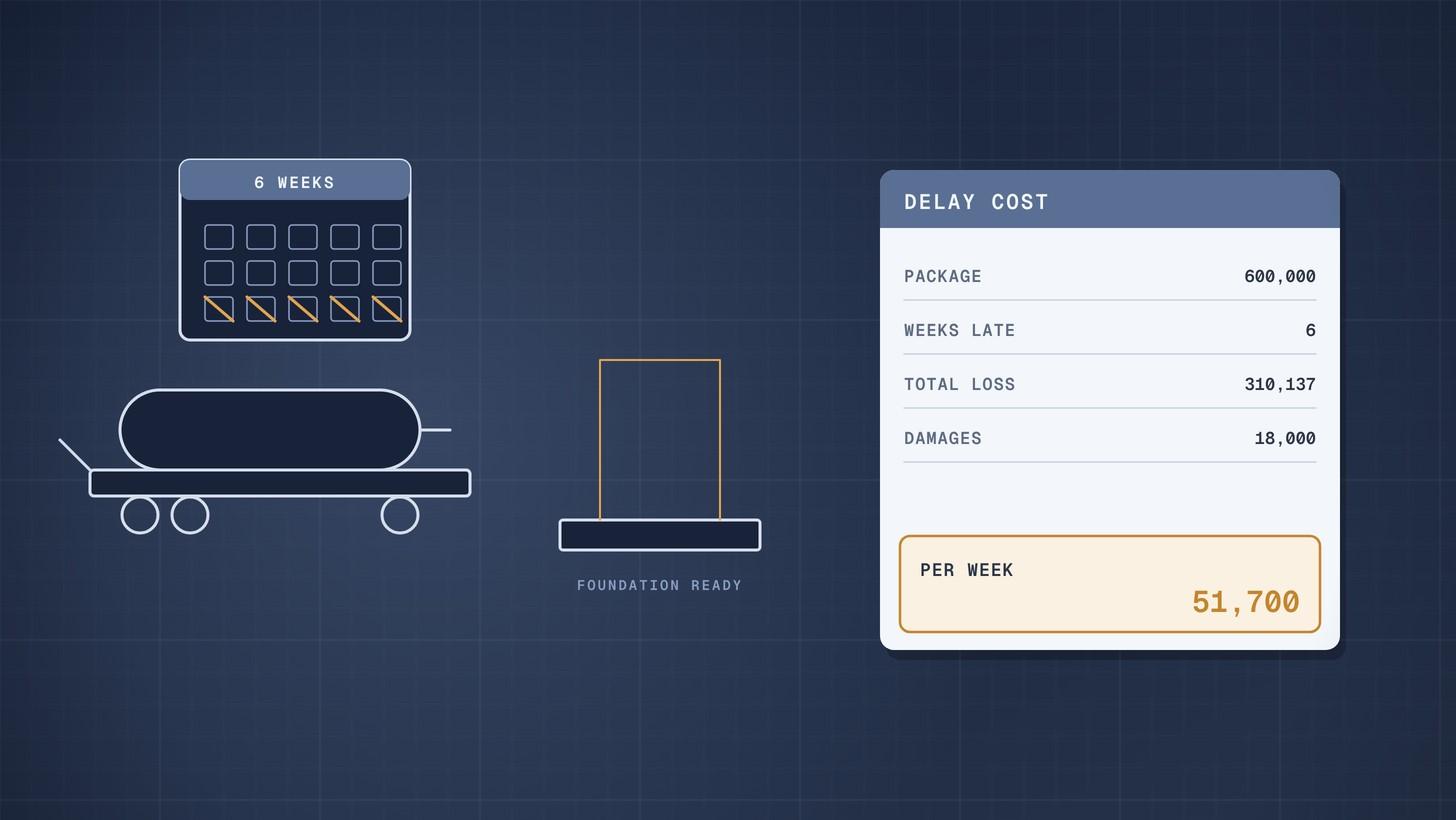
Cost of Late Equipment Delivery: Worked Example
How to calculate the weekly cost of late equipment delivery, compare it with liquidated damages and use it to set a damages rate a supplier can accept.
Payment Milestones and Supplier Cash Flow: Worked Example
How payment milestones, bonds and retention shape an equipment supplier's cash curve, with a worked example comparing two schedules on a £400,000 order.