
Payment Milestones and Supplier Cash Flow: Worked Example
How payment milestones, bonds and retention shape an equipment supplier's cash curve, with a worked example comparing two schedules on a £400,000 order.
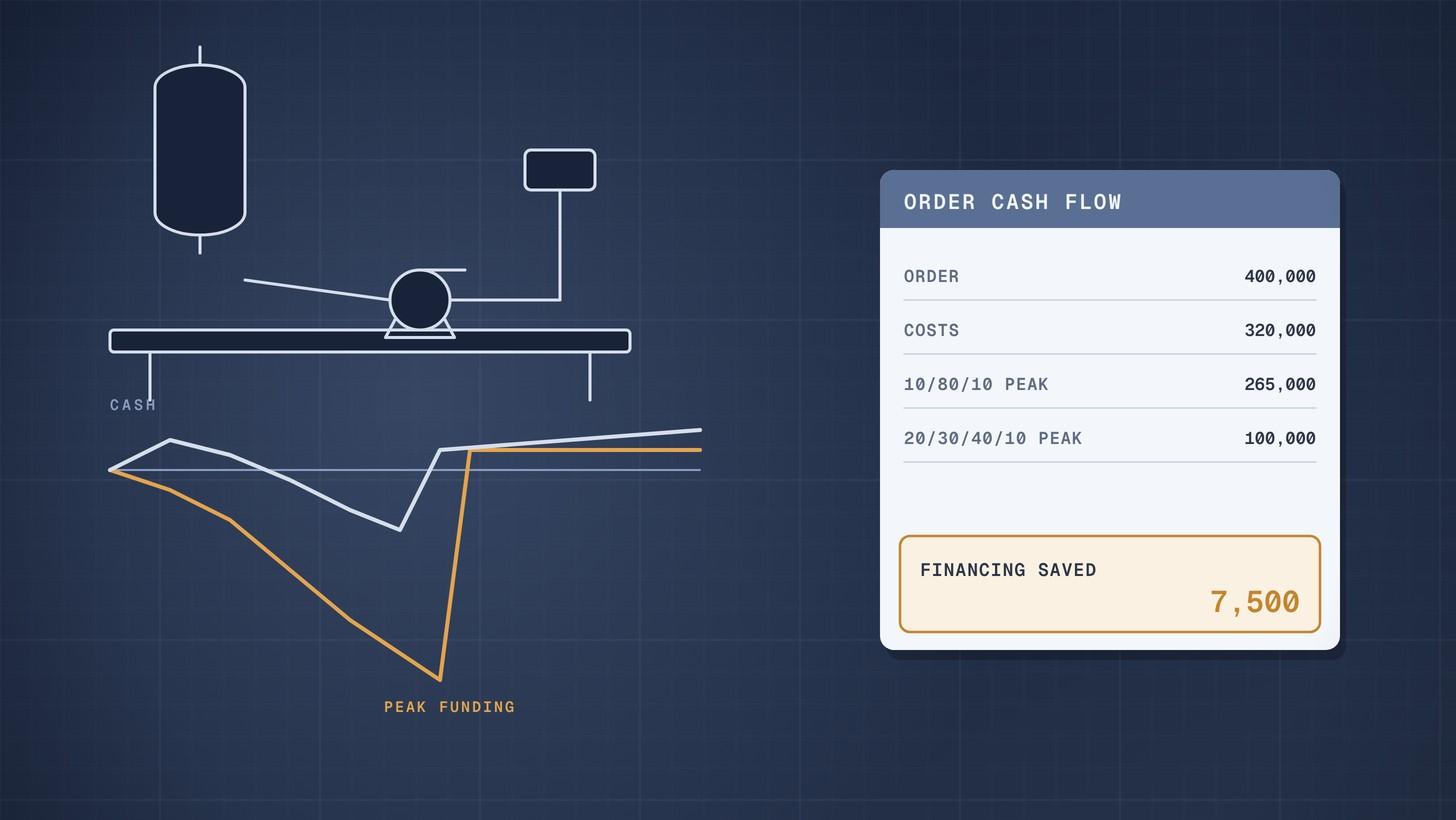
For an equipment supplier, payment milestones decide how much of each order you have to fund yourself before the customer pays. In the worked example below, the same £400,000 package needs peak funding of £265,000 under a 10/80/10 schedule on 60 day terms, but only £100,000 under a 20/30/40/10 schedule on 30 day terms. The difference in financing cost is about £7,500, close to a tenth of the order's margin.
That money is real, and it can be priced. The steps below show how to draw your cash curve for an order, compare two schedules and decide what to ask for when you quote.
Why this matters now
Engineered equipment is built months before it is paid for. Brodies, the law firm, notes that larger projects often need heavy spending before work starts, on long lead materials, specialist equipment and off site fabrication [1]. For a fabricator that means paying for plate, pumps, motors and instruments long before the delivery invoice goes out.
Borrowing to cover the gap has become dearer. The Bank of England raised Bank Rate to 4% on 5 November 2026 [2], and an overdraft or invoice finance facility costs more than that. A schedule that left you funding a quarter of a million pounds for most of a year eats into margin that was priced when money was cheaper.
Access real procurement opportunities from global buyers
Join ChemCapital to get discovered by verified procurement teams across pharmaceutical, chemical, and industrial manufacturing.
What milestone schedules look like
There is no single standard. A Projectmaterials guide to equipment payment terms lists common structures such as 30/70 (advance and shipping documents), 20/70/10 and 10/80/10, with the last 10% often held as retention [3]. Its example for a larger valve package spreads the payments wider: 15% at order, 15% against raw material certificates, 20% at half way through manufacture, 20% after the factory acceptance test, 20% on shipment and 10% after mechanical completion or 12 months [3].
The guide puts retention at typically 5% to 10%, held until the warranty ends or field tests pass [3]. Our guide to payment milestones and retention bonds covers the buyer's side of the same terms.
Step 1: draw your cost curve
Start with when your money goes out. For a typical engineered package, spending is slow during engineering, jumps when you order the main bought out items, stays high through fabrication and tails off after the factory test.
In the example, a supplier wins a £400,000 order for a skid mounted package. Its costs are £320,000, leaving an £80,000 margin. Costs are illustrative and assumed to be paid in the month they fall due:
| Month | Activity | Cost |
|---|---|---|
| 1 to 2 | Engineering and drawings | £40,000 |
| 3 to 4 | Bought out items ordered and paid | £110,000 |
| 5 to 7 | Fabrication and assembly | £130,000 |
| 8 | Factory test, packing, shipping | £20,000 |
| 9 to 10 | Site support and commissioning | £15,000 |
| 16 | Warranty call out | £5,000 |
| Total | £320,000 |
Step 2: lay the receipts over it
Now add when the customer pays under each schedule. Remember that the payment date is the milestone plus the payment term.
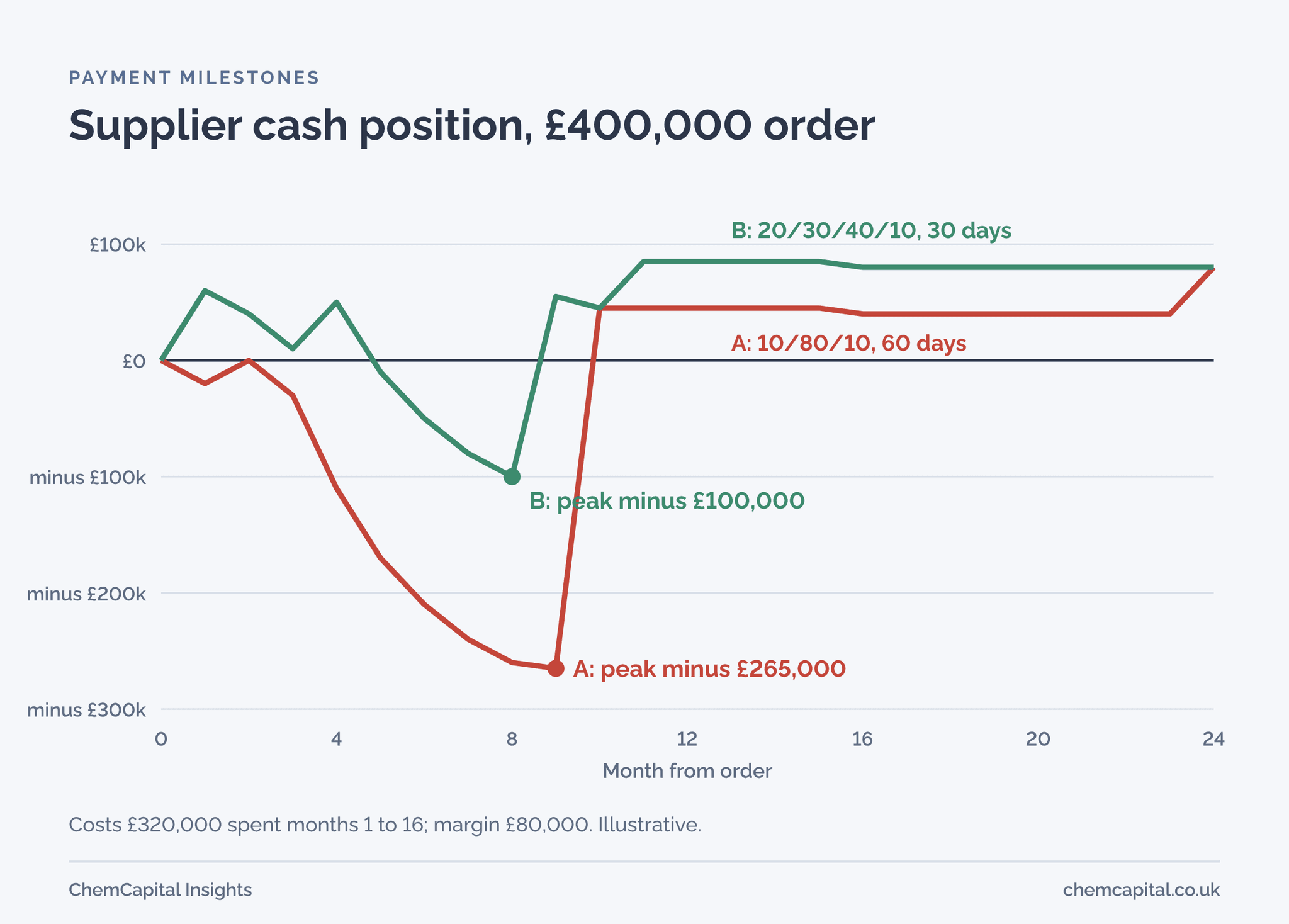
Schedule A: 10/80/10, 60 days. 10% at order, 80% on delivery in month 8, and 10% retention released at the end of a 12 month warranty in month 22. Each invoice is paid 60 days later, so the cash arrives in months 2, 10 and 24.
Schedule B: 20/30/40/10, 30 days. 20% at order against an advance payment bond, 30% when the main bought out items are ordered in month 3, 40% on delivery and 10% on acceptance in month 10 against a warranty bond. Each invoice is paid 30 days later.
Step 3: read the peak and the cost
The running total of receipts minus costs is your cash curve. Its lowest point is the peak funding the order needs.
| Schedule A | Schedule B | |
|---|---|---|
| Peak funding | £265,000 in month 9 | £100,000 in month 8 |
| Months with negative cash | 8 | 4 |
| Overdraft interest at 7% | £7,610 | £1,400 |
| Retention waiting 14 months | £3,267 | nil |
| Bond premiums | nil | £2,000 |
| Cost of the schedule | £10,877 | £3,400 |
The 7% is an illustrative borrowing rate, Bank Rate plus a margin. The retention line is the value of waiting 14 months for £40,000 of money already earned, at the same rate. The bond premiums are illustrative too: 2% a year on an £80,000 advance payment bond for nine months and on a £40,000 warranty bond for a year. Your bank or surety will quote real figures.
On these numbers, schedule A costs the supplier about £7,500 more than schedule B. That is 9% of the margin, before anything goes wrong.
Two other levers
Your own suppliers' terms. The cost curve assumed you pay for bought out items in the month you order them. If your pump, motor and instrument suppliers give you 60 day terms instead, the £110,000 moves two months later. Under schedule A the peak barely changes, because everything has still been paid by month 9, but the interest falls from £7,610 to about £6,330. Back to back terms help, but they rarely fix a schedule that pays 80% at delivery.
Pricing the schedule. If a buyer will not move from 10/80/10, the £10,877 cost of that schedule is about 2.7% of the order value. You can add it to the price, show it as an option ("price on 10/80/10" and "price on 20/30/40/10"), or offer a small discount for better milestones. Showing both prices tells the buyer exactly what the milestones are worth, and many buyers will choose the cheaper one once they see the gap.
Slippage. Every milestone tied to an event outside your control is a risk to the curve. If the customer is slow to approve drawings or to arrange the factory acceptance test, the payment moves while your costs do not. Tie milestones to events you can evidence, and say in the contract what happens if the customer causes the delay, for example payment on the planned date or after a set number of days.
Bonds: the price of better milestones
Customers ask for security in return for paying early. Designing Buildings describes an advance payment bond as securing a payment made before work starts against the supplier's default, and notes it is normally an on demand bond [4]. Brodies adds that its value typically falls as the advance is repaid or earned, and that performance bonds are usually around 10% of the contract value [1].
Retention can also be swapped for a bond. Designing Buildings says retention is often 5%, with half released at practical completion and the rest when defects are made good, and that a retention bond can replace the cash retention, with the subcontractor paying the premium [5]. For an equipment maker, a warranty bond in place of a 10% retention brings the last payment forward by a year or more.
A bond uses part of your facility with the bank or surety, so check the limit before you offer one on every quote.
When the customer pays late
The schedule assumes customers pay on time. If they do not, UK law gives you a remedy. The Small Business Commissioner explains that statutory interest on late commercial payments is 8% plus the Bank of England base rate, with the base rate fixed at 31 December for January to June and at 30 June for July to December [6].
If the £320,000 delivery payment in schedule A were 30 days late, statutory interest at 8% plus 4% would be about £3,156. Whether you claim it is a commercial decision, but knowing the number helps in the conversation.
What to put in your quote
- Propose your own milestones. Tie them to events you control and that match your spending: order, drawings approved, main items ordered, factory test, delivery.
- Price the alternative. If the customer insists on 10/80/10, show the financing cost as a separate line or build it into the price.
- Offer bonds in return for advances. An advance payment bond that reduces as milestones are met is easier for a buyer to accept than an unsecured deposit.
- Shorten the tail. Offer a warranty bond instead of cash retention, and define acceptance so it cannot drift.
- State the payment term. 30 days from a valid invoice is very different from 60 days from the end of the month.
Our guide on how to price an engineered equipment quote shows where financing sits alongside materials, labour and margin.
On ChemCapital, buyers use AI supplier discovery to find equipment makers and invite them to quote through structured RFQs. See the benefits for suppliers.
This is general information, not financial or legal advice.
Ready to be found by process plant buyers? Start a free 14 day ChemCapital trial, with no credit card needed.
Frequently asked questions
How do payment milestones affect a supplier's cash flow?
They decide how much of the order the supplier funds before being paid. In the worked example, a 10/80/10 schedule on 60 day terms needs peak funding of £265,000 on a £400,000 order, while a 20/30/40/10 schedule on 30 day terms needs £100,000.
What are typical payment milestones for engineered equipment?
Common structures include 30/70, 20/70/10 and 10/80/10, while larger packages may add payments for raw materials, manufacturing progress and the factory acceptance test. Retention is typically 5% to 10%, held until the warranty ends or field tests pass.
What is an advance payment bond?
It is a bond or guarantee that protects a buyer who pays in advance if the supplier defaults. It is usually on demand, and its value typically falls as the advance is repaid or earned through later milestones.
What interest can a UK supplier charge on late payment?
Statutory interest on late commercial payments is 8% plus the Bank of England base rate. The base rate at 31 December applies from January to June, and the rate at 30 June applies from July to December.
Continue reading
Informational only, not procurement or legal advice. Cited names, frameworks, and statistics belong to their respective owners.
Access real procurement opportunities from global buyers
Join ChemCapital to get discovered by verified procurement teams across pharmaceutical, chemical, and industrial manufacturing.
List your companyRelated articles
Payment Milestones, Retention and Bonds on Process Equipment Orders
How to tie payment milestones to evidence on process equipment orders, when to hold retention, and what advance payment guarantees, bonds and PCGs secure.
Cost of Late Equipment Delivery: Worked Example
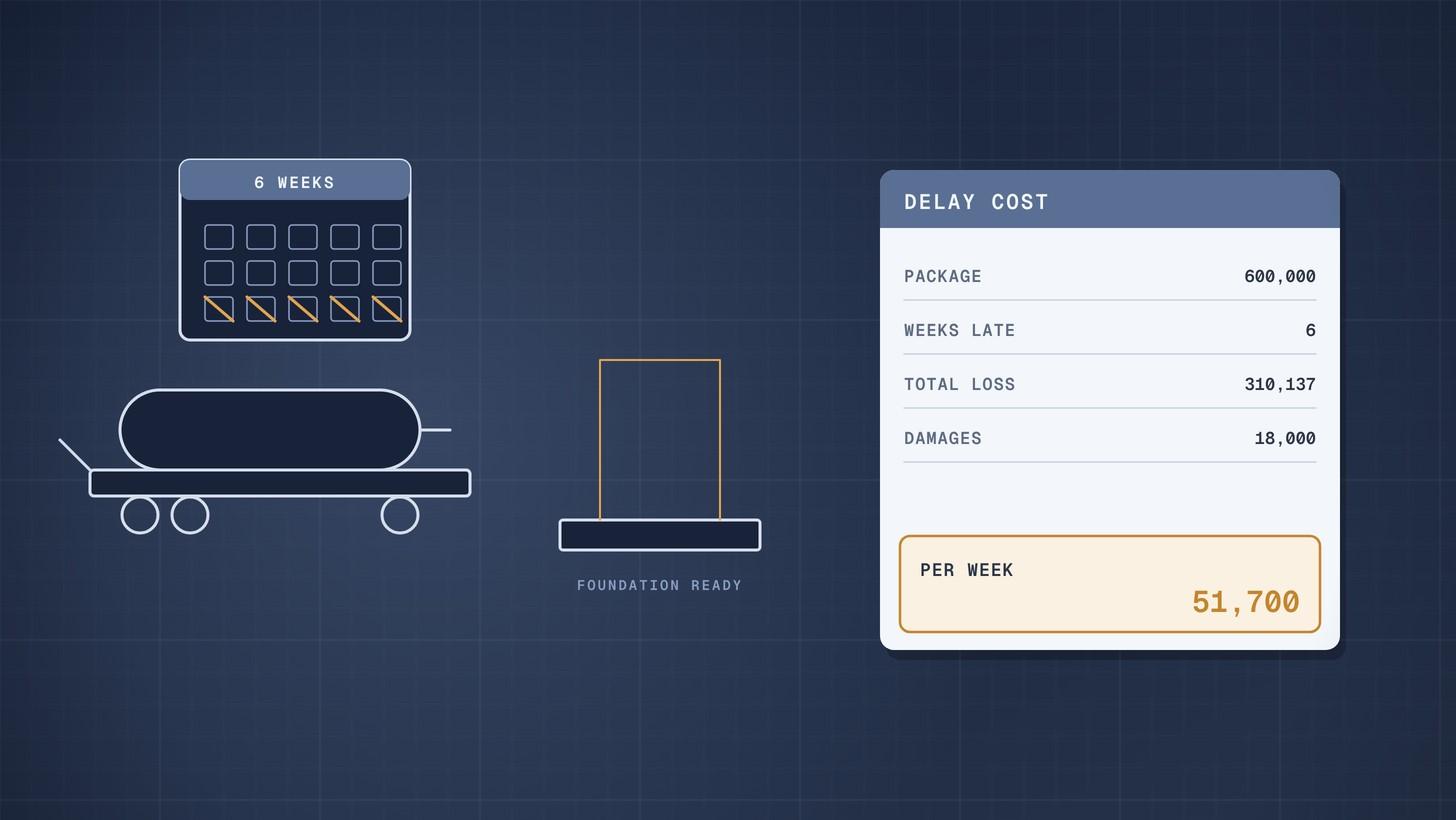
How to calculate the weekly cost of late equipment delivery, compare it with liquidated damages and use it to set a damages rate a supplier can accept.

Performance Guarantees and Performance Tests for Process Packages
What a process package supplier should guarantee, how the performance test is run, and what happens when the plant falls short, with a worked example of performance liquidated damages.